Kerang Cemetery Self Guided Walk


The Self Guided Walk Among the Tombstones at Kerang Cemetery explores the stories of some of the pioneers, residents and unusual characters buried in Kerang Cemetery. The present cemetery began in 1862, although the brochure records 72 burials before the register commenced in 1878. The first burial was a shepherd from Lake Meran Run.
The signs Neutral North and Neutral South inside the cemetery gates marked the divisions between Protestant and Roman Catholic burials before graves were divided according to religious denomination. The brochure states that no other cemetery had been found using this method of division in early cemeteries.
Before 1940, the main recorded causes of death included convulsions, diphtheria, snake bite, typhoid, croup and drowning. The average age at death was only 25 years because of the high rate of infant mortality. The Memorial Gates were opened in 1967 and dedicated to the memory of the pioneers. They were made by local firm Dunstan Farmers Engineering.
Kerang Cemetery Self Guided Walk
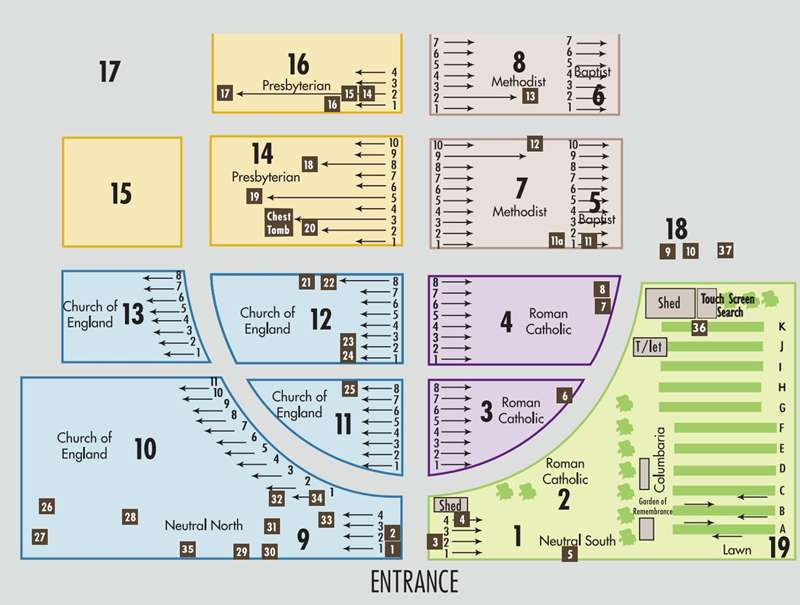
Note: References to a walk refer to the Self-guided Walk or Drive of Historic Kerang.
1. Woodford Patchell (1831-1893)
Born in Ireland and educated to a Batchelor of Arts at Trinity College, Dublin. Arrived at old Kerang 1857 to commence business but after a land price disagreement, purchased land 5 kms downstream from the owner of Gannawarra Station. Founder of modern Kerang in 1858 (refer walk 77) and believed to be the first practical irrigator in Victoria.
2. Thomas Littleton (1831-1886)
Born in Liverpool,England. Arrived in Adelaide 1853. Worked at old Kerang as a bookkeeper. Established his own store in Scoresby Street 1876 (refer walk 9). Headstone is evidence of high rate of child mortality.
3. Murphy Headstone
Celtic harp and shamrocks depict country of family’s origins. Also features Ivy-friendship, Olive-peace, Ferns-humility.
4. Josephine Cadusch (1892-1913) (refer walk 73)
Thrown from a buggy when a horse bolted. She was to be married a few months later. Headstone features the Anchor of Hope, Calvary Cross and 3-step pedestal representing The Trinity of Faith, Hope and Charity.
5. Duncan Marquis (1800 1867)
Born Argyll, Scotland. A shepherd on Lake Meran Run.
6. Roman Catholic Priest
Features Celtic Cross. Only Catholic Priest known to be buried in the cemetery. Grave restored by Father Joe Taylor.
7. S. Oliver (1917-1945)
8. O. Margarella (1917-1945)
Italian Prisoners of War
Both killed when a truck overturned returning from work on the Wakool rice fields. Headstones feature a soldier’s helmet provided by the War Graves Commission.
9. Thomas Bax (1846-1863)
Second burial registered at cemetery.
William Bax (1860-1866) – Fourteenth burial registered at cemetery. Both drowned in Loddon River.
10. Thomas Fenton (1852-1865)
Twelfth burial registered at cemetery. Headstone features a broken column, symbolic of a life cut short. Cause of death "departed this world suddenly from the bite of a snake".
11. George Adams (died 1907)
Born Dartmouth England. Left school when 13. Gold brought George to Bendigo 1854 but with little success in gold digging took up his former trade as a carpenter. Built the first Town Hall, Railway Station, School of Mines, St. Paul’s Tower and numerous business houses in Bendigo. Came to Kerang 1873 and set up business in Scoresby Street (refer walk 48). Many of Kerang’s early buildings were erected by George Adams. Sarah Adams (died 1919) and children.
11a Kerr Headstone
Features urn on elaborately fringed lace altar cloth symbolising the Shroud of Christ.
12. Martin Peacock
Was a judge at small country race meetings around this area. Punched in the face by an irate punter at Gannawarra Race Course and lost an eye.
13. Reuben Hetherington (died 1946) and Helen Hetherington (died 1959)
Lived in Gannawarra Homestead and raised 12 children. The first baby died in Helen’s arms as she carried it to the doctor. Reuben’s hand was blown off when a shotgun blew open. He was brought to Kerang for treatment by horse and gig.
14. Angus Heffer
Symbols of RAAF and masonic lodge on headstone. His brother was killed in World War II. Angus never married but took care of this brother’s family for the rest of his life.
15. Damien Williams
Redgum headstone. Grave constructed by family as a final tribute.
16. Coad family
Features family crest on headstone.
17. Roby Manuel (1895-1975)
Dare-devil World War I fighter pilot. Led the Australian Flying Corps victory flight over London in 1919 as 5,000 Australian troops marched below. He flew his plane through Tower Bridge.
18. Karlie McDonald (died 1927)
Teacher. Drowned in Loddon River while assisting a student in difficulty. Town clock erected as a memorial (refer walk 1).
Unnumbered Grave – Mary Fraser (died 1909)
Chest Tomb – Mary Fraser (died 1909), her daughter, Catherine (died 1941), and son-in-law, Henry (died 1942).
19. Thomas Gardner (died 1918)
"One of the original ANZACS". Featured on ABC presentation "Pozieres".
20. Angus McIntosh (died 1892)
Isabella, Jane and Mary Jane all victims of the 1919 Influenza epidemic.
21. Septimus Chenoweth (1891-1911)
Thrown from a horse at the corner of Boundary and Wellington Streets. Inquest found he was "riding a horse down Wellington Street in a dangerous and irresponsible manner". Headstone features clasped hands. One male and one female to signify love, friendship, farewell. Always the right hand. The left hand was the hand of the Devil.
22. Robert Henry Bott (died 1918) and Mary Ann Bott (died 1937)
Travelling through the area in 1879, their small son vanished at Kow Swamp. No trace of him was ever found. Many years later Mary Ann dreamt that he was on-board a ship coming into Melbourne. She actually met the ship but found no-one who was likely to be her son. She placed a light in the window every night for the rest of her life for her lost child.
23. Henry Taverner (died 1889) and Margaret Sarah Taverner (died 1913)
Both came from Ireland in the 1852 Gold Rush. Owned the "Old Loddon Inn" at old Kerang in 1864. Built the Commercial Hotel (refer walk 3) in Kerang 1877. Built "Summerhill" farm just north of Kerang on the Murray Valley Highway 1876. Inscription reflects the rather morbid attitude to death which prevailed at the time.
24. Dr. William Gregory (1843-1888) and T.S. Wilson (died 1894)
Dr. Gregory practiced in Kerang 1882-1888. Born in Madras, India and was highly qualified. Made several voyages as a ship’s surgeon between England and Australia. After he died his widow, Martha, bought the Farmers Arms Hotel in Kerang, now Gilbert Hotel, burnt down in 2009 (refer walk 36). She married T.S. Wilson in 1892 and when he died in 1894 he was buried with Dr. Gregory. Martha died in 1895 and is believed to be buried in the same grave but there is no inscription to this effect. The marble angel on top of the red granite column is an example of grave sculpture from the Victorian period, holding a trumpet to signify the Day of Judgement and finger pointing to heaven in the traditional pose.
25. David Hawthorne (1833 - 1897)
Born in England, he arrived at Port Fairy in 1852 and from there went to the Goldfields where he had both thumbs crushed in a mining accident. Came to Kerang 1878 and established Hawthorne’s Department Store (refer walk 2).
William David
(1868-1871) Ethel (died 1887, aged 8 months)
Edith (1881-1888) Stanley (died 1892, aged 12 months)
26. Stillborn babies
In 1937 legislation directed that stillborn babies be buried in a mass grave, largely unmarked. This law repealed 1953.
27. Chinese Graves of Ah Chung (1841-1914) and Tie Leung (1858-1924)
Most probably market gardeners.
28. John Pettigrove (died 1886)
Died of blood poisoning. Buried in Kerang but also has a headstone in Cohuna Cemetery.
29. William Mowat (1882-1892) and Olive Mowat (1884-1888)
Old wooden marker badly worn by time and weather. Similar to those used in the old Kerang cemetery of which none have survived.
30. Mary Dash (1868-1877) and Katie Dash (1876-1878)
Roots of the peppercorn tree have grown around the headstone which is in very good condition due no doubt to protection provided from the tree.
31. Susanna Peacock (died 1888)
Had 16 children including one set of twins (14 and 15). After giving birth to these twins, she sent word to her husband who was at work and then arose to finish the washing!
32. Mary Ann Henderson (1849-1883)
Died following the birth of twins leaving behind a family of nine children.
33. Esther Pippin (1832-1881), Ellen Pippin (1866-1881) and Mary Ready (1856-1881)
All drowned in the Barr Creek.
34. Alexander Duncan Fraser (died 1917) and Mary Fraser (died 1920)
Mary was housekeeper at Tragowel Station when Burke and Wills stayed overnight on their ill-fated expedition in 1860. John Wills gave Mary a copy of "Longfellows Poems" as a memento.
35. Charlotta Jane
Born in tent on Bendigo Goldfields where the guns in front of Eaglehawk town Hall stand now. Also 3 children - Accident, Convulsions, Diptheria.
36. Murdoch Whyte
RAAF, World War II. Caught in massive thunderstorm over Darwin and could not land. Bomber he was flying had fuel for 8 1/2 hours. Kept it in the air for 11 1/2 hours finally landing safely at Darwin RAAF Base.
37. Frank Marshman Long (Marsh)
Champion Sportmen and bomber pilot over mediterranean in World War II.
Opening Hours:
The cemetery is an outdoor public cemetery.
Location
Westblade Avenue, Kerang 3579 View Map
Web Links
→ Kerang Cemetery Self Guided Walk Brochure (PDF)
→ Self-guided Walk or Drive of Historic Kerang


