Kerang - Self-guided Walk or Drive of Historic Kerang


Discover Kerang’s history on this self-guided heritage tour, which can be completed either on foot or by car.
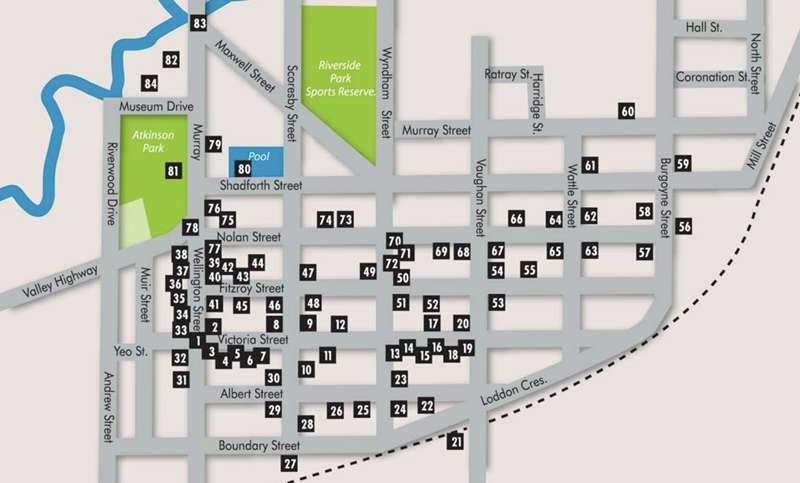
The suggested starting point is the Memorial Town Clock at the corner of Victoria and Wellington streets. From here the route explores historic buildings, businesses, public places and other sites around Kerang, with descriptions explaining their history and significance.
Sites include the Memorial Town Clock, former Hawthornes Department Store, Court House, Railway Station, Old Shire Hall, original Lester-Smith Lookout Tower and Kerang Olympic Swimming Pool. The tour can be completed in its entirety or broken into smaller sections.
Download the Self-guided Walk or Drive of Historic Kerang brochure and map.
Founding modern day Kerang in 1858, a notable Irishman Woodford Patchell had a vision for a sustainable and prosperous township. He promptly built a store, residence and a hotel on the same site and bearing the same name as the modern Kerang Hotel. A bridge was built across the Loddon River in 1863. Patchell was a little devious in achieving his success hiring a man and dray to drive repeatedly over the track to his business to achieve a "well-worn" effect. This lead travellers to believe this was the route they too should take!
In the 1860’s there was an increasing realisation that only irrigation could sustain the wanted desired in Australia’s population and Woodford Patchell’s greatest achievement was his work with irrigation. Claimed to be the first practical irrigator in Victoria, Patchell grew experimental crops along the Loddon River. The story of Patchell’s success as an irrigator spread and one of the Chaffeys visited and invited Woodford Patchell and Thomas Littleton to Mildura.
The great flood of 1870 had a positive effect on development at Patchell’s Kerang. Buildings were moved from the site of old Kerang 5km upstream of the Loddon River. The recorded total rainfall for the year was 27 inches (compared with average of 14). In 1874 original land leases were thrown open for selection and with a building boom seemingly on the way, Patchell started a brick kiln on the north side of the cemetery. Within a short time there was another kiln nearby and from these two enterprises came all the bricks for the town until the railway reached Kerang in 1884.
The year is now 1912 and buildings are being erected as fast as labour can be procured. During the last two years, good useful roads have been laid through all the main streets and where it was almost impossible three years ago to cross the road in wet weather, today there is no such inconvenience. Two streets monopolise most of the business and these are lined with smart stores, well stocked with requirements and on market days it is a scene of great activity. Saturday is late night shopping. The town is quite lively, the streets well lighted with electric light, and the town wears a bright and gay appearance.
Public buildings are well abreast of the times and comprise a post, telegraph and money order office and savings bank in one building, state school, public hall, shire hall and offices, fire brigade station, orderly room, five churches, branches of five banks, electric light and power house, mechanics institute, flour mill, cooperative butter factory, two newspaper offices, an iron and brass foundry, carriage factories, agencies for ten insurance companies, a new courthouse, along with six well-appointed hotels. There are very fine saleyards where sales are held two days a week and on other special occasions as required. The Kerang horse market bears a well known reputation throughout Australia.
In fact in any part of the colony I have been, I have not seen more substantial buildings than at Kerang – an important village with a prosperous district around it (Source: Extract from Letter to the Editor to The Times 6/9/1912 signed "Progress")
Located midway between Melbourne and Mildura and 25kms south of the Murray River today Kerang is a thriving town of just under 4,000 people. The mainstay of the local economy continues to be a prosperous agricultural district supporting a strong and growing business sector. Irrigation remains an integral component of many local farming enterprises and indeed it is irrigation on which Kerang’s stability is built. Having died in 1893 Woodford Patchell would not have seen his vision fully fulfilled. Patchell’s forethought and ingenuity however laid the groundwork for Kerang to continue as a sustainable and prosperous township for the past 145 years.
This self-guided walk/drive brochure has been designed to provide residents and visitors with a glimpse into Kerang’s historic past and an alternative activity to enjoy. If you have time to spare, why not put on your walking shoes and enjoy the walk in its entirety or in stages. If your time is somewhat limited, hop in the car and take a drive. The choice is yours but whichever way you choose please return some day soon to enjoy more of what is on offer in this unique part of Victoria.
It is suggested that you commence your walk/drive at one of Kerang’s well known landmarks, the town clock on the corner of Victoria and Wellington streets. As you cast your thoughts back to the 1800’s imagine that many of the businesses along both Victoria and Wellington streets originally had verandahs. A law requiring cantilever constructions and the abolition of verandah posts was introduced in 1978 with exemptions being the Commercial Hotel (3), Royal Hotel (8) and Strathclyde building (32). Present day Kerang would take on a very different appearance had the original verandahs been permitted to stay.
Self-guided Walk or Drive of Historic Kerang Map
1. Memorial Town Clock
Erected 1933 in memory of school mistress, Miss Karlie McDonald, who drowned while saving two high school students from the Loddon River in 1927.
2. Former Hawthornes Department Store
Originally a combined wooden store and home built 1878. Two storey brick store built 1885 and expanded 1927. Fire destroyed shoe section 1915. Building completely gutted by fire 1954 and current two storeyed building constructed. By 1969 the store employed 60 staff. Fire again destroyed part of the building in 1969. One local commented that there had never been a better range of nightwear seen on the streets of Kerang than that worn by spectators out to see the fire! Known as the "Myers of the Bush", Hawthornes was the hub of the town, priding itself on personalised service. Modern day building still owned by the Hawthorne family.
3. Commercial Hotel
Originally built on this site early 1874 for Henry Taverner. Building modernised 1938 and extensively refurbished 1999.
4. Pays Victoria Stores Street Building
Large department store operated by Pay family 1901-1963. Original store destroyed by fire 1918 and reopened 1921. Basement excavated at this time by manpower to become a furniture and hardware department. Purchased by Permewan Wright and transformed in 1964 after being unchanged for 62 years. Later became Half Case and Payless Superbarn. Transformed again in 1997 into Patchell Plaza.
5. Municipal Chambers
Built 1927 as a First World War memorial. In the portico, two bronze tablets bear the name of the 175 men who made the supreme sacrifice and on others made of copper, are the names of all the men who served. Portico is also architecturally significant, being circular, two floors high and pillared. Presently Gannawarra Shire Council offices.
6. Court House
Built 1912 and still in use. When first built, the Court House was surrounded by a garden with picket fence.
7. Post Office
Original post office was in Patchell’s store in Nolan Street (near 77) before being temporarily located at the site of the Royal Hotel (8). Present post office dates back to 1886.
8. Royal Hotel
Opened on this site 1884. Original stables still located at the rear. First licensee was Patrick O’Donnell, an early police officer.
9. Newsagent
Original site of Thomas Littleton’s store built 1877 by Geo Adams & Sons (48). Sold 1886 when Littleton died. Later became Kay & Potts store, closed 1960.
10. Toilets
Site of "Atkinson" family home, once used as a temporary library before being demolished.
11. State School
First school was a slab hut built 1874 by Woodford Patchell in Nolan Street (near 77). Single school room and three small skillion rooms built 1875 on present site by Geo Adams & Sons (48). By 1878 there were 90 pupils. Current brick building built 1880 of local bricks and Murray Pine floors. Prior to second State school opening in 1967, 620 children enrolled. 2003 enrolments 206. Oak tree inside the grounds was planted at the coronation of King George V in 1911. There are four primary schools (two state and two private) currently in Kerang, a Technical High School and a TAFE college.
12. St. Andrew’s Presbyterian Church
Built 1892 for 811 pounds. Hall erected 1912. Extensions and new vestry opened 1967. Dome in church grounds is a circular brick-lined rain water tank, over 2.4m deep, now disused. Similar tanks in the grounds of some of the older homes in Kerang.
13. St. John’s Anglican Church
Commenced 1879 from a site on Mount Kerang. Shifted to present site in 1900 after being unroofed by a storm. Old building demolished 1962 and replaced by the A frame structure. During demolition, an old bottle was recovered from the original foundation stone cavity, containing documents circa 1900. A magnificent 15x7ft quilted wall hanging completed in 1998 hangs above the altar. Memorial gates erected pre 1927 by Mary Lucy Cadush (nee Pay) in memory of her sons who served in World War 1.
14. Historic Home – 85 Victoria Street
Home of Bob Leng – Stock and Station Agent who prior to coming to Kerang struck it rich in WA gold rush. Established stock and station business in Wellington Street.
15. Historic Home – 93 Victoria Street
Example of early cottage hospital operated by Nurses Stevenson and Clothier circa 1896. Demolished
16. Masonic Lodge
Formed 1884 and present building built 1913. Once considered as one of the finest lodges in country Victoria.
17. Historic Home – 98 Victoria Street
Built 1902 for 490 pounds. A magnificent Norfolk Island Pine planted 1903 still stands in the back yard.
18. Historic Homes – 99-101 Victoria St.
19. Historic Homes – 103-105 Victoria St.
Land granted to Surveyor Richard Gurden 1877 and sold 1907 to Geo Adams & Sons (48). Subdivided 1910 and homes built shortly after. Hand painted, pressed steel ceilings, leadlighting and portholes add to the interest of these homes.
20. Historic Home – 104 Victoria Street
"Avon-Dale" built by Geo Adams & Sons (48) for Francis Morris 1921. Morris family occupied home until 1993. Features Jarrah flooring, pressed steel ceilings, portholes, and leadlighting.
21. Shire Depot Shed
Until 2003 a World War II Catalina Air Base hangar from Lake Boga served as the depot shed. Demolished due to white ant damage.
22. Historic Homes
Numbers 37-53 Albert Street – moved from Bendigo in flat sections by train around 1884 following the gold rush.
23. Site of Miss Margaret Keats’ vet practice and home
"Oamaru" – 60 Wyndham Street.
Original lemon scented gum tree still stands. Miss Keats MBE (1895-1970) was the first female vet registered in Victoria. She later became the first woman government-employed vet when made Stock Inspector at Gonn Crossing (Murrabit) on the Murray River.
24. Historic Home – 56 Wyndham Street
Home of Fred Taverner built 1920’s. His father, Henry, purchased an inn at old Kerang township in mid 1860’s before moving to Patchell’s Kerang around 1874. Noted for building Commercial Hotel (3) and "Summerhill" home, just north of Kerang on Murray Valley Highway.
25. Historic Home – 27 Albert Street
Residence of Butter Factory Manager. Butter Factory, built 1905, was located behind. Large shed at rear used to house trucks.
26. Model Dairy in Albert Street
Site of Nurse French’s Private Hospital.
27. Railway Station
Kerang Railway Station opened 1884 when the railway line from Bendigo to Kerang opened. Line extended to Swan Hill 1889, same year Kerang Shire Council opened the Kerang-Koondrook tramway to carry produce from the Riverina on the New South Wales side of the Murray River for sale in Kerang and Melbourne. Line closed 1976, ending 87 years of regular passenger services. A line to Murrabit/Stony Crossing opened 1925. Line closed 1962, 37 years to the day after the opening. Before railway, all mail and passengers were conveyed by Cobb & Co. coaches. Regular passenger and freight trains still pass through Kerang from Melbourne to Swan Hill.
28. Site of "The Coffee Palace"
Tearooms and boarding house, demolished 1984. In early times commercial travellers came with their samples by train. A Sample Room was at the rear of the Commercial Hotel (3). Merchandise was displayed allowing shopkeepers to order stock.
29. Historic Home – 12 Scoresby Street
"Wendouree" built 1905 for Mr. Ernest Pay, proprietor of Pay’s Victoria Stores (4). Home typical of Victorian style popular among merchant and professional classes. Pay family occupied home until 1997. Note unusual double curved verandah.
30. Large timber and corrugated iron building
Constructed 1912 as a skating rink, a popular hub of town entertainment with a band regularly playing. Boasted the only granolithic floor outside the capital cities, sections of the floor still exist today. When skating became unfashionable, the building became a Dodge dealership, Dunlop tyre and retread facility, and later a Mazda agency and motor garage. Presently Complete Pump Supplies.
31. Bank Building
Originally the Union Bank built 1927, then ANZ Bank. Converted to Municipal Library in 1975.
32. Strathclyde Building
Established late 1880’s by solicitors "Connelly, Tatchell and Dunlop". Opened as "Strathclyde" selling pottery and gifts in 1976 and more recently Kerang Antiques.
33. Original Commercial Banking Company
(C.B.C.) built 1936. Now accountants office.
34. Exchange Hotel
First established 1884. Rebuilt 1901 following a fire. Verandah removed 1956.
35. Arnoldt & Greenwood’s
Original premises part of Horse Bazaar (36). Ford dealership commenced 1913. Company first with petrol pumps and free air on the kerbside. At one stage 7 brands of petrol were served 24 hours a day. First Ford cars came from Canada in large wooden crates, wheels were fitted on arrival. When Ford set up in Geelong a car cost 180 pounds. Greenwood family still operate this business.
36. Original Horse Bazaar
(Horse market) built 1875 by Gilbert Heathcote. Operated as Yeo, Taverner & Company 1888-1896 until it went into liquidation and was purchased by Donald McDonald, Stock Agent. Kerang’s first recorded stock sales were in 1877. Each agent had separate yards all located between Wellington Street and Muir Avenue, and Nolan and Shadforth streets. Current saleyards were completed in 1940 and continue to be an important part of the region’s economy.
37. Gilbert Hotel
Originally a large timber boarding house built 1878 named The Farmer’s Arms. Second storey and balcony added 1882. Original timber walls still behind the bricks. Licence transferred 1888 and name changed to the Gilbert Club Hotel. Verandah and wrought iron work removed 1950’s and the present verandah added 1987. Original stables still in use at rear of hotel as panel beater’s premises
38. "O’Donnell’s" Building
Patrick O’Donnell was an early police constable at Kerang and owner of the first Royal Hotel (8). He was father of the late Cr. P.J. O’Donnell who owned the Gilbert Hotel (37). Patrick O’Donnell’s brother, Frank, owned these buildings which housed a variety of shops including a butcher shop, skins/hides shop, and grocery shop.
39. Original Bank of N.S.W.
Built 1936. More recently the Westpac Bank. Closed 1999.
40. TAFE building
Built 1881 as London Chartered Bank. A stately building of obvious English design with sharply pitched roof to throw off snow! Later E.S. & A. Bank, then ANZ Bank. Served as Borough of Kerang offices from 1972-1995, before becoming a TAFE facility. Original stables on Fitzroy Street. Original iron work on roof made by local foundry, Avards.
41. Site of the District Land Survey Office
Originally a large double storey brick building built as a residence for Woodford Patchell. Demand for 320-acre blocks in the district made a Land Survey office necessary and one was opened here in 1874. Second storey removed while operating as Lamaros Café when a 2,000 gallon tank fell into the top east wall in the 1970’s. The top west wall toppled into Fitzroy Street.
42. Regent Arcade
Site of original Mechanics Institute (Town Hall) erected 1881. A venue for many social events. Acquired by O’Halloran Theatres 1937 and developed as the Regent Theatre. A ticket to the large lounge upstairs cost 3/3 to impress; downstairs 1/6 and front stalls 9d. Demolished 1967 to make way for current arcade, opened 1968 by The Hon. John Gorton, Prime Minister of Australia.
43. "Hellers" Building
Built 1912. Originally a café with exquisite dining room of cast iron and marble. Renowned for freshly squeezed fruit juice. Also sold fresh fruit and vegetables and had an ice-cream making plant at rear.
44. Chimney and brick wall, Timber Yard
Part of original building owned by Woodford Patchell.
45. Franzini’s Garage
Built 1915. Franzini’s commenced business in Kerang 1911 operating a British Leyland and Nash and de Soto car dealership as well as a blacksmith shop at the rear of the building. Franzini’s were renowned for workmanship. Business still owned and operated by Franzini family.
46. Original State Savings Bank
Built 1911.
47. Bakery
Established 1889. Operated by the Gray family since 1962.
48. A.G. Adams & Sons Funeral Directors
Circa 1873, Kerang’s oldest established family business. George Adams built the Wesleyan Church at old Kerang and while there built a coffin when someone died. His company, Geo Adams & Sons, built many of Kerang’s early buildings and homes. In more recent years A.G. Adams & Sons developed the modern Northland Shopping complex between Victoria and Fitzroy Street. The funeral business continues to be operated by the Adams’ family.
Historic Homes – A number of Kerang’s historic homes are located in Fitzroy Street. Please enjoy them as you proceed up the street – Numbers 41, 43, 59, 61, 67, 70, 72, 74, 78, 80, 89 and 91 are particularly noteworthy.
49. Fire Brigade
Built 1928. Brigade founded 1881 by George Adams (48) and his sons, George and Alfred. Horse drawn reels used in early days. First fire was at the livery stables (36). Only a brick wall saved the Gilbert Hotel (37) next door. The worst town fires were the duck opening 1918 fire at Pay’s store (4), and fires at Hawthorne’s store (2) in 1915, 1954 and 1969. New headquarters constructed across street in 2001.
50. Site of Kerang’s first bank
The Bank of Victoria opened 1877.
51. Baptist Church
First built 1878. Present brick church built 1937.
52. Historic Home – 67 Fitzroy Street
Home of George Adams (48) built around 1879. Home currently being restored. Original front door features red gold dust glass.
53. Original site of Kerang Bowling Green
First formed 1927. Club moved to present site on Murray Valley Highway in 1944.
54. Uniting Church
Site of Kerang’s first church, the Wesleyan Chapel moved from old Kerang 1875. Cyclone destroyed original building. Present building erected 1963.
55. Historic Home – 80 Fitzroy Street
Built by the Hawthorne Family 1880’s. Features jarrah ceilings. After the Great Flood of 1870, Mount Kerang or The Hill as it was known, became a popular location for buildings. Note that this part of Kerang is several feet higher than the surrounding land.
56. Kerang District Health
Built on Mount Kerang overlooking a former quarry site. Officially opened 1954 by the Governor of Victoria, Sir Dallas Brookes. Glenarm Nursing Home wing added 1977.
57. St. Joseph’s Primary School
Current hall built 1912. Additional buildings added 1958. Library built 2002.
58. Historic Home – 102 Nolan Street
Building commenced around 1896 by Mr. Buscombe, partner of Yeo, Taverner & Company (36). Bank foreclosed taking house, office and horse bazaar. Auctioned 1897 and purchased by Donald McDonald, stock and station agent. Home has 11 rooms and 3 cellars. Grounds laid out by Curator of Botanical Gardens.
59. 19 Burgoyne Street
Architecturally interesting 27 square home. Built 1963 by Ludwig Herschman, an engineer in the German Army.
60. Kerang Technical High School
Established 1919 in the grounds of the Kerang State School (11). Brick buildings opened 1927 on present site. Technical wing established 1971 with Kerang being the third high school in Victoria to obtain technical facilities. 820 students In 1971, 530 in 2003.
61. Northaven
Former site of "Glenarm" home built 1893. Opened as Glenarm Private Hospital 1908 by Nurse Ellenor Albrecht who formerly ran an infectious disease hospital "Leahurst" in Burgoyne Street (on current hospital site). Glenarm purchased by Baptist Union of Victoria 1958 and Northaven opened 1960 as elderly person units
62. Roman Catholic Church
Commenced 1885. Present building built 1894 and renovated 1971 to double its seating capacity to 400. Presbytery built 1894. Beneath are two large cellars.
63. Historic Home – 81 Nolan Street
Double brick construction built in 1923 for the then Shire Engineer, Mr. McKenzie. The home was named "Trebarva" after his Scottish home town.
64. Historic Home – 88 Nolan Street
"Winchester" built by George Hawthorne around 1886. Designed by German Architect. Owned by Hawthorne family until 2002.
65. Historic Home – 79-77 Nolan Street
Believed to be the oldest residence still in use in Kerang. Built around 1874 by Kerang’s first town surveyor, Michael Duggan Breen, during a development boom on Mount Kerang. After several owners, the house was operated as Miss Crane’s Boarding House from 1948-1965. Operated as block of four flats 1983–2001. Extensively renovated 2002.
66. Historic Home – 74 Nolan Street
Owned by Cadusch family (73).
67. Historic Home – 5 Vaughan Street
Methodist Parsonage built of mud bricks between 1899-1902. Bricks made on-site. House remained a Parsonage until 1995. Now private residence.
68. Water Tower – built 1955.
69. Historic Home – 57 Nolan Street
Built 1900-1910. Originally thought to have six bedrooms, dining room, large lounge, bathroom and a kitchen off the back verandah. The cellar was next to the kitchen. A ‘dumb waiter’ allowed food to be hoisted from the cellar directly into the kitchen.
70. Site of Old Shire Hall
Built 1873 by Geo Adams & Sons (48) as Shire of Swan Hill headquarters. Kerang Shire formed 1898. Ceased to be Shire Hall when Municipal Chambers (5) built in Victoria Street 1927.
71. Historic Home – 76 Wyndham Street
Built 1873 by Geo Adams & Sons (48) and formally used as caretaker’s cottage.
72. Historic Home – 72 Wyndham Street
Built 1873 by Geo Adams & Sons (48) for the first Shire Engineer, Mr. C. Albrecht. Under the original bull nose verandah was a set of four bells, each of different size and sound. They were used to call the various servants when needed. Rear shed in original condition. Was used as stable with groom’s room and buggy shelter either side. Post and beams are squared with broad axe and walls built of drop slabs. Roof has round Murray Pine rafters and the blocked and shaped stable floor remains in place.
73. Historic Home – 40 Nolan Street
Site of original Shire Hall Hotel established 1879. Licence transferred to Joseph Cadusch in 1885. In 1891, the Cadusch family operated three Kerang hotels – Shire Hall Hotel, Commercial Hotel (3) and Royal Hotel (8). Original timber building burnt to ground 1903 and present brick building erected. Hotel mostly patronised by working class. Delicensed 1921. The building later became a boarding house "Federal House", then Wilson’s Clothing Factory between 1945-1957, manufacturers of "Stamina" sports trousers employing 50 people, Stewart’s Motor Garage, and now is a private home.
74. 38 Nolan Street
Site of Bowmans Aerated Waters (soft drink factory).
75. Memorial Hall
Built on land donated by Lord Edward Trenchard, an Englishman who ran a stock and station agency. Site originally saleyards. Hall built between 1954-1960 as World War II memorial. Honour Boards mounted in 2000 can be viewed through the double glass doors. Gun in front of the RSL clubrooms was a German World War I trophy.
76. Toilets at rear of Memorial Hall.
77. Kerang Hotel
Site of Woodford Patchell’s original Kerang Hotel built 1865. Hotel of today built 1928 and incorporates parts of the old building. Patchell’s Store was on vacant land further along Nolan Street. Before railway, the Kerang Hotel was the booking office for Cobb and Co. coaches. People would gather on the verandah to await the arrival of the coaches, sometimes well after dark. Kerang’s first bottle shop opened here 1973. Function room and motel added 1987.
78. Major Mitchell Cairn
Erected 1952.
79. Lester-Smith Lookout Tower
Unique water tower built 1883 as people became tired of getting water from the river or a well near the present Shell Service Station. In 1973 the huge lookout tower was lifted to the top to provide a full panoramic view of Kerang, the Loddon River nearby and the surrounding lakes district. Power station located on this site 1917-1960’s. Sir John Gorton Library of ultra modern design built 2003.
80. Kerang Olympic Swimming Pool
Opened 1963 by the then Senator John Gorton, a district farmer who later became Australia’s 19th Prime Minister. 61 metre water slide erected 1982.
81. Atkinson Park
Part of original property owned by Woodford Patchell, the park was named after Charlie Atkinson, owner of a chemist shop in Kerang opened by his father, Douglas, next door to Pays Victoria Street Store (4) in 1884. Home (10). He later served as a councillor on the Shire of Kerang and took a great interest in the community and in beautifying the town.
82. Tennis Courts
Well known throughout the State but they are of added interest in that they occupy part of the land on which Woodford Patchell conducted his irrigation experiments.
83. Patchell’s Bridge (Twin Bridges)
Woodford Patchell first built a bridge on this site 1863 to attract travellers away from the settlement upstream. Patchell’s first bridge was not very impressive but it stood up against the force of the great flood in 1870 and as the years went by and the railway by-passed the old township site, many of the buildings were moved to Patchell’s Kerang. Named Patchell’s Bridge 1978.
84. Historical Museum
Home built 1800’s by A.G. Shelly, brother-in-law of Woodford Patchell. Later used as a bush nursing home and hospital then again as a private home. Last owned by Mr. & Mrs. J. Franklin. Museum established 1967 and now houses over 3,000 artefacts including Woodford Patchell’s irrigation work from 1863.
Compiled by Gannawarra Shire Council with assistance from Kerang Family History Group.
Location
Cnr Victoria Street and Wellington Street, Kerang 3579 View Map
Web Links
→ Self-guided Walk or Drive of Historic Kerang Brochure (PDF)


