Glenrowan - Ned Kelly Discovery Hub


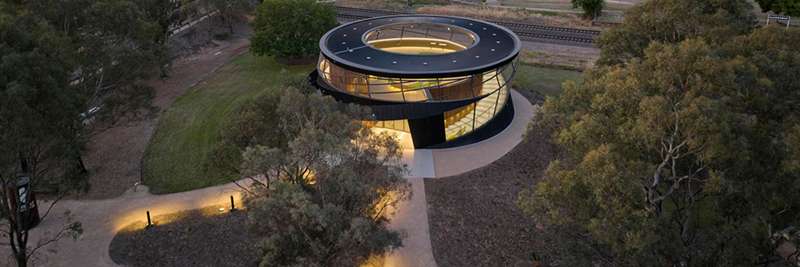
Discover the unforgettable story of Ned Kelly's Last Stand, a defining moment in Australian history that continues to captivate and divide opinions.
The Ned Kelly Discovery Hub tells the story of the Glenrowan Siege, which took place just across the railway tracks from the hub on Monday, 28 June 1880.
The twelve-hour gun battle between the infamous Kelly Gang and police followed an extensive and expensive police search for Ned Kelly and his Gang, who had been hiding in the local bush for two years. The siege marked the end of the era of the Australian bushranger and led to reforms of Victoria's police force.
Kelly and gang member Joe Byrne had hatched a scheme to draw out police and trackers by murdering Joe's childhood friend Aaron Sherritt, a police informant As there was no regular rail service through North-East Victoria on Sundays, they knew that any train from Melbourne that day would carry police hunting them. The gang planned to derail and ambush the train at Glenrowan.
As the police response to Sherritt's death was much slower than the Kelly Gang expected, the gang was forced to change their plans. They rounded up over sixty people and held them hostage in the Glenrowan Inn. When the train eventually approached Glenrowan, .hostage Thomas Curnow managed to escape from the inn. He waved his sister's red scarf in warning as the train approached.
Police then disembarked at Glenrowan and surrounded the inn. Three gang members - Joe Byrne, Dan Kelly and Steve Hart - were killed in the following shootout. The hostages were traumatised, and three died: Martin Cherry, John Jones and George Metcall.
Ned Kelly was wounded and arrested. He was later convicted of the murder of police at Stringybark Creek two years earlier. He was executed by hanging in Melbourne Gaol on 11 November 1880.
Visit the Discovery Hub to learn more about Glenrowan, the siege, and Australia's most notorious and controversial outlaw. Climb the stairs to view the siege site and locate the places where Ned Kelly was born, raised and roamed.
Around the town, you will find markers with additional Information about the events of the Glenrowan Siege.
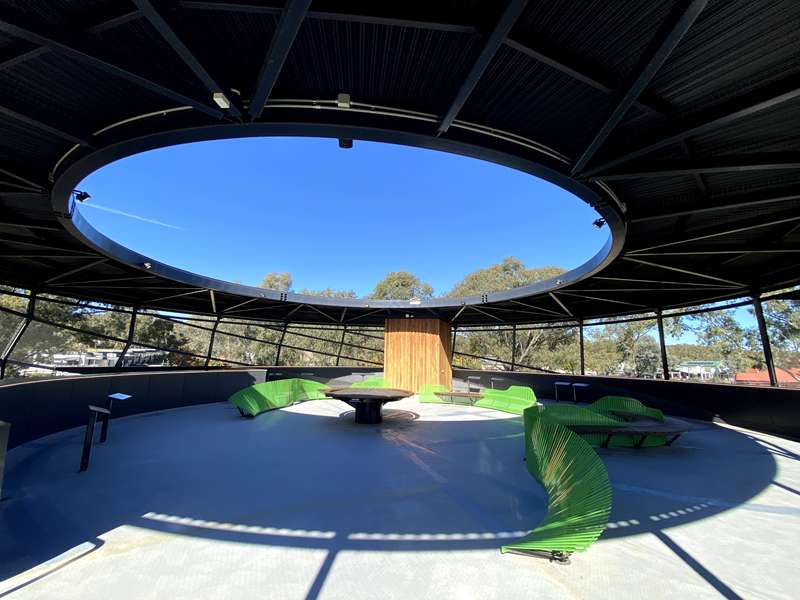
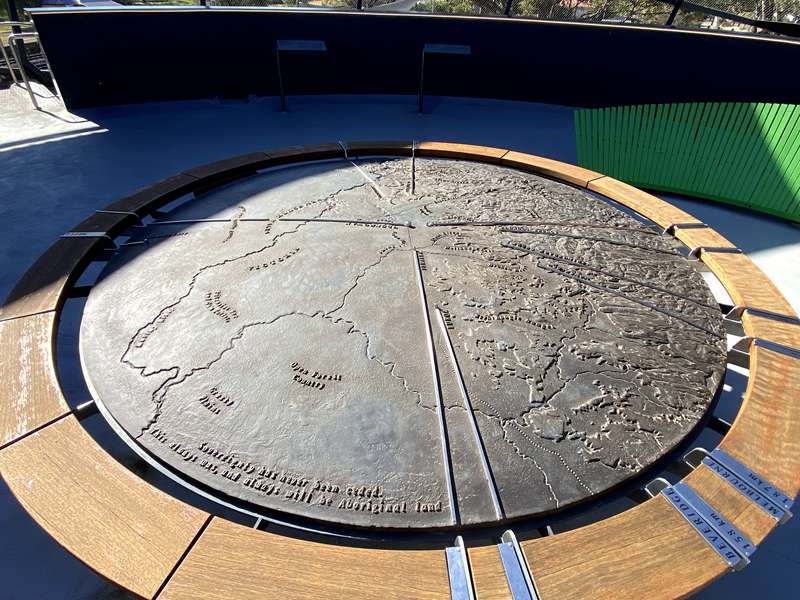
The spectacular Discovery Hub building has a circular lookout platform which evokes the shape of Ned Kelly’s iconic helmet. Charred timber cladding represents the role of fire in the Australian environment and during the siege itself. The viewing platform houses a central cast bronze map, which highlights key siege locations. Stainless steel mesh wraps the platform, offering open views.
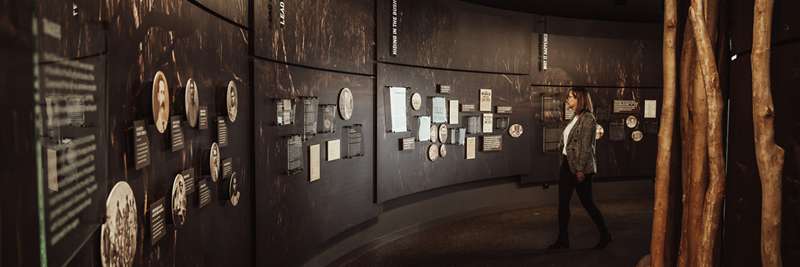
Inside, the siege story unfolds through a blend of immersive displays, personal accounts, and historical resources.
Opening Hours:
Opening Times
Cost:
Entry Prices
Note: Access to the visitor information brochures is free of charge.
Glenrowan - The Siege Setting
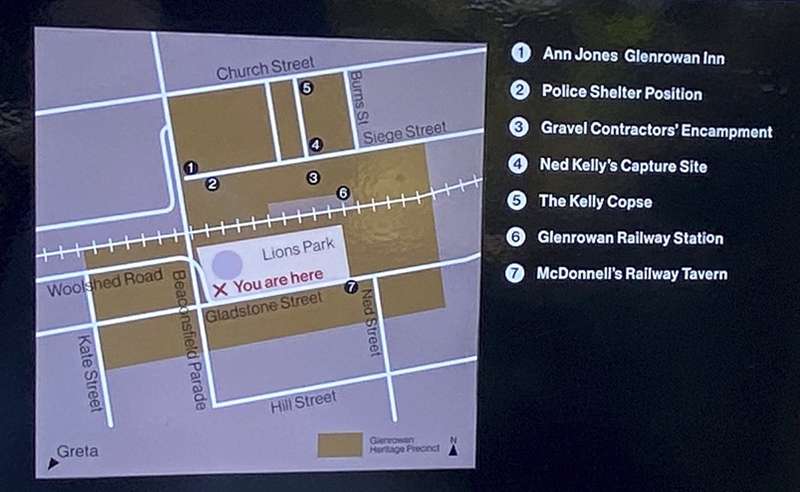
Although the town of Glenrowan has evolved since the 1880 siege, the topography, landscape and layout remain largely unaltered. The roads in the heritage precinct are as surveyed in 1875. Mt Glenrowan continues to dominate the town from the north and the railway line and corridor are on the original alignment along the lowest point of the Gap in the Warby Ranges.
Out in the ranges of Strathbogie,
we Fiercely roam The caves we seek,
our hiding place, Are a wild and
barren home.
Part of a ballad reputed to have been written by Joe Byrne
During their fugitive years the Kelly Gang took refuge in the series of interconnected ranges in the North-East Victoria. Aided by the sparse undergrowth and moonlight they could outwit the police by galloping their horses over tremendous distances. As Morgan’s Lookout on Mt Glenrowan affords extensive views over Glenrowan, reportedly Ned Kelly utilised this vantage point to secretly observe the activities in the town below.
Viewing Platform Signage about Siege Locations
GRETA
The small settlement beside Fifteen Mile Creek has had two town centres over the years, both called Greta.
The original township, now known as Greta West, was established in 1853. That same year, the colony of Victoria established a police force. The first police arrived in Greta in 1870. The posting was considered particularly tough as it was situated deep in Kelly country.
Ned Kelly lived here from the age of 12 after his father died. Young Ned was soon known to the local police. He sought refuge at the station when chased by his uncles
Pat and Jim Quinn and was later badly beaten by Senior Constable Hall for resisting arrest.
In 1878, Constable Fitzpatrick of the Greta police went alone to the Kelly homestead to arrest Dan for horse stealing. In events that set off the hunt for the Kelly Gang, Fitzpatrick was wounded in a scuffle. Ellen Kelly, along with her neighbour and son-in-law, were arrested, tried and found guilty of attempted murder.
POWER'S LOOKOUT
Power's Lookout was one of the bush sanctuaries where the Kelly Gang stayed during the police search between the murders at Stringybark Creek and the Glenrowan Siege.
Ned knew this scrubby landscape well. At 14, he had been apprenticed to bushranger Harry Power, who had made this area his base.
From Power, Ned learnt to work the region, deal with authorities and survive in the bush. Power was eventually captured here.
STRINGYBARK CREEK
Stringybark Creek was the site of the fatal shootout between police and the Kelly Gang on 26 October 1878.
Accounts of the incident vary. Ned Kelly insisted he shot Constables Lonigan, Scanlan, and Sergeant Kennedy in self-defence. Surviving police constable McIntyre says they were ambushed.
The murders at Stringybark Creek were a turning point in the hunt for the Kelly Gang: days later, the four bushrangers were proclaimed outlaws.
MANSFIELD
In 1878, a group of police from Mansfield set out to locate the Kellys, whom they hoped to find camping nearby.
They set up camp near Stringybark Creek, less than a kilometre from the gang's hideout at Bullock Creek. They were discovered, and three of them were murdered by the gang in a decisive moment in the search.
The bodies of three dead police were returned to Mansfield for burial. A publicly funded memorial was later built there.
MELBOURNE
In 1880, Melbourne was booming with gold wealth and teeming with migrants.
Grand buildings and national institutions multiplied quickly as the city established itself as a modern international capital and the centre of state government administration.
Ned Kelly was transported here from Beechworth for trial at the Supreme Court for the murder of Thomas Lonigan at Stringybark Creek. The jury quickly returned a guilty verdict. Judge Redmond Barry pronounced the death penalty and refused to allow an appeal.
Some believe that Ned Kelly's trial for the murder of Lonigan was unjust, but had he survived this, it is unlikely he would have escaped conviction for shooting Sergeant Kennedy on the same occasion. Ned was executed by hanging at Melbourne Gaol on 11 November 1880.
BEVERIDGE
Ned Kelly was born in Beveridge on a freehold owned by his father, John ‘Red’ Kelly, who had raised funds through small successes at gold mining.
‘Red’ Kelly was born in Ireland during a wretched time of famine, disease and colonisation. He came from a large, poor family and was transported to Australia in 1841 for stealing pigs. He met and married Ellen Quinn in Melbourne in 1850.
‘Red’ and Ellen had mixed fortune. They built a home in Beveridge that still stands, but they had little success with farming and were forced to sell the property when Ned, their oldest boy, was nine.
In 1864, they headed further inland and rented 40 acres near Avenel. In 1865, the hapless ‘Red’ was gaoled for four months for unlawful possession of a hide. The 46-year-old died of ‘dropsy’ the following year, leaving seven children.
EUROA
In 1878, while on the run, the Kelly Gang held up the National Bank in Euroa to secure a small sum of money that allowed them to avoid capture by the police.
This raid was described in The Argus newspaper as ‘cool impudence and daring effrontery’. Though the population of Euroa at that time was only about 300, the town was well established and had substantial buildings, including hotels, post office, police station and banks.
In preparation, the Kelly Gang had taken hostages at nearby Younghusband’s Station, where they reportedly treated their captives respectfully and gave them a show of horse tricks as they departed.
BENALLA
Police stationed at Benalla coordinated the search for the outlawed Kelly Gang after the murders at Stringybark Creek in 1878.
Following the Glenrowan Siege in 1880, Ned was taken, along with the body of Joe Byrne, to Benalla, where a frenzied crowd of journalists and supporters (among them Ned’s sister Kate) had gathered.
Joe Byrne’s body was strung up on the lock-up doors and photographed by someone from the waxworks and a Melbourne photojournalist before being hastily buried in the paupers’ section of the cemetery.
JERILDERIE
Jerilderie, just over the border into New South Wales, is one location where Ned and the Kelly Gang spent time while on the run from police in 1879.
They stopped there to hold up the Jerilderie bank, where they took hostages and burnt loan documents. While in Jerilderie, Ned dictated to Joe Byrne the letter that is taken as his manifesto. The Jerilderie Letter attempts to justify his actions and claims police corruption.
In it, Ned argued that he had acted in self-defence at Stringybark Creek and that he represented the oppressed. Ned attempted to have the letter published in the local newspaper, but it wasn’t publicly available until 1930.
GLENROWAN SIEGE
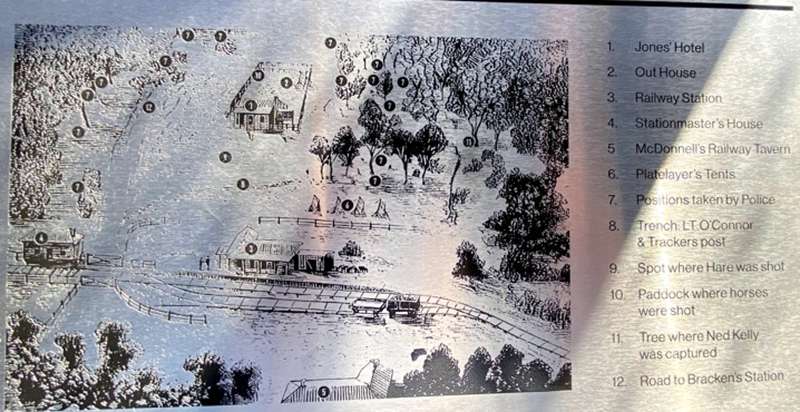
The Glenrowan Siege was the outcome of a failed plan by the Kelly Gang to derail a special train carrying police and Aboriginal trackers who had been searching for the outlaws for nearly two years.
After Joe Byrne killed police informant Aaron Sherritt at his home in Sebastopol on Saturday, 26 June 1880, the Kelly Gang assembled in Glenrowan to carry out their deadly plan. Delays, mistakes and problems resulted in the gang taking hostages and holding them at the Glenrowan Inn until the special police train arrived from Melbourne.
Fighting at the inn began in the early hours of Monday, 28 June 1880, and resulted in the deaths of three hostages and three gang members, the wounding, capture and arrest of Ned Kelly, and the destruction by fire of the inn.
Location
45 Gladstone Street, Glenrowan 3675 View Map
✆ 1800 801 065
Email Enquiry
Web Links
→ www.nedkellydiscoveryhub.com.au
→ Ned Kelly Discovery Hub on Facebook


