Glenrowan Heritage Siege Precinct Walk


Glenrowan is the site of the final siege and capture of Ned Kelly and his gang in 1880. Their story is preserved in township attractions, museums, and historic walks.
The events leading to the Glenrowan Siege began on the evening of June 26, 1880, when Dan Kelly and Joe Byrne murdered Aaron Sherritt in Woolshed Valley near Eldorado, suspecting him of being a police informant. The murder triggered the dispatch of a police contingent, including Aboriginal Trackers, who were enroute to Beechworth to pursue Dan and Joe for Sherritt’s killing. The Trackers were the primary target.
Take a journey through Glenrowan, where the dramatic events of that fateful night unfolded. Visit key sites along the Heritage Siege Walk and immerse yourself in the story of how the infamous siege came to an end.
Glenrowan Heritage Siege Precinct Walk Map
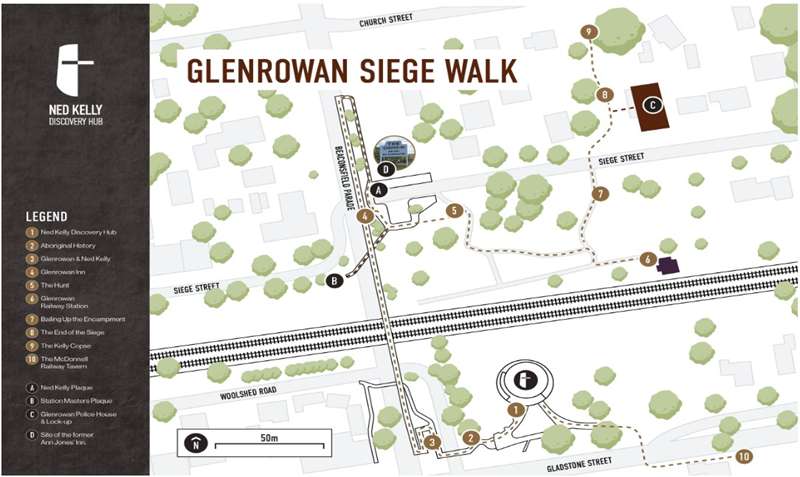
Glenrowan Heritage Siege Precinct Walk Key Locations
1. NED KELLY DISCOVERY HUB
The Glenrowan Siege in 1880 marked the dramatic end of the Kelly Gang. After years on the run, they made a final stand here. The town has changed. but traces of its past remain - heritage roads still follow the original survey, and Mt Glenrowan watches over it all.
2. ABORIGINAL HISTORY
For thousands of years, Aboriginal people lived in this region, fishing, hunting, and gathering along the rivers and plains. Mount Glenrowan and Winton Wetlands remain significant cultural sites. Early maps name local tills Cumbaignuk, with Bindagaree (Glenrowan Lookout) overlooking the Bunnamunna Plains.
3. GLENROWAN & NED KELLY
Named after early settlers George and James Rowan, Glenrowan grew during the gold rush and boomed with the arrival of the railway in 1873. The Glenrowan Inn, opened by Ann Jones in 1878. later became the centre of the infamous siege after the Kelly Gang's failed plan to derail a police train.
4. GLENROWAN INN
Excavations at the Glenrowan Inn site uncovered thousands of artefacts, revealing glimpses of everyday life and the siege's destruction. Ann Jones, an Irish immigrant, ran the inn where the Kelly Gang held hostages. After a night of gunfire, police set it alight - ending the standoff and changing her life forever.
5. THE HUNT
Aboriginal trackers from Queensland played a key role in the search for the Kelly Gang. feared by Ned for their skill They arrived in Glenrowan just before the siege, joined by local trackers Moses and Spider. Though vital to the outcome, they were never properly rewarded.
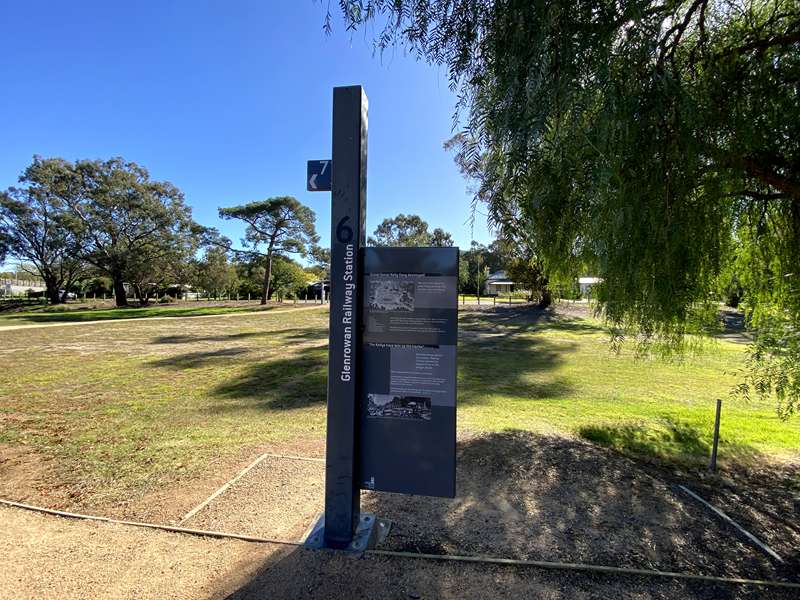
6. GLENROWAN RAILWAY STATION
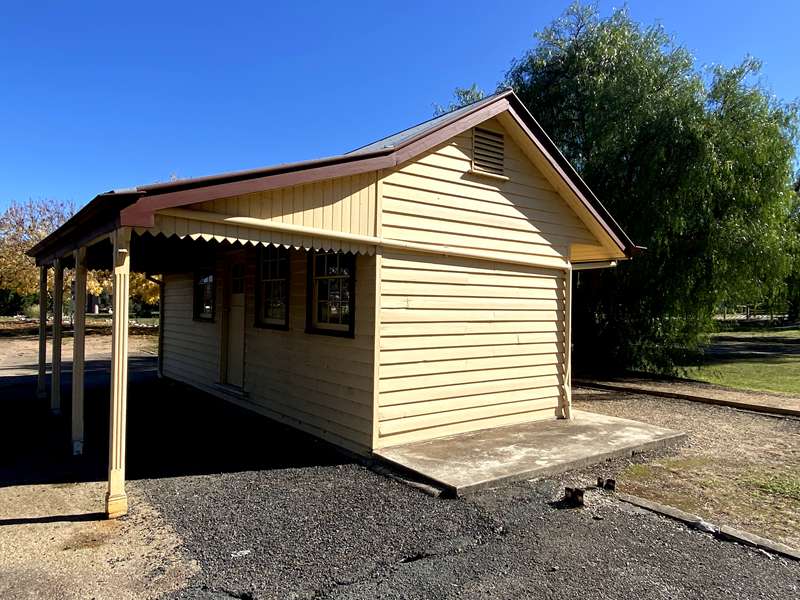
Opened in 1874. the railway transformed Glenrowan into a busy stop for travellers. During the siege, the Kelly Gang targeted the tracks but failed to derail the police train. Local teacher Thomas Cumow bravely warned the train, saving lives. Today's station is a replica of the original.
7. BAILING UP THE ENCAMPMENT
On June 26, 1880. the Kelly Gang mistakenly took gravel contractors near the Glenrowan Inn as hostages, thinking they were railway workers. The gang then forced track workers to damage the line before moving everyone to the inn.
8. THE END OF THE SIEGE
At dawn on June 28.1880, Ned Kelly, in armour and cloak, emerged from the mist, startling police and onlookers. Wounded and weakened. he was eventually captured by Sergeant Steele. The siege ended after five hours, marking the dramatic close of the Kelly Gang's final stand.
9. THE KELLY COPSE
After being injured in a gunfight, Ned Kelly retreated to a copse of trees, where he hid overnight, weakened by his armour and wounds. His bloodied skullcap and rifle were found nearby. but Kelly remained undetected until making his final stand, cementing his place in Australian legend.
10. MCDONNELL'S RAILWAY TAVERN
Located near the railway station, McDonnell's Tavern was a regular gathering place for Kelly supporters. The outlaws tethered spare horses here and stored a drum of gunpowder. After the siege, the bodies of Dan Kelly and Steve Hart were brought to the tavern, where Ned Kelly's sisters and cousin Kate mourned their loss. The hotel has been demolished.
Review:
It's great to walk around Glenrowan and be immersed in the history of Ned Kelly. However, take the map and the associated map legend with a grain of salt. Some new signage has been installed (see below). This is:
1. Glenrowan Inn (at site 4 on the map)
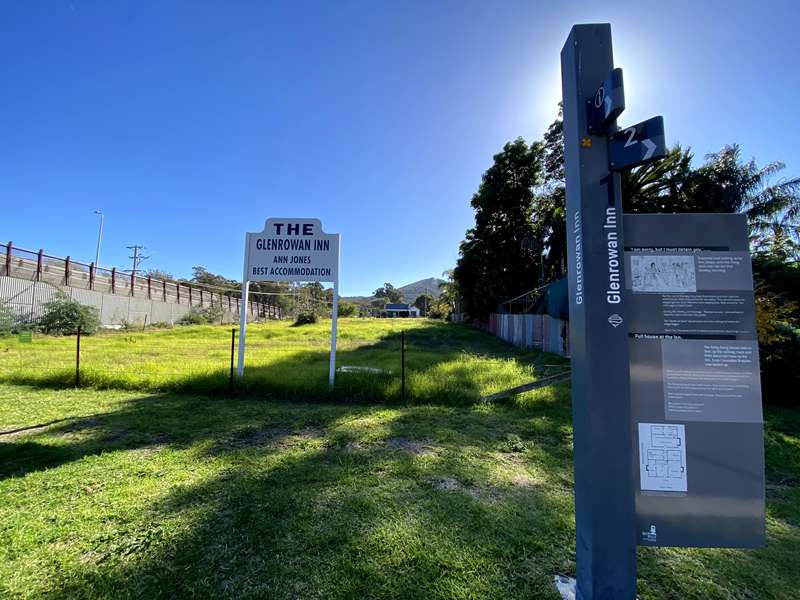
“I am sorry, but I must detain you.”
- Ned Kelly
Business was looking up for Ann Jones, until the Gang took over her Inn that Sunday morning.
For the rest of the day, they kept themselves and their captives entertained, while they waited for the police. They danced, sang and played games. Even Ned was seen playing hop, step and jump – but with a gun in each hand.
During the revelry, one hostage – Thomas Curnow – planned how to raise the alarm and alert the police.
The “house of sport” would soon turn into a living hell when the siege began.
“Don’t fire. The place is full of women and children; stop firing!”
- Anonymous
Full house at the Inn.
The Kelly Gang forced men to tear up the railway track and then escorted them to the Inn. Even Constable Bracken was bailed up.
Women and children were held at the stationmaster’s house… and later joined their menfolk. More than 60 people were crammed inside the small Inn; about 40 were still there when the battle began.
The Gang occupied two hotel rooms. Their armour was a disturbing final touch to their preparations for fighting the police.
With nerves frayed from lack of sleep, they watched the plan come apart.
Why hadn’t the train arrived?
Where were the police?
Had they fallen into a trap?
No surrender!
It was hot work shooting at the police. Joe Byrne stopped to grab a drink at the bar, but was shot in the groin and fatally wounded.
Three hostages were caught in the crossfire and died: George Metcalf, Martin Cherry, and sweet, young Jack Jones.
“We remained there expecting every minute to be shot until about half past nine in the morning.”
- James Reardon, who was trapped with wife, Margaret and their eight children
Eventually, the hostages were released, but the siege continued with regular exchanges of gunfire.
Finally, the police decided on a last, decisive act. At 2.50pm, the Inn was set alight to flush out the last of the gang.
“All eyes were now fixed on the silent building… still no sign of life.”
- The Argus, 29 June 1880
2. Police Shelter Position (at site 5 on the map)
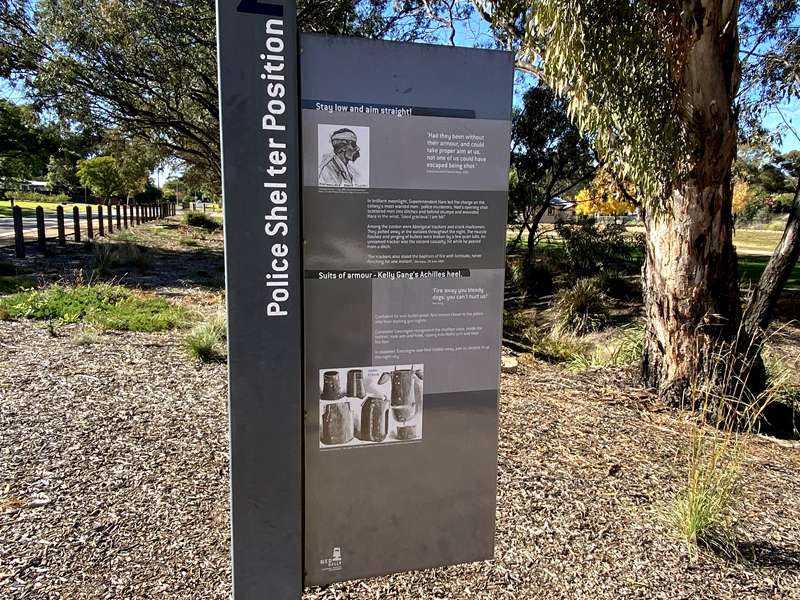
Stay low and aim straight!
“Had they been without their armour, and could take proper aim at us, not one of us could have escaped being shot.”
- Superintendent Francis Hare, 1881
In brilliant moonlight, Superintendent Hare led the charge on the colony’s most wanted men – police murderers. Ned’s opening shot shattered men into ditches and behind stumps and wounded Hare in the wrist. Good casuals! and hit.
Among the cordon were Aboriginal trackers and crack marksmen. They peered away at the outlaws throughout the night. The muzzle flashes and pinging of bullets were buried by a few silent kills. An unnamed tracker was the second casualty, hit while he peered from a ditch.
The trackers also stood the baptism of fire with fortitude, never flinching one instant.
- The Argus, 29 June 1880
Suits of armour – Kelly Gang’s Achilles heel.
“Fire away you bloody dogs, you can’t hurt us!”
- Ned Kelly
Confident he was bullet-proof, Ned moved closer to the police into their waiting gun sights. Constable Gascoigne recognised the muffled voice inside the helmet, took aim and fired, ripping into Ned’s arm and then his foot. In disbelief, Gascoigne saw Ned hobble away, just as rockets lit up the night sky.
“Is that you Ned?”
- Joe Byrne
Some police were close enough to hear wounded Ned Kelly ask his friend Joe Byrne for assistance. Crouched near the side of the Inn, Constable Phillips listened, amazed at the hushed, but heated, conversation. One sounded defeated; the other determined to go on.
“I always said this bloody armour would bring us to grief.”
- Joe Byrne
Surprise rear attack:
“I fired five or six charges straight at him and saw them jump off his body. I cried out – This man must be the devil!”
- Jesse Dowsett, railway guard and civilian volunteer, 1881
By dawn, local reinforcements arrived. Thirty police encircled the Inn and were intent on revenge.
Some of the police retreated to a safer position, concerned not to be killed by the men opposite, as bullets pierced the flimsy building.
The police turned, startled by an advancing figure who staggered from tree to tree. It was Ned Kelly. Wounded and aiming poorly, the “madman” fired anyway.
Bullets ricocheted off Ned’s armour, with little effect, until he was felled by Sergeant Steele.
3. Gravel Contractors' Encampment (at site 7 on the map)
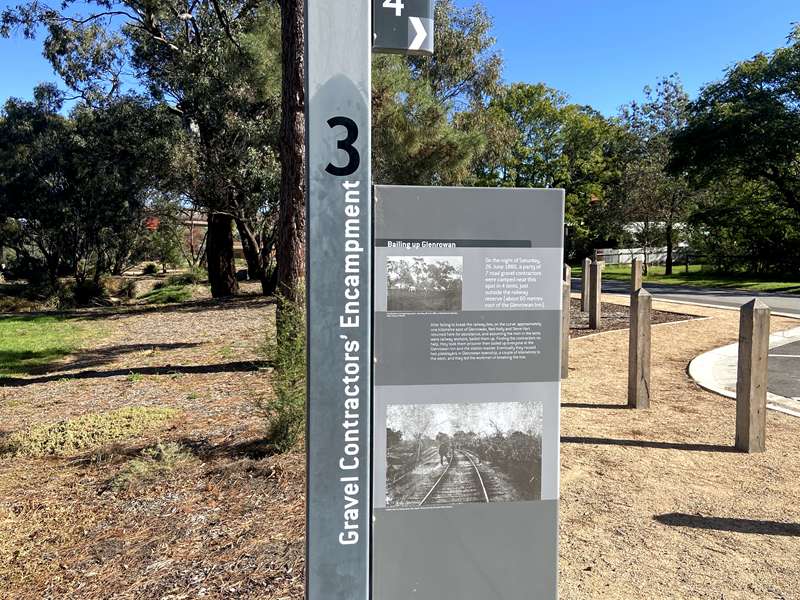
Bailing up Glenrowan
On the night of Saturday, 26 June 1880, a party of 7 road gravel contractors were camped near this spot in 4 tents, just outside the railway reserve (about 60 metres east of the Glenrowan Inn).
After failing to break the railway line, on the curve approximately one kilometre east of Glenrowan, Ned Kelly and Steve Hart returned here for assistance, and assuming the men in the tents were railway workers, bailed them up. Finding the contractors no help, they took them prisoner then bailed up everyone at the Glenrowan Inn and the station master. Eventually they roused two platelayers in Glenrowan township, a couple of kilometres to the west, and they led the workmen in breaking the line.
4. Ned Kelly's Capture Site (at site 8 on the map)
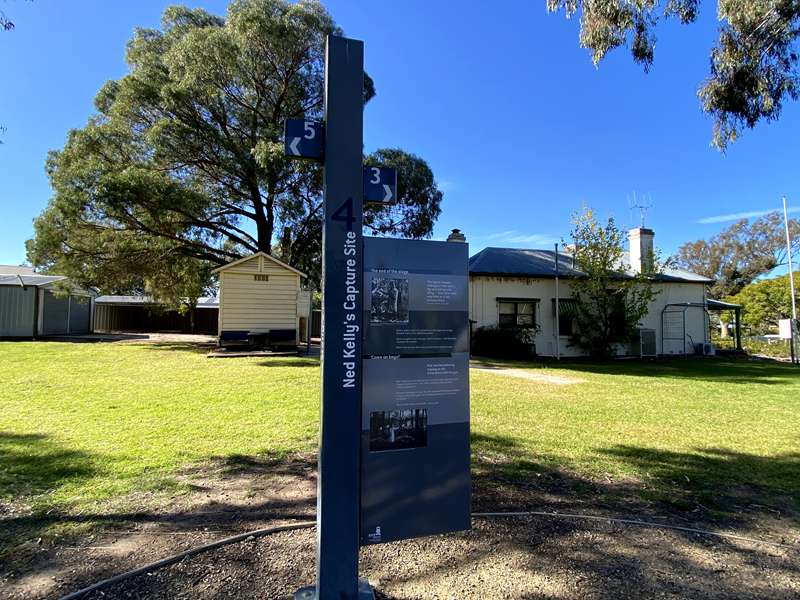
The end of the siege.
“The figure stopped, raising one foot onto a log and aiming and firing… Shot after shot was fired at it, but without effect.”
- Australasian Sketcher, 3 July 1880
At first, police could not comprehend the shape advancing towards them in the cold dreary dawn. Some thought it was a bunyip, others a demon – until Ned Kelly revealed his revolver. Within half an hour, Ned’s last confrontation would be over.
“Come on boys!”
Ned taunted police by tapping on his breastplate with his gun.
Ned called out to his brother, Dan, and Steve Hart, who were still trapped inside the Inn. The police scattered when all three outlaws opened fire.
Between exchanges of gun fire, the wounded Ned limped towards a huge, white, fallen gum tree. Someone shouted out to him to surrender.
“Never, while I have a shot left.”
- Ned Kelly, 1880
Wanted alive, not dead!
Witnesses differed in their accounts of how Ned was finally captured after being shot down by Sergeant Steele.
The policeman Steele claimed that he alone wounded, unmasked and disarmed Ned Kelly.
But other men also said they helped by wrestling down Ned and hauling off his helmet and armour.
Some of those watching Steele were convinced that he meant to take no prisoners, and came between him and the wounded villain.
“I’ll shoot any bloody man that dares touch him.”
- Constable Hugh Bracken
The Police Lockup
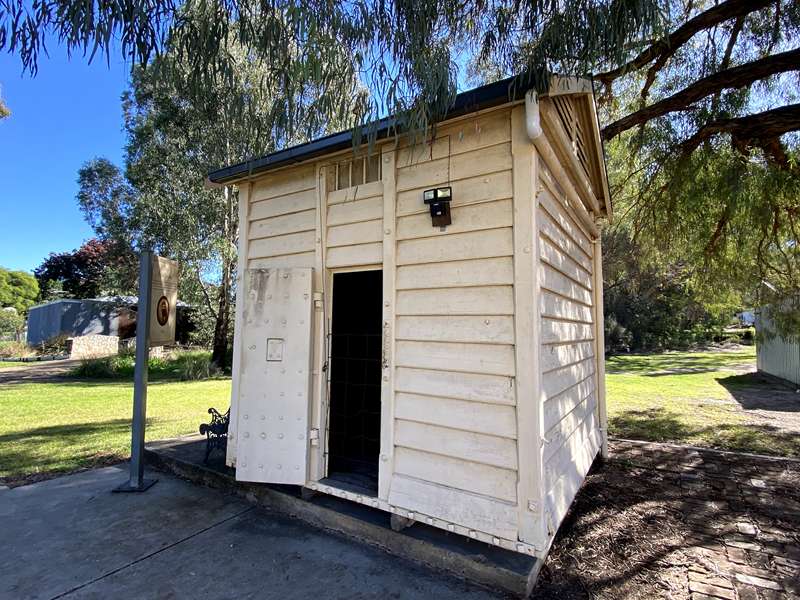
The original Greta police lockup, first relocated to the *Glenrowen (*Correct spelling, old township) township in 1880, was moved to this site when the nearby police station office and residence was erected around c1885.
Ned Kelly began his colourful career at odds with the law when as a lad of 16 years, he became a guest of the Crown in the lockup at nearby Greta (now Greta West).
There is an evocative sense of ironic symmetry about these historic circumstances that is heightened by the lockup’s eventual relocation to this precinct, only a few meters from where he was finally brought down by Sgt Steele’s shot gun, 9 years after his first confinement in the Greta lockup.
The Old Police Station
The Siege Street police station office and residence was erected on this site around c1885. The building’s bricks, handmade c1858, and its granite footings, were originally used in the construction of the earlier township’s hotel stables, catering for the travelling public on the old Sydney Road.
The hotel, located east of the Taminick Road intersection with the Sydney Road on its Northern alignment about 1 1/2kms west of this precinct, became redundant following the construction of the North Eastern Railway through Rowen’s Gap in 1873. In 1880, the hotel premises, leased by Victoria Police and operated as the *Glenrowen (*Correct spelling, old township) police station, was bailed up by Ned Kelly, the officer in charge, Constable Hugh Bracken taken prisoner by Ned. On this occasion Ned commented on his familiarity with the lockup, which he noted had been relocated from nearby Greta.
Decommissioned in the year 2000, these Siege Street premises are now the property of the Rural City of Wangaratta. The premises are extensively used as a meeting place by the Glenrowan and district community.
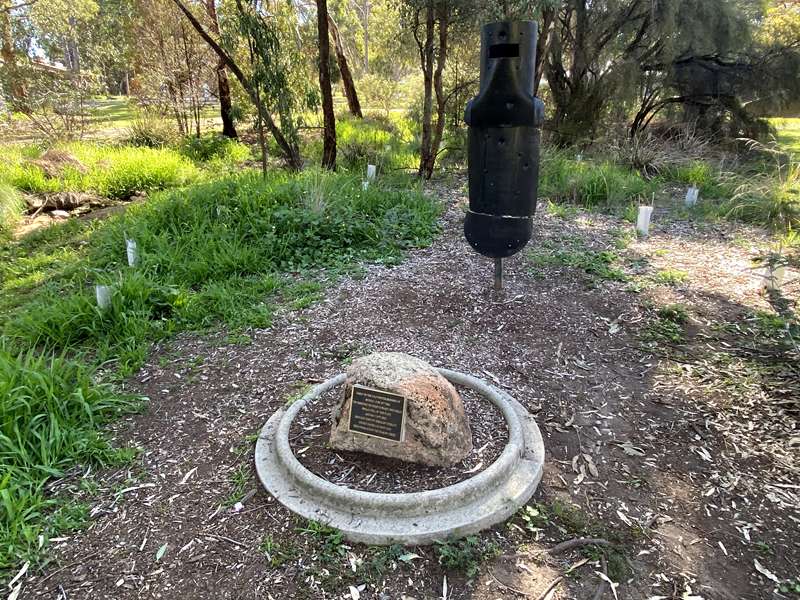
5. The Kelly Copse (at site 9 on the map)
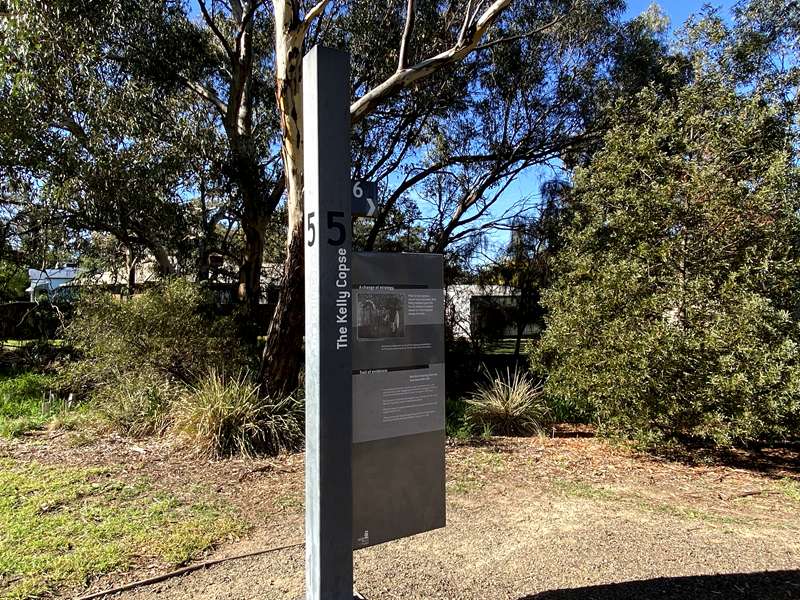
A change of strategy.
Prior to his capture, dazed and wounded, Ned Kelly hobbled past the Inn to where his horse stood in a fan-shaped clump of trees.
Ned had no option but to call off the rallying sympathisers. He then planned to return to the Inn and rescue the others.
Trail of evidence.
Ned bled heavily from his shattered left arm. He removed the padded cap from under his helmet to try and stem the blood flow. Staggering, he somehow managed to mount his horse and then rode east to meet his cousin, Tom Lloyd.
Tom returned to retrieve the forgotten cap and rifle, but left them behind. They were caked in blood and useless.
After the siege, the police discovered the cap and rifle about 100 metres from the Inn.
“These articles not only belonged to one of the outlaws, but to Ned Kelly himself, was soon proved.”
- The Argus, 29 June 1880
Weighed down by armour.
“Ned had only one good hand and could barely reload his revolver.”
Yet he continued on to challenge the thirty police who were positioned around the Inn. Bullets thumped at his helmet - “like blows from a man’s fist”. His face was battered by the face piece which lacked padding to soften the blows. Ned found it harder to move about or take aim, let alone think.
“I could have got away last night, for I got into the bush with my grey mare, and lay there all night. But I wanted to see the thing end.”
- Ned Kelly, The Argus, 29 June 1880
Rockets signal to a rebel army.
“I had plenty of mates in the neighbourhood ready to join us”
- Ned Kelly, 1880
Armed sympathisers readied to join the Kellys. Some accounts said there were 150 men, others only 30.
The dissidents included distant Kelly relatives, and selectors fallen on hard times. The police despised them – and the feeling was mutual.
Together, the dissidents would declare the Republic of North East Victoria, but the moment never came. Near Morgan’s Lookout, Ned ordered them to stay out of the fight. They left bewildered and confused.
6. Glenrowan Railway Station (at site 6 on the map)
Extra! Extra! Kelly Gang destroyed!
“We were now about to enter Kelly country, and caution was necessary.”
- Joseph Melvin, The Argus, 29 June 1880
Ned Kelly planned to derail a special police train about a kilometre east of the Glenrowan Railway Station. The train was speeding to the scene of a murder near Beechworth.
On board was a team of reporters. When the train made an unscheduled stop at Glenrowan, they got the scoop of a lifetime.
“The Kellys have torn up the tracks!”
Two kilometres before the station, Thomas Curnow alerted the engine driver to the danger ahead. Police descended onto the platform amid chaos. As the police charged the Glenrowan Inn, where the Kelly Gang and their hostages were bailed up, a volley from the verandah greeted them. Flashes of gunfire revealed the unearthly forms in their armour.
“The first brush was exceedingly hot. The police and gang blazed away at each other in the darkness.”
- Joseph Melvin
Scribbling, sketching and dodging bullets.
The station became a refuge for the press, being somewhat safer than out in the open.
Some reporters ventured close to the action – into ditches and behind trees. They scribbled, made sketches and shouted out warnings.
From their safe spots, the press and spectators witnessed the siege and Ned’s last moments of freedom.
“In the dim light of morning, with the steam rising from the ground, he looked like the ghost of Hamlet’s father with no head.”
- Argus, 3 July 1880
Wild beast brought to bay!
Telegraph keys tapped out news of Ned’s capture.
Badly wounded, stripped of armour and guns, Ned was carried to the station for treatment and rest.
In Melbourne and Sydney, crowds stood outside newspaper offices and brought business and traffic to a standstill. Within hours, news of Ned’s capture reached London.
By noon, more reporters and spectators arrived at Glenrowan. Photographers set up their bulky wet-plate cameras and developed images in a tent.
Photos:
Location
54 Gladstone Street, Glenrowan 3675 View Map


