Walhalla Self-Guided Town Walk


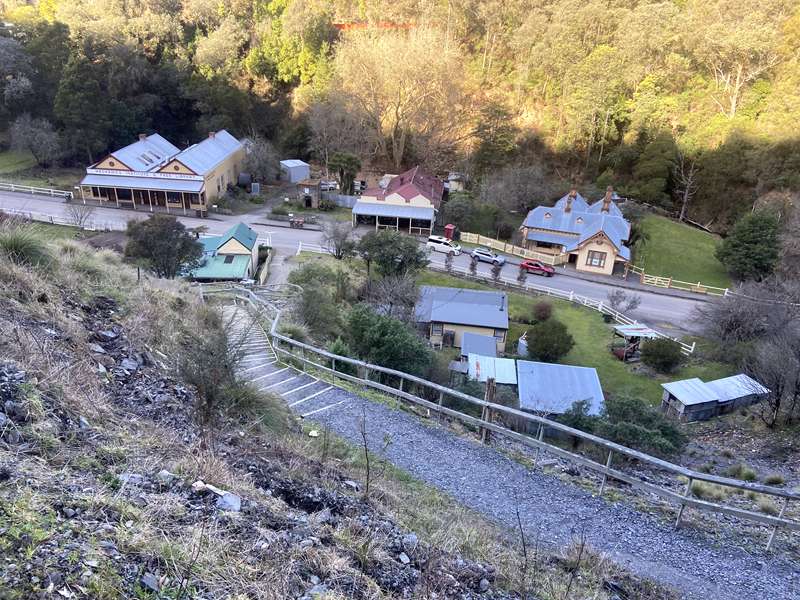
Follow the trail of over 30 interpretation signs from one end of Walhalla township to the other on this fascinating journey back to Walhalla's gold-era with photos and stories of the past.
Pick up a free copy of the visitor map from a Visitor Information Centre or download using the link below.
Highlights include the Walhalla Cemetery. Visit one of the most unusual cemeteries in Australia which is perched on a steep hillside. More than 1100 graves tell a story of great hardship and provide an insight into what life and death was like during the gold era.
Another highlight is the Walhalla Cricket Ground. Back in Walhalla's heyday, flat land was at a premium and so the solution for a sports field was to slice the top off a nearby mountain! Take the 1 km walk up the zig-zag track to see if you can hit a six onto the roof of the Star Hotel (with a tennis ball of course)
The Star Hotel and Oddfellows
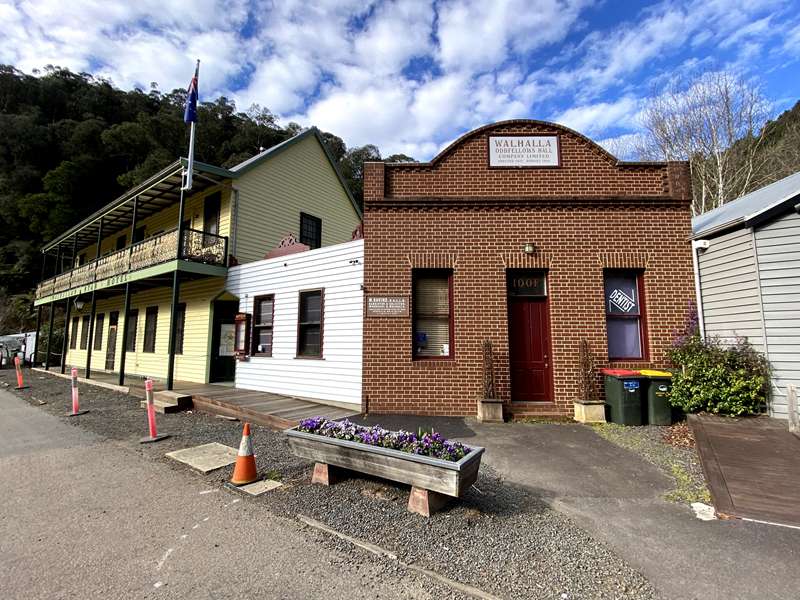
The Star Hotel was the last of Walhalla's 14 original hotels to survive the town's decline after 1915. In October, 1873, the Gippsland Times reported that "a neat looking hotel called the Star, built by Mr Austin, ... contributes an air of business to this rising part of the town."
Initially constructed as a single-storey building, the hotel was licensed in turn to the Parker and the Conlan families. It endured as one of very few remaining businesses and treasured social hub following the town's demise.
The Oddfellows Hall (IOOF - Independent Order of Oddfellows) next door was built in 1873 and was one of the few buildings built of brick in Walhalla. It became one of the very few Grand Encampment branches of Oddfellowship in Australia.
A fire on December 20, 1951, destroyed the hotel, largely dilapidated by then, along with the Oddfellows Hall and the Shire of Walhalla Offices. The Fire Brigade was despatched promptly from Erica, but arrived too late to be of any use. A faulty wood-burning hot water service was identified as the cause of the blaze.
The Star Hotel and associated buildings were constructed in 1998 by the Leaney family and were the catalyst for electricity connection to Walhalla at the same time.
The Walhalla District Cooperative Meat Supply Association Limited
In the early years hunger plagued the miners as they had no knowledge or acceptance of indigenous food and freighting provisions into the town was both difficult and extremely expensive.
Agnes Buntine drove the first bullock team into Walhalla in 1863. Finding the earliest miners starving, she promptly shot one of her bullocks to feed them.
As the town developed, an abattoir was established on Slaughteryard Track to the east of the town centre, near the Suburb of Maidentown. In 1882, documents in support of building a railway to Walhalla noted that 1000 head of cattle. and 2000 sheep and pigs-were transported to the town, mostly to feed the growing town's population.
Meat was delivered from the abattoir to the township slung over the back of pack horses, an extremely unhygienic practice by modern standards!
The population needed a reliable and regular supply of meat and other provisions. With no refrigerators or other methods for keeping food fresh, food had to be consumed soon after it was purchased. The Walhalla District Cooperative Meat Supply Association was formed in 1907 and occupied this site.
The Site of Lewis Loan's Star Brewery
A grand ball, in September 1885, marked the opening of this brewery by owners, Lewis and Elizabeth Loan (formerly, licensees of the Star Hotel in Walhalla).
Their ales became the favorite of the Governor of Victoria, Sir Henry Loch. In fact, Loan's aerated waters and bitters regularly won international awards at shows and exhibitions - prizes that ranked them amongst the best beer and soft drink manufacturers in the world. The Loans partly attributed their success to the purity of the water obtained from a spring on their property.
Lewis Loan's death, in May 1898, saw the brewery closed, its buildings, plant and equipment being sold off at a public auction soon after.
Lewis and Elizabeth Loan are buried in a prominent grave in the Walhalla Cemetery.
Phillips Cottage
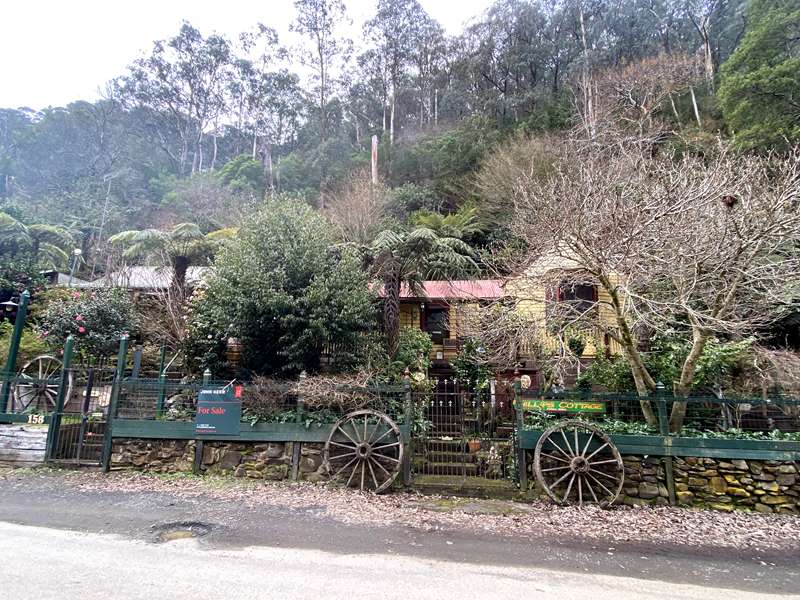
Phillips cottage, named after John Eddy Phillips, an early owner, is one of the town's original houses and can be identified in many early photographs of the town.
The house was constructed prior to 1868. The cottage you see today is the combination of two buildings, the gable end (with bay window) and the section with the verandah. These two structures were pulled together to form the cottage.
The design is typical of Walhalla early residences - quite small, clad in square cut hardwood weatherboards with a corrugated iron roof. The- windows are narrow and tall and the steep roof was required since snow was not unusual in the district.
Many building materials were sourced locally, but roofing iron had to be shipped from Melbourne to Port Albert and carried to Walhalla, strapped on the sides of pack horses.
People had hoped that the completion of the railway to Walhalla in 1910 would make it cheaper to transport building materials and other goods into the town.
The boom was ending however, and the railway instead made it easier for families to shift their households and belongings to more prosperous parts of the state. Many old Walhalla houses still survive in other areas of Victoria.
There are fewer than 10 original cottages surviving in Walhalla. Most of the cottages and houses you now see have been built in recent years to conform with the style of the gold era.
Walhalla Cricket Ground
In the early days, sporting events took place on any available flat land within the township. By the early 1870's, increased mining activity and the resultant growth in buildings and population, meant this was no longer possible.
The only alternative site was on top of this hill, 200 metres above road level. This was cleared, levelled and enlarged by the laborious use of pick and shovel. The oval had a rough earthen surface and was surrounded by a cycling track. The reserve became a popular venue for the town's sporting and social activities.
In 1907, the visiting Melbourne Cricket Club team, led by renowned Test Captain Warwick Armstrong, challenged the Walhalla team. According to local legend, Armstrong made a wager that he could hit a ball down into the yard of the hotel directly below. Instead, he was caught on the boundary by local, Dick Merrington.
The ground is still maintained and used for social and sporting events. The return walk takes about 45 minutes.
Spetts Cottage
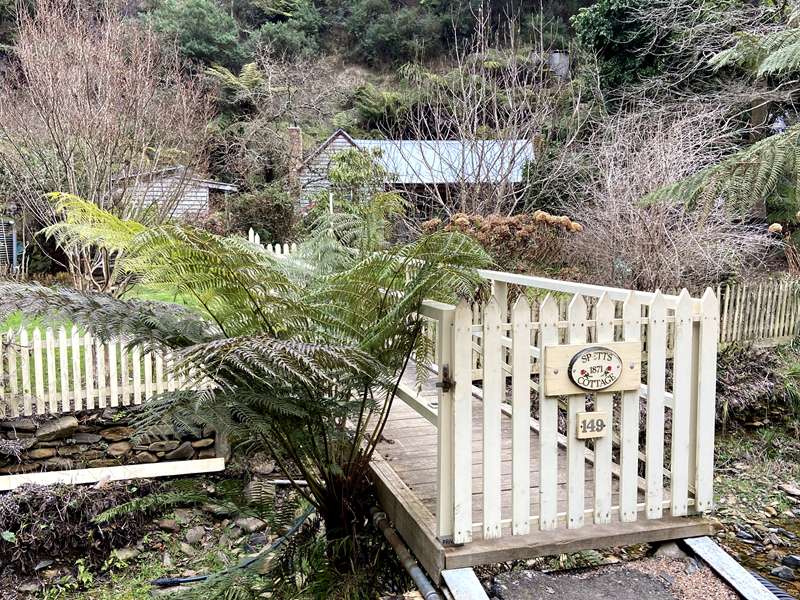
Spetts Cottage, one of about a dozen original gold era cottages left in Walhalla today, was built by Swedish-born Charles Spetts and his English bride Eleanor in the early 1870's.
It was extended over the years to accommodate their family of seven surviving children.
The cottage boasted one of the finest gardens in the valley. An apple, pear and mulberry tree remain today and continue to bear fruit.
Members of the Spetts family owned the residence until 1943, when it was sold to another old Walhalla mining family. Under the terms of sale, daughter Caroline Spetts remained in the house until her death in June 1944.
Subsequent ownes, appreciating the historic significance of the cottage, have undertaken a program of ongoing restoration.
Walhalla State School (Number 57)
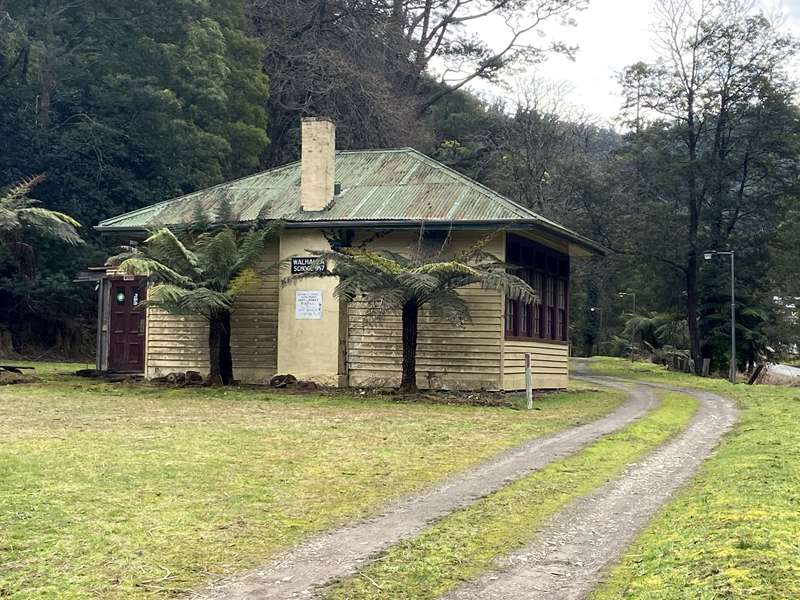
Prior to the building of a school, classes for the town's children were held in the Mechanics' Institute and later in a small building adjoining it. Other schools also operated in the Wesleyan and Catholic chapels for a short period.
In 1873, When the Government introduced free compulsory education, 333 children attended classes held in the various town venues.
Larger school premises were sought as the town's population grew, and the current site was purchased in 1874. Ah Gwan (a Chinese settler) originally occupied the land and operated a market garden here.
The first official school was opened on October 13th, 1875 with Henry Tisdall its first head teacher. Under his direction, and with Walhalla's population at its peak in the 1880s, the school's facilities were stretched to the limit and classes had to be held in hallways and shelter sheds.
The school was destroyed by fire in April 1891 and a larger building erected soon after.
The number of school age children declined as the town's population dwindled following the closure of the mines. In 1939 the large school building was dismantled to make way for a single-roomed 'one teacher' school. The Walhalla State School finally closed in early 1965.
Site of Guatta's Wine Shop
A Colonial Wine Licence was first issued to Charles McDowell in 1891. After several subsequent licence transfers, it was acquired by Giovanni and Angelina (de Luis) Guatta in June 1898.
Giovanni supplemented his income in a variety of ways: he supplied wood for the mines, worked on roads in the surrounding district, farmed an area at the junction of Stringer's and Fear Not Creeks (5 kms north of here), and was employed as a council worker by the Shire of Walhalla.
The Guatta's thirteen children were all born in the spacious eight-roomed house which adjoined the shop. Five of these children died in infancy or childhood, a not uncommon occurrence in those days. At one stage in the 1920's, five of their seven sons played in the Walhalla football team.
The wine shop's cellar was dug into the side of the mountain and can still be seen today.
The Criterium Hotel Site
Patrick Murphy, a milkman at Walhalla, built and operated The Criterion Hotel from January 1867. Three years later it was purchased by David Meikle, a successful miner on the Tubal Cain Reef and first underground manager of the Walhalla Mine, who renamed it The Bush Hotel.
The hotel reverted to its original name, The Criterion in 1879, following its purchase by John and Mary Jacomb, whose names became synonymous with the hotel for some thirty-six years. John was heavily engaged in local prospecting and it was largely left to Mary to handle its day-to-day operations.
Following the closure of the Long Tunnel Extended Mine in June 1911 and the first closure of the Long Tunnel Mine in December 1912, the government-appointed Licences Reduction Board reviewed the number of hotels in Walhalla. In evidence, the last licensee, John Cusack, revealed that in the previous year he had taken 900 pounds in bar sales alone. In spite of this, a decision was made to revoke the licence, effective from December 31st 1913.
The premises were subsequently operated as a boarding house by W. Seear. Photographic evidence shows that the hotel did not survive beyond the mid 1920's. The current structures on the site recreate the scale and outline of the original outbuildings.
Band Rotunda
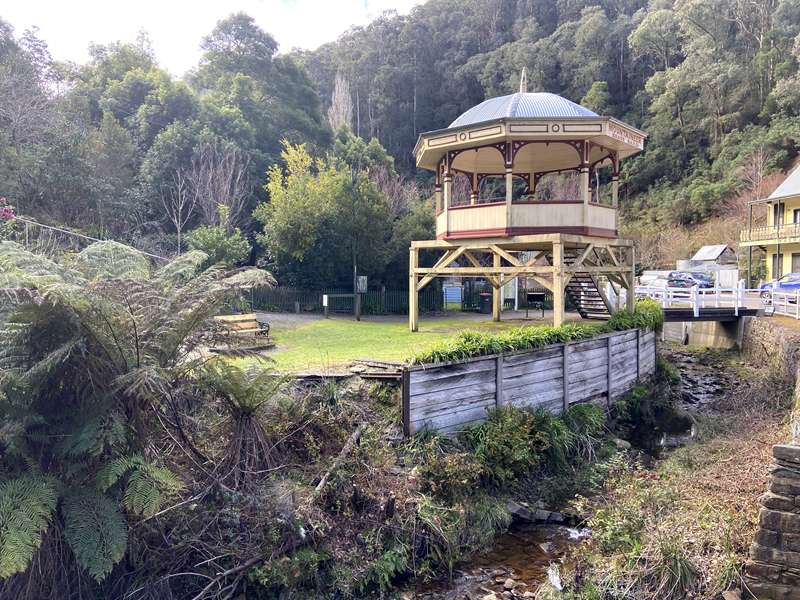
"...quite an ornament to the junction..." Walhalla Chronicle 3 July 1896
In Walhalla's remote location local bands became very important in the social and cultural life of the town.
The Mountaineer Brass Band called for designs for a band rotunda in 1895 and awarded a prize of 3.3.0 pounds to Mr F. Meyer for his winning design. Completion of the rotunda was celebrated on the evening of 29 October 1896 with a torchlight procession.
The rotunda has been the venue for many events over years including concerts, poetry readings, lectures and weddings. It has survived several floods to remain one of Walhalla's most picturesque and historic landmarks.
Walhalla Masonic Lodge (Number 69)
The first official meeting of the Walhalla Branch of the Freemasons was held in the Oddfellows Hall on July 26th 1876.
This building was constructed in 1866 and was originally the Wesleyan Chapel. In 1878 it was purchased by the Freemasons who spent a further 176 pounds on various modifications.
Originally the Freemasons operated under the English Constitution (Number 1700) but in 1889 adopted Victorian Constitution (Number 69).
Many of the building's furniture and fittings date from the town's gold rush era.
Lodge Number 69 is one of Australia's longest operating and most distinguished Lodges.
Site of Walhalla Police Station
Until 1864 a police presence at Stringer's Creek was maintained by visiting troopers. Following the recommendation of Mounted Constable Feely who noted. "... that peacebreaker - grog - [had found] its way into the valley...", a police building and lock-up were established around 1865 on the lower slope of what came to be known as Camp Hill, overlooking the cemetery entrance track and the Reefers Arms' Hotel.
By 1866, calls were being made to relocate the police station to a more central site in the growing township. However, it took until the summer of 1878 for a substantial new station building to be erected on this site.
The station continued to operate until November 1929, when, as a result of Walhalla's dwindling population, it was closed and its sole remaining policeman transferred to Erica, 15 kilometres away.
The buildings were considerably damaged in the floods of June 1952 and, later that year, the main building was relocated to the township of Boolarra (South Gippsland), whilst the lock-up was relocated to Cowwarr (North Gippsland).
The Grand Junction Hotel
The Junction Hotel was built in late 1865 by John F. Williams. In 1872 the hotel was renamed the Grand Junction by its new owner William Fuller. It became Walhalla's only 3 storey hotel. A cow once entered the top storey entrance, off Church Hill Road. It had to be led down two flights of stairs before being led out the front door!
The hotel was de-licenced in December 1913. After a short spell as a boarding house it was dismantled and part of it removed to Traralgon.
The large stone retaining wall, behind the hotel and remaining today, was built by John Rutter in 1869.
Walhalla Fire Station (1901)
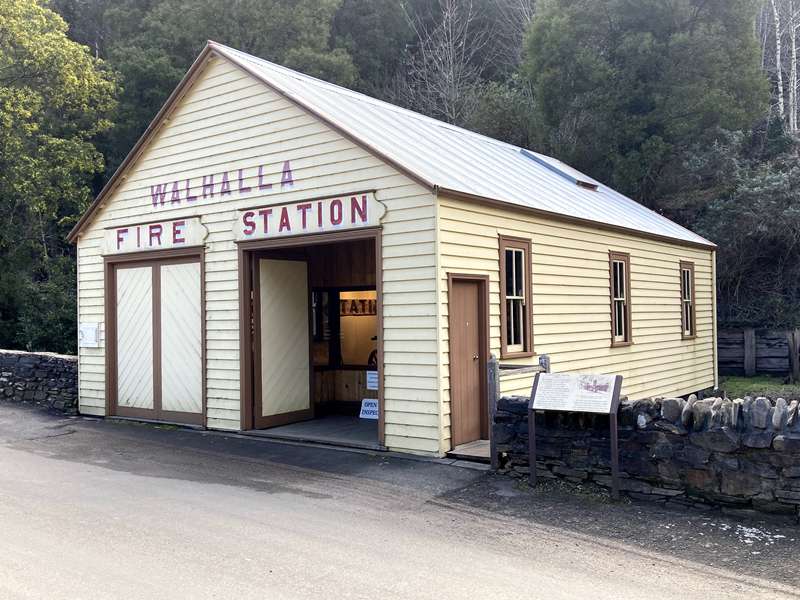
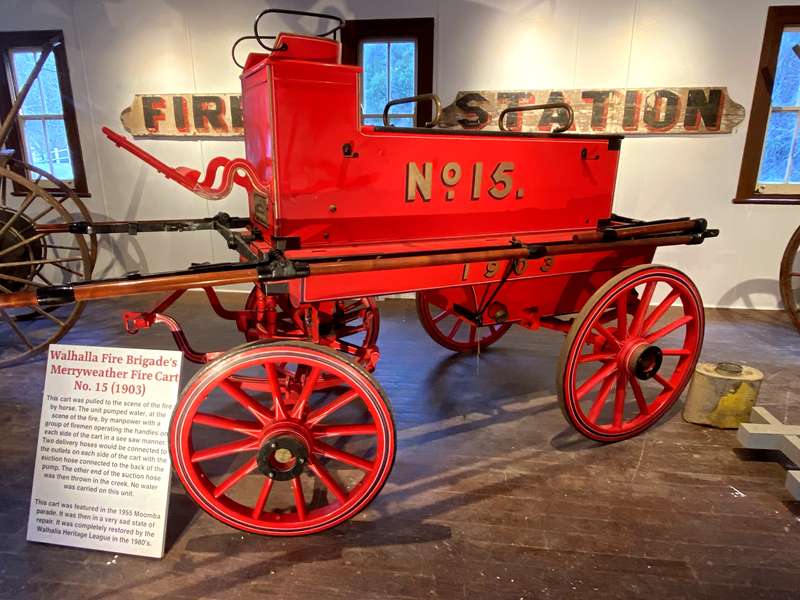
The Walhalla Volunteer Fire Brigade was originally formed in July 1871. It was registered much later, on March the 11th, 1889. Mr F. Bowden was appointed Captain. The original Fire Station was located in the Long Tunnel Mine yard.
In 1901 Mr. P. Carey won the contract to construct this building at a cost of 155 pounds. The building was built straddling the creek due to the lack of suitable flat ground in the town centre. The Walhalla Fire Brigade was de-registered in 1961.
Over the years this building has been utilised for many uses including a public hall and a museum. It is known as the most unusual Fire Station in the state and has been fully restored in recent years.
The Corner Stores
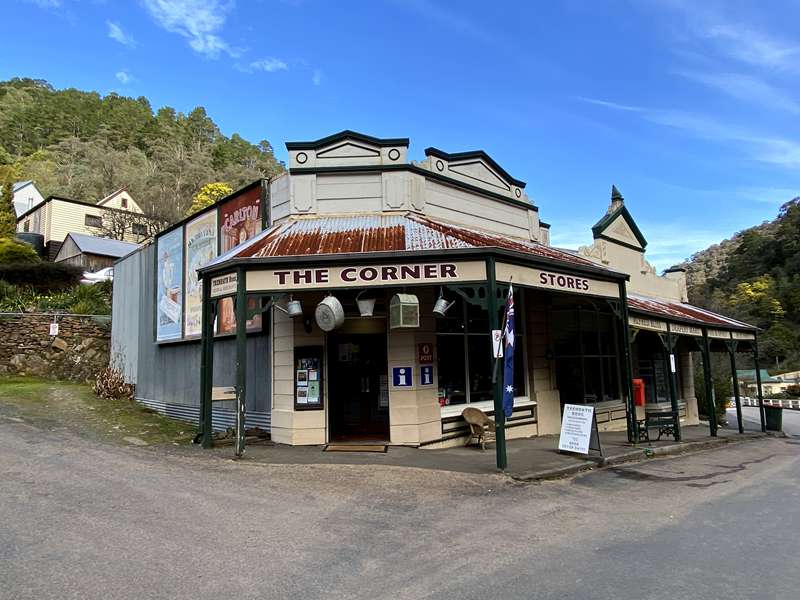
This site was first occupied by Cornelius Murphy who built the Shamrock Hotel in 1865. In later years it was renamed as The Royal, and then the Long Tunnel Hotel. It was destroyed in the major town fire of 1888.
After the fire a Walhalla accountant, Mr Frederick C. Tricks, acquired the land, and the present Corner Stores were completed in 1894.
James and William Trembath operated a general store out of the corner shop up until 1929. The shop was then purchased by William Trembath (Jr.) who operated it for many years.
A timber mill operating in the old Long Tunnel Mine yards (1949-1970) purchased these three shops for accommodation for its workers. They rapidly fell into a state of disrepair, and when the mill closed were derelict.
The buildings were purchased by the Walhalla Improvement League in March 1984 and fully restored. The League then moved its museum from the old Walhalla Fire Station into the corner shop.
The Walhalla Chronicle (Moondarra, Toombon & Woods Point Times)
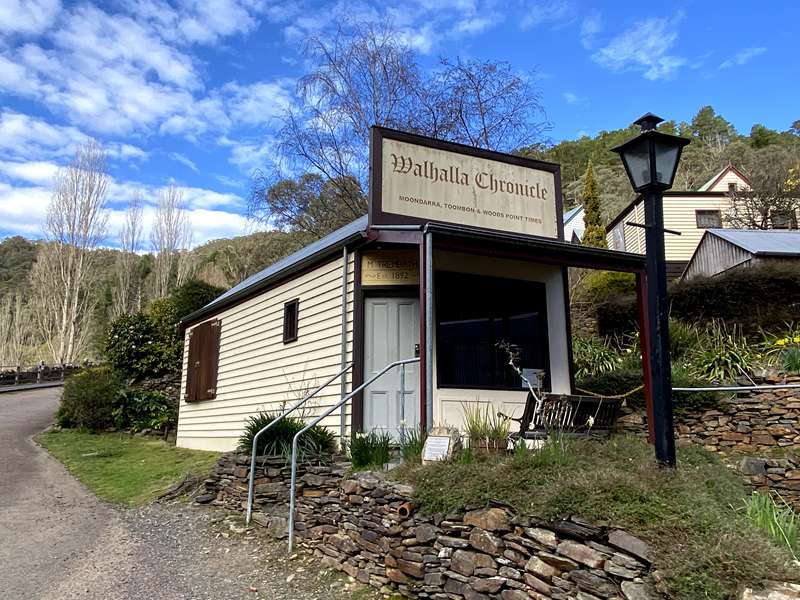
James Ryan was initially responsible for publishing the Gippsland Chronicle at the Crooked River gold fields. As the Stringer's Creek (later renamed Walhalla) goldfields became established he realised that long-term prospects were better in Walhalla. He transported his printing equipment from the Crooked River goldfields in 1867 and was set up to print the Walhalla Chronicle by 1869.
In 1914 the last of the major gold mines closed in Walhalla and the offices of the Walhalla Chronicle closed soon after. The Walhalla Heritage and Development League now owns the Walhalla Chronicle (Moondarra, Toombon and Woods Point Times) business name. The printers equipment in the shop was donated by Mr John Brickley (Blackburn).
This printers shop is established in what was originally Michael Trembath's (recreated) original general store. This building was rebuilt in 2003 by Brian Brewer (& family), descendents of the Trembath family.
These offices of the Walhalla Chronicle, Moondarra, Toombon & Woods Point Times were officially opened by the Mayor of Baw Baw Shire, Mr Geoff Davey on November 29th, 2003.
The Site of the Long Tunnel Mine Yard
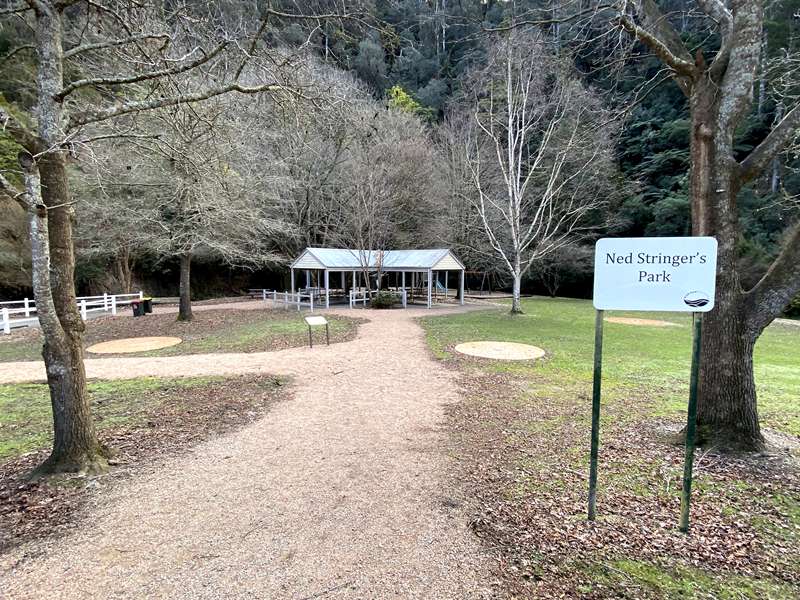
Between 1865 and 1914 this site housed the surface workings of the Long Tunnel Gold Mining Company. Formed after the purchase of two claims at a cost of 500 pounds each from a private syndicate in November 1864, the Long Tunnel Gold Mining Company went on to become Victoria's richest gold mine.
Over the next fifty years, the mine produced 820,251 ounces of gold then worth over 2.8 million pounds and paid dividends totalling almost 1.3 million pounds. The shafts reached more than 1200 metres underground. Ore was crushed in the company's thirty-stamp battery and at its peak, the mine employed over two hundred and fifty staff.
Finally ceasing operations in December 1914 due to declining gold returns, rising costs and a labour shortage caused by World War I, the mine's buildings and extensive plant were put up for auction in June 1915. Much of the equipment was taken away by the recently arrived railway. The closure of the Long Tunnel Gold Mine marked the end of large-scale mining in Walhalla, with most of the town's population leaving to find employment elsewhere.
Whilst there was some minor mining activity in Walhalla during the 1920's and 1930's, this site remained vacant until the opening of a sawmill in April 1949. It provided much needed local employment and operated until 1970.
On closure of the mill, the area was developed as a public reserve and later dedicated to the memory of Edward "Ned" Stringer, whose small party of prospectors discovered gold in this valley in December 1862.
Walhalla Mechanic's Institute
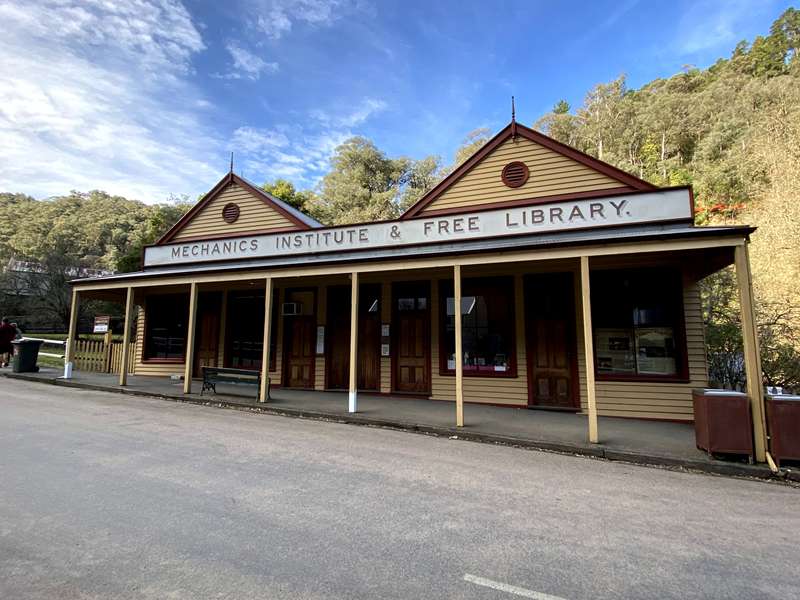
In 1865 the Mechanics's Institute site was purchased by public subscription for 80 pounds from Edward Nelson, a miner. The building was opened following a tea meeting on May 6th 1867 and provided the town with a place to meet, worship and educate.
It was used by all denominations until each could construct its own church.
The building was used as the town's first school, with classes being held there from 1867 until the State School was officially opened in 1875.
In 1883 the Mechanics' Institute, under Harry Tisdall's chairmanship, had 78 members, a library of 556 books and 150 more on order. This valuable resource made a significant contribution to adult and technical education in the town. These and many historical documents relating to the town's early history were lost when the building was destroyed in the major fire of 1888. After the fire rebuilding commenced almost immediately.
The new building survived the decline of the town but was again destroyed by a fire in 1945, caused by a worker burning off blackberries nearby. Following this fire the site remained vacant for many years.
The Mechanics' Institute was again rebuilt between 1983 and 1988 by a group of local volunteers and interested trades people.
The Bank of Victoria
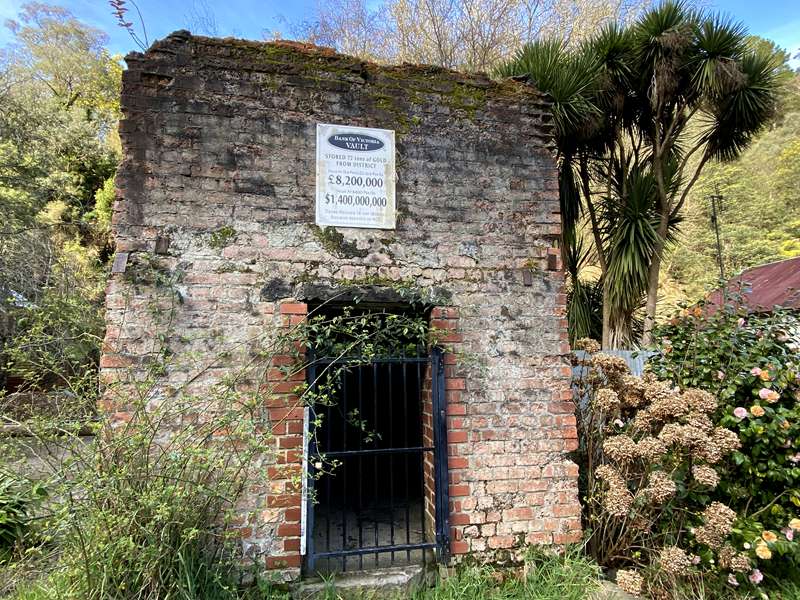
A branch of the Bank of Victoria was established in Walhalla around June 1865 with Mr D.B. Liddell as its manager. With Long Tunnel, Walhalla and Golden Fleece mines amongst its customers, it was the larger of Walhalla's banks. (The Bank of Australasia, which was located almost directly over the road, also serviced Walhalla.)
In March 1868 the Bank of Victoria purchased the present site, and by July, Andrew Lundy had commenced construction.
The building was destroyed in the major town fire of November 1888. Until a new building could be constructed, business was conducted in premises adjoining Catherine Parry's Grand Junction Hotel.
The new premises boasted a more ornate facade and features such as a substantial vault and commodious living quarters for its manager and his family.
During its operation the bank vault stored a total of approximately 73 tons (74 tonnes) of gold.
The shutdown of Walhalla's mines saw the Bank of Victoria finally close in 1915.
Walhalla Post & Telegraph Office
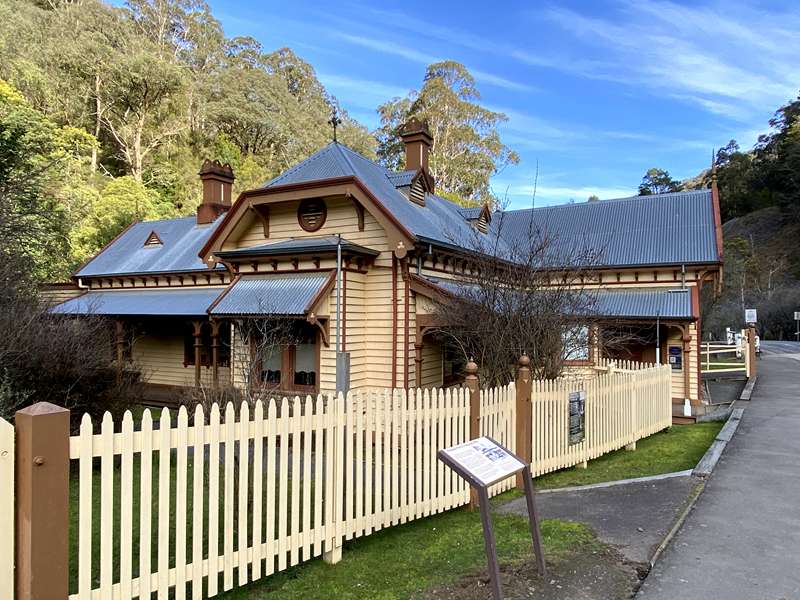
A Post Office was opened on the Stringer's Creek Goldfield on August 24th, 1864. Mr Ferdinand Duval was the town's first postmaster operating the Post Office in conjunction with his store.
According to early statistics, 1337 items passed through the Post Office in the first year, but by 1868 this had grown to a staggering 157,383 items. In 1870 the telegraph line was completed, connecting the town to the outside world. To cope with this increased business, a larger building was opened on March 10th, 1886. The facility grew to be Gippsland's third largest mail centre.
Until the train arrived in 1910, mail was delivered by horse drawn coach. Large crowds would gather outside the building and await its arrival. Overseas mail always created the greatest excitement.
The current building survived the disastrous 1888 township fire after a desperate struggle by townspeople to stop the fire's spread.
In 1948 the building was purchased by postmistress, Miss Doreen Hannan, who continued to operate the Post Office until 1963. She lived in the building until her death in 1988.
The Walhalla Gold Mine
The Walhalla Gold Mine was one of the town's earliest, largest and richest mines. This name is thought to have been coined by its Scandinavian-born mining manager Henry Rosales. His inspiration was 'Valhalla' which, in Norse Mythology, was the abode of Viking heroes slain in battle.
The mine was to eventually yield some 144,000 ounces (4,100 kg) of gold and distributed 228,478 pounds in dividends during the period 1864 to 1881.
Such was the significance of the mine, that `Walhalla' was adopted and gazetted as the mountain settlement's new name in 1866. Declining yields and profits from the Walhalla Mine saw the Long Tunnel Mining Co. purchase the mine's lease, offices and plant in April 1881. The entire operation closed in 1914.
Site of St. Patrick's Catholic Church
The Rev. William Shinnock was reputed to be the first Catholic priest to visit Stringer's Creek in May 1864.
Three years later, on August 11th 1867, a chapel was consecrated on this site by the Rev. Fr. Gerald Byrne.
The chapel also served as a small school in the 1870's, but was destroyed in the major Walhalla fire of 1888. It was rebuilt soon after.
In May 1945, a fire lit by the Crown Lands Department to burn off blackberries behind the Mechanics' Institute ignited leaf litter in the gutter of that building. The fire spread to the Bank of Australasia and the Catholic Church on the opposite side of the road, destroying all three buildings.
Unlike the Mechanics' Institute, the church and Wank have yet to be rebuilt.
Walhalla (Pearson Memorial) Hospital
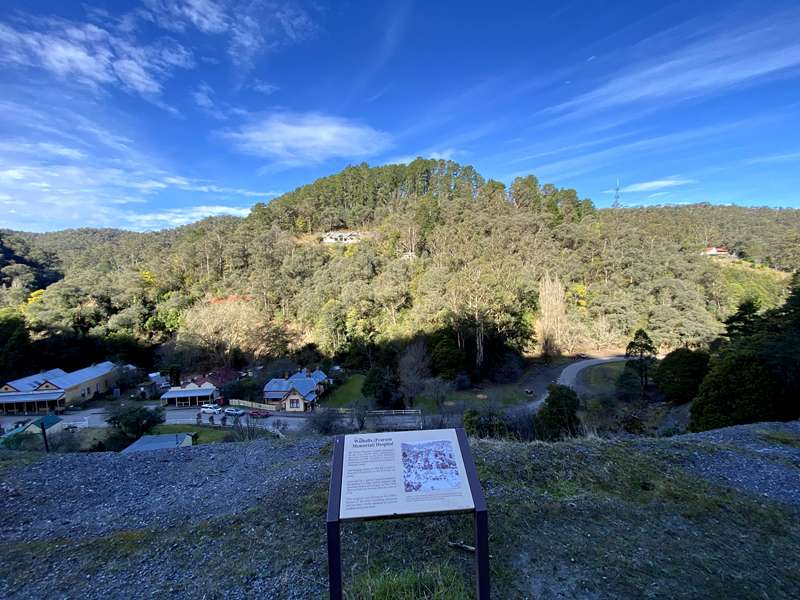
Mr William Pearson, a wealthy shareholder in the Long Tunnel Mine, donated his spacious cottage as the first Walhalla Hospital in 1884. Initially it was used exclusively to treat casualties of accidents in Walhalla's mines.
The Hospital closed in 1900 due to lack of demand (58 patients in the previous six years).
Later calls for a 'general' hospital resulted in the opening of a larger facility, complete with operating theatre and morgue, in May 1909. This was built by Herman Gloz at a cost of 736 pounds.
This hospital was closed in the 1940's because of the town's dwindling population and has since briefly operated as a private residence and guest house.
Timber Tramway (No. 1: South)
This section of the Alpine Walking Track originally formed part of an extensive network of narrow gauge industrial tramways constructed for Walhalla's mines.
The No. 1 South Tramway, at 11.6kms, was the second longest of Walhalla's timber. tramways. This particular tramway performed the dual function of also transporting ore.
The tramways were cut by manual labour, and once cleared, wooden or iron rail was laid. Horse-drawn carts, could, then commence delivery of firewood and structural timber to the mines. The mines were completely reliant on wood-fired steam boilers to operate their crushing plants, winches, drill compressors and other equipment.
At their peak, the insatiable boilers of Walhalla's mines consumed around 34,000 tons (34,560 tonnes) of wood annually, which resulted in the surrounding hills becoming denuded of forest for many kilometres.
Long Tunnel Mine
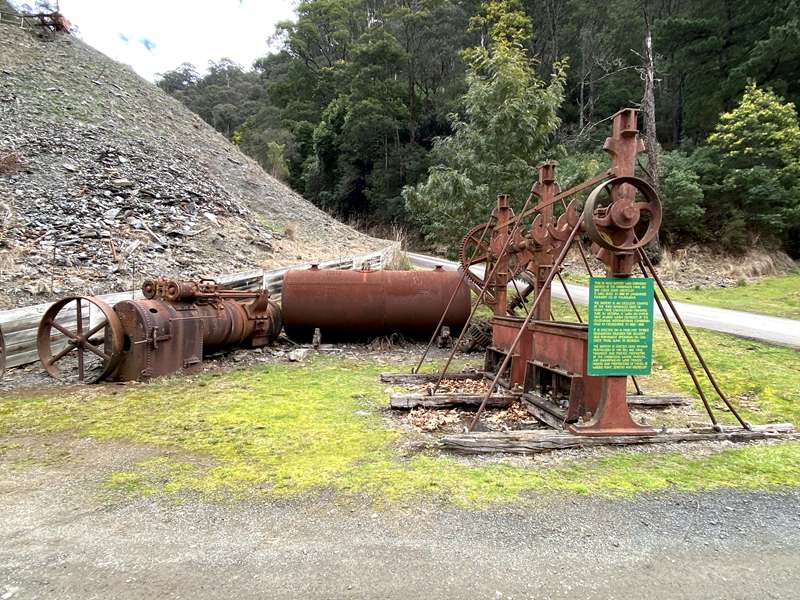
(Below and to the north of this sign, and now filled in, is the original main entrance to the Long Tunnel Mine.)
Ned Stringer's prospecting party first found gold in this valley in December 1862. The search was soon on for the source of the high levels of alluvial gold that was being panned in the creek.
In February, 1863 Cohen's Reef was found by John Hinchcliffe and James Myers and underground mining in pursuit of this rich quartz reef had begun by mid-year.
In 1864 the Squatters Junction Company was working a large claim which went on to become the Long Tunnel Company 1865. The first 8 years of mining work resulted in the recovery of no gold and the investors received no dividends. In the following 18 months all previous expenditure was recovered. If you were one of the early investors you would have received a massive 10,240% return on your investment.
The prosperity of the mine was highlighted by many other local mines adopting the words "Long Tunnel" in their company names to help entice investors.
The mine lease was finally declared void on February 15, 1915 and a great deal of equipment was freighted out of the town on the recently completed railway. The mine is one of Victoria's richest gold mines producing about 25.43 tonnes of gold, from 790,724 tonnes of ore, during its working life.
Photos:
Location
Main Street, Walhalla 3825 View Map
Web Links
→ Walhalla Self-Guided Town Walk map


