Wail State Forest


The Wail State Forest is located 25 minutes northwest of Horsham, just off the Western Highway. The majority of the area is native bushland. It follows the east side of the Wimmera River for 12km where there are numerous camping and picnic areas.
Cultural History
The Wail State Forest and adjoining Little Desert National Park have a rich and diverse cultural history. The Wotjobaluk people lived and hunted along the Wimmera River and nearby woodland plains for thousands of years, where food, shelter and water were plentiful. There are numerous cultural sites found at Wail including scar trees, middens and surface scatters. The traditional owners ask all visitors to respect these cultural sites. All sites are protected by law.
Bushwalking
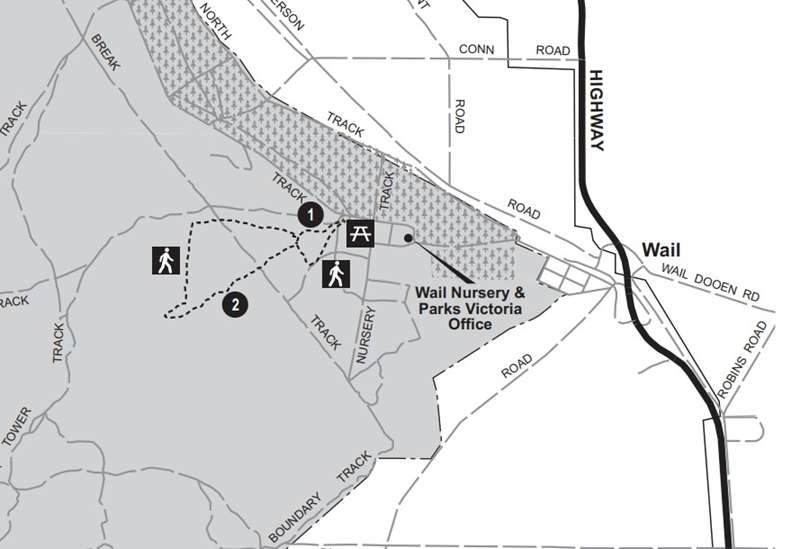
The Wail Trail and Scenic Loop walks are located near the Wail Nursery office, and meander through stringybark and native pine open woodland. Both walks start from a carpark easily accessible by two-wheel drive vehicles. The Scenic Loop walk takes off from the Wail Trail part way in and passes through many different vegetation communities along the way.
In spring time, many different wild flowers can be seen along both the walks. At ground level you may be lucky enough to see pink finger orchids, tiger orchids, twining blue fringe lilies and button daisies. In the shrub layer you will see heaths, correas, tea-tree, banksias and many other beautiful flowering plants.
The different tree species you see include brown stringybarks, slender cypress pines, yellow gums and red gums. Some of the species are labelled around the walk to help you identify what you are looking at.
1. Wail Trail
Length: 1km
Time: 30mins (return)
Grade: Basic
2. Scenic Loop
Length: 2.5km
Time: 60mins (return)
Grade: Basic
Camping & Picnicking
The most popular camping and picnicking sites tend to be along the Wimmera River, where a number of basic facilities can be found at several locations. Big Bend, at the southern end of the forest is the largest camping and picnicking area. Most sites have fireplace and picnic table facilities; however there are no toilet facilities in the forest. No bookings are required for camping. See location of camp sites.
Motorbikes & Four Wheel Driving
Motorbike riding and four wheel driving are popular activities in the forest. Motorbikes and vehicles can use all formed roads open to the public. However, motorbikes and vehicles must be registered, can't be taken off-road and all riders and drivers must be licensed. The track network has multiple users so please be considerate and be wary of wildlife. Department of Sustainability & Environment (DSE)
staff and Victoria Police conduct regular patrols.
Campfires
Campfires are part of the outdoor experience, and there are several properly constructed fireplaces along the Wimmera River. If using these, please ensure you use only dead, fallen wood. DSE encourages all campers and picnickers to use fuel stoves where possible to reduce the risk of fire escapes and minimise pressure on nearby habitat.
Firewood Collection
To help ensure the sustainable management of Victoria's forests, DSE controls the amount of firewood collected and the areas that are available for collection. Before removing firewood from State forests, a firewood license must be obtained. Firewood can only be taken from the Sugar Gum Plantation at Wail. Firewood licenses and maps are available from Horsham and Hindmarsh Shire Council Offices.
Access for Dogs:
Dogs are allowed in State forests, but must be under direct control at all times.
Getting There
Located about 335km NW from Melbourne, Wail is easily accessible via the Western Highway. Travel through Ballarat to Horsham, and 25km NNW of Horsham is the Wail Nursery turn off. This side road will take you directly to the State forest. Wail is about 40km from Nhill along the Western Highway if traveling from Adelaide.
Location
Wail Nursery Road, Wail 3401 View Map
Web Links
→ Wail State Forest (Park Notes)


