untitled (seven monuments) (Healesville)

-(healesville).jpg "untitled (seven monuments) (Healesville)")
untitled (seven monuments) is a public art project by Aunty Joy Murphy Wandin (Wurundjeri), Jonathan Jones (Wiradjuri/Kamilaroi) and Tom Nicholson (Celtic-Australian) that marks the historical boundary of Coranderrk Aboriginal Station, one of Australia's most significant sites.
untitled (seven monuments) was inspired by the rich cultural history of the Coranderrk Aboriginal Station. Established by Wurundjeri and other displaced Aboriginal people in 1863, Coranderrk quickly became both a thriving economic community and a powerful base for Aboriginal self-organisation and political advocacy. However, the community was constantly pitted against the forces of colonisation and other settler-imposed systems, and by 1924 only a handful of determined Elders remained on a much reduced parcel of land. Today Coranderrk continues to be an important living place for Wurundjeri people, and for the wider Aboriginal community.
untitled (seven monuments) includes seven sites that together mark the boundaries of Coranderrk in 1866, when it was at its largest, comprising 4,850 acres. Each marker comprises an upturned flagpole and brick footing, with a plaque on each face, surrounded by Coranderrk (Christmas bush). untitled (seven monuments) invites the public to move between these markers to learn about Coranderrk's extraordinary history and traverse Wurundjeri country.
Location of Sites
Several sites are located within what is known today as Healesville. Others are outside the town.
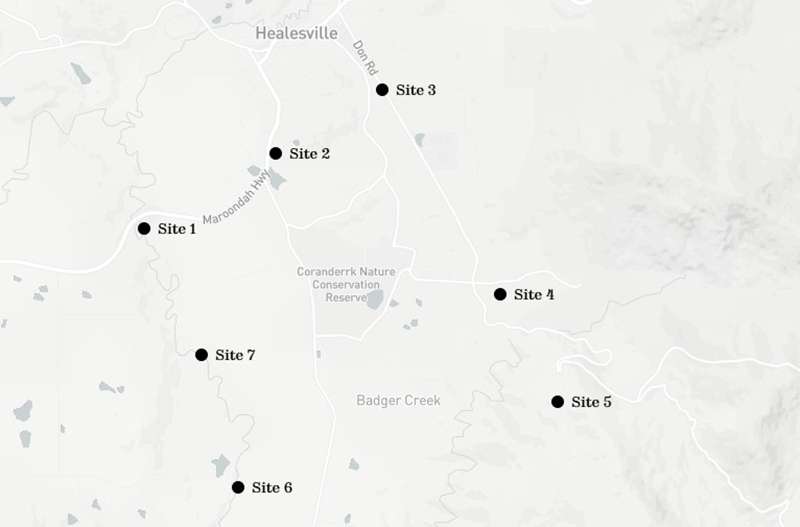
Site 1 Everard Park Picnic Area, Cnr Maroondah Hwy and Maxwells Rd
This monument is located in Everard Park Picnic Area on the banks of the Birrarung (Yarra River). It is 100 metres from the locked gate as you walk along the vehicle track away from the Maroondah Highway, amongst the bushes on the left, adjacent to a majestic manna gum tree. This site marks the eastern corner of Coranderrk.
FACE 1 (on all monuments)
Untitled (seven monuments) is an art project by Auntie Joy Murphy Wandin, Johnson Jones and Tom Nicholson.
Seven Cairns mark the original boundary of Coranderrk Aboriginal station, where Wurundjeri and other displaced Aboriginal people established a remarkable community in 1863. Coranderrk fights for its rights and maintains culture. It is self-sufficient; its industries including farming and brickmaking.
This brick marker is a footing of an upturned flagpole, concealed within country, Coranderrk (Christmas Bush) slowly grows upwards.
FACE 2
The Wurundjeri seasonal calendar is made up of seven seasons. March is the time of Luk (eel season).
This is the time to catch some fat luk. They are wriggly and have slippery, hard skin but are very tasty when cooked. Luk are an important part of Wurundjeri life and have been caught for many generations along the Birrarung (Yarra River).
Binap (red gum), wrun (white gum) and swamp gum are flowering. Djaak (wattle gum) is plentiful and in the middle of this month the warrak (banksia honeysuckle), long-leaf box and silver-leaf stringybark come into blossom, proving sweet nectar for the queep-queep (birds).
FACE 3
In March 1998, 200 acres of the original Coranderrk Aboriginal station - including the manager's house, the only remaining building - are returned to the Wandoon Estate Aboriginal corporation. In 2011 it is added to the Australian National Heritage list.
FACE 4 is missing.
Site 2 Corner of Mt Riddell Road and Airlie Road
This monument is located on a road reserve at the conjunction of Mt Riddell Road and Airlie Road, approximately 100 metres from the Maroondah Highway. As you look down the valley with your back to the town, you are looking towards the centre of Coranderrk.
FACE 2
The Wurundjeri seasonal calendar is made up of seven seasons. April, May And June is the time of Warin (wombat season).
Warin comes out of hiding to soak up the sunshine. Along with the Marram (Eastern grey kangaroos) and Wimbi (Wallabies), they enjoy the new growth. The male Bulin Bulin (lyrebird) struts and dances around, showing off their beautiful feathers and telling the females that they are looking for partners.
Many different moths emerge, which the Queep-Queep (birds) enjoy during the day and the Sugar and Feathertail gliders feast on at night.
FACE 3
In 1917 the Board for the Protection of Aborigines decides its policy to "concentrate" Aboriginal people at Lake Tyres, and to close the Aboriginal mission stations at Lake Condah and Coranderrk. Healesville Shire passes a resolution in 1918 requesting Coranderrk is handed over for soldier settlement in 1921. The Games Act excises 2,400 acres, leaving Coranderrk with 50 acres, described by the board as "poor land and not required".
FACE 4
In 1940 Frank built the mortuary, home and funeral parlour on the corner site he had acquired in 1937, and that survives today.
He began by purchasing the substantial building, thought to have been the bakery, on the Coranderrk Aboriginal reserve in Badger Creek, and then unoccupied.
Frank proceeded to demolish the building, with a help of a recruited force of local labour, mainly young children from the Hort and Pulham families, remunerated with lollies. About 80,000 bricks, originally made on site, were cleaned to remove the mortar.
John Kennedy,
The life of Frank Sperry Heritage, 2008.
Site 3 Corner of Don Road and Mt Riddell Road
This monument is located opposite Healesville Cemetery, on the corner of Don Road and Mt Riddell Road. Please use the roadside parking provided for the cemetery and take care when crossing Mt Riddell Road to visit the monument. This site marks the northern corner of Coranderrk.
FACE 2
The Wurundjeri seasonal calendar is made up of seven seasons. January - February is known as biderap (dry summer season).
There is little rainfall and the warm weather brings out the female brown butterflies. They flitter here and there through the Bowat (tussock grass), which has grown long and dry, ready for creative making. At night the growling grass frogs can be heard as they play.
Before sunrise, the constellation of the Southern Cross is high in the southern night sky.
Bunjil (Wedge-tailed eagles) begin their breeding.
FACE 3
In March 1863 a community of Wurundjeri and other displaced Aboriginal people led by Simon Wonga and William Barak walk to an old Wurundjeri campsite on the junction of Badger Creek and the Birrarung (Yarra River), where they establish Coranderrk which is gazetted on 30 June 1863 at 2,300 acres.
Site 4 Roma Avenue
This monument, framed by trees and overlooking paddocks, is located at the end of Roma Avenue. Follow Don Road from Site 3 for 3.3 km, take the turn-off into Garibaldi Street, and then turn right into Roma Avenue and drive to the end. Please be respectful of the monument's neighbours and take care with parking and driving in this street.
FACE 2
The Wurundjeri seasonal calendar is made up of seven seasons, November, December and early January is a time of Buath Garru (grass-flowering season).
Buliyong (small bats) cleverly catch insects in flight, making a clicking sound. You might hear the barking owl, which screams like a human.
The aromatic bush and velvety flowers of the kangaroo paw appear in striking colour.
Brown butterflies fly in and out of the rays of the warm sun and the pearly raindrops, around sunrise the Orion constellation sits in the western sky.
FACE 3
On 3 November 1881 Captain Andrew Page gives evidence at a Victorian Parliamentary Inquiry confirming that fences are being destroyed by neighbouring farmers. The same effort to disrupt Coranderrk occurs through lobbying, in 1893 the Crown Lands Reserves Act cancels 2,400 acres, almost half of Coranderrk's permanent reservation.
FACE 4
My method of managing the Blacks is to allow them to rule themselves as much as possible. When there is any strive among them, this is always settled at a kind of court, at which I preside.
They are very proud and sensitive and you can work a great deal upon their pride: in that way you can make them see that it is disgraceful to take what they have not earned.
It would be cruel on the part of the board to move the aborigines from Coranderrk and that is why I refused to be a part to it.
John Green 1863.
Site 5 Nyora Road, Mount Toolebewong
This monument, overlooking Coranderrk, sits high in the cool air of Mount Toolebewong and marks the eastern border of Coranderrk. From Don Road take the turn-off to Nyora Road. The marker is on a bend some 850 metres up Nyora Road and located a few metres into the bush on the embankment on the left. The marker can be viewed from the roadside.
Site 6 Birrarung (Yarra River)
This site marks the southern corner of Coranderrk and is located high on the banks of the Birrarung near Spring Creek, nestled amongst manna gum trees and alongside fertile farming land. It is not publicly accessible.
Site 7 The junction of Birrarung (Yarra River) and Coranderrk Creek (Badger Creek)
This site is on the junction of the Birrarung and Coranderrk Creek and is accessible by appointment only, through the Wandoon Estate Aboriginal Corporation at wandoonestate@gmail.com. With permission, walk from the historic manager's house, along Coranderrk Creek, until you meet the Birrarung.
If travelling by car, you can visit three sites within an hour: for example, sites 2, 4 and 5, or sites 1, 3 and 5. In two hours you can visit sites 1, 2, 3, 4 and 5. Over a day you can visit six of the sites (not all seven sites are publicly accessible).
Location
Cnr Maroondah Highway and Maxwells Road, Healesville 3777 View Map
Web Links
→ www.untitledsevenmonuments.com.au


