Trentham Self-Guided High Street Walk


Explore Trentham’s history on this easy self-guided walk along High Street. The route passes historic buildings and local details, including two horse troughs built in the 1930s by Annis and George Bills.
Distance: 2 km return
Time: Approximately 1.5 hours
Grade: Easy
Starting point: Trentham Visitor Information Centre, 66 High Street, Trentham
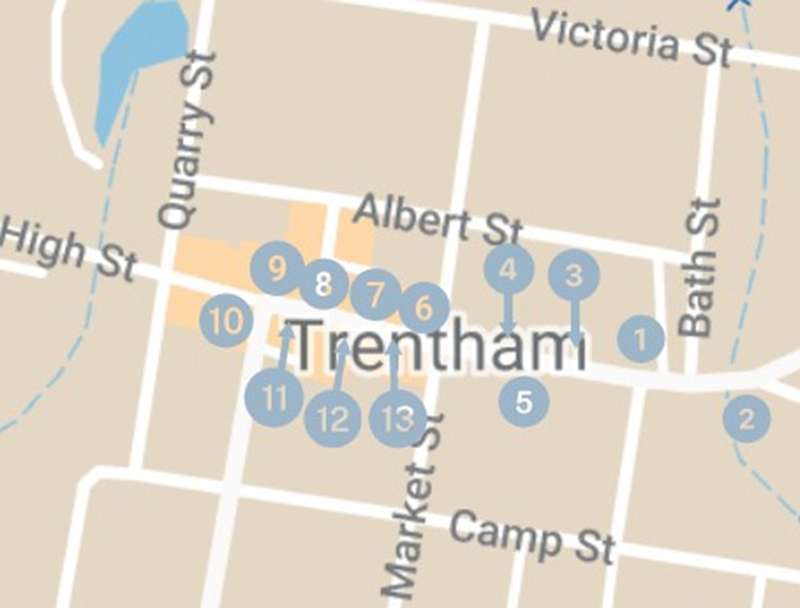
Trentham Self-Guided High Street Walk Map
A Brief History of Trentham
Trentham's High Street is a reflection of the needs of local industry over the decades: from a wandering dirt track first used by timber cutters and gold miners seeking their fortune, to the current paved thoroughfare lined with retail and hospitality businesses catering to the tourist market.
Waves of Europeans began to arrive in the region from 1837 following the establishment of the vast Mollison sheep run. It decimated the traditional way of life of the Dja Dja Wurrung. Over the ensuing decades, timber, mining, agriculture, and eventually tourism became mainstays of local livelihoods.
In 1880, the coming of the railway bolstered business activity across the Central Highlands. It carried all supplies in, and locally grown produce (particularly potatoes) and raw timber out. William Trewhella opened the Sunnyside Ironworks in 1893, which became Trewhella Bros Foundry in 1903. It would go on to export farming machinery (such as the famed 'Wallaby Jack') to the world.
Following the World War years and a decline in local manufacturing, the potato industry sustained Trentham through until the 1980s. Today the town is best known as a tourist destination and hub for those seeking a tranquil treechange.
Places of Interest
1. Mechanics TrenthamStart your walk at the Visitor Information Centre, which is located inside the Mechanics Trentham, a newly constructed community hub which incorporates the original Mechanics Institute hall (circa 1881).
The building was designated Trentham's town hall in 1938. A brick facade was added in 1954, then removed as part of the recent redevelopment. Enter the original section of the Mechanics Trentham (now Trentham Library) to see the restored central panel of a painted curtain (and its rod) that hung in the hall from 1897 to 2021.
2. Chinese Spring
Exiting the Mechanics Trentham, turn left and walk along High Street to the small bridge over Trent Creek. On its southern side is Chinese Spring: the site where a number of Chinese market gardens operated in the 19th and early 20th centuries. Gardens like these played a key role in keeping the local population supplied with fresh fruit and vegetables.
Looking further east, you can see Trentham's first Avenue of Honour, planted in 1919 after WWI.
3. 60 High Street
Turn around and walk back up High Street, past the Mechanics Trentham, stopping outside the small empty weatherboard cottage at no. 60. Originally constructed as Henry Bewley's Pharmacy in 1884, a series of chemists and doctors occupied the building until the 1930s. From 1936 to the 1970s it was the residence of successive dairymen who operated their dairy from a shed at the rear of the property.
4. St George's Anglican Church
Right next door is St George's Anglican Church, the foundation stone for which was laid in 1927 after extensive community fundraising to replace an earlier weatherboard structure. Visitors are welcome to go inside.
5. Commercial Hotel
Look across High Street at the Commercial Hotel, now a private residence. Patrick Murphy built the Commercial, the first brick building in Trentham, in 1865 using local clay bricks. When Patrick Murphy died at the age of 49 in 1884, his widow Mary carried on the business until 1889.
6. Gweneth Wisewould Memorial Clock
Continue on to the intersection of High and Market Streets, noting the old Trentham Post Office (circa 1927) and Trentham War Memorial on the opposite side of High Street. Look right up Market Street to spot one of Trentham's two Bills horse troughs. Hundreds of these troughs were built across Australia in the 1930s, the legacy of Annis and George Bills.
Cross over Market Street and stop to admire the Gweneth Wisewould Memorial Clock, which celebrates the life of Trentham's remarkable town doctor from 1938 until her death in 1972. The clock is kept a minute fast, as 'Dr Gwen' had a reputation for rarely being on time!
7. Nortons Drapery
No. 52 High Street, now Trentham Bakery, is another of the town's earliest two-storey brick commercial buildings. It was constructed in 1882 to house Nortons Drapery following a fire in the original timber building. The Freemasons Hall was located upstairs.
8. Wolff Stores
The stores between here and Wolff Lane were built by J.W.S. Wolff (1834-1910) after the town's second land sale in 1866. Wolff had shares in the local Snake Gully gold mine, and invested the money he made into businesses in Trentham. He was a much-respected business and family man.
One of Wolff's stores was a bakery, which had its oven at the back of the row of buildings. This restored Scotch oven is still being used by Red Beard Bakery a century-and-a-half later.
9. Dashwood's Emporium
At no. 32 High Street is the Dashwood's General Merchants and Harness Emporium building. Originally built by William Dashwood around the same time as the Wolff stores, it later served as a hotel and dance hall. The structure was destroyed by fire twice (1880 and 1886) and rebuilt each time.
10. Cosmopolitan Hotel
Cross over High Street at the T-junction with Cosmo Road to see the historic Cosmopolitan Hotel. Joseph Bickley purchased this corner lot in 1863 and built Bickley's Hotel, later renamed The Cosmopolitan.
It was run by Bickley descendants and various others until 1937, after which it served a number of other commercial uses. The structure was devastated by fire in 2005, but a sympathetic restoration in 2011 brought this grand old venue back to life.
11. Town Square
Cross Cosmo Road and take a break in charming Trentham Town Square. Local businessman W.J. Anderson took over an existing grocery, butchery, bakery, drapery, ironmonger and timber business on this site in 1890, which he sold to the Trentham Farmers Co-operative in 1920.
Following a fire in 1929, newly constructed buildings housed a variety of businesses until 1978 when the site was cleared to make way for the establishment of the Town Square.
12. Hotel Trentham
Continue heading east along High Street to the Hotel Trentham. The original pub (circa 1866) on this site was known as Patrick Murphy's Bank Hotel (as it was built next to the National Bank).
In 1926, a new brick front was constructed following a fire. Some parts of the rear of the building are original. Hotel Trentham has won plenty of new fans since it reopened in early 2024 after a complete renovation.
13. National Bank of Australasia
The town's first bank (and Post Office) operated in one of William Dashwood's shops on the opposite side of High Street. The construction of the brick National Bank of Australasia in 1883 at no. 37 reflected a new level of prosperity for the town, given the railway had arrived three years earlier.
Today the building houses Trentham General cafe.
This walk ends on the corner of High and Market Streets. You may like to continue north up Market Street to visit the old Trentham railway station precinct.
Location
66 High Street, Trentham 3458 View Map
Web Links
→ Trentham Self-Guided High Street Walk Brochure (PDF)


