Torquay History Walking Trail


Occupying the Torquay region for thousands of years before European settlement, the Wadawurrung people are the traditional owners of the land you are standing on.
Torquay was originally named 'Spring Creek' when developed as a European settlement in the 1840s. By the late 1880s, Spring Creek was well known as a farming and fishing community. By 1900, the area became a popular tourist destination with sea bathing becoming popular for medicinal purposes.
In 1892, the owner of the Palace Hotel, James Follett, organised a referendum to change the name of the settlement from Spring Creek to Torquay. James Follett was from Torquay in England. The name change was successful.
In 1945, the Torquay Surf Life Saving Club was established and was the first Surf Life Saving Club in Victoria. Many surfers began riding surf boards and surf skis at Torquay's back beach. The more adventurous went further to the west to surf the now world famous Bells Beach.
In 1969, the surfing companies of Rip Curl and Quiksilver were established by local surfers and it soon followed that Torquay became known as 'the surfing capital of Australia'.
As you walk along this History Trail, you will come across 28 historic sites, all with signs detailing our settler history, with photographs communicating the stories and significance of those sites. The signs will give you an excellent insight into the way Torquay looked from the late 1880s to the early 1900s. Many of the original properties still stand today.
Torquay History Walking Trail Map
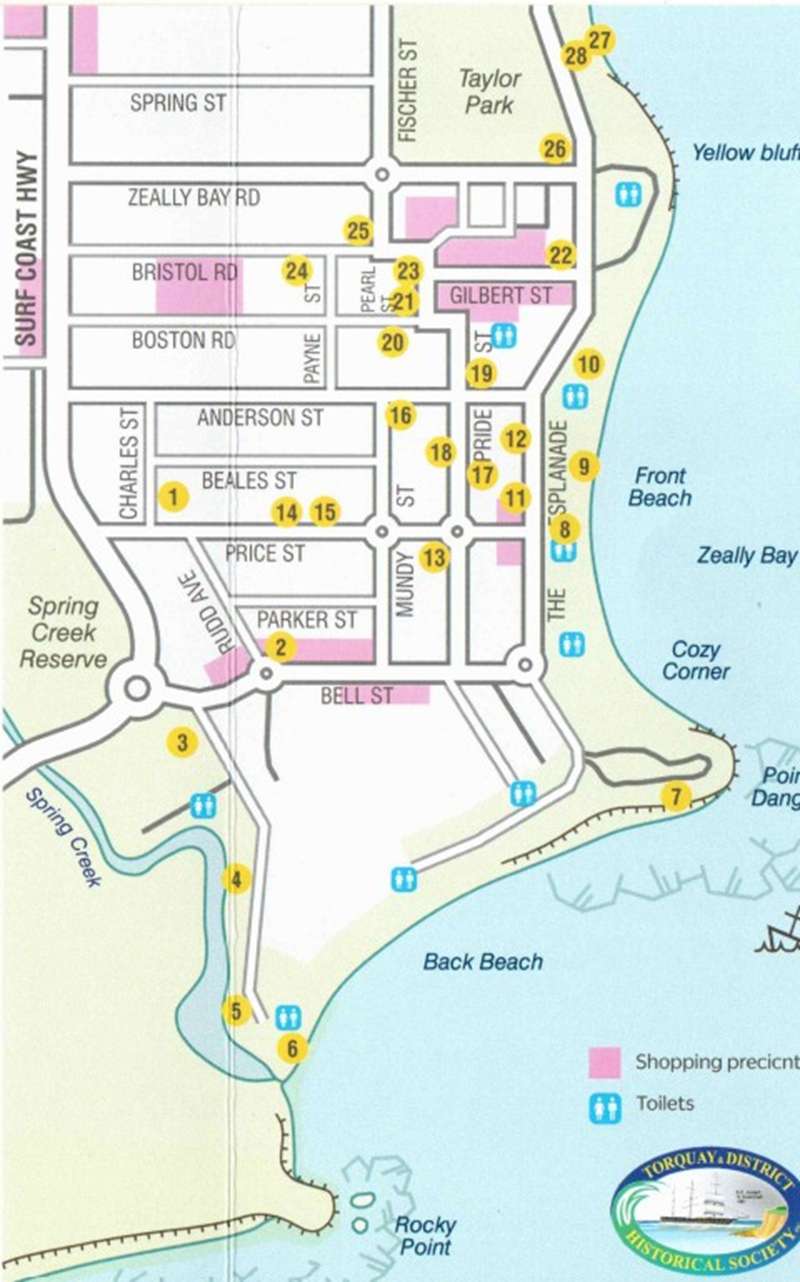
Torquay History Walking Trail Locations
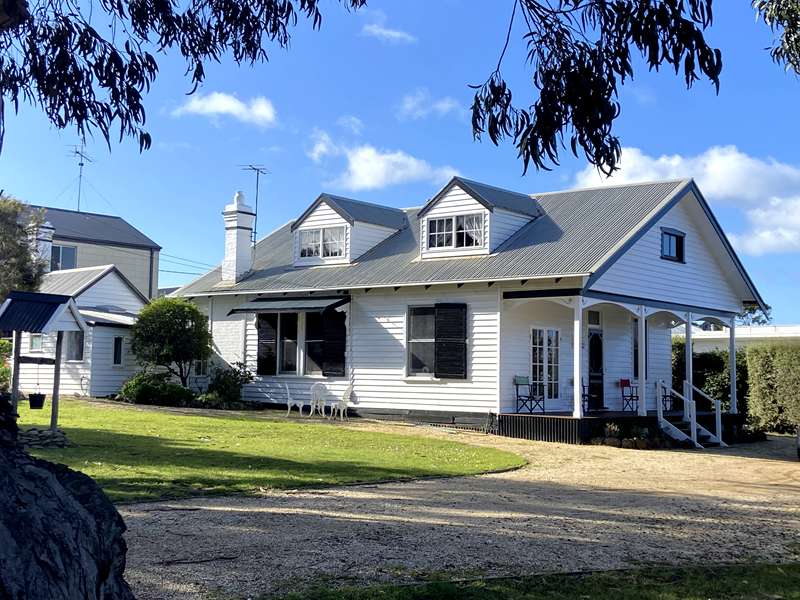
1. "Bromsgrove" original holiday house of Colonel Price
2 Charles Lane
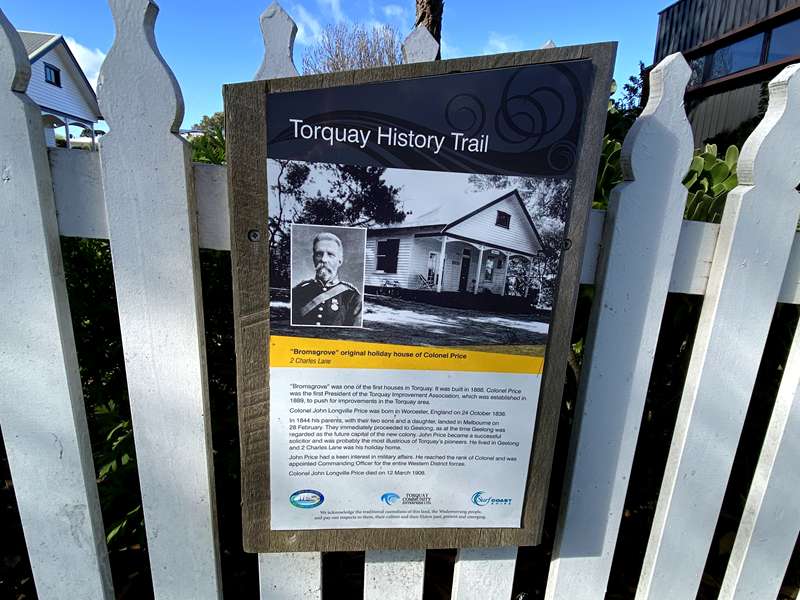
“Bromsgrove” was one of the first houses in Torquay. It was built in 1888. Colonel Price was the first President of the Torquay Improvement Association, which was established in 1889, to push for improvements in the Torquay area.
Colonel John Longville Price was born in Worcester, England on 24 October 1838.
In 1844 his parents, with their two sons and a daughter, landed in Melbourne on 28 February. They immediately proceeded to Geelong, as at the time Geelong was regarded as the future capital of the new colony. John Price became a successful solicitor and was probably the most illustrious of Torquay’s pioneers. He lived in Geelong and 2 Charles Lane was his holiday home.
John Price had a keen interest in military affairs. He reached the rank of Colonel and was appointed Commanding Officer for the entire Western District forces.
Colonel John Longville Price died on 12 March 1908.
2. Torquay Hotel Circa 1888
36 Bell Street
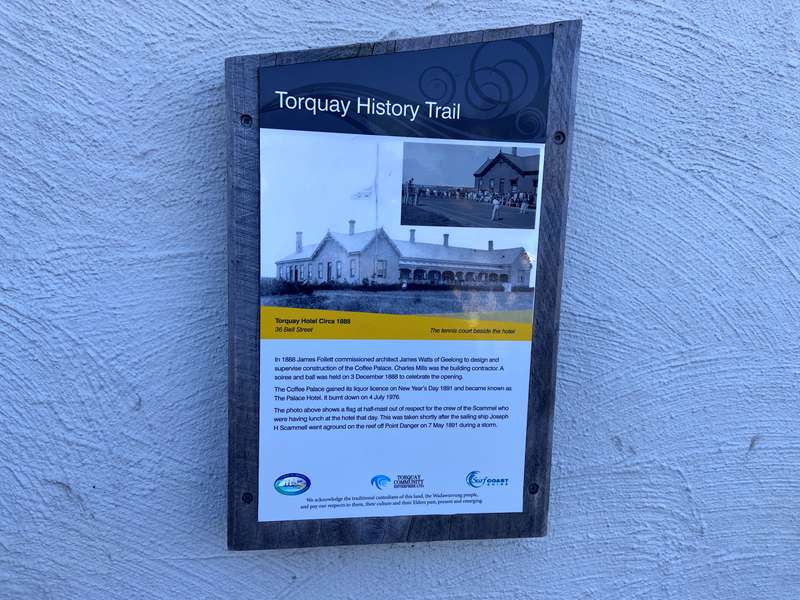
In 1888 James Follett commissioned architect James Watts of Geelong to design and supervise construction of the Coffee Palace. Charles Mills was the building contractor. A soiree and ball was held on 3 December 1888 to celebrate the opening.
The Coffee Palace gained its liquor licence on New Year’s Day 1891 and became known as The Palace Hotel. It burnt down on 4 July 1976.
The photo above shows a flag at half-mast out of respect for the crew of the Scammell who were having lunch at the hotel that day. This was taken shortly after the sailing ship Joseph H Scammell went aground on the reef off Point Danger on 7 May 1891 during a storm.
3. Original Torquay Golf Club
Surf Beach Drive
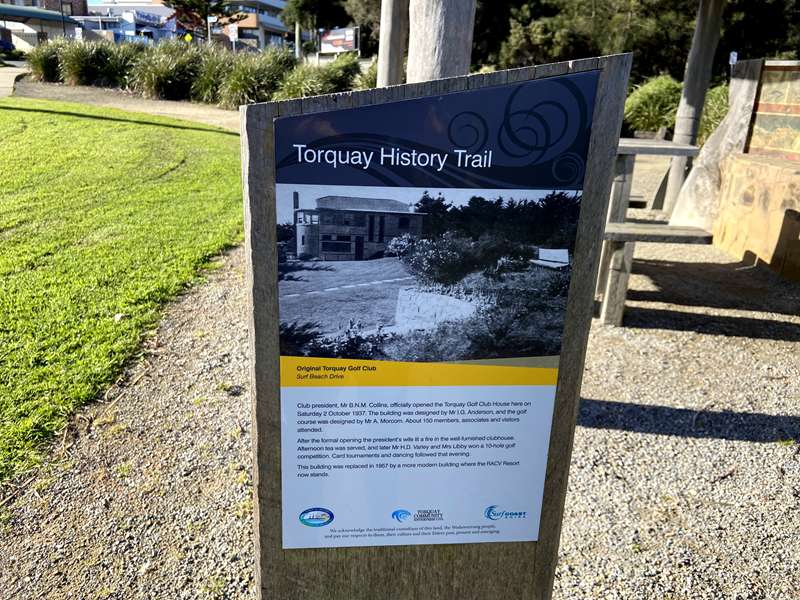
Club president, Mr B.N.M. Collins, officially opened the Torquay Golf Club House here on Saturday 2 October 1937. The building was designed by Mr I.G. Anderson, and the golf course was designed by Mr A. Morcom. About 150 members, associates and visitors attended.
After the formal opening the president’s wife lit a fire in the well-furnished clubhouse. Afternoon tea was served, and later Mr H.D. Varley and Mrs Libby won a 10-hole golf competition. Card tournaments and dancing followed that evening.
This building was replaced in 1957 by a more modern building where the RACV Resort now stands.
4. Hot water depot
Surf Beach Drive
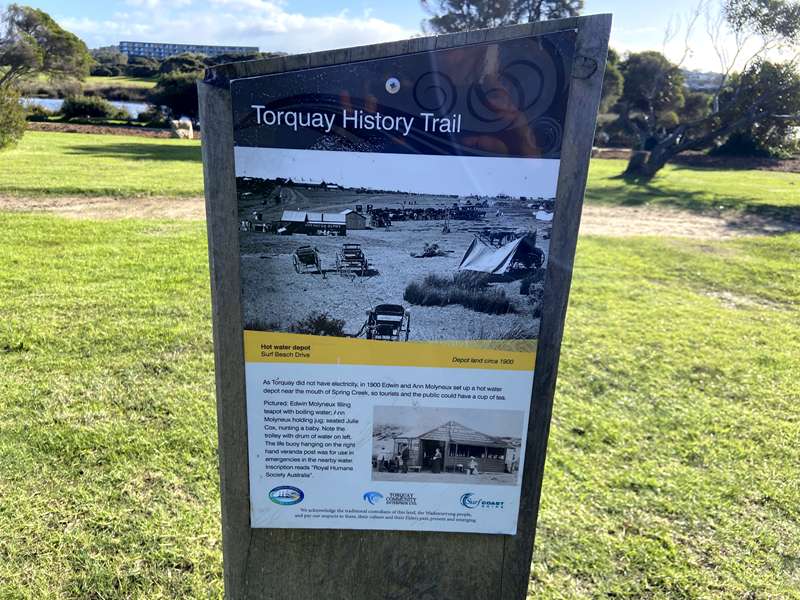
As Torquay did not have electricity, in 1900 Edwin and Ann Molyneux set up a hot water depot near the mouth of Spring Creek, so tourists and the public could have a cup of tea.
Pictured: Edwin Molyneux filling teapot with boiling water; Ann Molyneux holding jug; seated Julie Cox, nursing a baby. Note the trolley with drum of water on left. The life buoy hanging on the right hand veranda post was for use in emergencies in the nearby water. Inscription reads “Royal Humane Society Australia”.
5. Kim-Barne Wadawurrung Tabayl
Welcome to Wadawurrung Country
Surf Beach Drive
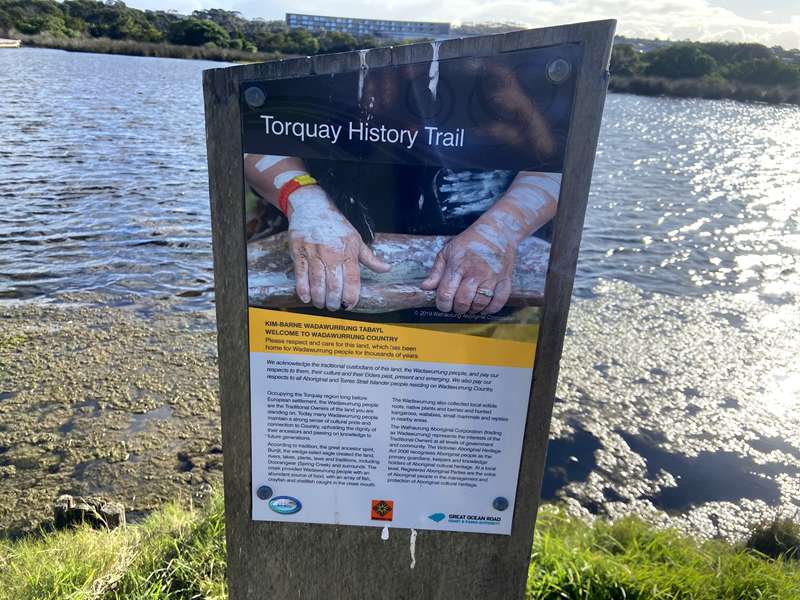
Please respect and care for this land, which has been home for Wadawurrung people for thousands of years.
We acknowledge the traditional custodians of this land, the Wadawurrung people, and pay our respects to them, their culture and their Elders past, present and emerging. We also pay our respects to all Aboriginal and Torres Strait Islander people residing on Wadawurrung Country.
Occupying the Torquay region long before European settlement, the Wadawurrung people are the Traditional Owners of the land you are standing on. Today many Wadawurrung people maintain a strong sense of cultural pride and connection to Country, upholding the dignity of their ancestors and passing on knowledge to future generations.
According to tradition, the great ancestor spirit, Bunjil, the wedge-tailed eagle created the land, rivers, lakes, plants, laws and traditions, including Doorangwar (Spring Creek) and surrounds. The creek provided Wadawurrung people with an abundant source of food, with an array of fish, crayfish and shellfish caught in the creek mouth.
The Wadawurrung also collected local edible roots, native plants and berries and hunted kangaroos, wallabies, small mammals and reptiles in nearby areas.
The Wathaurung Aboriginal Corporation (trading as Wadawurrung) represents the interests of the Traditional Owners at all levels of government and community. The Victorian Aboriginal Heritage Act 2006 recognises Aboriginal people as the primary guardians, keepers and knowledge holders of Aboriginal cultural heritage. At a local level, Registered Aboriginal Parties are the voice of Aboriginal people in the management and protection of Aboriginal cultural heritage.
6. Torquay Surf Life Saving Club
Surf Beach Drive
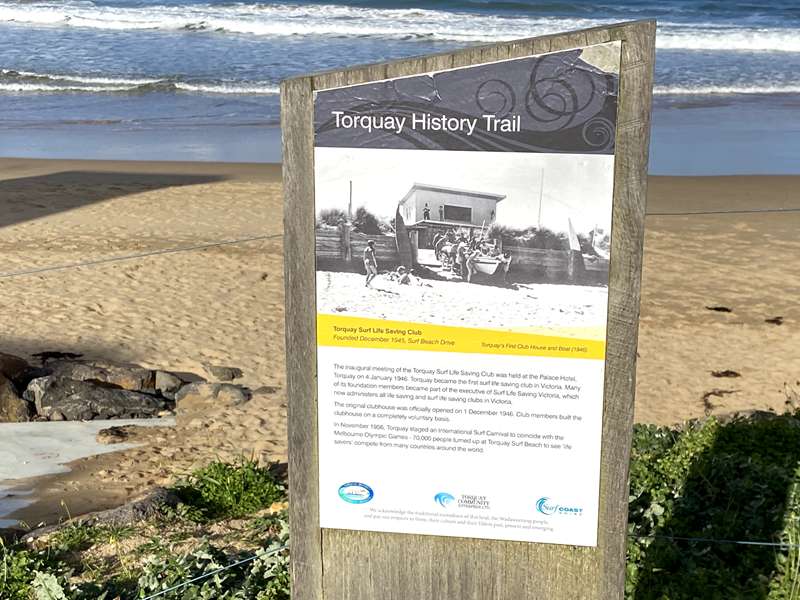
The inaugural meeting of the Torquay Surf Life Saving Club was held at the Palace Hotel, Torquay on 4 January 1946. Torquay became the first surf life saving club in Victoria. Many of its foundation members became part of the executive of Surf Life Saving Victoria, which now administers all life saving and surf life saving clubs in Victoria.
The original clubhouse was officially opened on 1 December 1946. Club members built the clubhouse on a completely voluntary basis.
In November 1956, Torquay staged an International Surf Carnival to coincide with the Melbourne Olympic Games - 70,000 people turned up at Torquay Surf Beach to see ‘life savers’ compete from many countries around the world.
7. S.S. Joseph H. Scammell
Point Danger
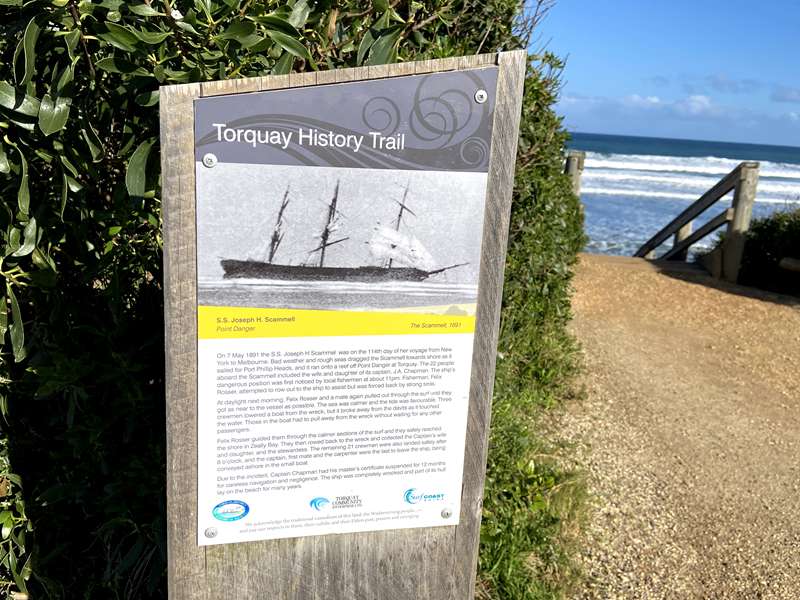
On 7 May 1891 the S.S. Joseph H Scammell was on the 114th day of her voyage from New York to Melbourne. Bad weather and rough seas dragged the Scammell towards shore as it sailed for Port Phillip Heads, and it ran onto a reef off Point Danger at Torquay. The 22 people aboard the Scammell included the wife and daughter of its captain, J.A. Chapman. The ship’s dangerous position was first noticed by local fishermen at about 11pm. Fisherman, Felix Rosser, attempted to row out to the ship to assist but was forced back by strong seas.
At daylight next morning, Felix Rosser and a mate again pulled out through the surf until they got as near to the vessel as possible. The sea was calmer and the tide was favourable. Three crewmen lowered a boat from the wreck, but it broke away from the davits as it touched the water. Those in the boat had to pull away from the wreck without waiting for any other passengers.
Felix Rosser guided them through the calmer sections of the surf and they safely reached the shore in Zeally Bay. They then rowed back to the wreck and collected the Captain’s wife and daughter, and the stewardess. The remaining 21 crewmen were also landed safely after 8 o’clock, and the captain, first mate and the carpenter were the last to leave the ship, being conveyed ashore in the small boat.
Due to the incident, Captain Chapman had his master’s certificate suspended for 12 months for careless navigation and negligence. The ship was completely wrecked and part of its hull lay on the beach for many years.
8. Torquay Royal Life Saving Club
The Esplanade
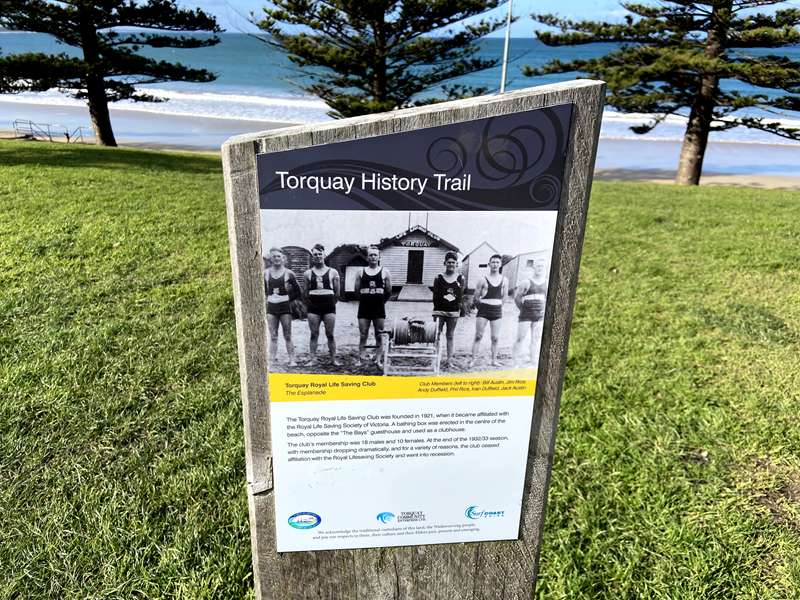
The Torquay Royal Life Saving Club was founded in 1921, when it became affiliated with the Royal Life Saving Society of Victoria. A bathing box was erected in the centre of the beach, opposite the “The Bays” guesthouse and used as a clubhouse.
The club’s membership was 18 males and 10 females. At the end of the 1932/33 season, with membership dropping dramatically, and for a variety of reasons, the club ceased affiliation with the Royal Lifesaving Society and went into recession.
9. Bathing Boxes
Front Beach, Torquaу
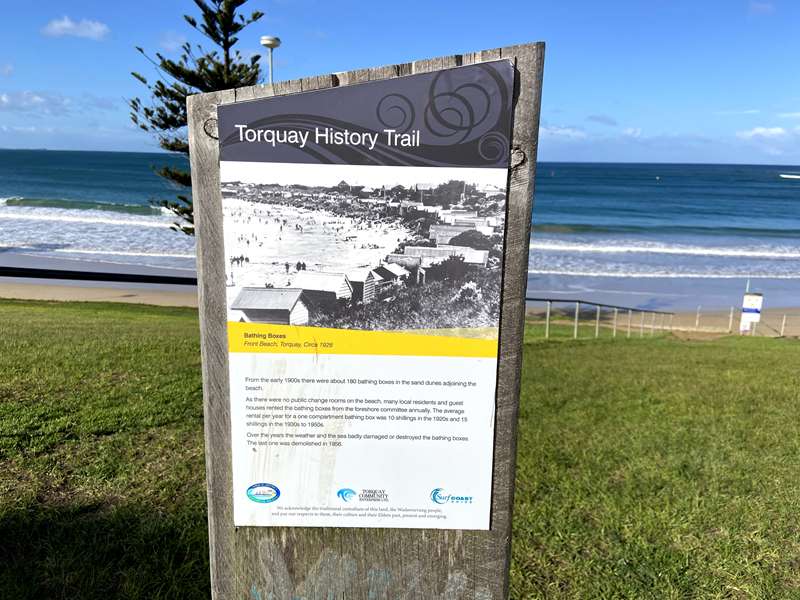
From the early 1900s there were about 180 bathing boxes in the sand dunes adjoining the beach.
As there were no public change rooms on the beach, many local residents and guest houses rented the bathing boxes from the foreshore committee annually. The average rental per year for a one compartment bathing box was 10 shillings in the 1920s and 15 shillings in the 1930s to 1950s.
Over the years the weather and the sea badly damaged or destroyed the bathing boxes. The last one was demolished in 1956.
10. Front Beach and Gardens 1938
The Esplanade
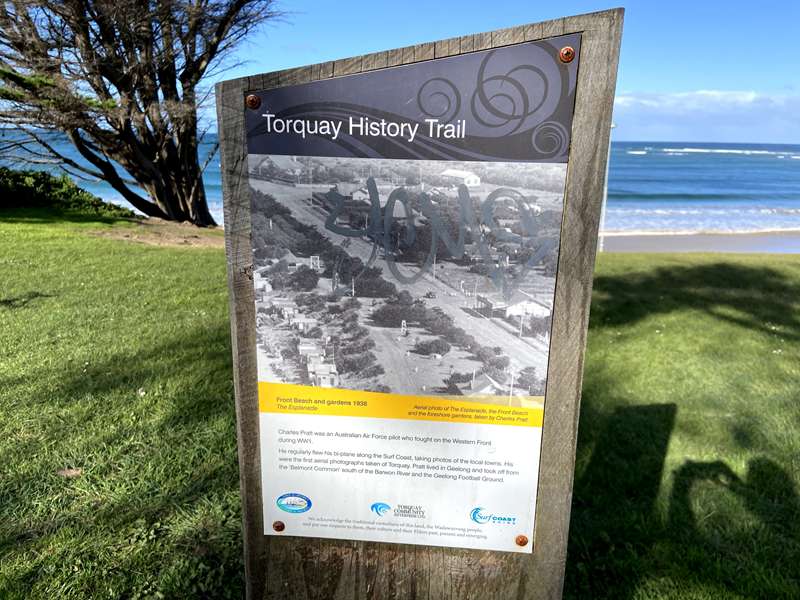
Charles Pratt was an Australian Air Force pilot who fought on the Western Front during WW1.
He regularly flew his bi-plane along the Surf Coast, taking photos of the local towns. His were the first aerial photographs taken of Torquay. Pratt lived in Geelong and took off from the ‘Belmont Common’ south of the Barwon River and the Geelong Football Ground.
11. Two Bays Guest House
20 The Esplanade
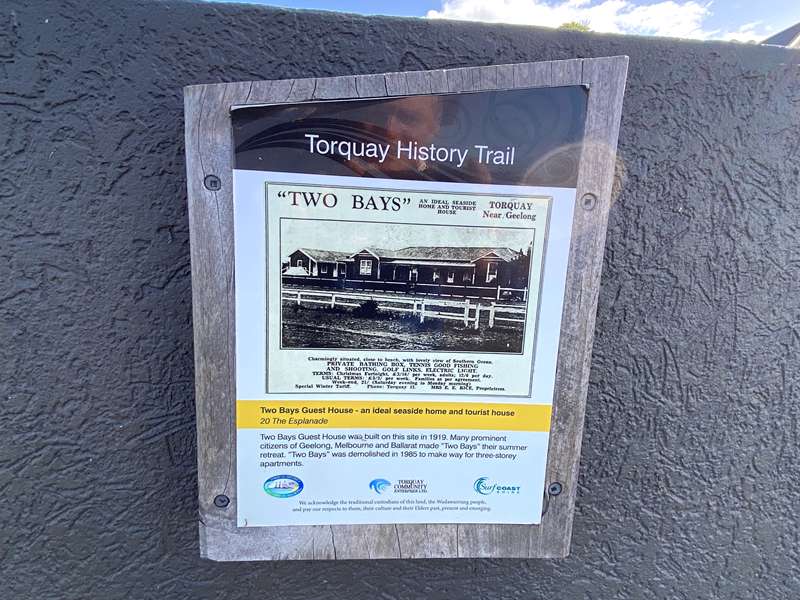
Two Bays Guest House was built on this site in 1919. Many prominent citizens of Geelong, Melbourne and Ballarat made “Two Bays” their summer retreat. “Two Bays” was demolished in 1985 to make way for three-storey apartments.
12. "Doc" Hughes' General Store
24 The Esplanade
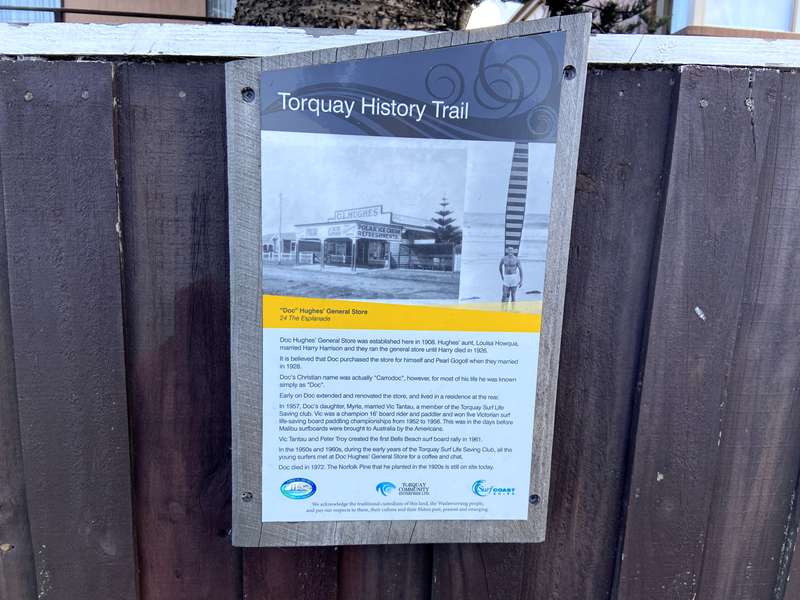
Doc Hughes’ General Store was established here in 1908. Hughes’ aunt, Louisa Howqua, married Harry Harrison and they ran the general store until Harry died in 1926.
It is believed that Doc purchased the store for himself and Pearl Gogoll when they married in 1928.
Doc’s Christian name was actually “Carrodoc”, however, for most of his life he was known simply as “Doc”.
Early on Doc extended and renovated the store, and lived in a residence at the rear.
In 1957, Doc’s daughter, Myrle, married Vic Tantau, a member of the Torquay Surf Life Saving club. Vic was a champion 16’ board rider and paddler and won five Victorian surf life-saving board paddling championships from 1952 to 1956. This was in the days before Malibu surfboards were brought to Australia by the Americans.
Vic Tantau and Peter Troy created the first Bells Beach surf board rally in 1961.
In the 1950s and 1960s, during the early years of the Torquay Surf Life Saving Club, all the young surfers met at Doc Hughes’ General Store for a coffee and chat.
Doc died in 1972. The Norfolk Pine that he planted in the 1920s is still on site today.
13. St Heliers Guest House
Corner Pride and Price Streets
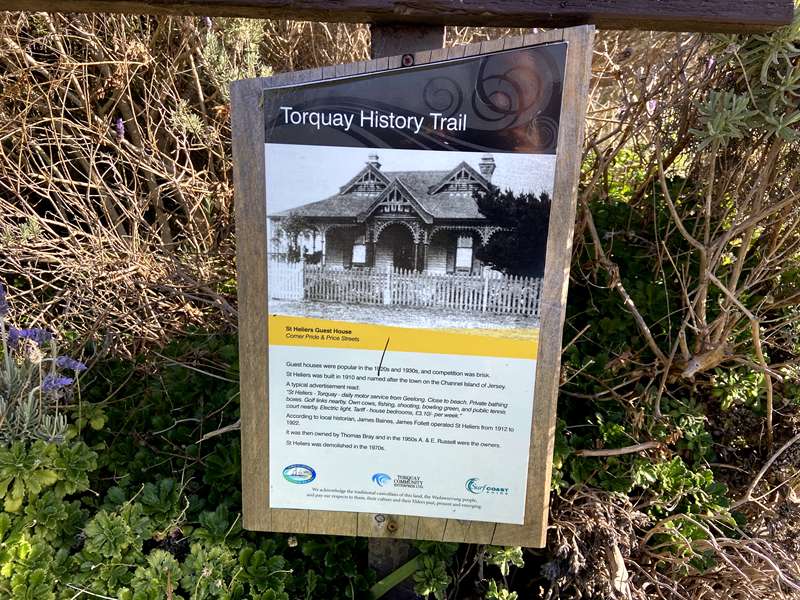
Guest houses were popular in the 1920s and 1930s, and competition was brisk.
St Heliers was built in 1910 and named after the town on the Channel Island of Jersey.
A typical advertisement read:
“St Heliers - Torquay - daily motor service from Geelong. Close to beach. Private bathing boxes. Golf links nearby. Own cows, fishing, shooting, bowling green, and public tennis court nearby. Electric light. Tariff - house bedrooms, £3.10/- per week.”
According to local historian, James Baines, James Follett operated St Heliers from 1912 to 1922.
It was then owned by Thomas Bray and in the 1950s A. & E. Russell were the owners.
St Heliers was demolished in the 1970s.
14. The old Torquay Police Station
18 Price Street
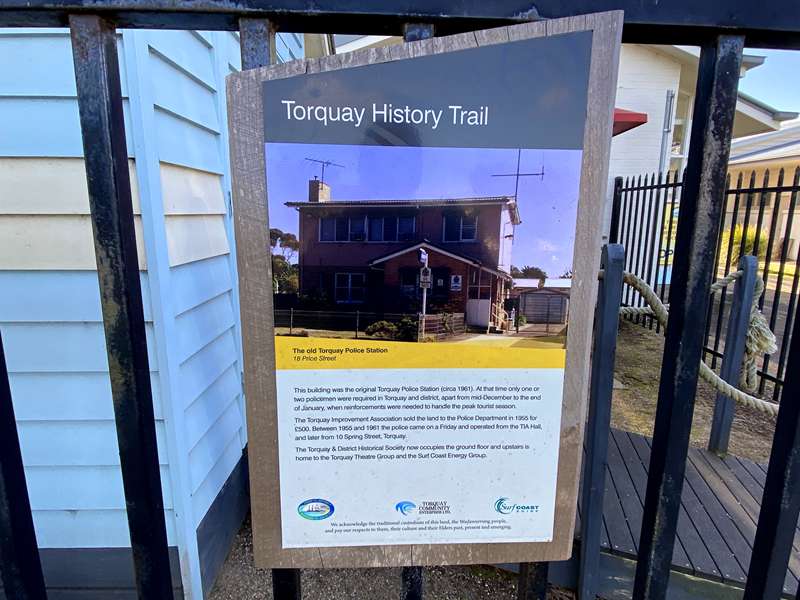
This building was the original Torquay Police Station (circa 1961). At that time only one or two policemen were required in Torquay and district, apart from mid-December to the end of January, when reinforcements were needed to handle the peak tourist season.
The Torquay Improvement Association sold the land to the Police Department in 1955 for £500. Between 1955 and 1961 the police came on a Friday and operated from the TIA Hall, and later from 10 Spring Street, Torquay.
The Torquay & District Historical Society now occupies the ground floor and upstairs is home to the Torquay Theatre Group and the Surf Coast Energy Group.
15. Torquay Improvement Association
10-12 Price Street
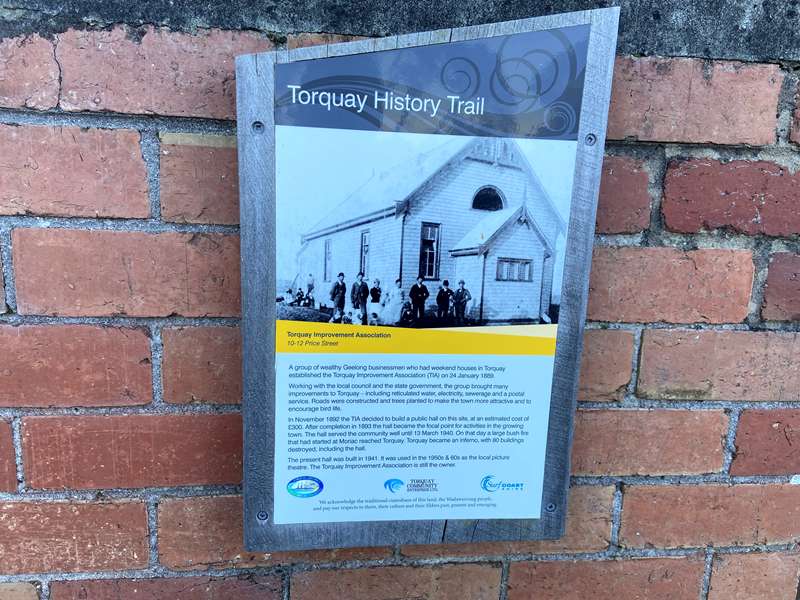
A group of wealthy Geelong businessmen who had weekend houses in Torquay established the Torquay Improvement Association (TIA) on 24 January 1889.
Working with the local council and the state government, the group brought many improvements to Torquay – including reticulated water, electricity, sewerage and a postal service. Roads were constructed and trees planted to make the town more attractive and to encourage bird life.
In November 1892 the TIA decided to build a public hall on this site, at an estimated cost of £300. After completion in 1893 the hall became the focal point for activities in the growing town. The hall served the community well until 13 March 1940. On that day a large bush fire that had started at Moriac reached Torquay. Torquay became an inferno, with 80 buildings destroyed, including the hall.
The present hall was built in 1941. It was used in the 1950s & 60s as the local picture theatre. The Torquay Improvement Association is still the owner.
16. The Old Butcher's Shop
19 Anderson Street, corner Munday Street
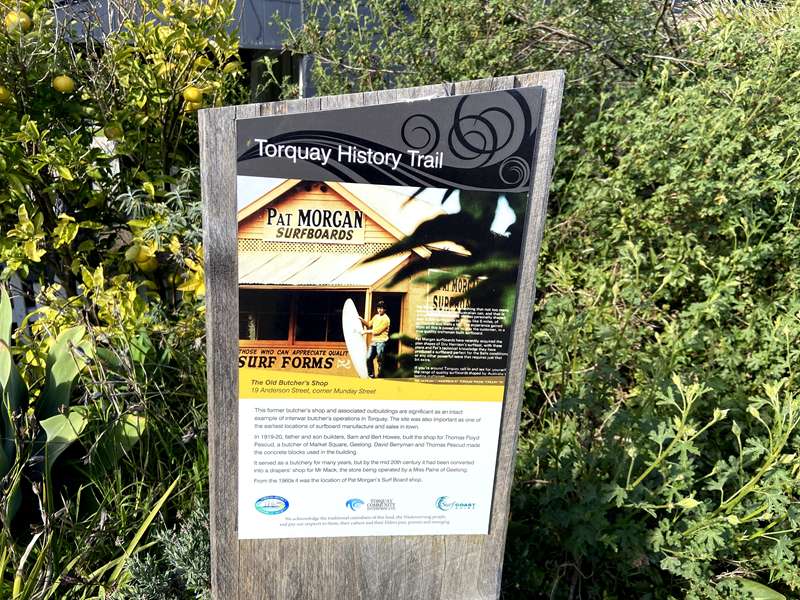
This former butcher’s shop and associated outbuildings are significant as an intact example of interwar butcher’s operations in Torquay. The site was also important as one of the earliest locations of surfboard manufacture and sales in town.
In 1919-20, father and son builders, Sam and Bert Howes, built the shop for Thomas Floyd Pescud, a butcher of Market Square, Geelong. David Berryman and Thomas Pescud made the concrete blocks used in the building.
It served as a butchery for many years, but by the mid 20th century it had been converted into a drapers’ shop for Mr Mack, the store being operated by a Miss Paine of Geelong.
From the 1960s it was the location of Pat Morgan’s Surf Board shop.
17. "Scammell House"
24 Pride Street
18. Quiksilver's first office location
29 Pride Street
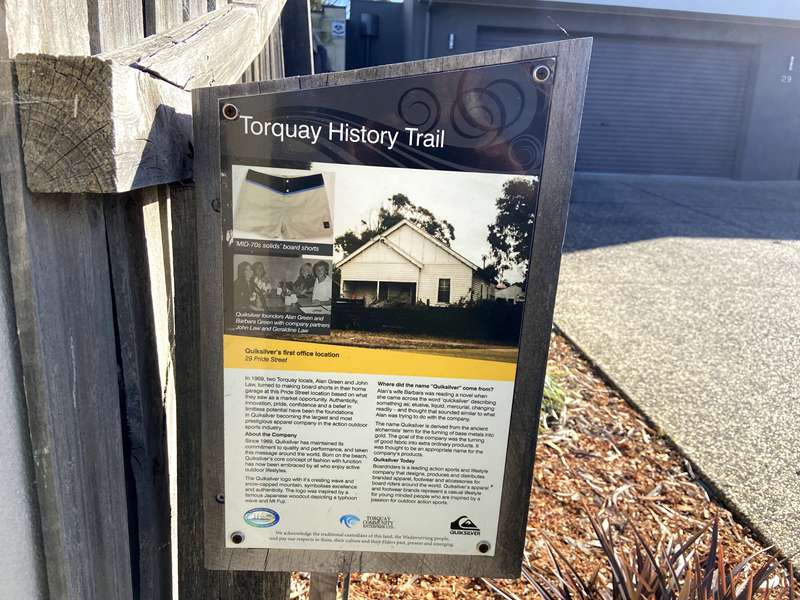
In 1969, two Torquay locals, Alan Green and John Law, turned to making board shorts in their home garage at this Pride Street location based on what they saw as a market opportunity. Authenticity, innovation, pride, confidence and a belief in limitless potential have been the foundations in Quiksilver becoming the largest and most prestigious apparel company in the action outdoor sports industry.
About the Company
Since 1969, Quiksilver has maintained its commitment to quality and performance, and taken this message around the world. Born on the beach, Quiksilver’s core concept of fashion with function has now been embraced by all who enjoy active outdoor lifestyles.
The Quiksilver logo with it’s cresting wave and snow-capped mountain, symbolises excellence and authenticity. The logo was inspired by a famous Japanese woodcut depicting a typhoon wave and Mt Fuji.
Where did the name “Quiksilver” come from?
Alan’s wife Barbara was reading a novel when she came across the word ‘quicksilver’ describing something as; elusive, liquid, mercurial, changing readily – and thought that sounded similar to what Alan was trying to do with the company.
The name Quiksilver is derived from the ancient alchemists’ term for the turning of base metals into gold. The goal of the company was the turning of good fabric into extra ordinary products. It was thought to be an appropriate name for the company’s products.
Quiksilver Today
Boardriders is a leading action sports and lifestyle company that designs, produces and distributes branded apparel, footwear and accessories for board riders around the world. Quiksilver’s apparel and footwear brands represent a casual lifestyle for young minded people who are inspired by a passion for outdoor action sports.
19. Seaview Villa
4 Anderson Street
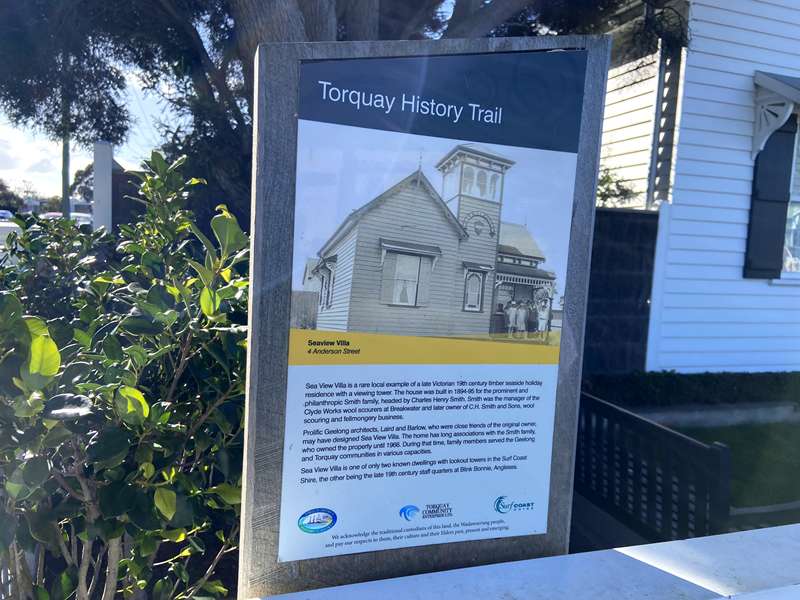
Sea View Villa is a rare local example of a late Victorian 19th century timber seaside holiday residence with a viewing tower. The house was built in 1894-95 for the prominent and philanthropic Smith family, headed by Charles Henry Smith. Smith was the manager of the Clyde Works wool scourers at Breakwater and later owner of C.H. Smith and Sons, wool scouring and fellmongery business.
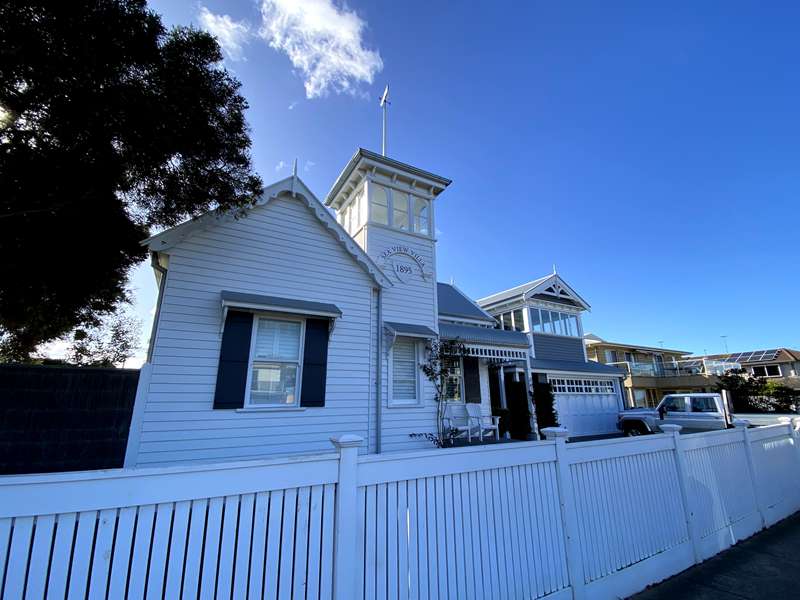
Prolific Geelong architects, Laird and Barlow, who were close friends of the original owner, may have designed Sea View Villa. The home has long associations with the Smith family, who owned the property until 1966. During that time, family members served the Geelong and Torquay communities in various capacities.
Sea View Villa is one of only two known dwellings with lookout towers in the Surf Coast Shire, the other being the late 19th century staff quarters at Blink Bonnie, Anglesea.
20. Original building for Rip Curl - Mayson's Bakery
5 Boston Road
21. Nairn's Dairy
Corner Pearl Street and Boston Road
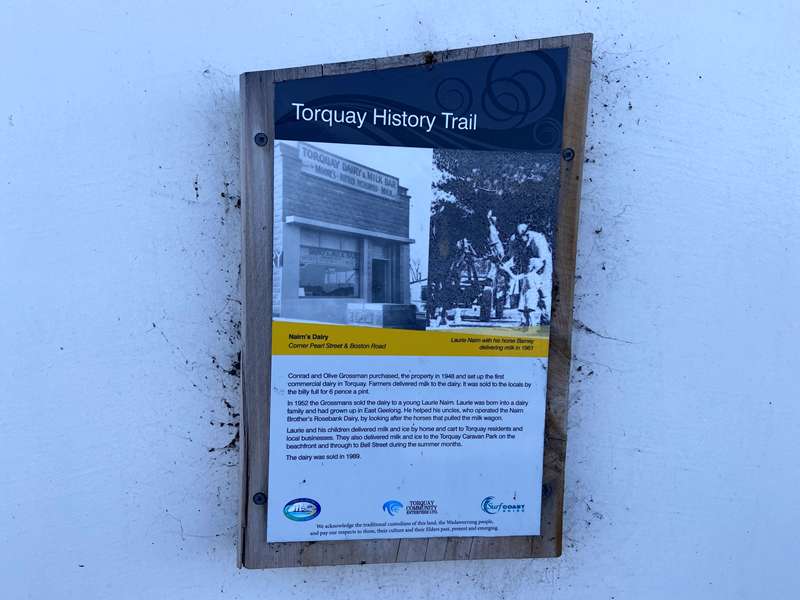
Conrad and Olive Grossman purchased, the property in 1948 and set up the first commercial dairy in Torquay. Farmers delivered milk to the dairy. It was sold to the locals by the billy full for 6 pence a pint.
In 1952 the Grossmans sold the dairy to a young Laurie Nairn. Laurie was born into a dairy family and had grown up in East Geelong. He helped his uncles, who operated the Nairn Brother’s Rosebank Dairy, by looking after the horses that pulled the milk wagon.
Laurie and his children delivered milk and ice by horse and cart to Torquay residents and local businesses. They also delivered milk and ice to the Torquay Caravan Park on the beachfront and through to Bell Street during the summer months.
The dairy was sold in 1989.
22. Aerial photo of Gilbert street
Corner Gilbert Street and The Esplanade
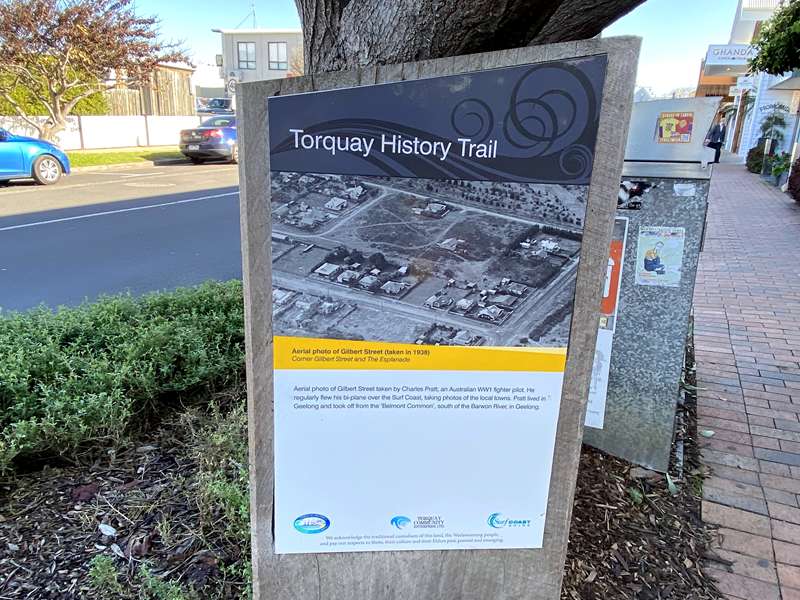
Aerial photo of Gilbert Street taken by Charles Pratt, an Australian WW1 fighter pilot. He regularly flew his bi-plane over the Surf Coast, taking photos of the local towns. Pratt lived in Geelong and took off from the ‘Belmont Common’, south of the Barwon River, in Geelong.
23. Original Torquay Post Office
Pearl Street, at end of Gilbert Street
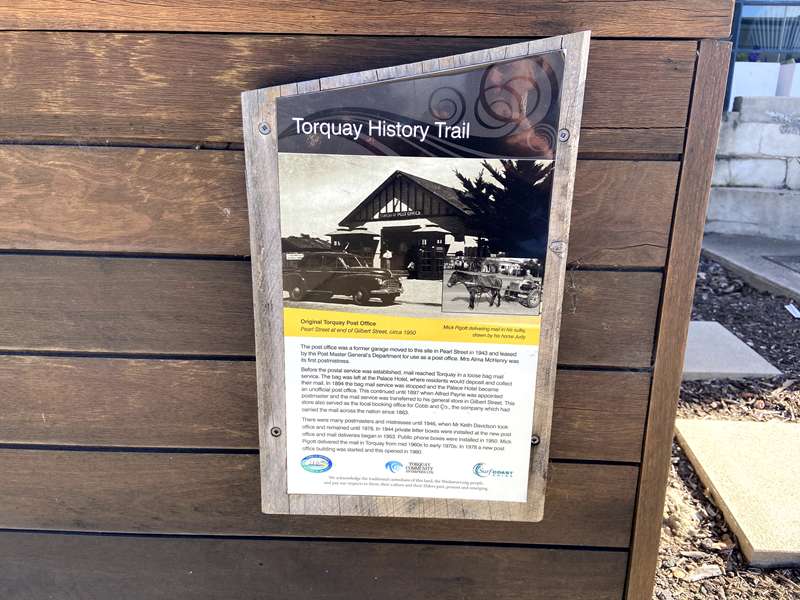
The post office was a former garage moved to this site in Pearl Street in 1943 and leased by the Post Master General’s Department for use as a post office. Mrs Alma McHenry was its first postmistress.
Before the postal service was established, mail reached Torquay in a loose bag mail service. The bag was left at the Palace Hotel, where residents would deposit and collect their mail. In 1894 the bag mail service was stopped and the Palace Hotel became an unofficial post office. This continued until 1897 when Alfred Payne was appointed postmaster and the mail service was transferred to his general store in Gilbert Street. This store also served as the local booking office for Cobb and Co., the company which had carried the mail across the nation since 1863.
There were many postmasters and mistresses until 1946, when Mr Keith Davidson took office and remained until 1978. In 1944 private letter boxes were installed at the new post office and mail deliveries began in 1953. Public phone boxes were installed in 1950. Mick Pigott delivered the mail in Torquay from mid 1960s to early 1970s. In 1978 a new post office building was started and this opened in 1980.
24. Original Torquay Primary School
39-59 Bristol Road
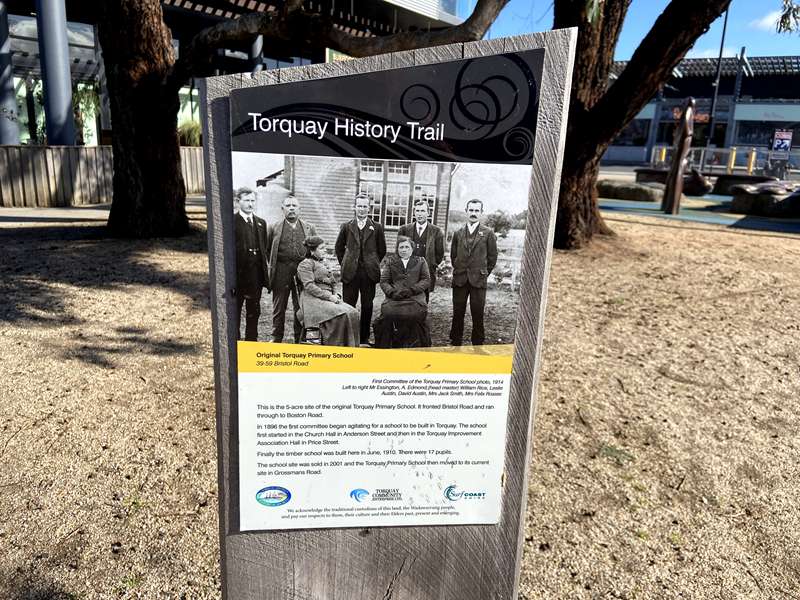
This is the 5-acre site of the original Torquay Primary School. It fronted Bristol Road and ran through to Boston Road.
In 1896 the first committee began agitating for a school to be built in Torquay. The school first started in the Church Hall in Anderson Street and then in the Torquay Improvement Association Hall in Price Street.
Finally the timber school was built here in June, 1910. There were 17 pupils.
The school site was sold in 2001 and the Torquay Primary School then moved to its current site in Grossmans Road.
25. Payne's Garage
18 Bristol Road
26. Taylor Park with gates
Corner of The Esplanade and Zeally Bay Road
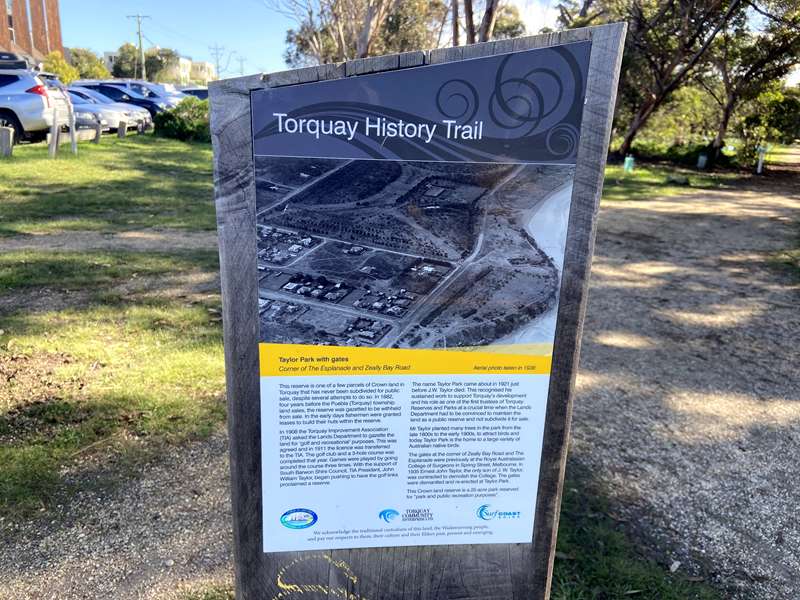
This reserve is one of a few parcels of Crown land in Torquay that has never been subdivided for public sale, despite several attempts to do so. In 1882, four years before the Puebla (Torquay) township land sales, the reserve was gazetted to be withheld from sale. In the early days fishermen were granted leases to build their huts within the reserve.
In 1908 the Torquay Improvement Association (TIA) asked the Lands Department to gazette the land for ‘golf and recreational’ purposes. This was agreed and in 1911 the licence was transferred to the TIA. The golf club and a 3-hole course was completed that year. Games were played by going around the course three times. With the support of South Barwon Shire Council, TIA President, John William Taylor, began pushing to have the golf links proclaimed a reserve.
The name Taylor Park came about in 1921 just before J.W. Taylor died. This recognised his sustained work to support Torquay’s development and his role as one of the first trustees of Torquay Reserves and Parks at a crucial time when the Lands Department had to be convinced to maintain the land as a public reserve and not subdivide it for sale.
Mr Taylor planted many trees in the park from the late 1800s to the early 1900s, to attract birds and today Taylor Park is the home to a large variety of Australian native birds.
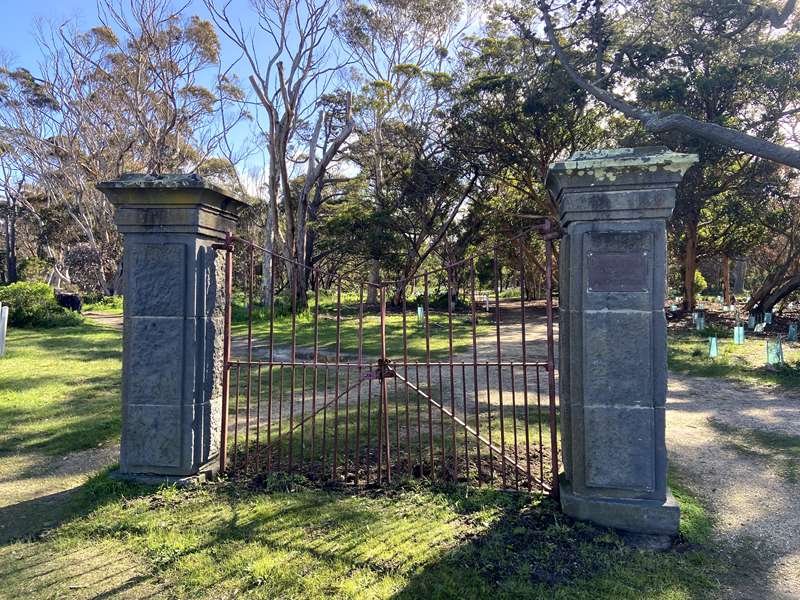
The gates at the corner of Zeally Bay Road and The Esplanade were previously at the Royal Australasian College of Surgeons in Spring Street, Melbourne. In 1935 Ernest John Taylor, the only son of J. W. Taylor, was contracted to demolish the College. The gates were dismantled and re-erected at Taylor Park.
This Crown land reserve is a 25 acre park reserved for “park and public recreation purposes”.
27. Fishermans Beach in the early 1900s
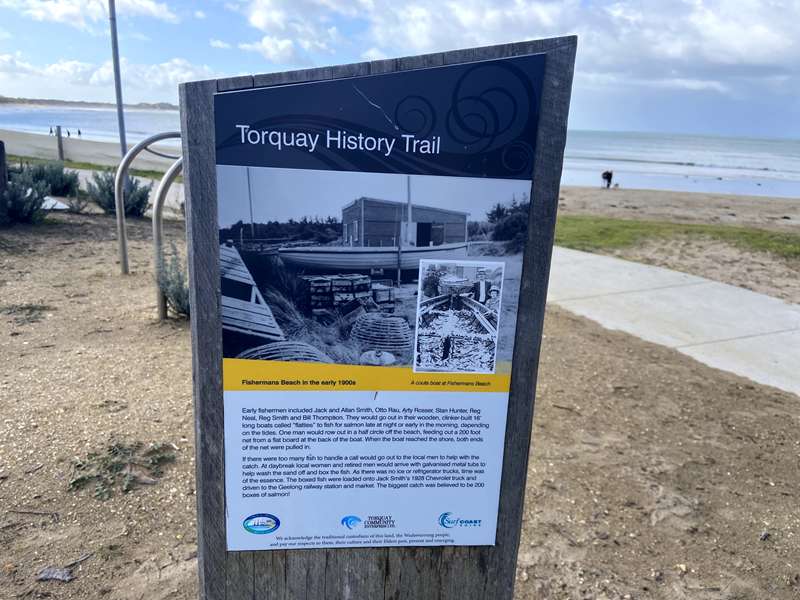
Early fishermen included Jack and Allan Smith, Otto Rau, Arty Rosser, Stan Hunter, Reg Neal, Reg Smith and Bill Thompson. They would go out in their wooden, clinker-built 16’ long boats called “flatties” to fish for salmon late at night or early in the morning, depending on the tides. One man would row out in a half circle off the beach, feeding out a 200 foot net from a flat board at the back of the boat. When the boat reached the shore, both ends of the net were pulled in.
If there were too many fish to handle a call would go out to the local men to help with the catch. At daybreak local women and retired men would arrive with galvanised metal tubs to help wash the sand off and box the fish. As there was no ice or refrigerator trucks, time was of the essence. The boxed fish were loaded onto Jack Smith’s 1928 Chevrolet truck and driven to the Geelong railway station and market. The biggest catch was believed to be 200 boxes of salmon!
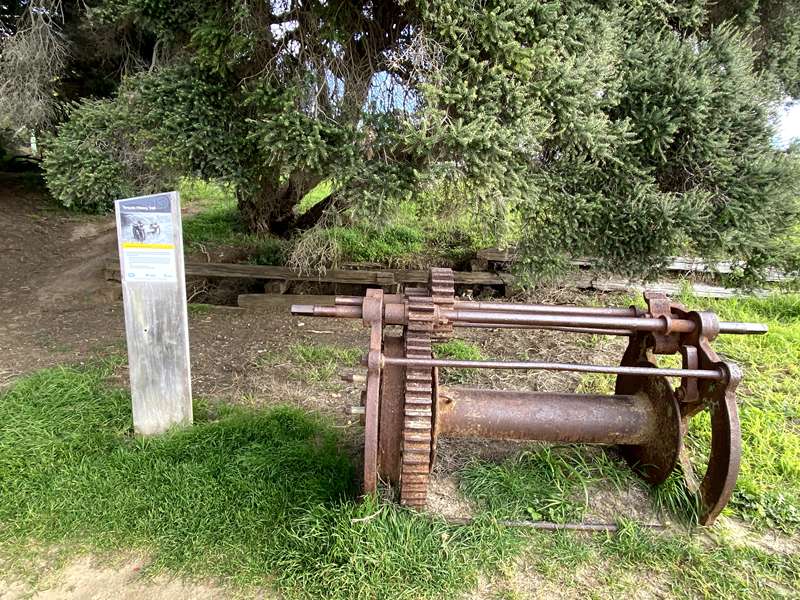
28. Fishing boat hand winch at Fishermans Beach
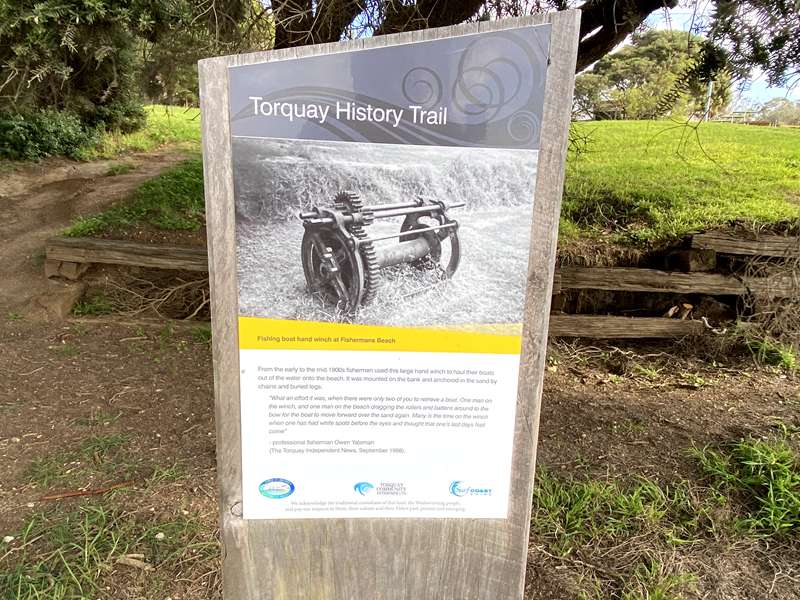
From the early to the mid 1900s fishermen used this large hand winch to haul their boats out of the water onto the beach. It was mounted on the bank and anchored in the sand by chains and buried logs.
“What an effort it was, when there were only two of you to retrieve a boat. One man on the winch, and one man on the beach dragging the rollers and battens around to the bow for the boat to move forward over the sand again. Many is the time on the winch when one has had white spots before the eyes and thought that one’s last days had come”
- professional fisherman Owen Yateman
(The Torquay Independent News, September 1988).
Photos:
Location
The Esplanade, Torquay 3228 View Map
Web Links
→ Torquay History Walking Trail Brochure (PDF)


