Toongabbie Heritage Town Track


A 3.2km stroll along user-friendly tracks will take you on a journey into Toongabbie's colonial past, as well as showcasing a vibrant community with a future.
Nestled in the foothills of the Great Dividing Range, a walk around Toongabbie is a retreat into times gone by. Established in 1863 as a supply depot and staging post on the road from Port Albert to Walhalla, you will find a number of restored historic buildings that include the heritage-listed Mechanics Institute, traditional colonial timber cottages along King Street and the 1884 St David's Church.
History of Toongabbie
Toongabbie is located on the Gippsland Plains and nestled at the foothills of the Great Dividing Range.
Toongabbie township came into existence in 1863 as a supply depot en-route to the Walhalla Goldfields after the discovery of gold at Stringers Creek in 1862 by Ned Stringer.
Walhalla boomed, the railways came in 1870 and the town grew. Increased movement through Toongabbie created interest, stimulating investment and it eventually evolved into an English style village.
While the links between Toongabbie and Walhalla developed, the formations of an agricultural industry in the Toongabbie district were being made.
As Toongabbie owes its early prosperity to the busy Walhalla Goldfields, its impressive Mechanics Institute and Free Library played an important role in linking the pioneering community as a social and cultural centre for the town and surrounding district.
Unfortunately, when the mines in Walhalla began to decline around 1910, Toongabbie's future as a transport town also began to decline. Toongabbie reverted to farming to sustain itself.
Today, Toongabbie is a thriving township, proud of its heritage and, although the pioneers are long gone, it continue to build on the foundations they laid. The fully restored heritage listed Mechanics Institute is now the oldest remaining public building in Toongabbie.
If you want to start this walk with a wander through the wetlands, park at the CFA station opposite the General Store and head south towards Traralgon on the Gippsland Plains Rail Trail. An interpretive shelter at the car park provides a map of the wetlands where you'll find a good example of land reclamation. Restored by a collective community effort begun in 2002 to clean up the site, the indigenous vegetation comprises a mix of Callistemons, Cherry Ballart (insert species), She-Oaks (Casuarina sp.), Melaleucas and Tea-Tree (Leptospermum sp.). A rich field of Common Reed (Phragmites australis), Bullrush (Typha orientalis) and Spiny-headed Matrush (Lomandra longifolia) provide a home for the numerous birds you can spot. Seating is available at several points.
There are remnants of the old railway line on the side of the track that hint at another time in Toongabbie's history, when it was known as the gateway to the Walhalla Goldfields. The railway opened in the 1870s and was a busy centre of transportation for the multitude of miners and their needs. It was not uncommon to see upward of 100 trucks on the rails on any given day during the boom times. After the Goldrush, the township sought to diversify its economic base with other income sources such as marble and oil, which was not successful in the long term. These days, it's an active farming community.
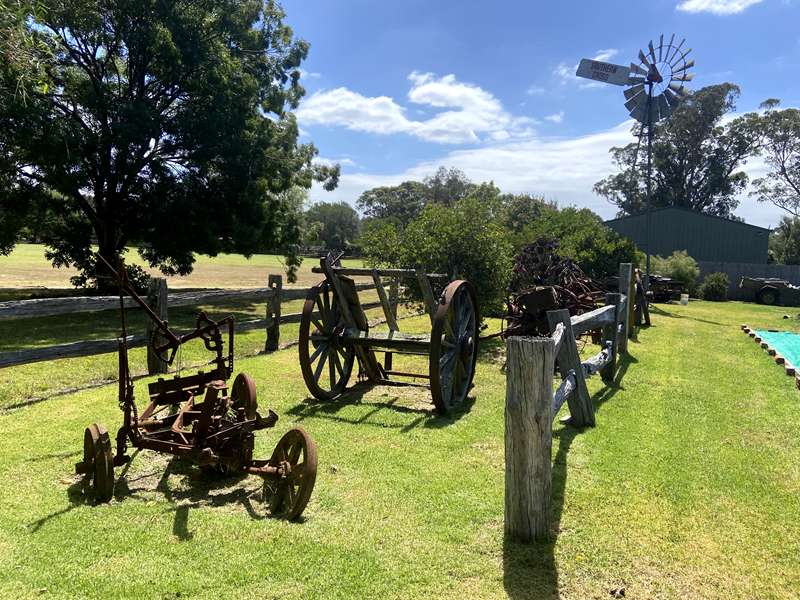
Make sure to walk around the external surrounds of the General Store, where you'll find reclaimed farm machinery and wagons that hint at an industrious past. (You can also find other examples as you walk around the town). The magnificent Village Green, popular with cricketers in summer as well as being used for winter sports, houses the Mechanics Institute and Federation Grand Stand.
Map of Route
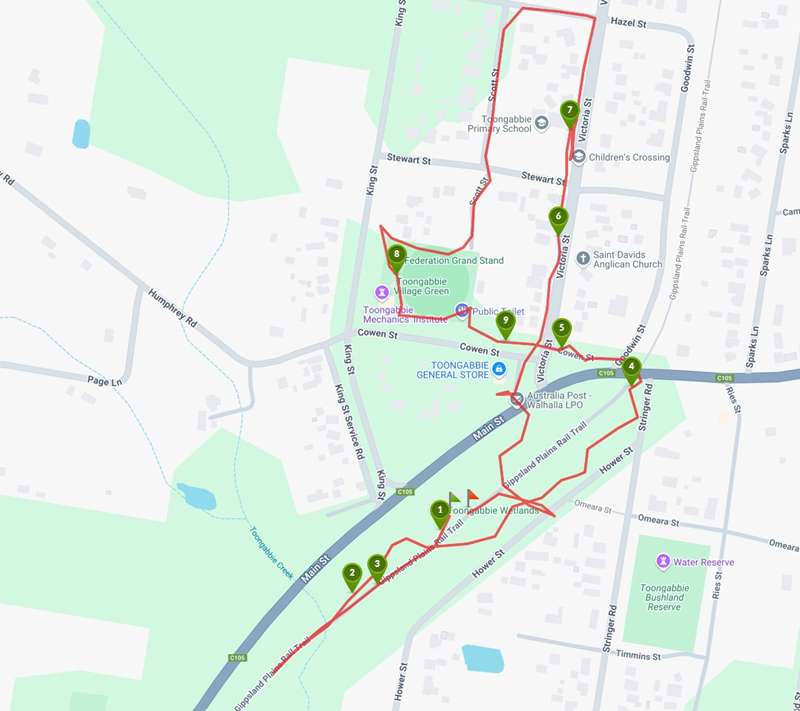
Interactive Map
Points of Interest
1. Giddy up
It's not uncommon to meet horse riders on the track as well as dog walkers, joggers and keen birdwatchers.
2. Walk through the wetland
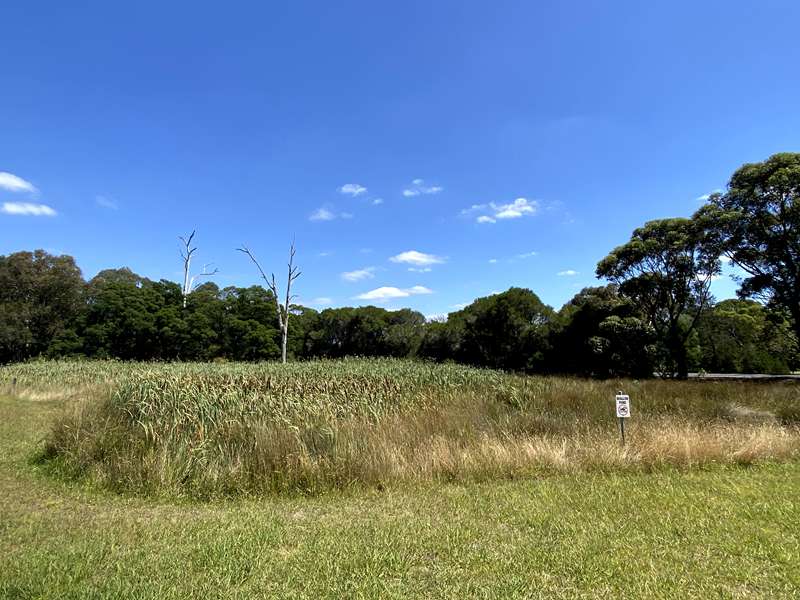
Important to the Gunaikurnai nation for their basket-weaving properties is a wetlands mix of reeds, the home of numerous birds, frogs, insects and reptiles. The wetlands can be dry during the summer months.
3. Historic railway
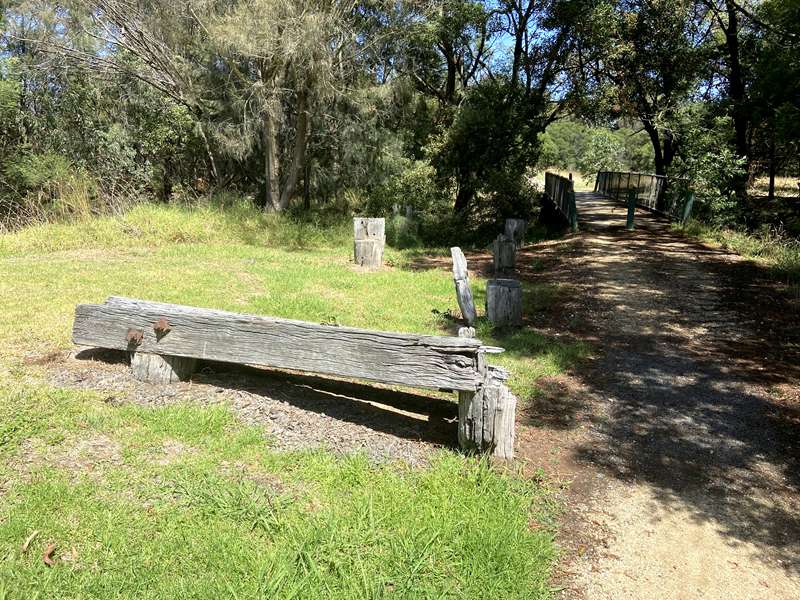
A key piece of infrastructure for the region was the introduction of the railway, signs of which are still evident on the rail trail. Look out for the remains of a bridge across Toongabbie Creek.
At the former Toongabbie Station there is a shelter with seats, information panels and water tap with bowl.
Site of the Toongabbie Railway Station
The Traralgon to Heyfield railway line was officially opened on 13 November 1883. The State School and Police Station had to be relocated when the line was built through the town. Goods for Walhalla now came by rail to Toongabbie. They were then carted to the 'Golden City in the Hills' by wagon. A large freight shed and platform were built in early 1884 to accommodate this flow. Goods came before people: the township had to wait until December 1887 before it obtained a station building. Passengers leaving the train at Toongabbie en route to Walhalla provided coaches with a brisk trade.
By mid 1890s the Toongabbie railway station was the second busiest by tonnage and the largest revenue earner in Gippsland for goods inwards. The opening of the railway between Moe and Walhalla in 1910 saw a dramatic reduction in goods traffic through Toongabbie. By 1941 the freight shed and a large section of the station building had been removed.
The railway station was officially closed on 17 July 1978. The last passenger train passed through the station in November 1983, exactly 100 years after the line had been built. Freight trains continued to run for a short period. The line was removed in 1985.
Toongabbie
Toongabbie's early history was entwined with the legendary gold town of Walhalla located deep in mountainous country to the west. After gold was discovered in the 1860s, a major route to Walhalla from Melbourne was by boat to Port Albert and then via a track across the red gum plains to Toongabbie, where hotels and accommodation houses were clustered. After Toongabbie came the arduous mountain trek to Walhalla. When the railway line to Toongabbie was completed in 1883, supplies and mining machinery for the gold town were railed from Melbourne and then hauled to Walhalla by bullock teams. Passengers could complete their journey by coach.
The first building at the station site was a large goods shed, reflecting the importance of the link with Walhalla. Also significant were the goods railed out from the Toongabbie Station, especially timber from local saw mills: ironbark from the hills and red gum from the plains. A crane was installed to lift timber and freight. There was a memorable sight at the station in October 1888. The grounds were awash with timber - piles, sleepers, posts and rails, planks and beams, firewood - all caused by a shortage of railway trucks. The station was also busy with passengers that year. Over 7000 outward passengers boarded the train at Toongabbie.
Toongabbie was a busy station in the late nineteenth century where machinery and supplies for Walhalla were unloaded and large volumes of timber were railed to Melbourne. There was also a brisk passenger trade.
The opening of the Moe to Walhalla railway in 1910 had an immediate impact on the Toongabbie Station. Business at the station declined, the goods shed was dismantled, the crane was taken away and Toongabbie lost its station master. There was a new development during World War I when stockyards were built. Sheep, cattle, horses and pigs were loaded on to trains. However with livestock transported by rail declining by the 1970s and a bus providing passenger transport, the station was closed in July 1978.
4. Ned Stringer Memorial
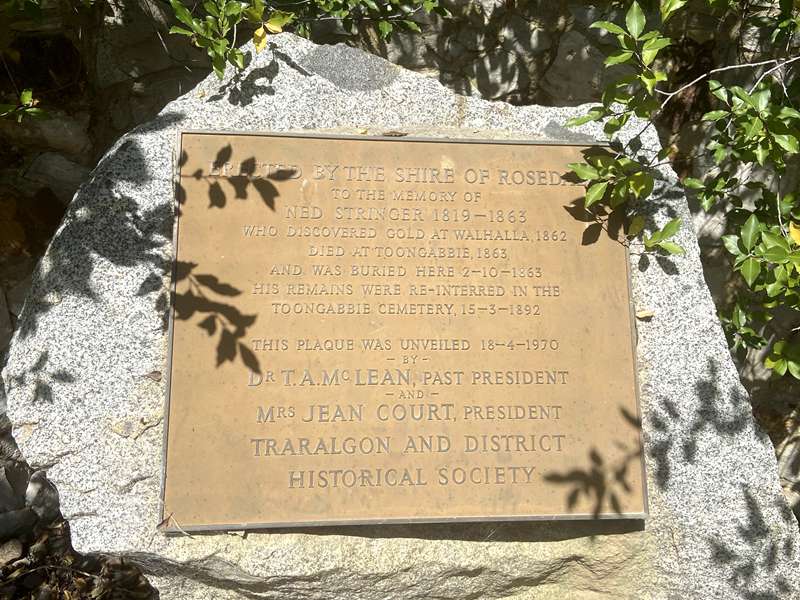
In honour of the first European settler to find gold in what is now called Stringers Creek, this discovery is credited with starting the Walhalla goldrush.
The memorial is located about 200m down Hower Street on the south side of the road.
5. Rose Garden
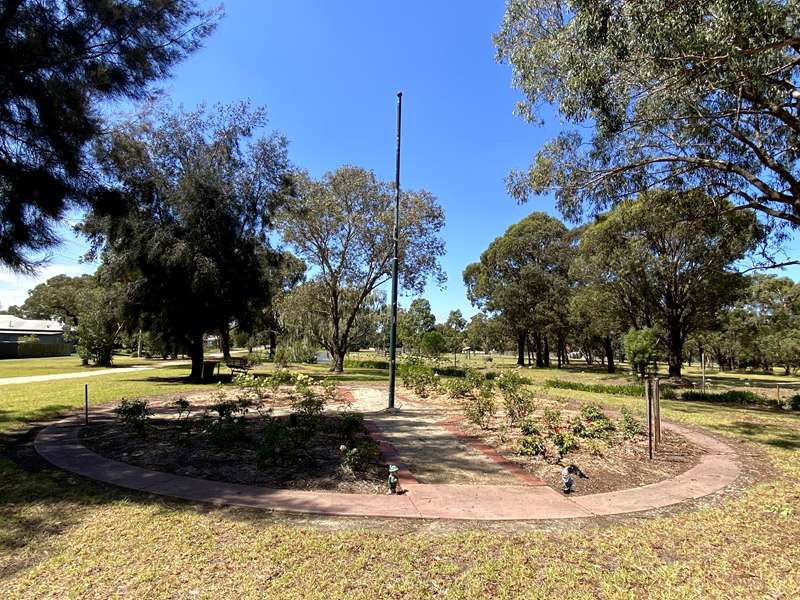
In bloom, this is a superb spot to close your eyes and breathe in the perfume of roses as you reflect on Toongabbie's history.
6. St David's Uniting Church
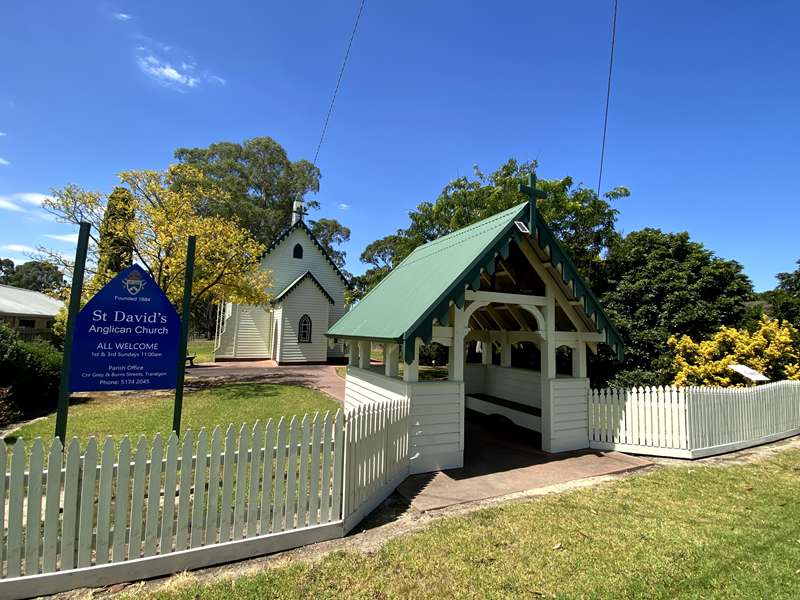
A beautifully cared-for 1895 building that features 13 different pressed metal designs on its internal walls is a great place for taking your breath away.
Henry Bosustow of Toongabbie completed the construction of this Church in September 1884. Strangely, it was erected on the neighbouring block of land owned by William Fryer. Fryer generously offered to exchange allotments, asking for no compensation.
The original trustees of the property were Messrs Jonathan Bassett, William Goodwin, Prescott Humphrey, John Majendie, Robert Morgan and Charles Stewart.
The Rev. Cadwallader P.T. Thomas of Rosedale, who oversaw the establishment of St. David's, conducted the first service on Sunday 26 October 1884.
The first couple to be married in the Church were James Hill and Miss Helen Wickes. A bell tower and porch were added to the building in 1900. The interior of the Church was refurbished in 1984 in time for the centenary service, attended by over 190 in the presence of Bishop Neville Chynoweth, Bishop of Gippsland.
The exterior of the Church building was totally restored and painted in 1992-93: A lichgate was erected in February 2001.
7. Plenty of play space
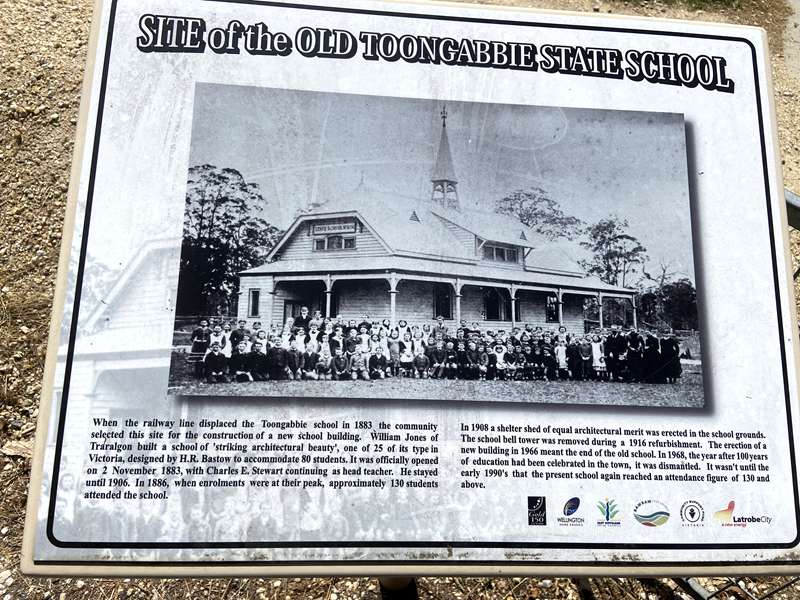
The historic primary school has several areas dedicated to play time.
When the railway line displaced the Toongabbie school in 1883, the community selected this site for the construction of a new school building. William Jones of Traralgon built a school of 'striking architectural beauty', one of 25 of its type in Victoria, designed by H.R. Bastow to accommodate 80 students. It was officially opened on 2 November 1883, with Charles E. Stewart continuing as head teacher. He stayed until 1906. In 1886, when enrolments were at their peak, approximately 130 students attended the school.
In 1908 a shelter shed of equal architectural merit was erected in the school grounds. The school bell tower was removed during a 1916 refurbishment. The erection of a new building in 1966 meant the end of the old school. In 1968, the year after 100 years of education had been celebrated in the town, it was dismantled. It wasn't until the early 1990's that the present school again reached an attendance figure of 130 and above.
8. What a grand stand
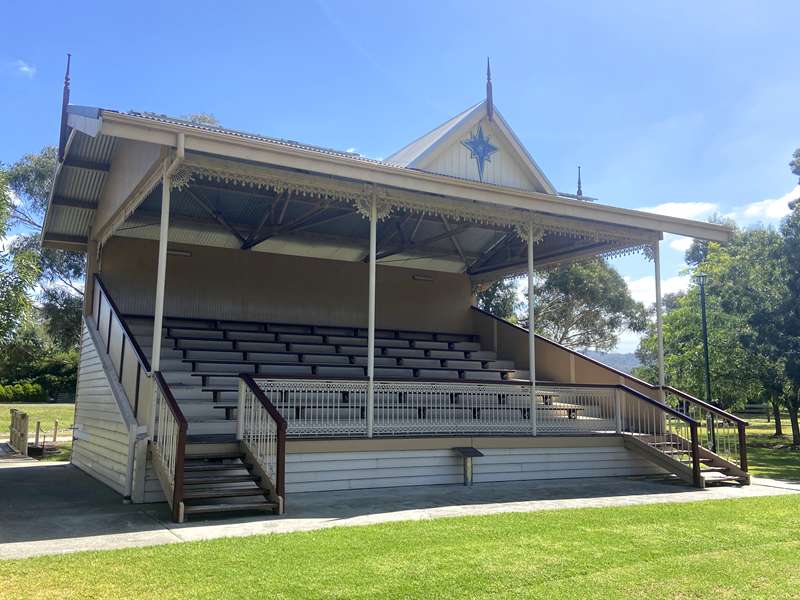
Constructed in celebration of the federation of Australia, this beautiful building on the Village Green is still used for sporting events and is adjunct to an excellent BBQ and picnic facility. There are toilets at the Village Green.
At the corner of the Village Green is the former Toongabbie Mechanics Institute and Free Library. Along the south side is a lovely row of shady trees with a table and row of seats.
Toongabbie Mechanics Institute & Free Library
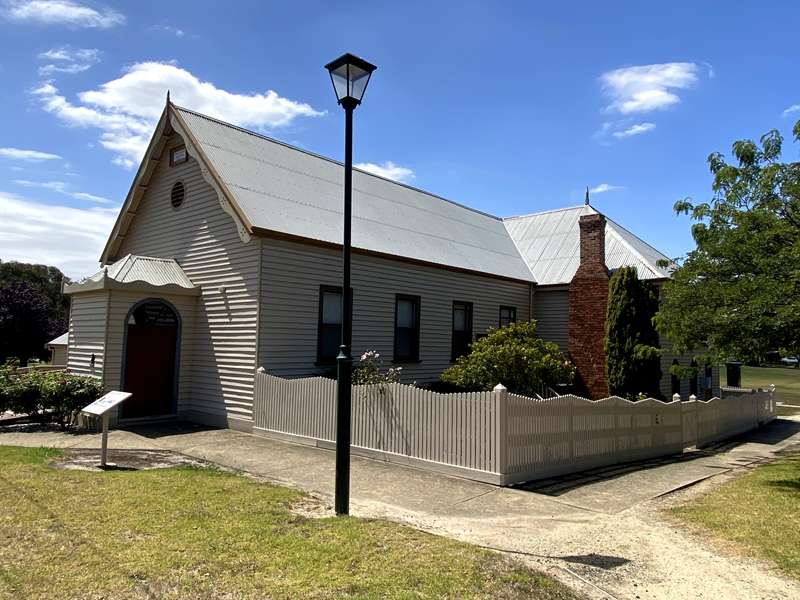
Local builders, Alfred Hollingsworth and Henry Bosustow, constructed the Toongabbie Mechanics Institute in 1883. A two-stony extension added in 1891, comprised of a lodge, library and supper rooms, kitchen, two small ancillary rooms and a stage. Over its 118-year history the hall has functioned as a lending library, Court of Petty Sessions, an agency of the Bank of Australasia, as well as a venue for lectures, concerts and dances, agricultural shows, weddings, private functions and meetings. It was the social and cultural centre of the town and surrounding rural district. Armed Service men and women were farewelled and welcomed home within its walls. By the late 1970s the hall had significantly deteriorated. It gained entry into the Victorian Historic Buildings Register in 1983. and the National Estate register via the Australian Heritage Commission in 1992.
Restoration to the exterior of the building, which is owned by the Department of Natural Resources and the Environment, began in 1991, and was carried out by the Historic Buildings Management Committee.
The interior restoration was completed with the assistance of the Federal Government Department of Employment, Education and Training through the New Work Opportunity program, and was co-ordinated by Gippsland Group Training and the Latrobe Shire. The Hon. Peter McGauran, M.P., Federal Member for Gippsland, re-opened the hall on the 1 September 1996.
9. General Store
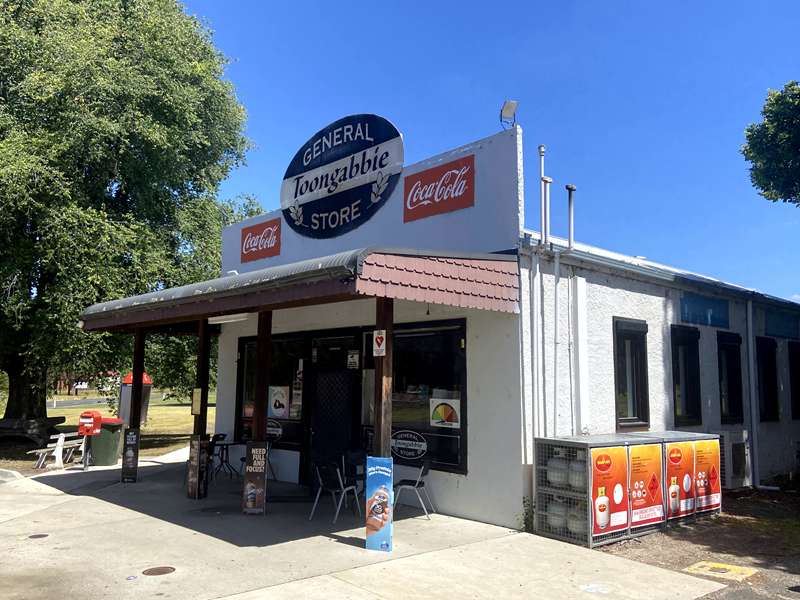
The General Store not only provides delicious food but has a collection of historic wagons and other farm machinery (across Cowen Street next to the Village Green), as well as a wonderful place to picnic under the trees. Next to the store are shaded tables and water tap with dog bowl.
Photos:
Location
Gippsland Plains Rail Trail, Toongabbie 3856 View Map
Web Links
→ Toongabbie Town Track (Walking Maps)


