Toolangi Sculpture Trail (Toolangi)


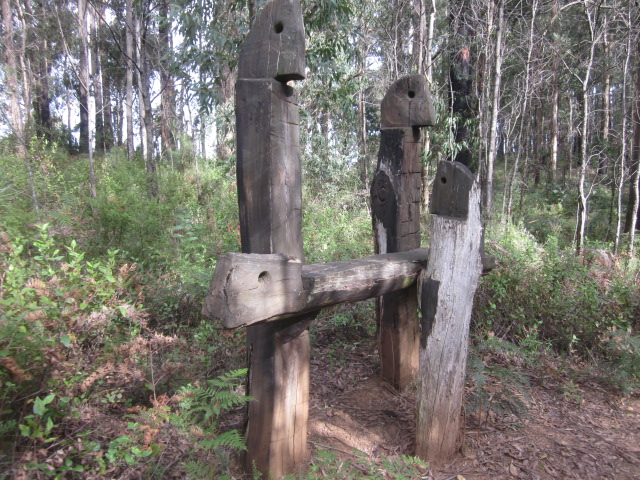
The Toolangi Sculpture Trail showcases the works from the international sculpture event held at the Toolangi Forest Discovery Centre in 1996. The sculptures are the work of a diverse group of top professional artists from Australia and the Asia-Pacific region.
Many of the original sculptures are still visible along the trail. They are all in different states of decay as intended. Information boards along the trail give you some basic information about the artist and the inspirations behind their work.
In 2016, to co-incide with the 20th anniversary of the International Sculpture Event, 15 artists from the Yarra Ranges and around the country created additional sculptures.
The distance of the sculpture trail is 1.5 km which is about a 45 minute duration return.
Toolangi Sculpture Trail Map (Original)
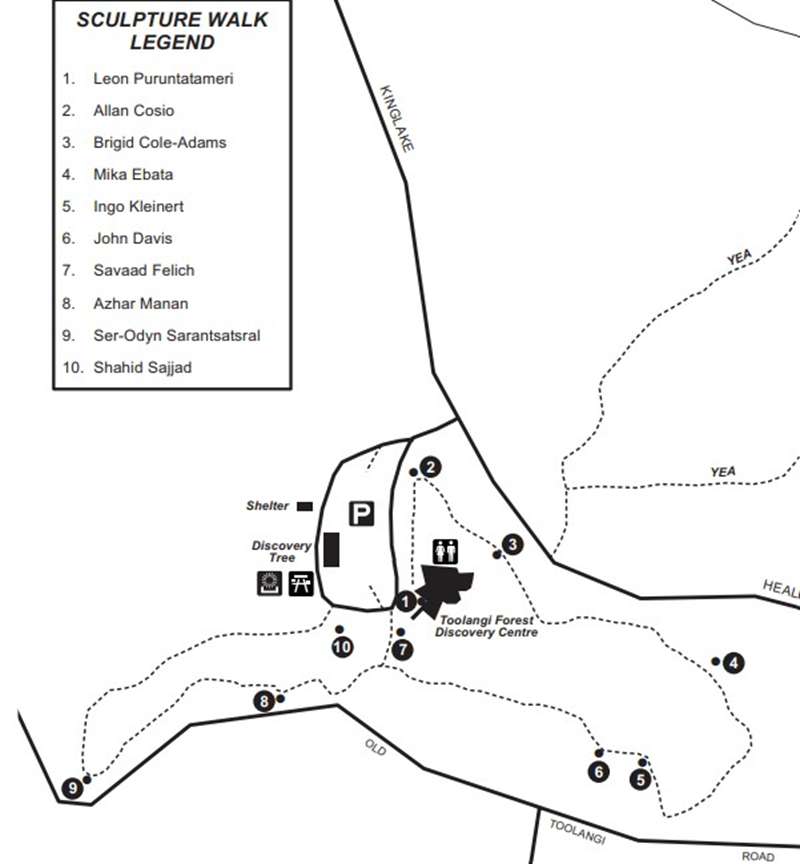
1. 'Pukamani Pole' by Leon Puruntatameri
-embed20.jpg)
The pole is traditionally used by the Tiwi people of Melville Island as a marker of an important place. The abstracted red-eyed pigeon stands guarded over the pole's environment. The delicate designs and the careful selection and execution of designs are indicators of the skill of the artist and the importance of the site.
Note: This artwork was located in the Forest Discovery Centre which is now closed.
2. 'Tartarin' by Allan Cosio
-embed21.jpg)
My issue is a stable climate, fertile soil, living rivers and forests, and a sustainable biosphere - Earth. I believe that human wellbeing depends not only on science, technology and industry, but also on a harmonious and symbolic relationship with the natural world. As long as the natural world is fertile, so will humans be.
3. Brigid Cole-Adams
4. 'Forest Wind' by Mika Ebata
-embed25.jpg)
Utilising the root of a gigantic messmate tree uprooted during a storm, Mika has created a passage through which air moves and creating turbulence and redirecting flow. It is aligned to frame remnants of a fire storm of the past to encourage meditation. Out of destruction new life is coming.
5. 'Empowering Nature' by Ingo Kleinert
-embed26.jpg)
The sculpture metaphorically alludes to the idea of ruins. By coming to terms with the past, we envisage the possibility of a future more harmonious in relationships! In this way, the structure of the sculpture seeks to empower nature and frame the history of our interaction with it.
6. 'Passage 1996' by John Davis
-embed28.jpg)
The sense of fragility in balance with solidity and substance, a rendering of light against dark, and purpose in the collection and distribution of parts, is intended to give a sense of ritual to the organic mode of vegetation.
7. 'The family' by Savaad Felich
-embed01.jpg)
The family figures are carved from recycled jarrah warehouse timbers and are situated beneath a canopy of tall trees. The family group is viewing the majestic height of the trees leading upwards and skywards and encouraging us to look beyond our sphere.
8. 'Two forms - from the Lost Heritage' by Azhar Manan
-embed04.jpg)
Hand crafted utilitarian objects, the cultural heritage of my people, in harmony with nature reflecting the ethos of traditional society, are disappearing before they are fully explored. The fishtrap, oversized and useless, not placed in a stream but hanging from a tree and open to decay is main statement. Symbolic of disappearing values.
9. 'Jonon Hongor' by Ser-Odyn Sarantsatsral
-embed05.jpg)
The horse, the Mongolian symbol of strength, is a reflection of the energy released by the tall messmate forest and its aesthetic value and it's service to mankind. It is a sentinel placed on the border of the wild forest growth and the tranquility of cultivated rolling meadows extending to the Yarra Vialley below. It reminds us that both environments are necessary and need to be respected.
10. 'Horizontal Interference' Shahid Sajjad
-embed11.jpg)
The chaos in human relationships and in the family, the neighborhood and different cultures is the question. No answer is intended. This is passed to the next generation.
Toolangi Sculpture Trail Map (Published in 2016)
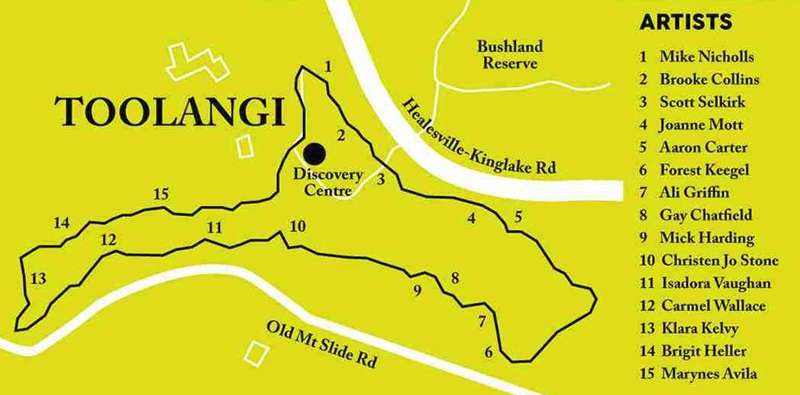
1. 'Bunjil and Wah' by Mike Nicholls
-embed22.jpg)
I have tried to create a spirit of place before its pre-colonial settlement amplifying the timelessness of the forest by combining the two totems of the Wurundjeri and Taungu-rung peoples, the eagle and the crow.
The Bunjil (eagle) rests on the shoulders of a spirit, while Wah (crow) perches on a shield, held aloft by a hand. The two sculptures are sentinel spirits purveying the surrounds, standing guard, protecting their sacred heritage.
3. 'Will' by Scott Selkirk
-embed23.jpg)
Forests have a remarkable ability to rebound from human activity, expressing an honourable Will to survive as our beasts of burden whilst quietly providing timber, air, water and spiritual nourishment. But how far can the back bend before it breaks, and Will we change enough in time to prevent it?
4. 'Precious Spots' by Joanne Mott
-embed24.jpg)
A series of three circular planted plots fenced in bush timber. Incorporated in the plots are common and threatened indigenous plant species. It is hoped that as these plantings grow they may contribute to the regeneration of threatened species "Pomaderris vaciniifolia" and "Nematolepis wilsonii" to the area.
5. 'Green Instruments' by Aaron Carter
-embed34.jpg)
Aaron Carter's practice finds a middle ground between painting and sculpture, within and through the open potential of landscape and abstraction. 'Green Instruments' is an ensemble of sculptures that explore affinities between natural phenomena and modernistic style shapes.
6. ' Horizontal Connectivity' by Forest Keegel
-embed35.jpg)
The Victorian Faunal Emblem Leadbeater?s Possum is critically endangered. Their greatest threat is clearfell logging for wood pulp to make paper. They rely on old trees with hollows to nest in and a connected understory to forage in. This patch of forest is not dense enough for them so the artist has planted Acacia species that they feed on and hand woven many metres of rope from shredded office paper in a futile attempt to restore horizontal connectivity.
7. 'Precious' by Ali Griffin
-embed27.jpg)
The smell of fire residue permeates the space, triggering conflicting memories of winter home fires and summer bushfire season. Precious gold leaf acts as a light in the darkness in stark contrast to the carbon black of the burnt logs, focusing the mind on the precious nature that surrounds us, and is in jeopardy. 'Precious' asks the question "what needs to happen for us to value what we already have"?
8. 'A Place to Dream' by Gay Chatfield
-embed30.jpg)
When I reflect on my childhood growing up in the country, I remember often finding myself down at a nearby creek alone, sitting in amongst the bush and entering into a state of daydreaming. My woven sculpture piece has been created to evoke that place of contemplation.
9. 'Gerr-djerring marramb-ina galk marrambik gerr-djerring mirin Woiwurrung badjii Taunwurrung' by Mick Harding
-embed31.jpg)
The two arch symbols represent Woiwurrung to the south and Taunwurrung to the north. The lines in between the two arches represent the reciprocal relationship between my mob Taunwurrung as two members of the Kulin Nation. Our people believe that men are made from bark and women are made from mud. This means we have an ongoing responsibility to our relationship with the forest.
10. 'The wood Wide Web' by Christen Jo Stone
-embed02.jpg)
Below ground mycorrizhal fungal networks in the forest originating at ancient mother trees allow plants to distribute resources and send warnings of attack with both benefitting from their mutual association. Clear felling, fungicides, tilling and upsetting natural subsoil layers destroys this social network of plants illustrated here with the human nervous systems on the felled mother tree.
11. 'Thick Airs' by Isadora Vaughan
-embed32.jpg)
Isadora Vaughan is a Melbourne based artist working in sculpture. Her works manifest out of a chaotic exploratory process into basic states of matter and a desire to personalise, dislocate and disrupt traditional hierarchies.
For 'Thick Airs' the artist has greatest a series of stains and dyes from ingredients sourced in and around the site, including lichen rubbed from the Discovery Centre, rhododendron from Healesville-Kinglake Road, clay from the Yea River, bed and sap from Eucalyptus in the bush reserve.
13. 'Hide' by Klara Kelvey
-embed06.jpg)
The construction of 'Hide' was a negotiation between the imposition of the urban fence and the irresistible power of the forest. The Australian native timber fence used to construct 'Hide' reflects part of the history of settlement. The final stages of 'Hide' will be the process of the forest growing over and reclaiming the fence. 'Hide' provides a quiet space for contemplation in the forest environment. 'Hide' is a functioning bird hide. Sightings can be recorded on the blackboard.
14. 'SYZYGY' - a pair of connected or corresponding things by Brigit Heller
-embed07.jpg)
Inspired by Mika Ebata's 'Forest Wind', 'Syzygy' has been created with a variety of collected dead branches that reflect on the different stages of a fallen free. The act of cutting, sorting and stacking is looking at the individuality of each plant and the inner life that is hidden under the bark of each tree.
15. 'Symbiosis' by Marynes Avila
-embed33.jpg)
'Symbiosis' extends Marynes Avila's ongoing research on the complexities of multiplicity through the concept of the perfect equilibrium and interconnection between everything that exists in the natural world. It establishes a parallel between thee structure of the human nervous system, trees internal and external structures and the idea of our brains resembling a microscopic neural forest as extraordinary as the Toolangi Forest.
'Evolving from,
devolving forward.
Delicate, subtle marks
unveiling
the hidden balance
interconnecting the forest.
'Work in Progress' by Savaad Felich
-embed29.jpg)
by Brad Sexton
-embed08.jpg)
This sculpture represents the delicate balance between community and the forest environment. Working with DELWP we are committed to providing the community resources, forest access, recreational sites and education whilst protecting the forest's historical, cultural, fauna and flora values.
'Totems in the Forest' by students of all ages with Avis Gardner
-embed03.jpg)
Totems are a universal symbol that serve as an emblem of a group of people, a reminder of ancestry or communication of a specific message. These totemic collaborative sculptures provide observable habitat for the smallest creatures in the forest. They remind us that we are part of an interdependant ecosystem where all living creatures need shelter and as humans we need to protect their environment. All the marks on the ceramic components have been made by students impressing materials sourced from the forest.
Totems 1 & 2: Dixons Creek Primary School, Grades 3 4 5 & 6
Totems 3 & 8: Ellimatta Youth Inc & Melbourne University Early Learning Centre
Totems 4 & 5: Kinglake Primary School, Grades 1 - 6
Totems 6 & 7: Healesville Primary School, Grades 4 5 & 6
Totems 9 & 10:Chum Creek Primary School, Grades 1 - 6
Cost:
Free
Review:
As you travel on the Healesville-Kinglake Road in the direction of Healesville, go past the C.J Dennis Hall, past the Fire Station and look for the Forest Discovery Centre sign. The lovely Forest Discovery Centre is unfortunately now boarded up and not used (apparently not sufficiently fire rated). The sculpture trail is in a rather dilapidated state and can be a bit tricky to find. At the Discovery Centre follow the sign "Yea River Walk" and then head into the bush when you come across the Sculpture Trail sign (but do not cross the road). Along the path there are some information signs covered in in-grained mud which is hard to read. The trail is fairly distinct and can be followed easily enough, even though it is a bit overgrown. It is quite exciting to find the sculptures along the way. The trail shouldn't take more than about 30 minutes.
-embed09.jpg)
-embed10.jpg)
When you get to the end of the trail, about 50m downhill there is a shelter with some displays on logging, BBQs and table.
Photos:
Location
Healesville-Kinglake Road, Toolangi 3777 View Map
Web Links
→ The Best Family Activities in the Yarra Valley
→ www.exploreoutdoors.vic.gov.au/activities/walking-in-victoria/toolangi-sculpture-trail


