Toolangi - Kalatha Giant Tree Walk


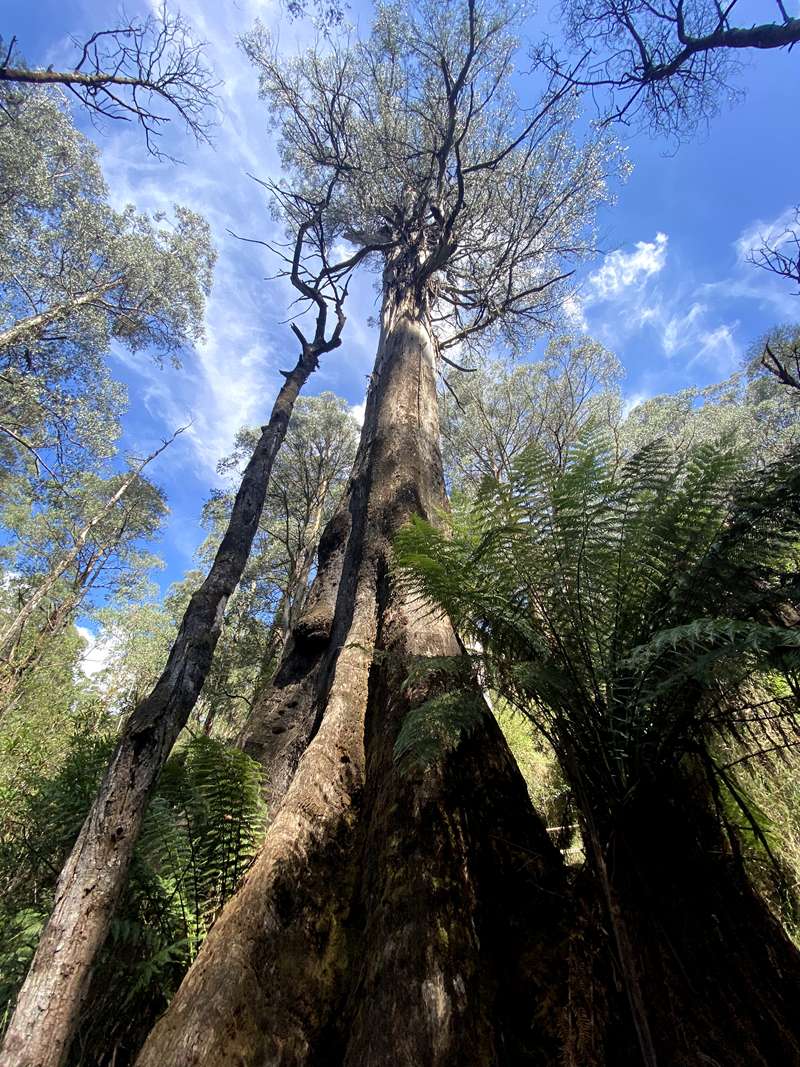
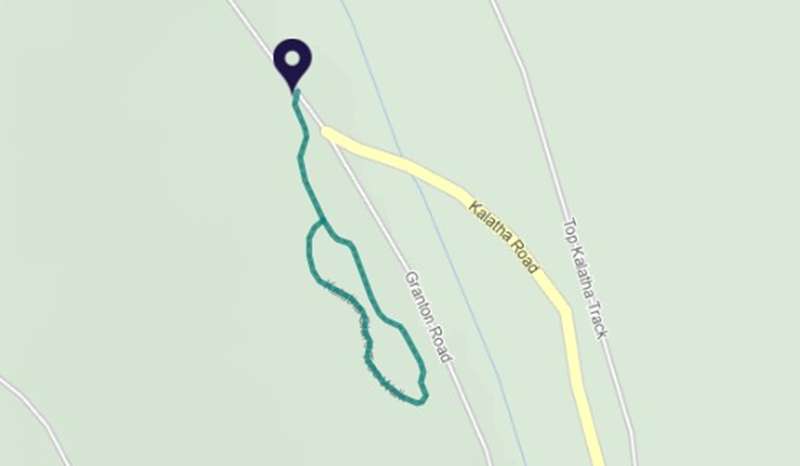
The Kalatha Giant Tree Walk is an easy 500 m return walk through Toolangi State Forest to a remarkable mountain ash estimated to be over 350 years old. The tree stands 73 m tall and has a circumference of 16 m. It survived multiple bushfires while the surrounding forest regenerated after the 1939 fires.
The trail passes tall eucalyptus trees, tree ferns, mountain pepper and wattles. Interpretation signs explain the tree's history and the ecology of the forest. A boardwalk provides a place to view and photograph the Kalatha Giant while protecting its roots.
The well-formed track has gentle hills and occasional steps. Allow time to read the signs and explore both sides of the tree.
How to Get There:
From Healesville, follow Myers Creek Road for approximately 13 km, then turn right onto Sylvia Creek Road. Continue for approximately 10 km and turn left onto Kalatha Road. The trailhead and small parking area are approximately 1.7 km along Kalatha Road, Toolangi VIC 3777. Check current forest road and track conditions before travelling: Forest and road closures.
Cost:
Free.
Access for Dogs:
Dogs are allowed in Toolangi State Forest.
Review:
It is wonderful to stand beside such a huge mountain ash and read its life story. Steps near the tree lead to a boardwalk on one side, while a track passes the other side.
Information Boards:
There are several interpretation signs near the tree.
Welcome to the Kalatha Giant Tree Walk
The Kalatha Giant is 73 metres tall and its girth is 16 metres at breast height. It is one of several massive and ancient mountain ash (Eucalyptus regnans) trees in this area of Toolangi State Forest.
For your own safety and to protect the special tree and the wildlife around it, please stay on the constructed track and boardwalks.
Walk quietly and you will see and hear many forest birds. You will probably notice scratching on the edge of the track, where lyrebirds have been foraging for invertebrates in the humus. Listen for their singing, including a remarkable mix of mimicked bird calls.
Eucalyptus trees can drop branches without warning, so be alert at all times and be especially cautious in wet and windy weather.
From small seeds, big trees grow
Mountain ash trees grow from tiny seeds to become some of the tallest plants on Earth, capable of reaching well over 100 metres. In the 19th century, some were measured at more than 130 metres - the tallest trees ever recorded.
In their race toward the light, saplings may grow rapidly. By the time they are 60 years old, they can be more than 70 metres tall, leaving all other plants below.
After this, they grow more slowly. The trunk grows thicker and buttress-like flutes develop around the base to help stabilise and strengthen the tree.
The crown of the tree becomes fully developed and lower side branches die and fall off, starting a process of decay that will lead to the development of hollows in the trunk.
Eventually, the very top of the tree dies as it struggles to draw sufficient water up from the roots. The dead top breaks off and the process of decay down the centre of the trunk begins.
Can you see the massive upright limb that has fallen from the Kalatha Giant? Look carefully - it is upside down!
Survival and Recovery
Mountain ash trees are fire-sensitive but sometimes survive intense bushfire events. Some have been through many major fire episodes in their long lifetimes.
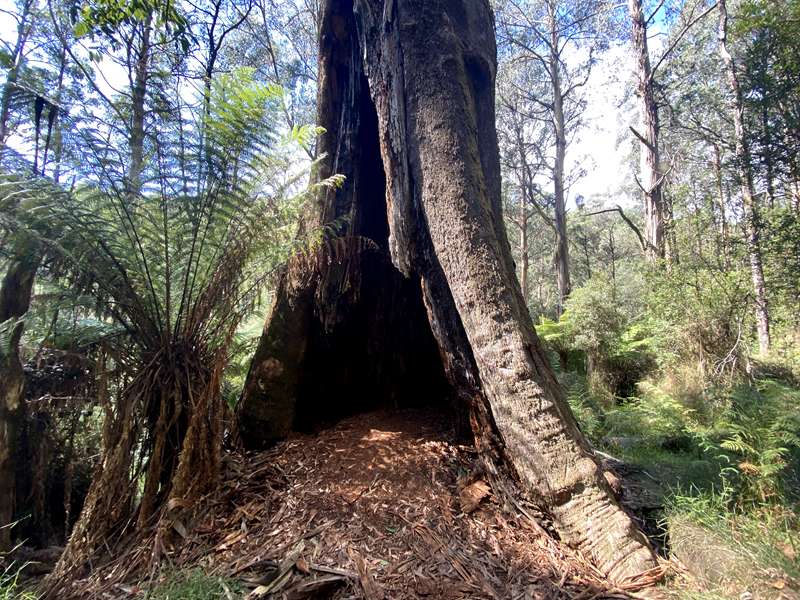
Can you see the large 'Cathedral Door' at the base of the Kalatha Giant? This is an old fire scar formed when a ground fire burned rapidly uphill, passing by the tree with little effect. However, the upslope side of the tree had probably collected a heap of dry litter that continued to burn long after the main fire had passed. This sustained fire penetrated through the bark and into the heartwood.
As the damage affected only one side of the trunk, the tree survived and healed. Bark regrew around the scar, forming the characteristic 'gothic' shape. The Kalatha Giant recovered and remains alive many decades later.
Home is a warm hollow
Hollows normally begin to form when a tree is around 120 years old, and it can take many decades for them to fully develop.
More than 40 species of Australian vertebrates need hollows in mountain ash trees for shelter and nesting.
These include bats, parrots, owls, gliders and possums. Each species prefers a particular type of hollow with a specific style and size of entrance, so a wide variety of hollows is needed to support a range of wildlife.
Completing the circle of life
When a natural fire burns through a mountain ash forest, it does not burn evenly. Some parts will burn hotter, some faster; in some areas there will be a ground fire, while in others flames will extend right up into the crowns of the trees.
After a fire, parts of the forest will have been singed or scorched and others partially or completely destroyed. There will even be patches that remain unburnt.
The thin bark of mountain ash provides little protection from fire; intense heat can penetrate and kill the living tissue beneath. If this damage encircles the trunk, it will break the essential connection between the roots and the crown, leading to the death of the tree.
A dead tree, or 'stag', will take decades to decay. Eventually it will collapse, leaving a stump. Slowly it will rot back into the earth, continuing to provide habitat and nutrients for many species as new forest grows around it.
Multi-storey living
The open crowns of mountain ash trees allow light to penetrate below, where other plants thrive.
Mountain ash forests often have a middle layer of wattle and other trees; an understory of broad-leaved plants, climbers and tree ferns; and a ground cover of grasses, ferns and mosses.
This forest is a community of many species living alongside and interacting with each other.
Photos:
Location
Kalatha Road, Toolangi 3777 View Map
Web Links
→ www.exploreoutdoors.vic.gov.au/activities/walking-in-victoria/kalatha-giant-tree-walk


