Sorrento Heritage Walk (Sorrento)


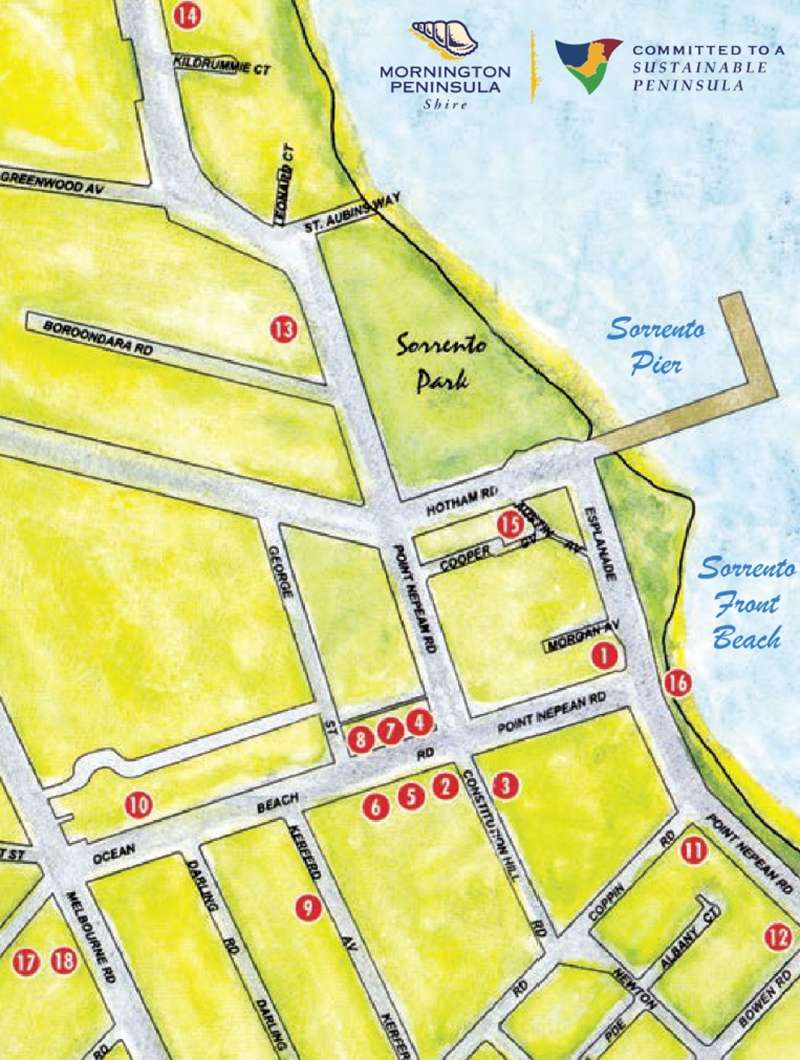
The Sorrento Heritage Walk is a fascinating self-guided tour through one of Victoria's most historic seaside towns. Beginning in the heart of Sorrento, the walk showcases beautifully preserved limestone buildings, grand hotels, churches, guesthouses and public buildings dating from the 1870s through to the early 1900s. Along the route you'll discover the people, industries and events that helped shape the Mornington Peninsula and the early history of Victoria.
Created by the Rotary Club of Sorrento in partnership with the Nepean Historical Society and the Mornington Peninsula Shire, the heritage walk features 18 significant heritage sites. Many buildings display interpretive plaques describing their history, allowing visitors to explore the township at their own pace.
Allow around 1.5–2 hours to complete the central walking route, although history enthusiasts may wish to spend longer exploring museums, cafés and nearby attractions.
The walk is mainly along Ocean Beach Road and includes 18 points of interest.
The Story of Sorrento
Long before European settlement, the Bunurong People regularly visited the Sorrento area to gather shellfish from the extensive rock platforms and hunt native wildlife. Controlled burning helped maintain open woodlands of Moonah, Casuarina and Wirilda, creating a landscape that early European explorers later described as park-like.
European history began in 1802, when Acting Lieutenant John Murray discovered the entrance to Port Phillip Bay. Just one year later, in 1803, Lieutenant Colonel David Collins established Victoria's first official European settlement at nearby Sullivan Bay. Although the settlement lasted only a few months before relocating to Tasmania in 1804, it marked the beginning of European settlement in what would become the State of Victoria. Because of this, Sorrento is often referred to as the Birthplace of Victoria.
Following the establishment of Melbourne in 1835, pastoralists began grazing stock across the southern Mornington Peninsula. However, the district soon became better known for another valuable resource—its extensive deposits of limestone. Lime kilns were established throughout the area, producing lime for Melbourne's rapidly expanding building industry. Large numbers of native trees were cut to fuel the kilns, with dense tea-tree quickly replacing much of the original vegetation.
By the 1860s, wealthy Melburnians were beginning to recognise the area's magnificent scenery, clean sea air and healthy climate. One of the earliest supporters was Sir Charles Gavan Duffy, who built a holiday home overlooking the bay and named it Sorrento after the famous Italian coastal town. His subdivision of surrounding land helped establish the township, while Sorrento Park was planted in 1870 using exotic trees supplied by renowned Government Botanist Baron Ferdinand von Mueller.
The man who transformed Sorrento into one of Victoria's leading holiday destinations was George Selth Coppin. An actor, entrepreneur, philanthropist and politician, Coppin recognised the area's tourism potential and invested heavily in its development. His companies constructed the landmark Continental Hotel, built guesthouses and bathing facilities, established ferry services from Melbourne, and laid out Ocean Beach Road, connecting the township with the ocean beach. He also built clifftop walking paths and later introduced a steam tramway linking the pier with the Back Beach, making Sorrento one of Victoria's most fashionable seaside resorts during the late nineteenth century.
Today, Sorrento retains one of Victoria's finest collections of nineteenth-century limestone buildings. Thanks to careful conservation by property owners, the Mornington Peninsula Shire, the Nepean Historical Society and community organisations, visitors can still experience the streetscape that welcomed holidaymakers more than 150 years ago. The Sorrento Heritage Walk offers a wonderful opportunity to explore this remarkable history while discovering the stories behind the town's most significant buildings.
Sorrento Heritage Walk Map
1. Koonya Hotel (1876)
Originally opened as the Mornington Hotel, this impressive limestone building was constructed in 1876 for John Boswell Clark. The hotel's construction was controversial, with existing hotel owners unsuccessfully attempting to stop its development through the courts. The building was renamed the Koonya Hotel in 1952, with Koonya being an Aboriginal word meaning seagull.
For more than a century the hotel has welcomed visitors to Sorrento and remains one of the town's best-known landmarks. A major restoration completed in 2001 preserved much of its historic character while ensuring it continued operating as a popular destination for dining and accommodation. The heritage plaque can be found near the restaurant entrance on The Esplanade.
2. Continental Hotel (1875)
The magnificent Continental Hotel is Sorrento's most recognisable heritage building and one of Victoria's grand nineteenth-century seaside hotels. Constructed in 1875 for the Continental Hotel Company, it was developed under the direction of entrepreneur George Selth Coppin, whose vision helped establish Sorrento as a premier holiday resort.
Built at a cost of £14,000, the hotel quickly became one of Melbourne's most fashionable coastal destinations. Over the years several additions were made, including an enclosed second storey and balcony, while the adjoining single-storey building originally operated as a general store.
Constructed almost entirely from locally quarried limestone, the Continental is believed to be Australia's only four-storey limestone building. It is recognised by the National Trust and remains one of the finest examples of Victorian-era resort architecture on the Mornington Peninsula.
3. Continental Ballroom (1904)
Built in 1904 as an extension to the Continental Hotel, the Continental Ballroom provided entertainment for hotel guests during Sorrento's golden era as a seaside resort. The ballroom was originally connected to the hotel by an elevated bridge spanning Constitution Hill Road, allowing guests to move easily between the two buildings. The bridge remained until it was dismantled during the 1960s.
After serving for many years as guest accommodation and staff quarters, the ballroom underwent a major restoration in 1994. Today it continues to host functions, celebrations, exhibitions and community events, preserving its long tradition as one of Sorrento's leading entertainment venues.
4. Stringer's Stores (1886)
Located on one of Sorrento's most prominent corners, Stringer's Stores is an excellent example of the town's commercial development during the late nineteenth century.
The original limestone corner building was constructed in 1886 for the Lentell family, with a second storey added less than a decade later. The adjoining brick building followed shortly afterwards before the two premises became home to David MacFarlan and William Stringer, who established the business that gave the property its enduring name.
For decades Stringer's Stores served generations of local residents and holidaymakers and remained in family ownership until the 1970s. The largely intact buildings continue to be one of Sorrento's best-known commercial landmarks and provide an excellent example of late Victorian and Federation-era shopfront architecture.
5. Morley's General Store (1902)
Morley's General Store was built in 1902 for local businessman Edward Morley, who operated a successful general store before later entering politics as the Member for Barwon.
Like many heritage buildings in Sorrento, the premises have adapted to changing times. Over more than a century the building has served as a bakery, newsagency, greengrocer, florist, craft shop, delicatessen and café.
The building displays attractive Federation architectural influences, making it an important part of Ocean Beach Road's historic streetscape while continuing to serve the local community through a variety of businesses.
6. Wilson's Butcher Shop (1905)
Constructed in 1905 for Godfrey Burdett Wilson, this handsome limestone shop replaced the family's original butcher shop on Point Nepean Road. The move reflected Sorrento's growing commercial centre around Ocean Beach Road during the early twentieth century.
The combined shop and residence remained a butcher's business for approximately 95 years, making it one of the town's longest-running family enterprises. Despite changes in ownership over the decades, the building remains a remarkably intact example of an Edwardian shop and residence.
Its limestone construction, decorative detailing and strong connection with one of Sorrento's pioneering families have earned it National Trust recognition as an important part of the town's architectural heritage.
7. The Former Oriental Coffee Palace (1887–1888)
Constructed between 1887 and 1888 by Irish lime-burner William Hughes, the Oriental Coffee Palace was built to provide quality accommodation for visitors without serving alcohol. During the late nineteenth century, coffee palaces became popular alternatives to hotels, offering family-friendly accommodation in response to the temperance movement.
The building remained a guest house until 1954 before being adapted for a variety of commercial uses, including a doctor's surgery, fish shop, butcher's shop and restaurant. Its rendered limestone façade, with two adjoining buildings connected at the upper level, remains a distinctive feature of Ocean Beach Road and provides a reminder of Sorrento's popularity as a Victorian holiday destination.
8. Athenaeum (1894)
The Athenaeum has been one of Sorrento's principal entertainment venues for well over a century. Built in 1894 for Isaac Bensilum and designed by architect J. F. Gibbons, the building originally contained a grand hall with an extensive dance floor, deep stage, dressing rooms and residential accommodation above.
Throughout its history, the Athenaeum has hosted travelling theatre companies, concerts, dances, community meetings, receptions, roller skating and countless social events. During the 1920s it began operating as a cinema, a role it continues to fulfil today with multiple cinema screens inside the historic building.
The Athenaeum is classified by the National Trust and remains one of Sorrento's most important cultural landmarks.
9. St Andrew's Presbyterian Church (1888)
St Andrew's Presbyterian Church began with the construction of its transept in 1888, followed by a limestone porch in 1889 and the larger nave and eastern wing in 1906.
Much of the later work was undertaken by Charles Haslett, who also built and operated a guest house in nearby Ocean Beach Road. The adjoining Ellen Grant Hall, completed in 1937, expanded the church's facilities and strengthened its role within the local community.
Today the church remains an attractive example of late nineteenth-century limestone architecture and continues to serve both worshippers and visitors interested in Sorrento's heritage.
10. Gannawarra (1904–1905)
Built between 1904 and 1905 by Ralph Marsden for Alex Ellis, Gannawarra is regarded as one of Sorrento's finest surviving Edwardian residences.
Together with the neighbouring property Carmel, the house later formed part of the guest house known as Antrim, which welcomed holidaymakers during the early twentieth century.
Constructed from locally quarried limestone with distinctive red brick quoins and decorative timber bargeboards, Gannawarra remains an outstanding example of Edwardian Italianate architecture and reflects the prosperity generated by Sorrento's booming tourism industry.
11. The Anchorage (1873)
One of Sorrento's grandest private residences, The Anchorage was built in 1873 by master stonemason John Farnsworth as the holiday home of George Selth Coppin.
The architect is believed to have been Levi Powell, who designed a number of distinguished Victorian mansions. Coppin even added a small private theatre where guests could enjoy performances during their stay.
Originally the property extended towards the former sea baths along what is now Coppin Road. Today The Anchorage remains one of the Mornington Peninsula's oldest and most intact Victorian limestone villas, reflecting both Coppin's wealth and his enormous influence on the development of Sorrento as a holiday resort.
12. North Esk (1880–1882)
Built between 1880 and 1882 for Sir James Service, Premier of Victoria, North Esk became one of Sorrento's most prestigious holiday homes.
The residence was later owned by parliamentarian John Halfey before passing to the Carnegie family, who retained it as a holiday residence for several decades. During the mid-twentieth century the house was converted into holiday apartments before being carefully restored as a private residence in 1996.
Visitors should take time to admire the beautifully preserved Victorian details, including the original cast-iron lacework, verandah balustrades and elegant limestone construction that demonstrate the high quality of nineteenth-century craftsmanship.
13. Former Butcher's Shop (1876)
This handsome limestone building was constructed around 1876 for Sir Charles Gavan Duffy, one of Victoria's most influential early politicians and Premier from 1871 to 1872. Located on what was then known as Portsea Road (now Point Nepean Road), the building was later purchased by Godfrey Burdett Wilson, whose pioneering butcher's business became well known throughout the district.
The Wilson family operated their butcher's shop here until relocating to larger premises in Ocean Beach Road in 1905. Today the building remains a private residence and is recognised by the National Trust as one of Sorrento's important surviving nineteenth-century limestone buildings.
14. St John's Church (1874)
St John's Church is one of the oldest surviving churches on the Mornington Peninsula. Construction began in 1874 after J. B. Wilson, Headmaster of Geelong Grammar School, donated the land for the new church.
The original nave was completed in 1874 and initially served a variety of community purposes before the church was progressively enlarged. Transepts were added in 1889, with the chancel completed between 1908 and 1911. Built almost entirely from local limestone, the church remains a fine example of Victorian Gothic Revival architecture.
The building is classified by the National Trust and continues to be one of Sorrento's most significant historic landmarks.
15. Sorrento Hotel (1872)
The Sorrento Hotel holds the distinction of being one of the township's earliest hotels. The original section was completed in 1872 for P. J. Martin, owner of the Australian Brewery, with master stonemason John Farnsworth brought from Adelaide to supervise construction.
As Sorrento's popularity grew, additional accommodation was required and tenders for another thirty rooms were called in 1873. Numerous extensions followed over the following decades, creating the substantial limestone complex seen today.
The Sorrento Hotel is classified by the National Trust and remains one of the finest surviving nineteenth-century hotels on the Mornington Peninsula, continuing a tradition of hospitality that has lasted for more than 150 years.
16. Sorrento Rotunda (1902)
Standing proudly on the foreshore, the Sorrento Rotunda was built in 1902 as a bandstand for the Sorrento Band. It was first used on New Year's Eve that year before being officially opened in March 1903.
During the heyday of paddle steamer excursions from Melbourne, visiting bands regularly performed concerts from the rotunda to entertain arriving passengers. One steamer captain even donated the ship's flag that flew from the flagpole during the opening celebrations.
The rotunda was renovated in 1988 and later carefully restored by the Rotary Club of Sorrento in 1998, ensuring it remains one of the township's best-loved landmarks.
17. Watts' Cottage (Ilfracombe) (1869)
Watts' Cottage, originally known as Ilfracombe, provides a rare glimpse into the everyday lives of Sorrento's pioneering families.
Built between 1869 and 1870 for John and Jenny Watts, the modest two-room limestone cottage became home to a family of nine children while they operated a small farm nearby.
After remaining in the Watts family until the 1960s, the cottage was carefully restored and relocated to the grounds of the Nepean Historical Society Museum as a community project undertaken by the Rotary Club of Sorrento. Visitors can now tour the cottage during museum opening hours and experience one of the peninsula's earliest surviving homes.
Watts' Cottage is classified by the National Trust.
18. Mechanics' Institute (1877)
Now home to the Nepean Historical Society Museum, the Mechanics' Institute was officially opened on 3 February 1877 and quickly became the social heart of Sorrento.
Over nearly 150 years it has hosted concerts, dances, balls, lectures, political meetings, church socials, sewing classes, roller skating, Red Cross activities during both World Wars and countless community celebrations. A library also operated from the building for many years.
The Nepean Historical Society Museum opened here in 1967, with an additional extension completed in 1994. Today the museum houses an outstanding collection of photographs, artefacts and historical displays documenting the rich history of Sorrento, Portsea and the southern Mornington Peninsula.
The Mechanics' Institute is also classified by the National Trust, reflecting its outstanding historical significance.
Preserving Sorrento's Heritage
The Sorrento Heritage Walk offers far more than a collection of beautiful old buildings. Together these eighteen sites tell the story of Victoria's earliest European settlement, the rise of the lime industry, the arrival of wealthy holidaymakers and the transformation of Sorrento into one of Australia's best-loved seaside resorts.
Many of these buildings remain in everyday use as hotels, churches, cinemas, businesses and private homes, allowing visitors to experience a remarkably intact nineteenth-century streetscape. Thanks to the efforts of property owners, the Nepean Historical Society, the Rotary Club of Sorrento and the Mornington Peninsula Shire, these historic landmarks continue to preserve the character and history of one of Victoria's most significant heritage towns.
Location
Ocean Beach Road, Sorrento 3943 View Map
Web Links
→ Sorrento Heritage Walk Brochure (PDF)


