Skipton - Platypus Viewing Platform


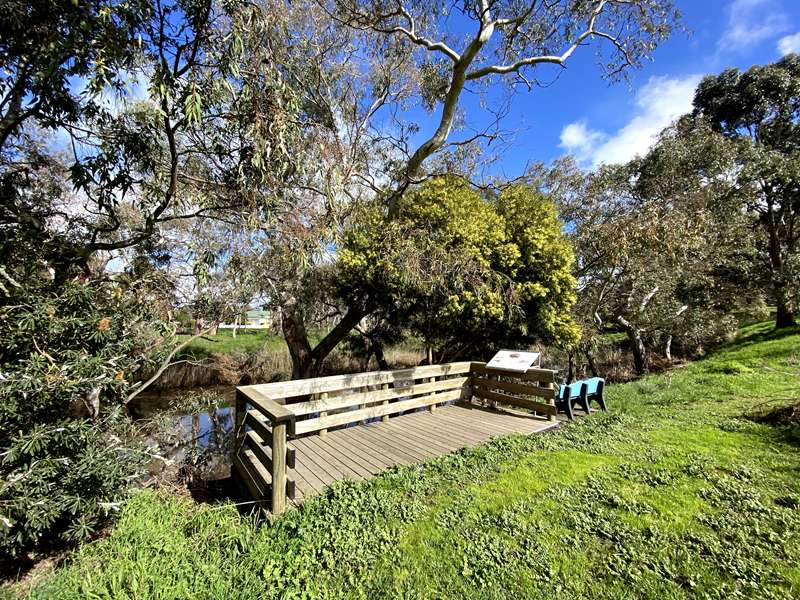
The Platypus Viewing Platform overlooks a bend in Mount Emu Creek within Stewart Park Historical Precinct. The creek supports a healthy population of platypuses and the platform provides a dedicated place from which to watch for these shy native animals.
Dawn and dusk generally provide the best opportunities for a sighting, although platypuses may appear at other times. Remain quiet and patient while watching the surface for bubbles, ripples or a V-shaped wake. Sightings cannot be guaranteed.
Avoid sudden movements, loud noises and flash photography. Platypuses should never be approached, disturbed or fed.
Facilities include:
- A dedicated creekside viewing platform
- Walking paths through Stewart Park
- Picnic tables and a covered barbecue area
- Public toilets nearby on Montgomery Street
- Historic buildings, a pedestrian suspension bridge and the Platypus Rising sculpture
Opening Hours:
The viewing platform is accessible at all times. Dawn and dusk are recommended for platypus watching.
Cost:
Free.
Access for Dogs:
Dogs are permitted on a leash in Stewart Park. Keep dogs quiet, restrained and away from the creek edge and wildlife.
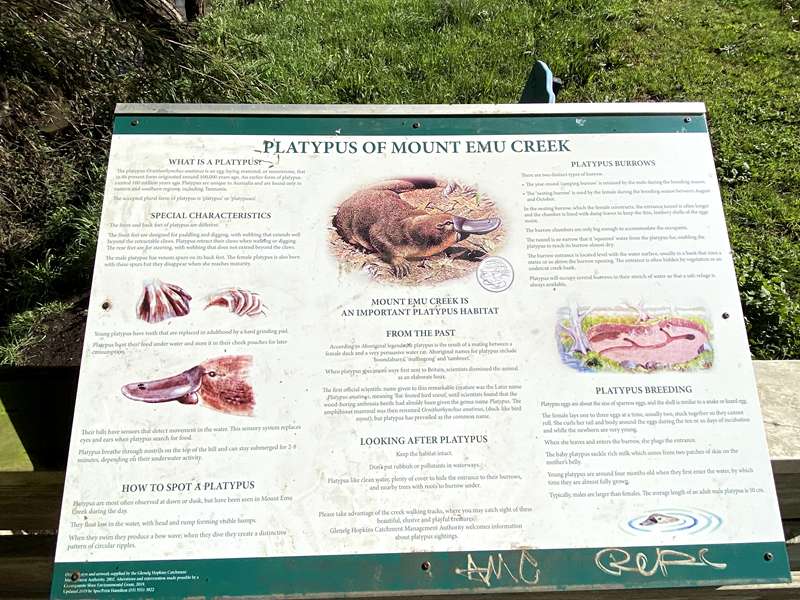
PLATYPUS OF MOUNT EMU CREEK
WHAT IS A PLATYPUS?
The platypus Ornithorhynchus anatinus is an egg-laying mammal, or monotreme, that in its present form originated around 100,000 years ago. An earlier form of platypus existed 100 million years ago. Platypus are unique to Australia and are found only in eastern and southern regions, including Tasmania.
The accepted plural form of platypus is ‘platypus’ or ‘platypuses’.
SPECIAL CHARACTERISTICS
The front and back feet of platypus are different.
The front feet are designed for paddling and digging, with webbing that extends well beyond the retractable claws. Platypus retract their claws when walking or digging. The rear feet are for steering, with webbing that does not extend beyond the claws.
The male platypus has venom spurs on its back feet. The female platypus is also born with these spurs but they disappear when she reaches maturity.
Young platypus have teeth that are replaced in adulthood by a hard grinding pad.
Platypus hunt their food under water and store it in their cheek pouches for later consumption.
Their bills have sensors that detect movement in the water. This sensory system replaces eyes and ears when platypus search for food.
Platypus breathe through nostrils on the top of the bill and can stay submerged for 2-8 minutes, depending on their underwater activity.
HOW TO SPOT A PLATYPUS
Platypus are most often observed at dawn or dusk, but have been seen in Mount Emu Creek during the day.
They float low in the water, with head and rump forming visible humps.
When they swim they produce a bow wave; when they dive they create a distinctive pattern of circular ripples.
FROM THE PAST
According to Aboriginal legends the platypus is the result of a mating between a female duck and a very persuasive water rat. Aboriginal names for platypus include ‘boondaburra’, ‘mallingong’ and ‘tambreet’.
When platypus specimens were first sent to Britain, scientists dismissed the animal as an elaborate hoax.
The first official scientific name given to this remarkable creature was the Latin name Platypus anatinus, meaning ‘flat-footed bird snout’, until scientists found that the wood-boring ambrosia beetle had already been given the genus name Platypus. The amphibious mammal was then renamed Ornithorhynchus anatinus, (duck-like bird snout), but platypus has prevailed as the common name.
LOOKING AFTER PLATYPUS
Keep the habitat intact.
Don’t put rubbish or pollutants in waterways.
Platypus like clean water, plenty of cover to hide the entrance to their burrows, and nearby trees with roots to burrow under.
Please take advantage of the creek walking tracks, where you may catch sight of these beautiful, elusive and playful creatures.
Glenelg Hopkins Catchment Management Authority welcomes information about platypus sightings.
PLATYPUS BURROWS
There are two distinct types of burrow:
- The year-round ‘camping burrow’ is retained by the male during the breeding season.
- The ‘nesting burrow’ is used by the female during the breeding season between August and October.
The burrow chambers are only big enough to accommodate the occupants.
The tunnel is so narrow that it ‘squeezes’ water from the platypus fur, enabling the platypus to reach its burrow almost dry.
The burrow entrance is located level with the water surface, usually in a bank that rises a metre or so above the burrow opening. The entrance is often hidden by vegetation or an undercut creek bank.
Platypus will occupy several burrows in their stretch of water so that a safe refuge is always available.
PLATYPUS BREEDING
Platypus eggs are about the size of sparrow eggs, and the shell is similar to a snake or lizard egg.
The female lays one to three eggs at a time, usually two, stuck together so they cannot roll. She curls her tail and body around the eggs during the ten or so days of incubation and while the newborn are very young.
When she leaves and enters the burrow, she plugs the entrance.
The baby platypus suckle rich milk which oozes from two patches of skin on the mother’s belly.
Young platypus are around four months old when they first enter the water, by which time they are almost fully grown.
Typically, males are larger than females. The average length of an adult male platypus is 50 cm.
Location
33 Montgomery Street, Skipton 3361 View Map


