Port Fairy Historic Walk


The first attempt to settle the area we now know as Victoria took place in 1803 at Sullivans Bay near Sorrento. Due mainly to the lack of fresh water this settlement was subsequently abandoned and it was not until around thirty years later that a permanent settlement was established.
In 1801 Lt. James Grant explored the coast of Victoria on behalf of the British Government in the survey vessel, The Lady Nelson. He named many features along the coast including Portland Bay after the Duke of Portland.
William Dutton a sealer, whaler and master mariner had been visiting the Portland Bay area for several years. In 1829 he erected what he described as a house there and in March 1833 he established a whaling station on behalf of Capt. John Griffiths. Edward Henty, a pastoralist from Tasmania, called at the whaling station while returning from the Spencer Gulf in a failed attempt to find suitable land to expand his pastoral interests. He was impressed by the land he saw at Portland Bay and in November 1834, Edward sailed into the bay aboard the schooner Thistle, to form a settlement. The British Government had not sanctioned this arrival in the Portland Bay area of the Port Phillip District of NSW (as this area was then known) but in many ways it seems that the floodgates had opened.
The Governor of NSW was keen to see orderly settlement of Victoria and to control that settlement. Major Thomas Mitchell. Surveyor General for NSW made an expedition into Victoria’s western districts in 1836—37. Mitchell named many features along the way including Mt Shadwell at Mortlake and the Hopkins River which rises near Ararat and flows to the sea at Warrnambool. Mitchell was surprised to find the Henty Brothers living at Portland although they had not ventured inland. When Mitchell’s glowing reports of “Australia Felix”, as he had called it were published, settlement began in earnest. It was against this backdrop that the Port Fairy area was establishing itself.
As in Portland the first regular European visitors were Bass Strait sealers and whalers on seasonal hunting expeditions from Tasmania. These were tough hard working men who had little time to leave written records so the exact dates are uncertain. It was probably around 1828 that Captain Wishart, on a sailing expedition in his cutter “Fairy”, became caught in a storm. Luckily he found shelter for the night in a little bay and at daybreak, he found that he was at the mouth of an excellent river. He named the bay “Port Fairy”, in honour of his tiny ship.
News of this safe anchorage and fresh water soon spread and two men Penny & Reiby established a bay whaling station on the island at the mouth of the river. In 1835 John Griffiths purchased the whaling station and the island now bears his name. Whales were harpooned in the bay and dragged up on to the island for processing. So many whales were taken that the supply was exhausted by the mid 1840s and the station closed.
During the mid 1830s some of these early seamen crossed over from the island and began to clear and cultivate the rich volcanic soils. They brought sheep and cattle from Tasmania and established a permanent settlement. In 1843 James Atkinson and William Rutledge each purchased 5120 acres from the Crown at the cost of £1 per acre. A condition of buying the land (called a Special Survey) at this low price was that the buyer was required to establish a town and encourage settlers. Atkinson laid out his township and named it “Belfast” after his birthplace. William Rutledge failed to establish a town on his survey and it was considered a failure. Irish immigrants were encouraged to settle here and this strong Celtic influence is still evident in the areas place names, architecture and culture.
Atkinson operated his township under the tenant system where the occupier of the land would pay rent to the land owner. Settlers would build a house at their own cost on land they rented from Atkinson. Because of this system it appears that Atkinson was disliked although this was perhaps unfair as he gave land for community purposes such as schools, churches, lecture hall and library. He also wanted the residents of the town to invest in businesses in the town rather than putting all their financial resources toward purchasing the block of land that their house was built on. Atkinson died in 1862 however his family held onto his lands and it was not until 1886 that the land became available to purchase freehold. In 1887 the residents of Belfast petitioned the Government to rename the town Port Fairy.
In 1862 the disastrous collapse of the local mercantile firm, William Rutledge & Co. dealt the town a paralysing blow. In the ensuing years investors abandoned Port Fairy in favour of other towns such as Warrnambool and the early promise that Port Fairy had shown failed to materialise. Today we have that economic downturn to thank for the many 19th century houses and buildings that remain.
While Port Fairy was finding it’s way in this new colony other towns and villages began to spring up. Batman and his party had arrived in Melbourne in 1835 and it was only sixteen short years later on July 1, 1851 that Victoria was declared a state in it’s own right. And the rest, as they say, is history......................
Port Fairy Historic Walk Map
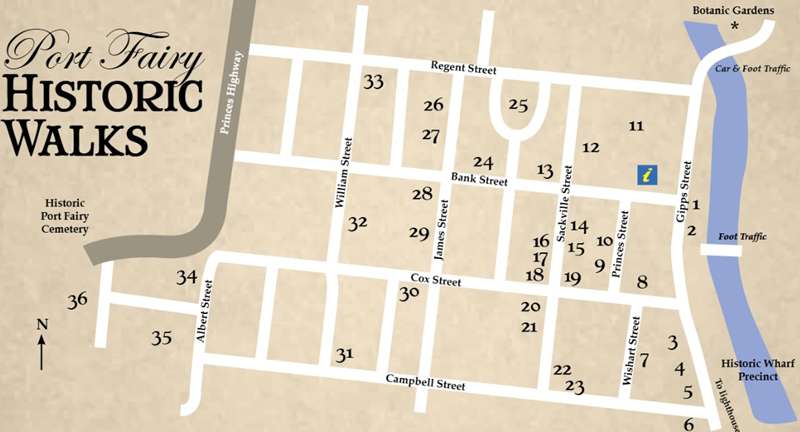
Port Fairy Historic Walk Locations
1. Former Joseph Goble’s Flour Mill - 75 Gipps Street. c.1866, later Port Fairy Butter Factory.
2. Prefabricated Cottages - 61, 63 and 65 Gipps Street. c.1853. Note the common chimney between 61 and 63.
3. Capt. Mills Cottage - 40 Gipps Street, c.1843. The back section is believed to be the oldest house still standing in Victoria.
4. Former Courthouse - 30 Gipps Street, c.1859. Now the Port Fairy History Centre.
5. Former Customs House - 28 Gipps Street, c.1861.
6. Merrijig Inn - 1 Campbell Street, c.1846. Note the stone mile post on the Campbell Street frontage.
7. Wishart Street - Wishart Street, a street full of interesting 19th century villas and cottages.
8. “Emoh” - 8 Cox Street, c.1844. Once home to William and Eliza Rutledge.
9. Former Anglican Church School - 4 Princes Street, c.1852.
10. Paired Cottages - 6-8 Princes Street, c.1859.
11. Railway Goods Shed - Railway Place, c.1890. The railway station was slightly to the west of the building. The line closed in 1977.
12. Sackville Street Cottages - Sackville Street. This block features several interesting mid 19th century cottages.
13. Star of the West Hotel - 76 Sackville Street, c.1856. Once the staging post for Cobb & Co. coaches.
14. Lecture Hall - 67 Sackville Street, c.1882.
15. Former Mechanics Institute Library - 65 Sackville Street, c.1865. Still in use as the local branch library.
16. Former Gazette newspaper office - 46 Sackville Street. Established in 1849.
17. Largely unchanged retail premises of the 19th century - 44 Sackville Street.
18. Former Bank of Australasia - 24 Sackville Street, cnr Cox Street, c.1857.
19. Former Post Office - 25 Sackville Street, cnr Cox Street, c.1880.
20. Former Stag Inn - 22 Sackville Street, cnr Cox Street, c.1847.
21. Paired Cottages - Sackville Street, south of the former Stag Inn. Once used as a bank and council offices. c.1853.
22. Motts Cottage - 5 Sackville Street. Built by William Hooper, c.mid1840s.
23. 19th Century Cottages - Campbell Street. This block contains a number of mid c.19th cottages.
24. Former Victoria Hotel - 36 Bank Street, c.1856. Now in disrepair.
25. St Johns Anglican Church - Church Street. Foundation stone laid in 1854, although the tower was not completed until 1955.
26. Uniting Church - 44 James Street. Formerly the Wesleyan Methodist Church, c.1856.
27. Former school established by Dr Braim - 42 James Street, c.1854.
28. Caledonian Hotel - 41 Bank Street, c.1844.
29. 30 James Street - Interesting house of 3 stories, c.1890s.
30. 51 Cox Street - c.1862. Originally built for Tucker and White, undertakers & cabinet makers.
31. 1 William Street - c.1856. Built from limestone rubble.
32. 29 William Street - Former Webb Bros. Cordial Factory and former drill hall of the Belfast Volunteer Rifles.
33. Former Market Hotel - 51 William Street, c.1873.
34. Somerset House - 16 Albert Street, c.1858.
35. Port Fairy State School, number 1188 - 10 Albert Street, c.1874.
36. St Patrick’s Roman Catholic Church - 487 Princes Highway, c.1859.
Location
Gipps Street, Port Fairy 3284 View Map
Web Links
→ portfairyhistoricalsocietyinc.org.au/heritage


