Port Campbell Jetty


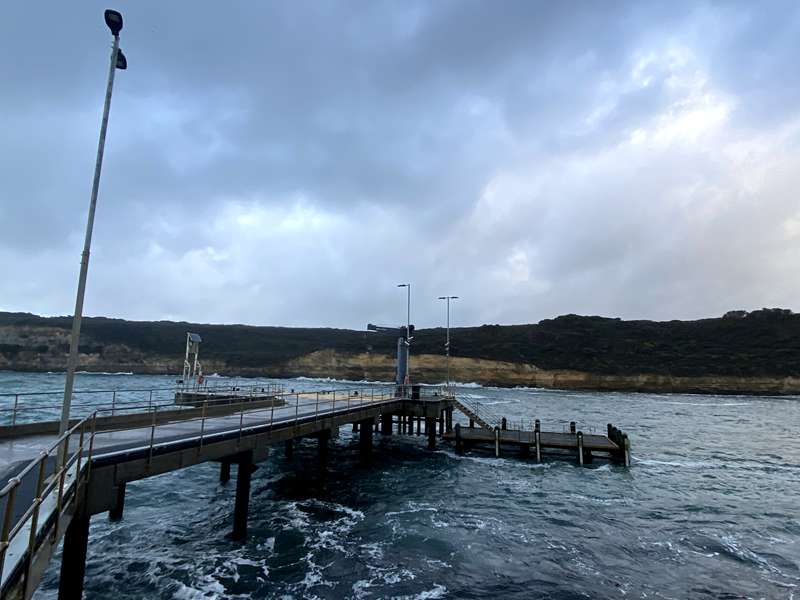
Port Campbell Jetty is a short working pier and popular fishing spot in the sheltered waters of Port Campbell Bay. The 50-metre-long jetty is surrounded by the towering limestone cliffs of the Shipwreck Coast and provides excellent views across the bay, beach and surrounding coastline.
The jetty remains an active port used by local commercial and recreational vessels. As there is no boat ramp, a crane on the jetty lowers boats directly into the water. Visitors may see fishing boats using the crane and unloading their catch.
Facilities and features include:
- 50-metre-long working jetty
- Recreational fishing
- Views across Port Campbell Bay
- Boat-launching crane
- Nearby car parking
- Public toilets on the Port Campbell foreshore
- Beach, picnic facilities, shops and cafes within walking distance
Fishing:
Port Campbell Jetty is a popular fishing location. Depending on the season and conditions, catches may include Australian salmon, silver trevally, squid, snapper, flathead, snook, wrasse, gummy shark and King George whiting.
A Victorian recreational fishing licence may be required. Observe fishing regulations, size and bag limits and any restrictions displayed at the jetty.
History:
A pier had been constructed at Port Campbell by 1878, following the wreck of the Loch Ard. The original forty-metre T-shaped structure assisted with sea rescues and salvage operations and provided a landing place for goods and produce serving the isolated district.
Historic storage sheds near the jetty held emergency ship-rescue equipment, including rockets used to carry rescue lines from land to vessels in distress. The small present-day pier was built in 1938.
Port Campbell developed as an important local port because its bay provided a relatively sheltered landing place along an otherwise treacherous section of the Southern Ocean coastline.
Access for Dogs:
Dog access rules may vary between the jetty, foreshore and adjoining Port Campbell National Park. Dogs are not permitted in Port Campbell National Park. Check signs at the jetty and keep dogs on a leash in shared public areas.
Opening Hours:
Open at all times unless temporarily restricted for port operations, maintenance or hazardous weather. Check the official Port of Port Campbell page for current notices.
Cost:
Free.
At the entrance road to the jetty there is the following signage.
Port Campbell Jetty
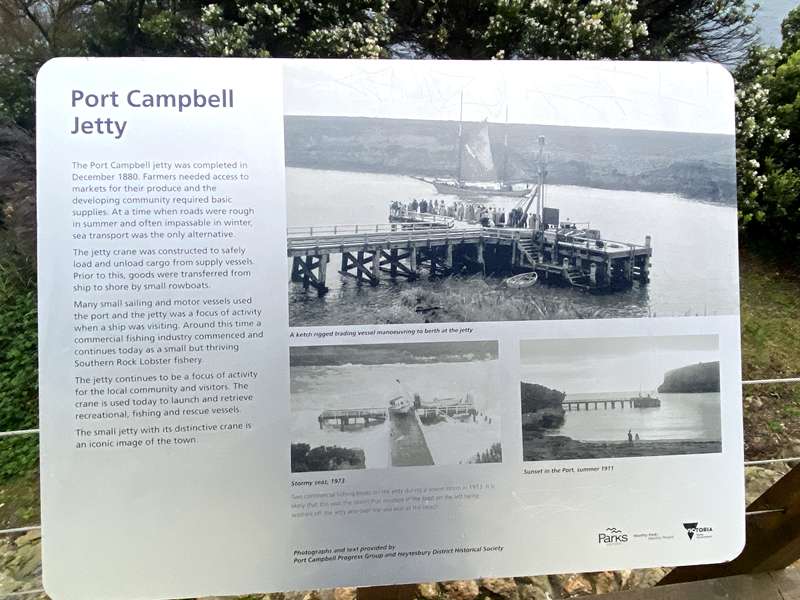
The Port Campbell jetty was completed in December 1880. Farmers needed access to markets for their produce and the developing community required basic supplies. At a time when roads were rough in summer and often impassable in winter, sea transport was the only alternative.
The jetty crane was constructed to safely load and unload cargo from supply vessels. Prior to this, goods were transferred from ship to shore by small rowboats.
Many small sailing and motor vessels used the port and the jetty was a focus of activity when a ship was visiting. Around this time a commercial fishing industry commenced and continues today as a small but thriving Southern Rock Lobster fishery.
The jetty continues to be a focus of activity for the local community and visitors. The crane is used today to launch and retrieve recreational, fishing and rescue vessels. The small jetty with its distinctive crane is an iconic image of the town
The Napier
Iron and timber steamer, 98 tons.
Built: Goolwa, South Australia, 1874.
Wrecked: Port Campbell Bay, September 1878.
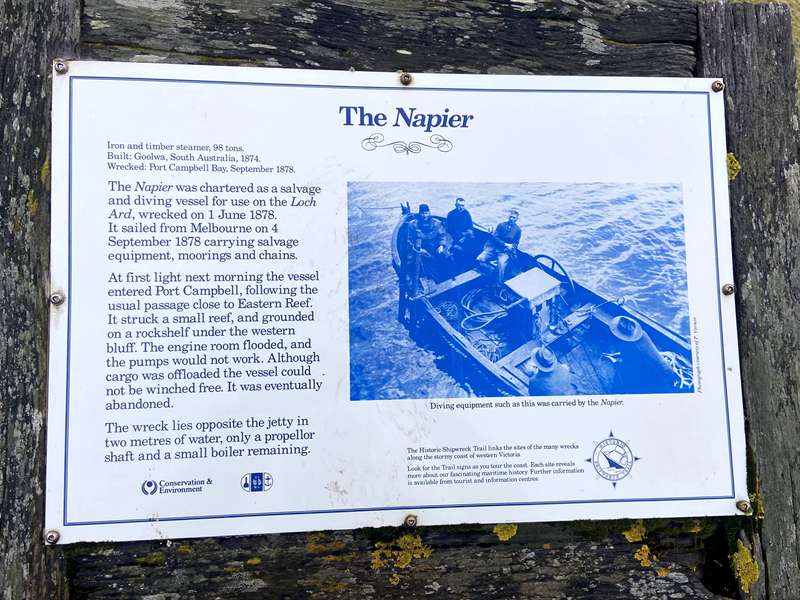
The Napier was chartered as a salvage and diving vessel for use on the Loch Ard, wrecked on 1 June 1878. It sailed from Melbourne on 4 September 1878 carrying salvage equipment, moorings and chains.
At first light next morning the vessel entered Port Campbell, following the usual passage close to Eastern Reef. It struck a small reef, and grounded on a rockshelf under the western bluff. The engine room flooded, and the pumps would not work. Although cargo was offloaded the vessel could not be winched free. It was eventually abandoned.
The wreck lies opposite the jetty in two metres of water, only a propellor shaft and a small boiler remaining.
Port Campbell Rocket Crew
The rough, often unpredictable ocean of the south west coast of Victoria has seen many ships wrecked and lives lost. The Port Campbell Life Saving Station was commissioned about 1890. Unlike most other stations on the Victorian coast, there was no lifeboat, but a well-trained rocket crew operated from here until at least 1947.
The crew trained regularly, firing the rocket across the bay, usually in the presence of many interested onlookers. The equipment was stored near the jetty entrance until 1936 when this current building was completed.
A rocket carrying a light line was aimed over the wrecked ship. The sailors then hauled aboard a hawser (heavy rope) and using a breeches buoy and pulley system they could be brought ashore.
The Port Campbell rocket crew attended the wreck of the Fiji on September 5th, 1891, where 15 of the crew of 26 were rescued. In August 1892, the crew attended the wreck of the Newfield which lay too far offshore for the successful use of the rocket apparatus.
Port Campbell Cliff Rescue Squad
The Port Campbell Cliff Rescue Squad was formed on March 13th, 1963 following the tragic loss of three members of the Brassel family at Beacon Steps.
Local policeman, First Constable Duncan Hales, recognised the need for a crew trained in vertical rescue and recovery. The steep cliffs and often treacherous ocean meant that rescue approaches from the sea were rarely possible.
Initial training was provided by the Police Search and Rescue Squad. Equipment was basic by modern standards. For many years the Squad stored its gear in the rocket shed alongside the old rocket apparatus.
The Cliff Rescue Squad is still active as a unit of the Victorian State Emergency Service. While the techniques and equipment have changed, the spirit of the original volunteers remains.
Photos:
Location
2 Lord Street, Port Campbell 3269 View Map
Web Links
→ www.greatoceanroadauthority.vic.gov.au/Land-We-Manage/Ports/Port-of-Port-Campbell


