Park Orchards Heritage Trail


The 4.5km Park Orchards Heritage Trail includes interpretive signs highlighting the area's history.
In the early 1800s, only occasional herds of grazing cattle moved through the virgin bushland that was to become Park Orchards. The hills were heavily timbered with wattle, stringybark, box, messmate and peppermint gums. Open areas held patches of grass in which wild flowers and native orchids grew. Kangaroos and wallabies wore tracks through the bush. Echidnas and wombats hid in the undergrowth. Silver possums swung among the trees and bandicoots were seen by keen-eyed bushmen. It was splendid country and in the 1870s became known as The Park.
All of Park Orchards rests on two Crown Allotments purchased by Francis McDonnell in 1874 and Charles Heape in 1875. Three of the earliest settlers in the area - Thomas Stinton, Euphemie Falconer and William Harris - bought nearby land in sections of one square mile for the price of 1 pound per acre. They were followed by Tom and Eliza Petty who purchased 559 acres in 1902.
In 1926, the Park Orchards Country Club Estate was designed by licensed surveyor and pioneer town planner, Saxil Tuxen and his partner, George Miller. Both men had worked previously with well-known landscape architect Walter Burley Griffin. The clients were timber merchants and developers Australis Sharp and John Taylor, with land owners, sisters, Eva Jane and Minnie Gibb. The Gibbs, along with William Sell, purchased their 559 acres from Eliza Petty of the prominent Doncaster orcharding family.
The Park Orchards Country Club Estate was an imaginative and ambitious scheme where purchasers of the 650 half-acre blocks would become members of the country club. They would then enjoy access to open air sporting facilities, including golf links, tennis courts, a swimming pool, oval and clubhouse. The idea was to create a family playground where life would be "healthy, pleasurable and worth living." Sadly, the the estate never reached its potential.
Park Orchards remains one of the most uniquely planned suburbs in Australia and is the finest surviving example of Tuxen's work. It includes graceful sweeping curved roads; extensive park space and open areas; the use of Park Road as the "backbone" of the estate; and Tuxen's trademark feature, concentric circles - in this case surrounding a large hill - creating attractive views from all points of Dirlton Reserve.
The estate was subdivided into large blocks so houses could be set amongst trees and shrubs. In the gardens of Park Orchards today, many of Tom Petty's original fruit trees continue to grow and there are radiata pines in abundance, relics of Australis Sharp and John Taylor's pine plantations.
In addition to the beauty of its natural bushland, Park Orchards has always maintained a strong community spirit. Local residents can take credit for many noteworthy achievements that make the town special through their work with the Park Orchards Ratepayers Association - whose goal was to maintain the picturesque character of the district, act as a catalyst for improvement and as a watchdog for unwanted development.
When Australis Sharp planned the estate in 1926, he said: "To owners of motor cars and vehicles, Park Orchards opens up a new vista in life where the work-a-day world can be most speedily changed to an environment of healthy and pleasurable associations."
The quality of life he envisaged is still enjoyed in Park Orchards today.
Park Orchards Heritage Trail Map
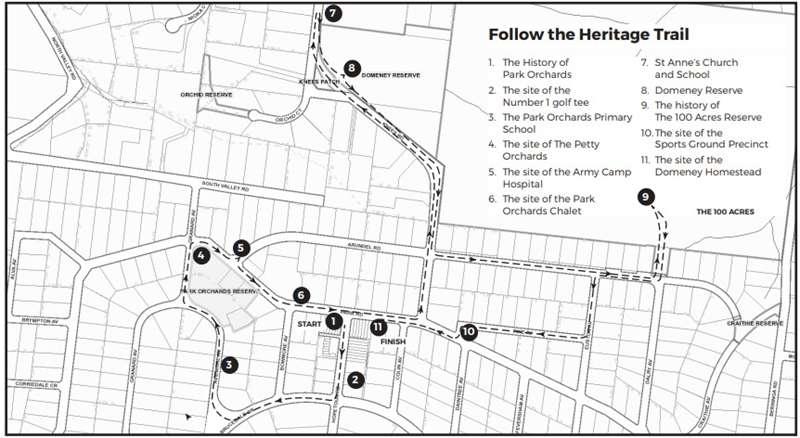
Points of interest on the trail are:
Site 1. The History of Park Orchards
You can start the Park Orchards Heritage Trail walk at any point along the map. Each site has a sign noting the interesting history of that site. The distance of this walk is approximately 4.5km.
In the early 1800s, only occasional herds of grazing cattle moved through the virgin bushland that was to become Park Orchards. The hills were heavily timbered with wattle, stringybark, box, messmate and peppermint gums. Open areas held patches of grass in which wild flowers and native orchids grew. Kangaroos and wallabies wore tracks through the bush. Echidnas and wombats hid in the undergrowth. Silver possums swung among the trees and bandicoots were seen by keen-eyed bushmen. It was splendid country and in the 1870s became known as The Park.
All of Park Orchards rests on two Crown Allotments purchased by Francis McDonnell in 1874 and Charles Heape in 1875. Three of the earliest settlers in the area - Thomas Sinton, Euphemie Falconer and William Harris - bought nearby land in sections of one square mile for the price of 1 pound per acre. They were followed by Tom and Eliza Petty who purchased 559 acres in 1902.
In 1926, the Park Orchards Country Club Estate was designed by licensed surveyor and pioneer town planner Saxil Tuxen and his partner, George Muller. Both men had worked previously with well-known landscape architect Walter Burley Griffin. The clients were timber merchants and developers Australia Sharp and John Taylor, with land owners, sisters Eva Jane and Minnie Cibb. The Cibbs, along with William Sell, purchased 559 acres from Eliza Petty of the prominent Doncaster orcharding family.
The Park Orchards Country Club Estate was an imaginative and ambitious scheme where purchasers of the 650 half-acre blocks would become members of the country club. They would then enjoy access to open air sporting facilities, including golf links, tennis courts, a swimming pool, oval and clubhouse. The idea was to create a family playground where life would be healthy, pleasurable and worth living. Sadly, the Depression of 1930 meant few blocks were sold and the estate never reached its potential.
Park Orchards remains one of the most uniquely planned suburbs in Australia and is the finest surviving example of Tuxen's work. It includes graceful sweeping curved roads, extensive park space and open areas, the use of Park Road as the "backbone" of the estate, and Tuxen's trademark feature, concentric circles - in this case surrounding a large hill - creating attractive views from all points of Dilton Reserve.
The estate was subdivided into large blocks so houses could be set amongst trees and shrubs. In the gardens of Park Orchards today, many of Tom Petty's original fruit trees continue to grow and there are radiata pines in abundance, relics of Australis Sharp and John Taylor's pine plantations.
In addition to the beauty of its natural bushland, Park Orchards has always maintained a strong community spirit. Local residents can take credit for many noteworthy achievements that make the town special through their work with the Park Orchards Ratepayers Association - whose goal was to maintain the picturesque character of the district and act as a catalyst for improvement and as a watchdog for unwanted development. When Australis Sharp planned the estate in 1926, he said: "To owners of motor cars and vehicles, Park Orchards opens up a new vista in life where the work-a-day world can be most speedily changed to an environment of healthy and pleasurable associations." The quality of life he envisaged is still enjoyed in Park Orchards today.
Site 2. The site of the Number 1 golf tee
Park Orchards had a 9-hole golf course which formed part of the original Country Club estate.
Site 3. The Park Orchards Primary School
Children initially went to Warrandyte and then North Ringwood prior to the school opening in 1962.
Site 4. The site of The Petty Orchards
In 1902 Tom Petty purchased 559 acres in Park Orchards. His name is still associated with the orchards locally.
Site 5. The site of the Army Camp Hospital
During the war 800 troops were stationed in Park Orchards. The original cabin on this site served as a hospital.
Site 6. The site of the Park Orchards Chalet
The original building on this site has a remarkable history including as the clubhouse of the Country Club Estate, an entertainment venue and the site of the army signal station during World War II.
Site 7. St Anne's Church and School
The small chapel on this site has a history dating back to wartime and has been repositioned three times.
Site 8. Domeney Reserve
Domeney Reserve was named after Bill Domeney, one of the original pioneers of Park Orchards.
Site 9. The history of The 100 Acres Reserve
This area is representative of the original flora and fauna and topography of the surrounding country side.
Site 10. The site of the Sports Ground Precinct
The Country Club Estate boasted an oval and tennis courts which were sited in this area.
Site 11. The site of the Domeney Homestead
This was the site of Bill Domeney's home depicted in the photograph. It is representative of six of the original properties.
The Park Orchards Heritage Trail was opened on 19 May 2019 and celebrates 40 years of service to our local Community by the Lions Club of Park Orchards.
Location
600 Park Road, Park Orchards 3114 View Map
Web Links
→ Park Orchards Heritage Trail (Walking Maps)
→ Park Orchards Heritage Trail Brochure


