Northern Victoria War Heritage Sites


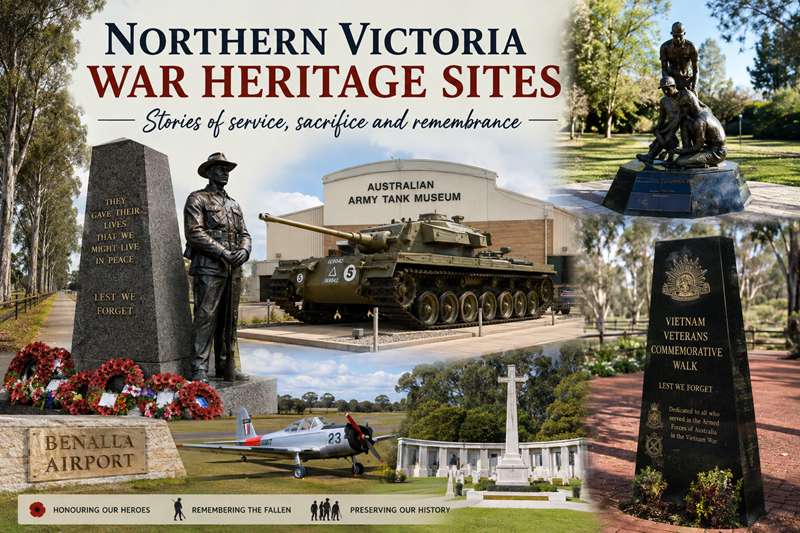
Northern Victoria has a remarkable collection of places connected with Australia's military history. Memorials, museums, former training camps, prisoner-of-war sites, cemeteries and commemorative landscapes tell stories ranging from the First and Second World Wars to the Vietnam War and Australia's post-war migration story.
The sites stretch from Melbourne's northern suburbs through Seymour and the Goulburn Valley to Benalla, Wodonga and Bonegilla. Together they provide an opportunity to explore stories of service, sacrifice, courage, internment, military training and remembrance.
This was not a 'land fit for heroes', but a land of heroes!
Stand in the Calder Woodburn Memorial Avenue and reflect on the need of one man to immortalise the sacrifice of his son and others like him. See the memorials built to honour the service of men and women, such as ‘Weary’ Dunlop. Be moved by the evocative Vietnam Veterans Commemorative Walk at Seymour.
Hear the stories of the Italian, German and Japanese prisoners of war detained during the Second World War. Memorials to those who died while interned are found in the Tatura and Murchison area.
Take in the Wodonga area, rich in both army and migrant history. Why not try something different and plan a special vintage flight at the Benalla Aviation Museum.
Follow in the footsteps of raw recruits as they travelled by train or truck to training camps. Camps in Seymour, Puckapunyal, Benalla and Bonegilla received the young enlistees and prepared them for War. Eager to serve and filled with the spirit of adventure, they passed through the camps and left to fight overseas. So many of them did not return.
1. ANZAC MEMORIAL, NORTHCOTE A fitting tribute
Set inside the 13-hectare All Nations Park, the Anzac Memorial honours those who fought in the two World Wars. The memorial features a Veterans Walk and a bronze sculpture of HMAS Berrima, which served in Australia’s first naval conflict in WWI. All Nations Park, Dennis Street, Northcote.
2. HEIDELBERG REPAT Care and commemoration
Opening as a military hospital in 1941, this facility became a repatriation hospital in 1947. Memorabilia, plaques, a Gallipoli Garden Memorial and a recent chapel with stained glass windows, acknowledge this special history. Banksia Street, Heidelberg.
3. SIGNALS CORP MUSEUM Keeping the lines of communication open
This museum is dedicated to the history of the Royal Australian Signals Corp. The museum holds a large collection of operator and maintenance manuals and a reference library is available. Simpson Barracks, Molloy Road, Macleod.
4. PUCKAPUNYAL ARMY BASE Preparing troops for combat
Opening in 1939, the Base has prepared troops for WWII, the Korean and Vietnam Wars, and is still used today. The Australian Army Tank Museum has a display of over 70 armoured fighting vehicles. Puckapunyal Army Base.
5. ITALIAN POW MEMORIAL Enemies, only through war
In WWII, 4,000 Italian, German and Japanese POWs were detained at Murchison. Those who died at the camp were buried at the local cemetery. They were later moved to a striking mausoleum, the Ossario. Cemetery, Willoughby Street, Murchison.
6. CALDER WOODBURN MEMORIAL AVENUE A living tribute to a son
Unusually, Eucalyptus species are used for this WWII Avenue, spanning 20km of the Goulburn Highway. Planted by ‘Fen’ Woodburn, it memorialises his son Calder and 110 local servicemen who died in the conflict. Goulburn Valley Highway, Shepparton.
7. PRIVATE ROBERT MACTIER Bravery in duty
The Private Robert Mactier Statue, in a park of the same name, was unveiled on 31st October 2014. Posthumously awarded the Victoria Cross in 1918, Mactier was born and raised in Tatura. Robert Mactier VC Memorial Garden, Hogan Street, Tatura.
8. TATURA WARTIME CAMPS MUSEUM Sinking HMAS Sydney
Explore the history of POWs and internees who occupied wartime camps. Tatura Irrigation and War Time Camps Museum contains archival material and artefacts, and conducts a tour to Camp 1 each October. 49 Hogan St, Tatura.
9. GERMAN WAR CEMETERY Australia’s first war cemetery
Established in 1958, this cemetery contains the remains of 250 internees and POWs from both World Wars. An Iron cross identifies POWs, a Latin cross identifies the civilians. Mulcahy Road, Tatura.
10. SHEPPARTON WAR MEMORIAL Celebrating mateship and courage
Two dramatic sculptures, Web Gilbert’s 1924 work ‘Helping Hand’ and Bela Angyal’s 2000 piece ‘Mateship’ stand at the Shepparton and District War Memorial. Learn about Private Nicholls who enlisted at 16 and was twice decorated. Corner Fryers & Welsford Street, Shepparton.
11. BANDIANA ARMY MUSEUM The ‘stuff’ to serve an army
Vehicles, artillery, uniforms, medals, ration packs, hexamine stoves – even a tank. All this and more in this eclectic museum! Gaza Ridge Barracks, South Bandiana.
12. BONEGILLA MUSEUM Block 19 – of national significance
Block 19 is the last remnant of the Bonegilla Army Camp, which was used as a migrant reception centre from 1947. Later used again by the Army, the site is now a museum. 82 Bonegilla Road, Bonegilla.
13. BENALLA AVIATION MUSEUM Up, up and away
This museum focuses on military air training history with working displays, flight simulators and restored jets. Book flights on a vintage training plane. Benalla Airport, Samaria Road.
14. WEARY DUNLOP STATUE, HEC WALLER MEMORIAL Legends of World War II Sir Edward ‘Weary’ Dunlop stands at the entrance to the Botanic Gardens. A granite memorial to Captain ‘Hec’ Waller, commander of the Tenth Destroyer Flotilla in the Mediterranean, is nearby. Midland Highway, Benalla.
15. HONOURING OUR HEROES The bravest of towns
Three statues honour local Victoria Cross recipients: Lieutenant Leslie Maygar, ALH, (Boer War), Corporal Alexander Burton, AIF, (Gallipoli) and Lieutenant Frederick Tubb, AIF, (Gallipoli). RSL Park, Kirkland Ave West, Euroa.
16. VIETNAM VETERANS COMMEMORATIVE WALK Sit and reflect
Interpretive panels, memorabilia, service lists and photographs - many supplied by veterans - tell the story of a controversial war. Vietnam is represented with blue gums planted to symbolise rubber trees and grasses as the rice paddies. High Street, Seymour.
17. AUSTRALIAN LIGHT HORSE PARK Charge of Beersheba
The site of the Seymour Camp, used in WWI for training Infantry and Light Horse Regiments. Ruins and relics of the camp remain. Goulburn Valley Highway, Seymour East.


