Nagambie - Goulburn Gates Walk


Park on either side of the river for this 4.9km return walk to view the four sets of Goulburn Gates that control water flow out of the weir into Northern Victoria's irrigation system.
Local History
In 1887 weir wall construction commenced on the Goulburn River at Nagambie. Work was completed in 1891 at a cost of 113,599 pounds. This was the first of Australia's significant irrigation network infrastructure, designed to control irrigation diversions throughout northern Victoria.
It was thought to be a visionary project at the time. The Weir would raise the Goulburn River level in such a way that water would flow by gravity along the three main irrigation waterways, Stuart Murray Canal, Cattanach Canal and the East Goulburn Main Channel. You will visit these in your walk.
The Stuart Murray Canal supplies parts of the Central Goulburn Irrigation System. Both the Stuart Murray Canal and Cattanach Canals divert water to Waranga Basin for extra supply to the Goulburn irrigation system. The East Goulburn Main Channel supplies the Shepparton Irrigation System.
Included in the construction was one of the first hydroelectric turbines. People came from all over to witness electric light as it lit the weir gates and the fine spray when the gates were open at night.
Evidence of the significance of the weir from its early days comes from in the form of the twenty years it was depicted on the ten shilling note and the back of the half sovereign coin. It also became a significant location for recreational and social events.
The granite blocks of the downstream face were quarried at nearby Mt Black. The concrete walls were rooted in the underlying bedrock. The metal superstructure had cast iron piers supporting 21 cast iron and wrought iron gates. The gates were lowered into indentations in the top of the wall to allow river and flood flows. Lowering and raising the gates was powered by water driven turbines.
Stabilising and refurbishment works were undertaken in 1983 and 1988. Two of the original western gates and lifting gear have been preserved in recognition of this special piece of Victorian history.
Created by the weir upstream, Lake Nagambie is a great place to visit too. A popular place for fishing, it is also well known for water sports. Lake Nagambie is home to major annual events such as rowing regattas and water skiing.
Location
Car parks on either the east or west bank of the river cater for starting anywhere along this easy return walk. The walk is based on viewing 4 sets of Goulburn Gates controlling water flow out of the weir and into the main irrigation channels of the region.
Note: Weir wall crossings are closed at 4pm.
Map of Walk Route
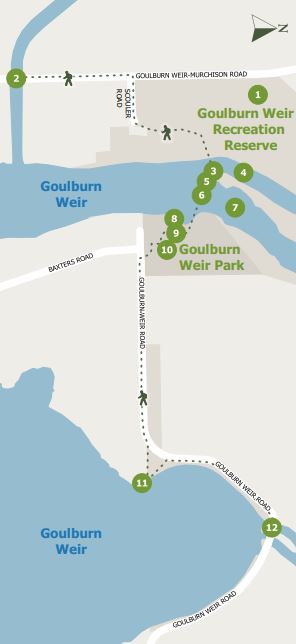
Points on map:
1. Goulburn Weir Recreation Reserve (west)
2. Cattanach Canal Gates
3. Control house and gears
4. Stuart Murray Canal
5. Gear systems
6. Goulburn River Gates
7. Goulburn River
8. Mobility assist device viewing area
9. Playground
10. BBQs, picnic grounds and toilets
11. River access
12. East Murchison Main Channel Gates
Interactive Map
Options: To shorten the walk by approximately 2km, simply exclude one set of gates from either side.
Facilities include car parking, a playground, BBQs, picnic tables and toilets.
Access for Dogs:
Dogs must be on-leash.
Information Signage
The Importance of Goulburn Weir
Goulburn Weir is vital to the Goulburn-Murray Irrigation District. The Goulburn-Murray District System encompasses some of Victoria's richest irrigated farmlands by negating the effects of low rainfall and variable river flow. Its produce - which includes fruit, vegetable, dairy, beef and lamb - represents 24 per cent of the state's annual agricultural production in value. The weir as a water diversion structure is the only one of its type on the Goulburn River. Goulburn Weir receives water that has travelled down the river.
Where the water goes
Once the water reaches the weir it can be diverted eastwards via the East Goulburn Main Channel where it goes on to supply the Shepparton area. Water also gets diverted to the west via the Stuart Murray and Cattanach Canal's which services the Central Goulburn area. Water from the weir also fills Waranga Basin which can supply the Central Goulburn, Rochester-Campaspe and the Pyramid-Boort areas.
Did you know?
The Goulburn River is Victoria's largest river basin. It flows 570 kilometres and coven 1.6 million hectares or 7.1 per cent of Victoria. The source of the Goulburn River is near Woods Point in the Great Dividing Range. The river runs down a winding path through Central Victoria before eventually meeting the Murray River near Echuca.
Water-harvesting and the construction and operation of Goulburn Weir have allowed river flows to be managed throughout the year. Water levels tend to be at their lowest in winter and spring and at their highest in summer and autumn.
The Brains Behind the Weir
ALFRED DEAKIN
Alfred Deakin was known as the Father of Irrigation in Australia. He began as Victoria's Minister for Water Supply in 1884. Later in the year, Deakin chaired the Royal Commission on Water Supply which recommended the use of irrigated water in large areas of unproductive land. Deakin's First Progress Report from the Royal Commission also stressed the need for state control of ownership over all sources of water supply.
The construction of Goulburn Weir had first been proposed to Victoria's parliament in 1880 but it was Deakin who persuaded parliament to approve the construction of the weir as part of the Irrigation Act of 1886. in his speech to introduce the act to parliament, Deakin said if it was not adopted, "the population will be swept away, and the land must go back simply to sheep-farming.' In 1903, Deakin would become Australia's second ever Prime Minister.
STUART MURRAY
Stuart Murray was appointed by Alfred Deakin as secretary to Royal Commission on Water Supply in 1886 and later that same year was named as engineer in chief of the Water Supply Department, where he had overall responsibility for the construction of Goulburn Weir. Murray was already familiar with the region having previously worked as an engineer for the United Echuca & Waranga Waterworks Trust. He would go on to become the first chair of the State Rivers and Water Supply Commission in 1906.
WILLIAM HENDERSON
William Henderson ran his own engineering practice in Scotland. He emigrated to Victoria in 1886 and soon afterward was appointed by the Water Supply Department to carry out detailed design, contract documentation and supervision of Goulburn Weir's construction. Henderson continued working with the department after the construction of the weir, aiding investigations into water supply for stock watering and domestic purposes in the Mallee region.
HUGH MCCOLL
Hugh McColl was a politician who vociferously advocated for town water supply and irrigation in northern Victoria for more than half a century. His advocacy for water supply in the state's north helped garner public interest and sway key decision-makers, Alfred Deakin included. McColl would unfortunately not live to see his vision fully realised, as he passed away just two years before construction of Goulburn Weir began.
Did you know?
In 1885, a year after being named Minister for Water Supply, Alfred Deakin travelled to America to research their irrigation methods, as there was a lack of information on irrigation techniques in Australia at the time. From this tour, he would write the report Irrigation in Western America, a copy of which still resides in the Jefferson Reading Room of the Library of Congress in Washington. The year after Deakin's research trip, the proposal for Goulburn Weir was approved by parliament.
Out of the Bedrock
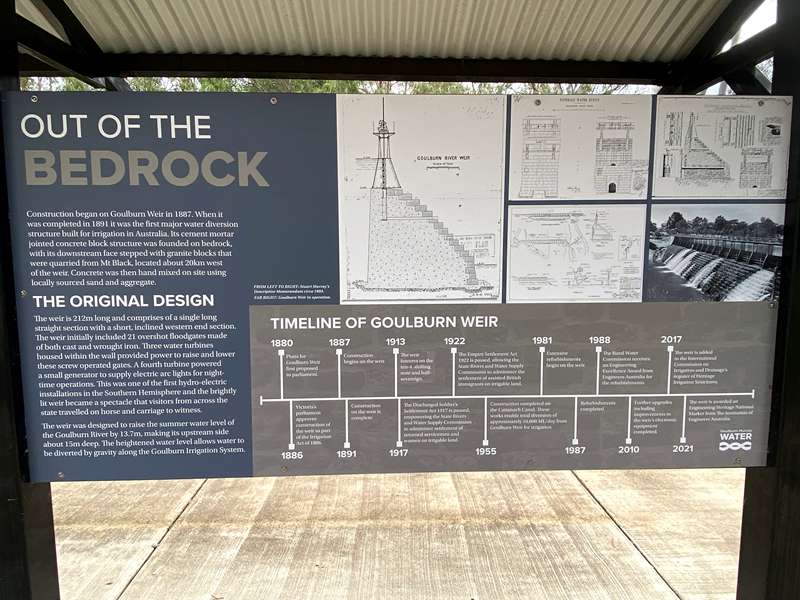
Construction began on Goulburn Weir in 1887. When it was completed in 1891 it was the first major water diversion structure built for irrigation in Australia. Its cement mortar jointed concrete block structure was founded on bedrock, with its downstream face stepped with granite blocks that were quarried from Mt Black, located about 20km west of the weir. Concrete was then hand mixed on site using locally sourced sand and aggregate.
The Original Design
The weir is 212m long and comprises of a single long straight section with a short, inclined western end section. The weir initially included 21 overshot floodgates made of both cast and wrought iron. Three water turbines housed within the wall provided power to raise and lower these screw operated gates. A fourth turbine powered a small generator to supply electric arc lights for night-time operations. This was one of the first hydro-electric installations in the Southern Hemisphere and the brightly lit weir became a spectacle that visitors from across the state travelled on horse and carriage to witness.
The weir was designed to raise the summer water level of the Goulburn River by 13.7m, making its upstream side about 15m deep. The heightened water level allows water to be diverted by gravity along the Goulburn Irrigation System.
Growing the State
Goulburn Weir supported growth in Victoria's north-west by creating farming opportunities where there were previously very few. This growth was hastened by the passing of the Discharged Soldier's Settlement Act 1917. The act empowered the State Rivers and Water Supply Commission to administer settlement of returned servicemen and women on irrigable land. Many World War I veterans were settled on properties in the region, which was sparsely developed at the time.
Further Settlement in the North
The Empire Settlement Act 1922 then served a similar purpose, allowing the commission to administer the settlement of assisted British immigrants on irrigable land.
After World War II there was a boom in the construction of water storages, including the enlargement of Lake Eildon. This further benefited irrigators in the state's northwest and saw the region grow even more.
Managing the Water
Since Goulburn Weir was constructed, various authorities have been charged with managing it. The need for legislative control led to the passage of the Waterworks Act in 1865. The actual administration of these statutory provisions came to be undertaken by the Victorian Water Supply Department.
Gradually there was a recognition that there was a need for a single more powerful and independent coordinating authority to manage Victoria's water resources. The Water Act of 1905 subsequently vested overall responsibility for conservation and distribution of Victoria's rural water supplies for irrigation, industrial and urban purposes with the State Rivers and Water Supply Commission. The Commission came into power in 1906. It was only in 1984 that it was eventually superseded by the Rural Water Commission.
However, the Rural Water Commission would be short-lived, as it was disaggregated into several smaller authorities in 1994, one of which was GMW.
Did you know?
The weir's significance was acknowledged when an illustration of it featured on the 10-shilling note between 1913 and 1933. The 10-shilling notes the weir appeared on were the first banknotes to be issued in Australia and the first 10-shilling notes to be printed in Australia. They were intended to replace the half-sovereign gold coin.
Time for an Upgrade
In 1981, more than 90 years after the Goulburn Weir was built, a major refurbishment of the weir began. The failure of a gate spindle in 1978 brought attention to how the sustained use of the superstructure had caused its condition to deteriorate and made refurbishments necessary.
The project included the installation of nine steel radial gates between newly built concrete piers and further stabilised the whole structure with stressed anchors and a new reinforced concrete downstream toe. The Victorian Government fully funded the $9.9 million refurbishments.
A Nod to the Past
While the upgrades to the weir were dramatic, much consideration was given to conserving its historical aspects. Two of the original iron gates were rebuilt and retained along with the adjacent turbine house. Some of the original gears that were used to operate the overshot floodgates also remain on the weir. While they are not used, they remain operational.
Efforts Rewarded
It was a considerable task to preserve the history of the weir and also ensure it met modern safety standards. The refurbishments were a great success and led to the Rural Water Commission receiving an Engineering Excellence Award from Engineers Australia in 1988. The performance of the weir since upgrading has been without incident.
Modern Solutions
Further improvements were made to the weir in 2010. This project included the strengthening of the gates and operating platform, the fitting of gate locking devices to the weir platform, an upgrade to the existing gate hoists and improvements to the weir's electronic equipment and the software used to monitor and control the radial gates.
Did you know?
One of the weir's original gates, two pier supports and a complete set of lifting gear were donated to Australia's National Museum in Canberra in 2010. Gallery Development Project lead curator George Main described the gate as a "very culturally, historically and economically significant piece of infrastructure".
Goulburn Weir Today
Goulburn Weir remains a vital structure in servicing many of Goulburn-Murray Water's customers. On average, 91 per cent of water released from Lake Eildon is diverted for irrigation purposes at Goulburn Weir. The weir forms Lake Nagambie, around which recreation, farming and housing developments have grown.
An average of 1,768,000ML is diverted through Goulburn Weir each year. Lake Nagambie itself has a capacity of 25,550ML, which means the weir diverts enough water each year to fill Lake Nagambie more than 69 times over.
Recognising its Significance
In 2017, Goulburn Weir was added to the International Commission on Irrigation and Drainage's Register of Heritage Irrigation Structures for "being the first major diversion structure built for irrigation development in Australia and supporting some of Victoria's best irrigated agriculture for more than 100 years'.
In 2021, the weir was accorded national recognition with the award of an Engineering Heritage National Marker from The Institution of Engineers Australia.
Goulburn Weir is also recognised by the National Trust of Australia as a place of high significance.
Did you know?
The construction of the original Goulburn Weir cost 106,000 pounds, about $11 million by today's equivalent. Parliament authorised the Treasurer of Victoria to issue 20,000 pounds towards the construction of the weir as part of the Irrigation Act of 1886. Parliament issued another 75,000 pounds to the construction of the weir as part of the Water Supply Loans Act of 1887.
Location
240 Goulburn Weir Road, Nagambie 3608 View Map
Web Links
→ Walk Notes - Goulburn Gates Walk (PDF)
→ Goulburn Gates Walk, Goulburn Weir (Walking Maps)


