Mortlake - Mount Shadwell Quarry Olivine Fossicking

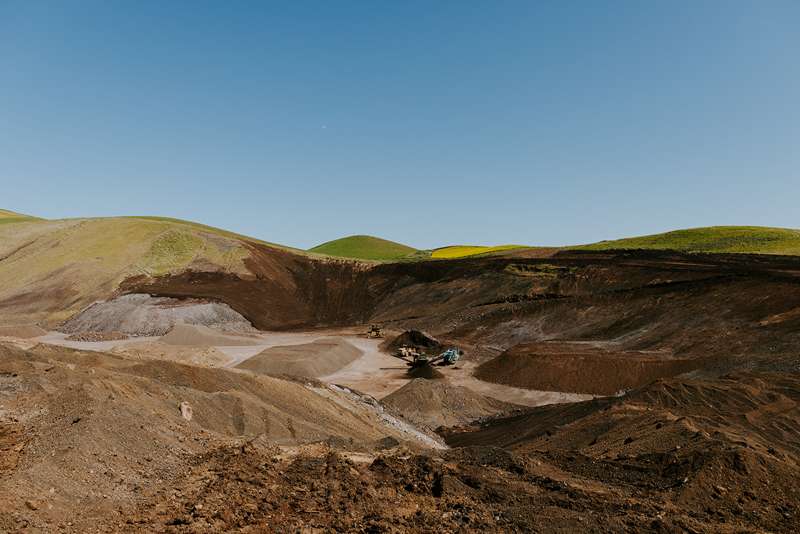
Mount Shadwell Quarry offers the unusual opportunity to fossick for olivine crystals in the volcanic landscape near Mortlake.
Olivine is an olive-green, grey-green or brown mineral found in basalt, peridotite and other igneous rocks. Gem-quality olivine is known as peridot.
At Mount Shadwell, olivine can be found inside large rocks ejected during volcanic eruptions, known as volcanic bombs. Fossickers can search these rocks for the distinctive green crystals and take home an unusual souvenir of the volcanic landscape.
Mount Shadwell is an extinct volcano and the quarry exposes volcanic material from its eruptions. Mortlake is known as Australia's olivine capital because of the quantity and quality of olivine found in the area.
This is an operating quarry and fossicking is only available during designated public fossicking sessions. Visitors must follow all directions and safety requirements when entering the quarry.
Opening Hours:
Fossicking is available on selected dates. See the Mortlake Olivine Fossicking booking page for current dates and times.
Cost:
See the Mortlake Olivine Fossicking booking page for current prices and bookings.
Mount Shadwell and Olivine
Mount Shadwell, known by the local Aborigines as Boorook, was given its English name by Major Thomas Livingston Mitchell, who passed near here in 1837/38 and who named it after his friend Major Thomas Henry Shadwell Clerke.
Mount Shadwell was an active volcano, formed when magma interacted explosively with ground water, blasting molten rock high into the air and which, when cooled, hit the ground to form small particles of red or black rock called Lapillus (scoria), along with bombs, blocks and ash. These piled up around the vent to form a cone with a deep central crater. After the initial eruption occurred, lava could then have formed within a lake in the crater to later burst out though the sides of the cone to form breached cones. This mountain appears to have had four separate eruption points. Bombs are relatively large volcanic rocks with a streamlined shape developed as liquid or semi-liquid blebs of lava spun through the air and then solidified.
Because of their size, ranging from a few centimetres across to huge specimens over a metre long, they did not travel far and landed near the vent of the volcano. Most bombs have spectacular olivine cores and a thin coating of scoria.
Gem-quality olivine is known as peridot, and is the birthstone for the month of August. Olivine is a group of minerals with a magnesium-iron silicate, composition which varies from magnesium-rich forsterite to iron-rich fayalite. Olivine is typically apple green with variation in iron content influencing the colour. Most specimens contain a second, dark green mineral called diopside. The specimens which gem hunters prefer are those which contain peridot of a size suitable for faceting. Fossickers may also find bombs yielding gem-quality anorthoclase. Olivine nodules are of great scientific interest because they are samples of the Earth's mantle, below the crust, and come from up to 100 km below the surface.
Location
261 Mortlake-Ararat Road, Mortlake 3272 View Map
✆ (03) 5568 2682
Email Enquiry
Web Links
→ visitgreatoceanroad.org.au/tours/mortlake-olivine-fossicking


