Monbulk Heritage Trail


When the depression of the 1890s followed the collapse of the land boom, 'Village Settlements' for subsistence farming were seen as one way of improving the problem of massive unemployment.
The "Dandenong Forest Village Settlement" was cut out from the forest reserve and opened for selection in 10 acre blocks. It was comprised of 76 farms and was cut out from the forest reserve and opened for selection in 10 acre blocks. It was comprised of 76 farms and named 'Monbulk'. The Post Office opened on the 19th May, 1898 and the town has grown from there.
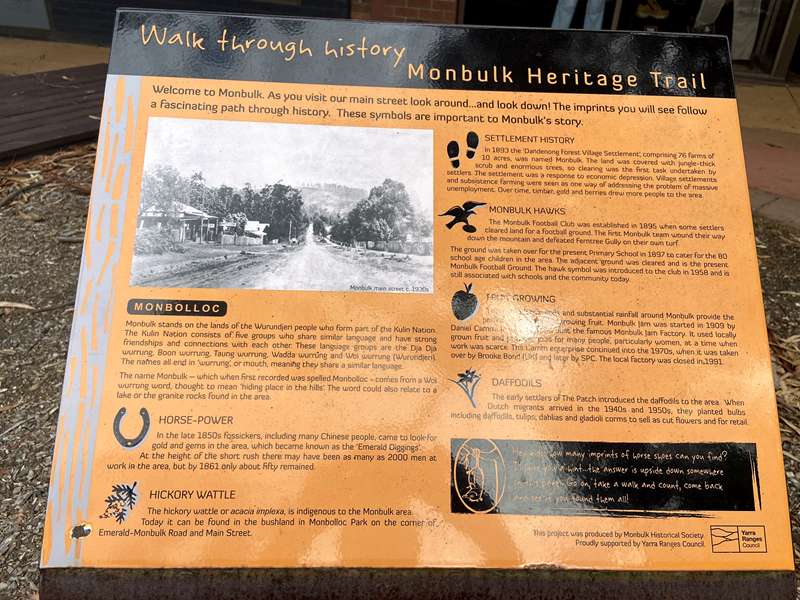
The Monbulk Historical Society has created a Heritage Trail on the footpath down Main Street Monbulk. Symbols stamped into the footpath to reference different periods and events depict the changes of the town's long history. The Trail is explained on an information board near the pedestrian crossing closest to the ANZ Bank (80 Main Road). Please look out for the information board and follow the words and symbols on the footpath relating to our history.
Walk Through History
Welcome to Monbulk. As you visit our main street look around ... and look down! The imprints you will see follow a fascinating path through history. These symbols are important to Monbulk's story.
MONBOLLOC
Monbulk stands on the lands of the Wurundjeri people who form part of the Kulin Nation. The Kulin Nation consists of five groups who share similar language and have strong friendships and connections with each other. These language groups are the Dja Dja wurrung, Boon wurrung, Taung wurrung, Wadda wurrung and Woi wurrung {Wurundjeri). The names all end in 'wurrung', or mouth, meaning they share a similar language.
The name Monbulk - which when first recorded was spelled Monbolloc - comes from a Woi wurrung word, thought to mean 'hiding place in the hills'. The word could also relate to a lake or the granite rocks found in the area.
HORSE-POWER
In the late 1850s fossickers, including many Chinese people, came to look for gold and gems in the area, which became known as the 'Emerald Diggings'. At the height of the short rush there may have been as many as 2000 men at work in the area, but by 1861 only about fifty remained.
HICKORY WATTLE
The hickory wattle or acacia implexa, is indigenous to the Monbulk area. Today it can be found in the bushland in Monbolloc Park on the corner of Emerald-Monbulk Road and Main Street.
SETTLEMENT HISTORY
In 1893 the 'Dandenong Forest Village Settlement', comprising 76 Farms of 10 acres, was named Monbulk. The land was covered with jungle-thick scrub and enormous trees, so clearing was the first task undertaken by settlers. The settlement was a response to economic depression. Village settlements and subsistence farming were seen as one way of addressing the problem of massive unemployment. Over time, timber, gold and berries drew more people to the area.
MONBULK HAWKS
The Monbulk Football Club was established in 1895 when some settlers cleared land for a football ground. The first Monbulk team wound their way down the mountain and defeated Ferntree Gully on their own turf.
The ground was taken over for the present Primary School in 1897 to cater for the 80 School age children in the area The adjacent ground was cleared and is the present Monbulk Football Ground. The hawk symbol was introduced to the club in 1958 and is still associated with schools and the community today.
FRUIT GROWING
The rich volcanic soils and substantial rainfall around Monbulk provide the perfect conditions fur growing fruit. Monbulk jam was started in 1909 by Daniel Camm. In 1913 Camm built the famous Monbulk Jam factory. It used locally grown fruit and provided lobs for many people, particularly women at a time when work was scarce The Camm enterprise continued into the 1970s, when it was taken over by Brooke Bond (UK) and later by SPC The local factory was closed in 1991.
DAFFODILS
The early settlers of The Patch introduced the daffodils to the area. When Dutch migrants arrived in the 1940s and 1950s they planted bulbs including daffodils, tulips, dahlias and gladioli corms to sell as cut flowers and for retail.
Location
80 Main Road, Monbulk 3793 View Map


