Moe - Edward Hunter Heritage Bush Reserve


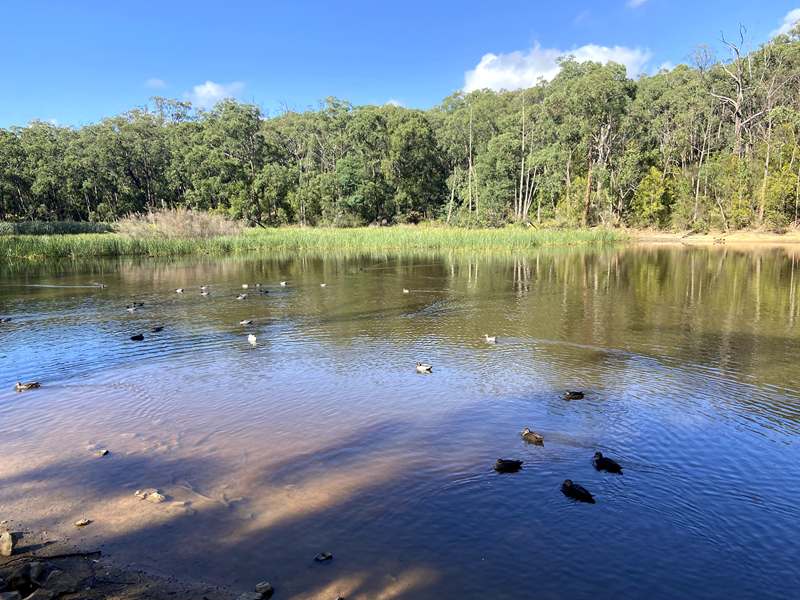
Within the town boundary of Moe, this 57 hectare reserve offers a picnic area and several walks for all year round enjoyment.
Walking tracks lead you through the reserve to a lake, with viewing platforms. There are a number of walking tracks, ranging from 700m to approximately 5km.
You can enjoy a picnic and watch the ducks on the lake.
There are a variety of native and non native flora to observe including the red banksia, lemon backhousia and orchids. There is an abundance of wildlife including ducks, blue tongue lizards, native mice, kookaburras, magpies, butterflies, various birds and numerous other animals. (Detailed lists can be found at the Coalville Road Entrance to the reserve)
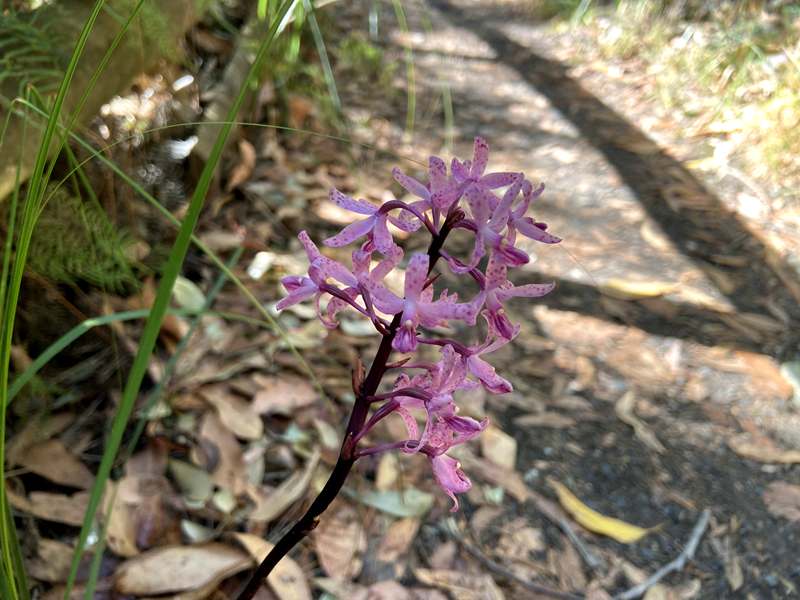
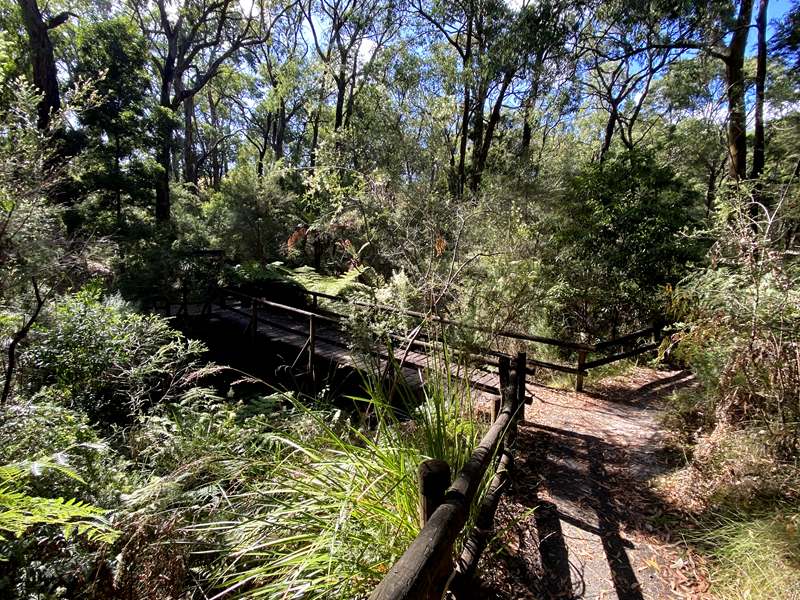
Facilities: Coalville Road car park only - picnic area, shelter. There is approximately 2km of formed paths and a further 1.5km of boardwalk. (Please note that wheelchair access is limited to the paths only. The boardwalk has no handrails and is too narrow for wheelchairs, however walking frames are okay.)
Edward Hunter Heritage Bush Reserve Map:
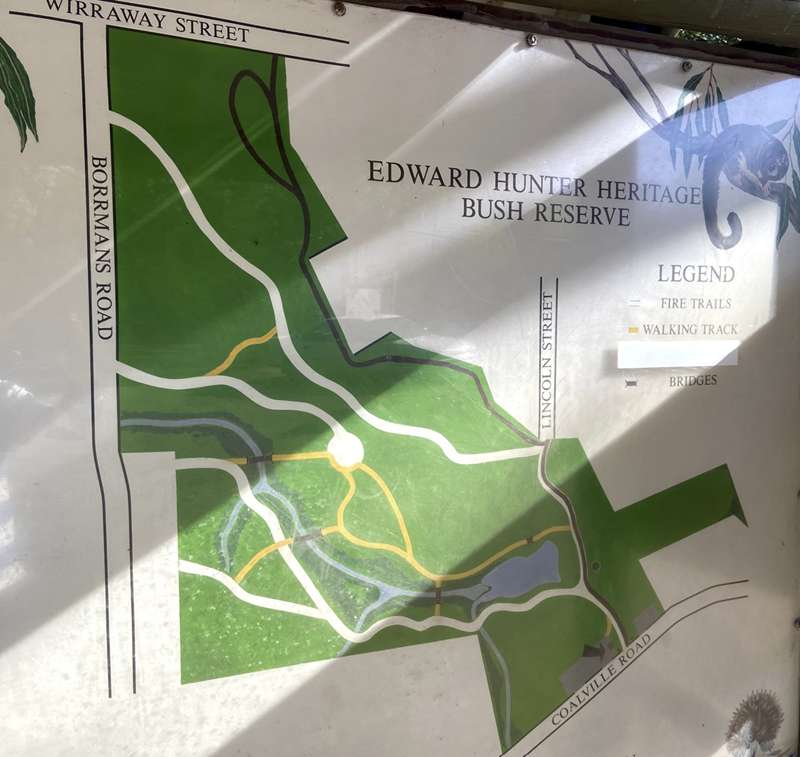
The Reserve is one of the largest patches of native remnant vegetation in the foothills of the Strzelecki Ranges in the Latrobe Valley. It is bounded by Coalville Road to the east, Borrmans Street to the south and Wirraway Street to the west and Service and Dwyer Roads to the northwest. To the north is the Princes Highway. There is also a small section on the eastern side of Coalville Road.
The main entrance to the Reserve is located on Coalville Road. Visitors have access to two carparks, and there is a covered seating area, a map of the Reserve and information about the plants and animals you can find within the Reserve. On the northern side of the lake is a rotunda, adjacent to the main entrance.
Information Panels:
Steam trains
The area that today makes up the Edward Hunter Heritage Bush Reserve was originally set aside in the late 1870s as a water catchment with a storage dam. This was the Moe Railway Reservoir which supplied water to the Moe Railway Station for passing steam trains.
With the completion of the Melbourne to Sale rail line in 1878, Moe Railway Station became a terminus for the Thorpdale, Walhalla and Yallourn lines. It was one of the largest railway yards outside the Melbourne metropolitan area.
As well as supplying steam trains, water from the catchment and dam was also piped to several railway houses. These were the first in Moe to have reticulated water.
Swimming carnivals
By the early 1950s, the rail line was electrified and water for steam trains was no longer needed. The reservoir had become the Edward Hunter Swimming Pool.
A wooden duckboard ran around the banks and a three metre high wooden tower with diving board was located on the western side of the reservoir. There was even a kiosk.
Swimming carnivals and bathing beauty contests were held here during the 1940s and 1950s. However, public use of the reservoir declined following at least two drownings and the establishment of an outdoor swimming pool in High Street, Moe, 1960.
Edward Hunter
The Reserve is named after Narracan Shire councillor Edward Hunter for his dedicated services to the Moe community from the 1920s to the early 1940s.
Edward Hunter was born in 1883 in Tanjil South and lived with his family in Anzac Street, Moe. His extensive contribution to the development of the Moe community included 27 years as director of the Moe Cooperative Dairying Company and 22 years as a representative councillor.
He was a Justice of the Peace and president of several organisations including the Moe Welcome and Farewell Home Committee, the Central Gippsland RACY, and the Rifle Clubs' Union. He was also vice-president of the Central Gippsland Stockowners' Association and the Moe Bush Nursing Hospital Committee.
In addition, he was a member of the Moe Recreational Committee and Golf Club and, it is believed, was even secretary of the Moe Country Women's Association for a time. He was also interested in horticulture and the local Fire Brigade, along with local angling, horse racing and football clubs.
Notably, Edward Hunter was chairman and government representative on the Moe Waterworks Trust, which managed the Moe Railway Reservoir during the time it supplied water for steam trains and for the local township.
Edward Hunter's many contributions to the community have inspired the conservation, maintenance and enhancement of some of the last remnant vegetation in Gippsland. Named in his honour, this Reserve is a wonderful asset for Moe and for generations of people to come.
Conservation Reserve
The Edward Hunter Heritage Bush Reserve comprises approximately 57 hectares of rich remnant bushland which includes the reservoir, access roads and walking tracks. The Reserve is home to native forest, ferns and grasses, with wildflowers, orchids and fungi appearing in season.
As you make your way along the tracks, you will hear and see a wide range of birds as well as insects. You may also catch sight of resident swamp wallabies, echidnas and lizards including blue tongues. The reservoir itself is habitat for turtles, water birds, native fish, frogs and yabbies.
Over the years, the Reserve has been managed through the activities of volunteers. These began with the efforts of people such as George Toye, an SECV surveyor/photographer and local conscientious conservationist, who developed the main tracks in the Reserve in the 1950s and 1960s.
A committee of management was established by volunteers in the 1970s to help manage the Reserve on behalf of the City Council and public. Many working parties, studies and special grants from local, state and federal bodies, as well as contributions from local businesses and voluntary groups, have resulted in the Reserve's present high standard.
Today, the Reserve faces increasing pressure from urban development on all sides. It requires ongoing care, consideration and attention by all users to ensure it remains a viable habitat for local species and a place for visitors to enjoy.
Can you hear the frogs?
In 2025 this reservoir was drained to remove invasive European Carp & American Gambusia (mosquito fish). This intervention was a huge success allowing the native frog population to grow significantly. To help our frogs and other native animals flourish we respectfully ask visitors to follow a few important rules:
Please don't fish in the reservoir. There are no fish to catch, and our native wildlife gets tangled in fishing line left behind.
Please don't dump unwanted goldfish in the reservoir. Goldfish are a type of carp. They breed and become invasive pests.
Please don't dump unwanted domestic ducks in the reservoir. They compete with native ducks for food and mates. The hybrid offspring are fertile, seriously impacting the survival of native duck species.
Please don't dump garden waste in the reserve. Seeds, bulbs and cuttings may grow and become troublesome weeds.
Please help to keep our reserve clean and litter free.
Review:
A real gem. A wonderful reserve to walk around with a beautiful lake with waterbirds and a range of different habitats with many different varieties of birds, flora, orchids and ferns. It's amazing to think that this exists within the town. The reserve is very well maintained and is well sign-posted.
At the car park on Coalville Road there is a shelter with two tables, information panels and an unshaded table.
From the car park there's a number of tracks (Correa Track and Cherry Ballart Track) leading towards the lake. On one side of the lake there is a boardwalk covered in chicken wire to make it less slippery. On the side of the lake there is a Yarning Circle with shelter with table and unshaded table.
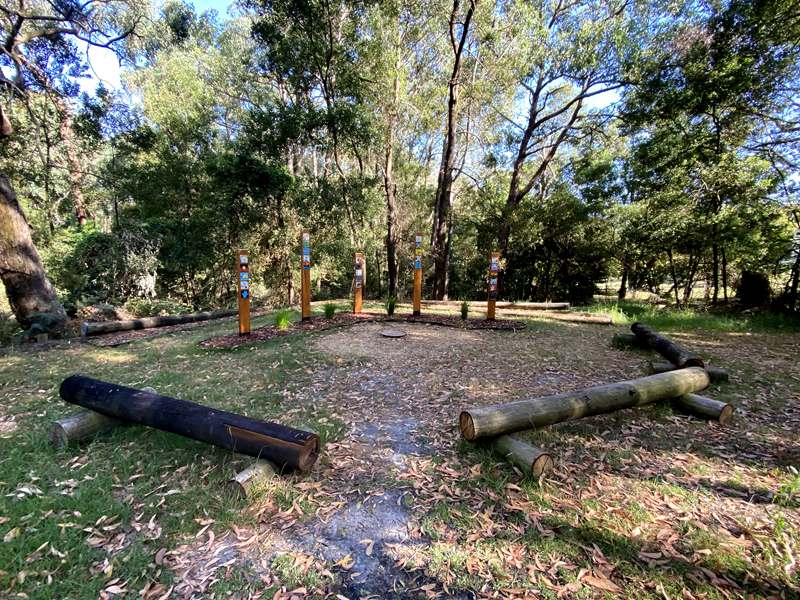
There are many tracks (some wide, some narrow) throughout the reserve. A highlight is the Coral Fern walk which starts on the western side of the lake and extends for a long distance to the south with a number of bridges to cross to the other side of the creek.
Photos:
Location
25 Coalville Road, Moe 3825 View Map
✆ 1300 367 700
Email Enquiry
Web Links
→ ehhbreserve.wordpress.com
→ Edward Hunter Heritage Bush Reserve - Moe on Facebook
→ Edward Hunter Heritage Bush Reserve Map
→ Edward Hunter Heritage Bush Reserve (Walking Maps)


