Marysville Triangle Heritage Walking Trail


Marysville Triangle Heritage Walking Trail was developed after the 2009 bushfires, which caused massive loss of life and devastation in this part of Victoria.
The towns of Marysville, Buxton, Narbethong and Taggerty are rebuilding from the ashes.
This trail takes you to special places that local people want to remember. Some of these are sites of buildings long gone; others the sites of buildings destroyed by the bushfires and places left standing after the fires.
History of the district
Marysville and the other triangle towns have long been famous for their beauty.
Marysville and Narbethong began as small stopovers for diggers travelling to the Woods Point and Jamieson goldfields during the 1860s gold rush. The majestic trees of the ash range soon attracted both tourists and timber-millers to the area and both towns were booming by the 1880s. The towns saw a further influx of visitors from the 1920s onwards as motor vehicles became affordable.
The rolling hills, fertile soils and flowing rivers at Buxton and Taggerty provided ideal conditions for dairying and crop farming and both towns had become thriving agricultural communities by the 1870s. Fishing enthusiasts were also drawn to the towns after trout were introduced to local rivers in the 19th century. They continue to enjoy superb fishing today.
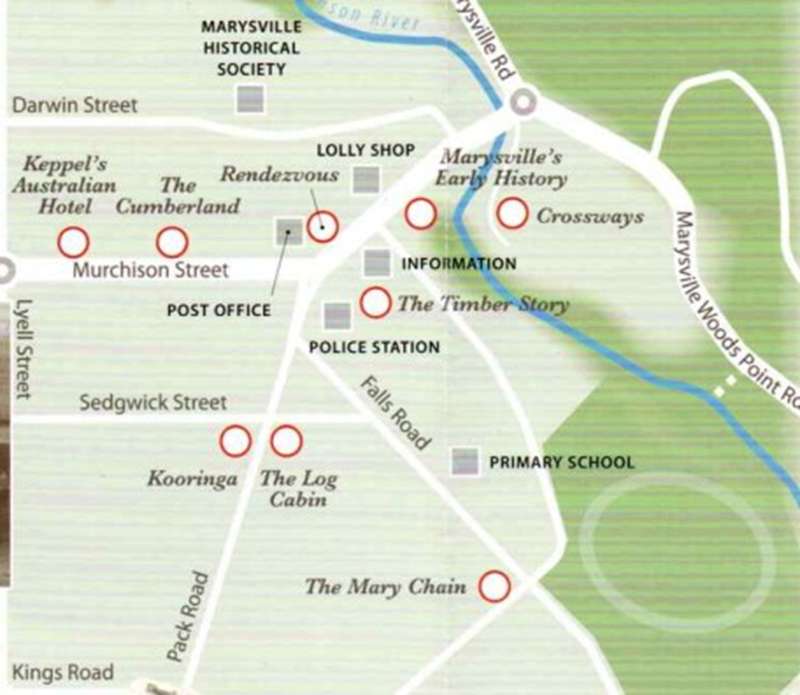
Location of Trail Signage
Keppel's Australian Hotel
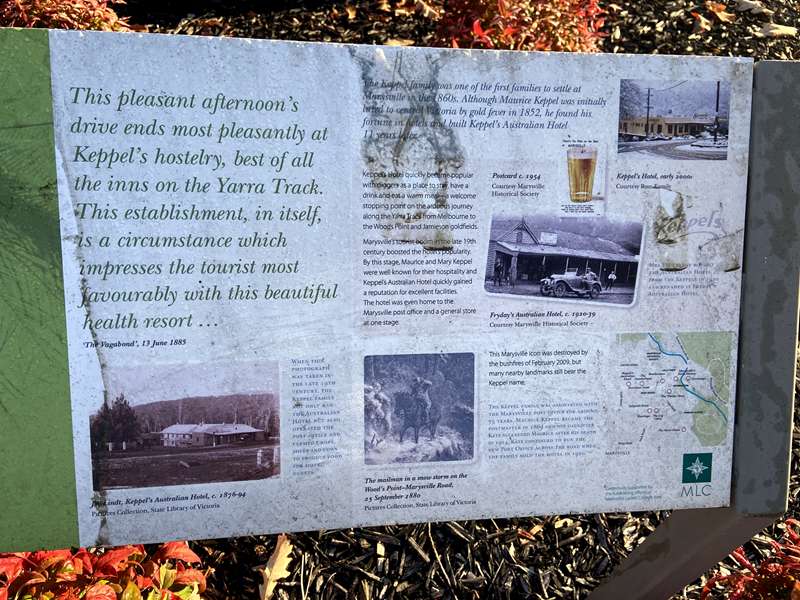
This pleasant afternoon's drive ends most Pleasantly at Keppel's hostelry, best of all the inns on the Yarra Track. This establishment, in itself, is a circumstance which impresses the tourist most favourably with this beautiful health resort...
'The Vagabond', 13 June 1885
The Keppel family was one of the first families to settle at Marysville in the 1860s. Although Maurice Keppel was initially lured to central Victoria by gold fever in 1852, he found his fortune in hotels and built Keppel's Australian Hotel 11 years later.
Keppel's Hotel quickly became popular with diggers as a place to stay, have a drink and eat a warm meal, a welcome stopping point on the arduous journey along the Yarra Track from Melbourne to the Woods Point and Jamieson goldfields.
Marysville's tourist boom in the late 19th century boosted the hotel's popularity. By this stage, Maurice and Mary Keppel were well known for their hospitality and Keppel's Australian Hotel quickly gained a reputation for excellent facilities. The hotel was even home to the Marysville post office and a general store at one stage.
This Marysville icon was destroyed by the bushfires of February 2009, but many nearby landmarks still bear the Keppel name.
The Cumberland
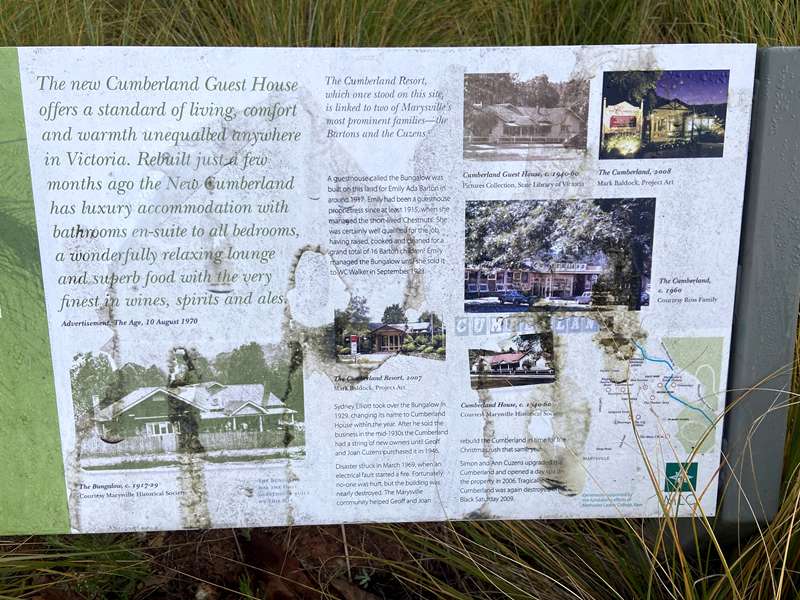
The new Cumberland Guest House offers a standard of living, comfort and warmth unequalled anywhere in Victoria. Rebuilt just a few months ago the New Cumberland has luxury accommodation with bathrooms en-suite to all bedrooms, a wonderfully relaxing lounge and superb food with the very finest in wines, spirits and ales.
Advertisement: The Age, 10 August 1970
The Cumberland Resort, which once stood on this site, is linked to two of Marysville's most prominent families - the Bartons and the Cuzens.
A guesthouse called the Bungalow was built on this land for Emily Ada Barton around 1917. Emily had been a guesthouse proprietress since at least 1915, when she managed the shortlived 'Chestnuts'. She
was certainly well qualified for the job, having raised, cooked and cleaned for a grand total of 16 Barton children! Emily managed the Bungalow until she sold it to WC Walker in September 1923.
Sydney Elliott took over the Bungalow in 1929, changing its name to Cumberland House within the year. After he sold the business in the mid-1930s the Cumberland had a string of new owners until Geoff and Joan Cuzens purchased it in 1946.
Disaster struck in March 1969, when an electrical fault started a fire. Fortunately no-one was hurt, but the building was nearly destroyed. The Marysville community helped Geoff and Joan rebuild the Cumberland in time for the Christmas rush that same year.
Simon and Ann Cuzens upgraded the Cumberland and opened a day spa on the property in 2006. Tragically Cumberland was again destroyed on Black Saturday 2009.
Rendezvous
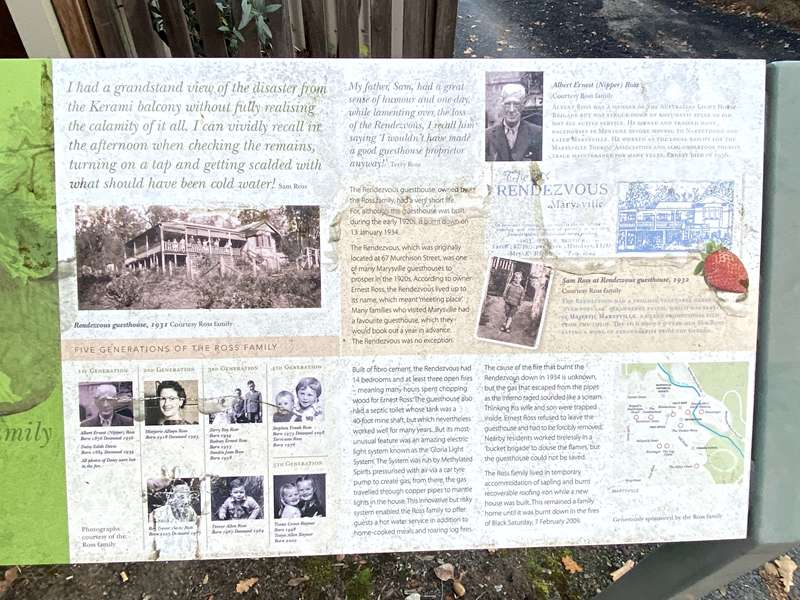
I had a grandstand view of the disaster from the Kerami balcony without fully realising the calamity of it all. I can vividly recall in the afternoon when checking the remains, turning on a tap and getting scalded with what should have been cold water! Sam Ross
The Rendezvous guesthouse, owned by the Ross family, had a very short life. For, although the guesthouse was built during the early 1920s, it burnt down on 13 January 1934.
The Rendezvous, which was originally located at 67 Murchison Street, was one of many Marysville guesthouses to prosper in the 1920s. According to owner Ernest Ross, the Rendezvous lived up to its name, which meant 'meeting place'. Many families who visited Marysville had a favourite guesthouse, which they would book out a year in advance. The Rendezvous was no exception.
Built of fibro cement, the Rendezvous had 14 bedrooms and at least three open fires - meaning many hours spent chopping wood for Ernest Ross. The guesthouse also had a septic toilet whose tank was a 40-foot mine shaft, but which nevertheless worked well for many years. But its most unusual feature was an amazing electric light system known as the 'Gloria Light System'. The system was run by methylated spirits pressurised with air via a car tyre pump to create gas, from there, the gas travelled through copper pipes to mantle lights in the house. This innovative but risky system enabled the Ross family to offer guests a hot water service in addition to home-cooked meals and roaring log fires.
The cause of the fire that burnt the Rendezvous down in 1934 is unknown, but the gas that escaped from the pipes as the inferno raged sounded like a scream. Thinking his wife and son were trapped inside, Ernest Ross refused to leave the guesthouse and had to be forcibly removed. Nearby residents worked tirelessly in a 'bucket brigade' to douse the flames, but the guesthouse could not be saved.
The Ross family lived in temporary accommodation of sapling and burnt recoverable roofing iron while a new house was built. This remained a family home until it was burnt down in the fires of Black Saturday, 7 February 2009.
Marysville's Early History
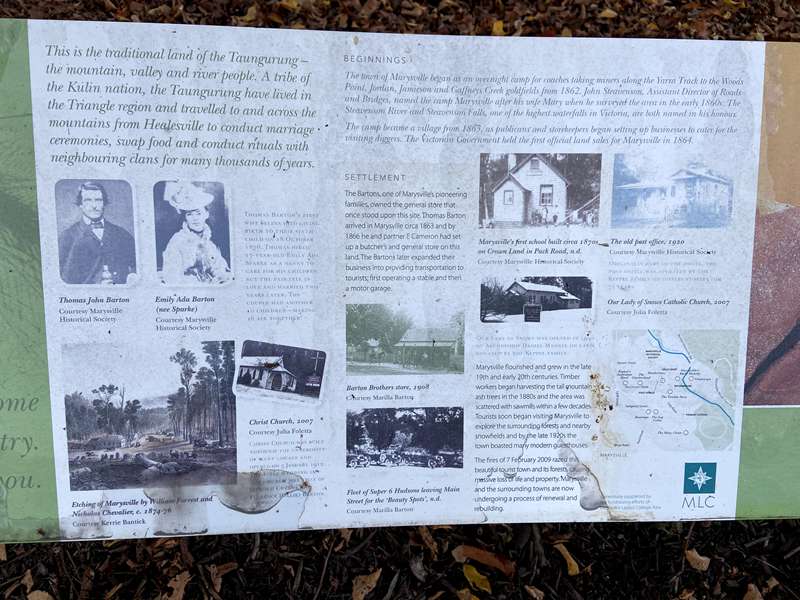
This is the traditional land of the Taungurung - the mountain, valley and river people. A tribe of the Kulin nation, the Taungurung have lived in the Triangle region and travelled to and across the mountains from Healesville to conduct marriage ceremonies, swap food and conduct rituals with neighbouring clans for many thousands of years.
BEGINNINGS.
The town of Marysville began as an overnight camp for coaches taking miners along the Yarra Track to the Woods Point, Jordan, Jamieson and Gaffneys Creek goldfields from 1862. John Steavenson, Assistant Director of Roads and Bridges, named the camp Marysville after his wife Mary when he surveyed the area in the early 1860s. The Steavenson River and Steavenson Falls, one of the highest waterfalls in Victoria, are both named in his honour.
The camp became a village from 1863, as publicans and storekeepers began setting up businesses to cater for visiting diggers. The Victorian Government held the first official land sales for Marysville in 1864.
SETTLEMENT
The Bartons, one of Marysville's pioneering families, owned the general store that once stood upon this site. Thomas Barton arrived in Marysville circa 1863 and by 1866 he and partner E Cameron had set up a butcher's and general store on this land. The Bartons later expanded their business into providing transportation to tourists; first operating a stable and then a motor garage.
Marysville flourished and grew in the late 19th and early 20th centuries. Timber workers began harvesting the tall mountain ash trees in the 1880s and the area was scattered with sawmills within a few decades. Tourists soon began visiting Marysville to explore the surrounding forests and nearby snowfields and by the late 1920s the town boasted many modern guesthouses.
The fires of 7 February 2009 razed this beautiful tourist town and its forests, causing massive loss of life and property. Marysville and the surrounding towns are now undergoing a process of renewal and rebuilding.
Crossways
The Timber Story
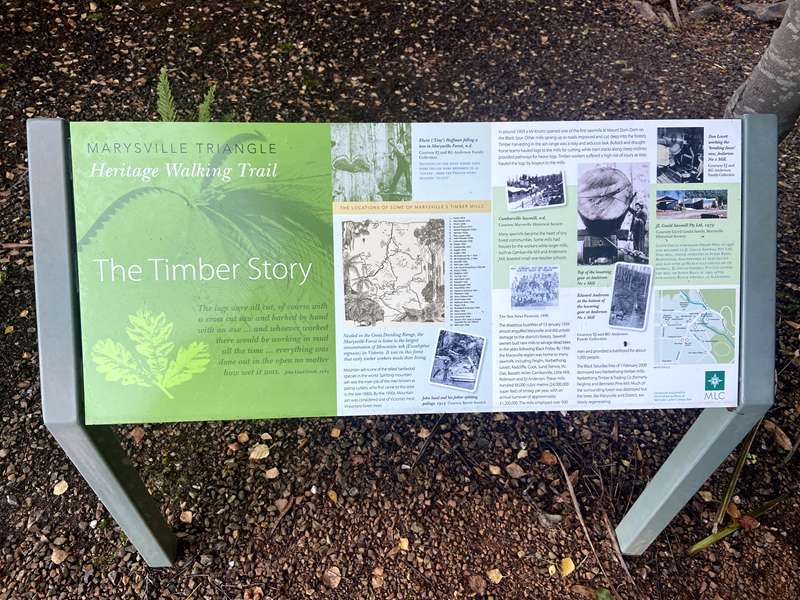
The logs were all cut, of course with a cross cut saw and barked by hand with an axe ... and whoever worked there would be working in mud all the time ... everything was done out in the open no matter how wet it was. John Lloyd Gould, 1985
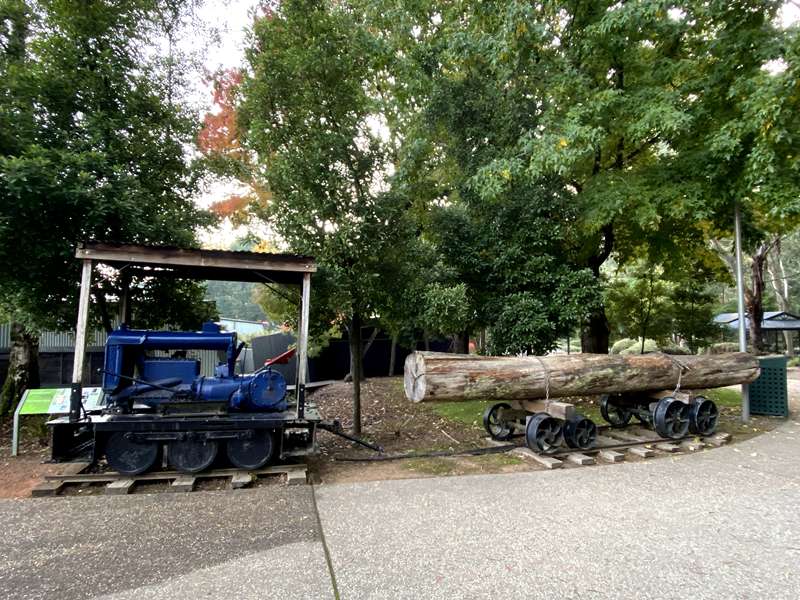
Nestled in the Great Dividing Range, the Marysville Forest is home to the largest concentration of Mountain ash (Eucalyptus regnans) in Victoria. It was in this forest that early timber workers made their living.
Mountain ash is one of the tallest hardwood species in the world. Splitting mountain ash was the main job of the men known as paling cutters, who first came to this area in the late 1880s. By the 1930s, Mountain ash was considered one of Victoria's most important forest trees.
In around 1909 a Mr Knotts opened one of the first sawmills at Mount Dom Dom on the Black Spur. Other mills sprang up as roads improved and cut deep into the forests. Timber harvesting in the ash range was a risky and arduous task. Bullock and draught horse teams hauled logs to the mills for cutting, while tram tracks along steep inclines provided pathways for heavy logs. Timber workers suffered a high risk of injury as they hauled the logs by bogeys to the mills.
Many sawmills became the heart of tiny forest communities. Some mills had houses for the workers while larger mills, such as Cambarville Mill and Andersons Mill, boasted small one-teacher schools.
The disastrous bushfires of 13 January 1939 almost engulfed Marysville and did untold damage to the district's forests. Sawmill owners built new mills to salvage dead trees in the years following Black Friday. By 1956, the Marysville region was home to many sawmills, including Feiglin, Narbethong, Lovett, Radcliffe, Cook, Sund Stenco, Vic Oak, Bassett, Miller, Cambarville, Little Mill, Robinson and EJ Anderson. These mills handled 56,000 cubic metres (24,000,000 super feet) of timber per year, with an annual turnover of approximately 1,200,000 pounds. The mills employed over 300 men and provided a livelihood for about 1,000 people.
The Black Saturday fires of 7 February 2009 destroyed two Narbethong timber mills: Narbethong Timber & Trading Co (formerly Feiglins) and Bennetts Pine Mill. Much of the surrounding forest was destroyed but the trees, like Marysville and District, are slowly regenerating.
Kooringa
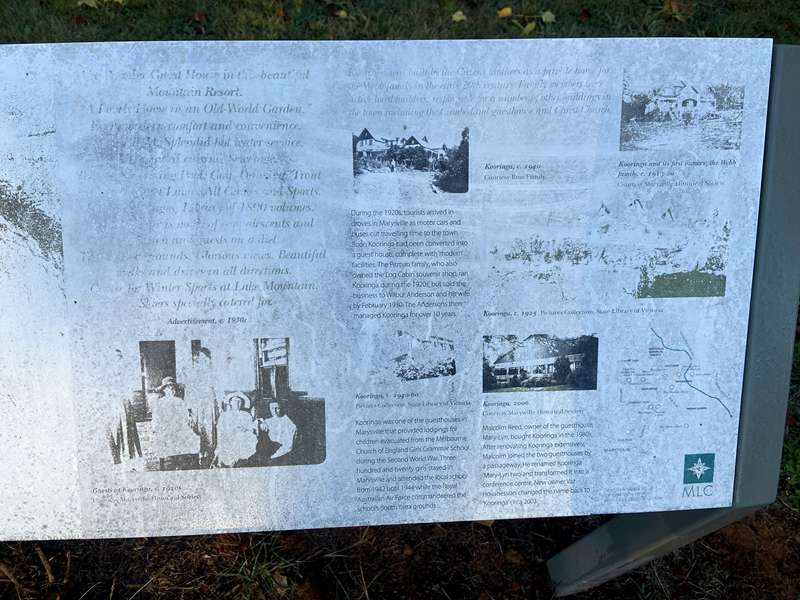
Kooringa was built by the Cuzens brothers as a private home for the Webb family in the early 20th century. Family members were active local builders, responsible for a number of other buildings in the town including the Cumberland guesthouse and Christ Church.
During the 1920s, tourists arrived in droves in Marysville as motor cars and buses cut travelling time to the town. Soon Kooringa had, been converted into a guest house, complete with 'modern' facilities. The Pitman family, who also owned the Log Cabin souvenir shop, ran Kooringa during the 1920s, but sold the business to Wilbur Anderson and his wife by February 1930. The Andersons then managed Kooringa for over 10 years.
Kooringa was one of the guesthouses in Marysville that provided lodgings for children evacuated from the Melbourne Church of England Girls Grammar School during the Second World War. Three hundred and twenty girls stayed in Marysville and attended the local school from 1942 until 1944 while the Royal Australian Air Force commandeered the school's South Yarra grounds.
Malcolm Reed, owner of the guesthouse, Mary-Lyn, bought Kooringa in the 1980s. After renovating Kooringa extensively, Malcolm joined the two guesthouses by a passageway. He renamed Kooringa 'Mary-Lyn two' and transformed it into a conference centre. New owner Vaz Hovanessian changed the name back to 'Kooringa' circa 2003.
The Log Cabin
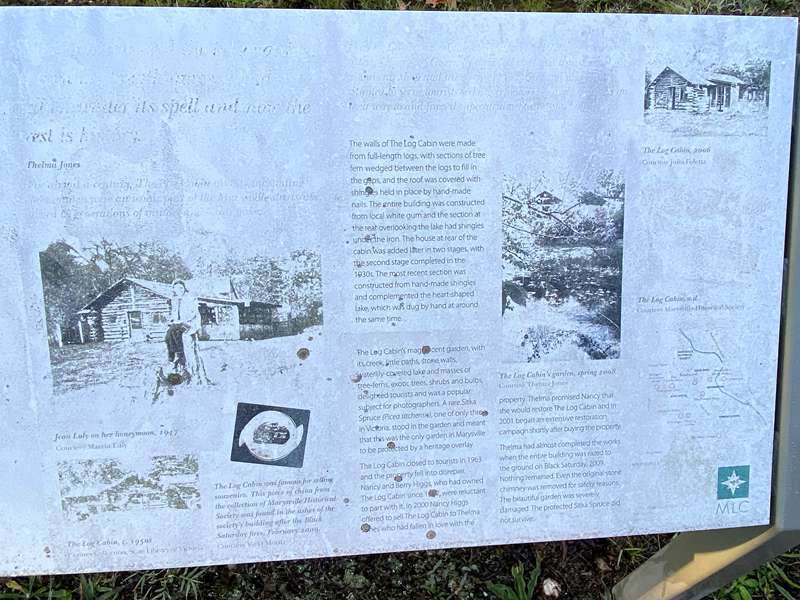
The walls of The Log Cabin were made from full-length logs, with sections of tree fern wedged between the logs to fill in the gaps, and the roof was covered with shingles held in place by hand-made nails. The entire building was constructed from local white gum and the section at the rear overlooking the lake had shingles under the iron. The house at rear of the cabin was added later in two stages, with the second stage completed in the 1930s. The most recent section was constructed from hand-made shingles and complemented the heart-shaped lake, which wIt dug by hand at around the same time.
The Log Cabin's magnificent garden, with its creek, little paths, stone walls, waterlily-covered lake and masses of tree-ferns, exotic trees, shrubs and bulbs, delighted tourists and was a popular subject for photographers. A rare Sitka Spruce (Picea sitchensis), one of only three in Victoria, stood in the garden and meant that this was the only garden in Marysville to be protected by a heritage overlay.
The Log Cabin closed to tourists in 1963 and the property fell into disrepair. Nancy and Berry Higgs, who had owned The Log Cabin since 1987, were reluctant to part with it. In 2000 Nancy Higgs offered to sell The Log Cabin to Thelma Ines who had fallen in love with the property. Thelma promised Nancy that she would restore The Log Cabin and in 2001 began an extensive restoration campaign shortly after buying the property.
Thelma had almost completed the works when the entire building was razed to the ground on Black Saturday, 2009. Nothing remained. Even the original stone chimney was removed for safety reasons. The beautiful garden was severely damaged The protected Sitka Spruce did not survive,
The Mary Chain
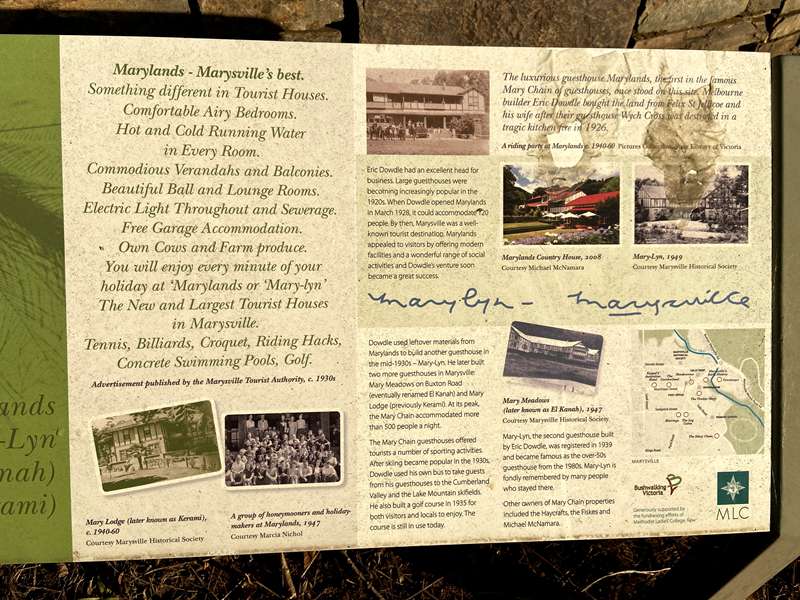
Marylands - Marysville's best.
Something different in Tourist Houses. Comfortable Airy Bedrooms. Hot and Cold Running Water in Every Room. Commodious Verandahs and Balconies. Beautiful Ball and Lounge Rooms. Electric Light Throughout and Sewerage. Free Garage Accommodation. Own Cows and Farm produce. You will enjoy every minute of your holiday at 'Marylands or Mary-lyn'. The New and Largest Tourist Houses in Marysville. Tennis, Billiards, Croquet, Riding Hacks, Concrete Swimming Pools, Golf
Advertisement published by the Marysville Tourist Authority, c. 1930s
Eric Dowdle had an excellent head for business. Large guesthouses were becoming increasingly popular in the 1920s. When Dowdle opened Marylands in March 1928, it could accommodate 120 people. By then, Marysville was a well-known tourist destination. Marylands appealed to visitors by offering modern facilities and a wonderful range of social activities and Dowdle's venture soon became a great success.
The luxurious guesthouse Marylands, the first in the famous Mary Chain of guesthouses, once stood on this site. Melbourne builder Eric Dowdle bought the land from Felix St Jellicoe and his wife after their guesthouse Wych Cross was destroyed in a tragic kitchen in 1926.
Dowdle used leftover materials from Marylands to build another guesthouse in the mid-1930s - Mary-Lyn. He later built two more guesthouses in Marysville: Mary Meadows on Buxton Road (eventually renamed El Kanah) and Mary Lodge (previously Kerami). At its peak, the Mary Chain accommodated more than 500 people a night.
The Mary Chain guesthouses offered tourists a number of sporting activities. After skiing became popular in the 1930s, Dowdle used his own bus to take guests from his guesthouses to the Cumberland Valley and the Lake Mountain skifields. He also built a golf course in 1935 for both visitors and locals to enjoy. The course is still in use today.
Mary-Lyn, the second guesthouse built by Eric Dowdle, was registered in 1939 and became famous as the over-50s guesthouse from the 1980s. Mary-Lyn is fondly remembered by many people who stayed there. Other owners of Mary Chain. properties included the Haycrafts, the Fiskes and Michael McNamara.
Buxton (at Buxton Recreation Reserve Playground, Mareeba Avenue, Buxton)
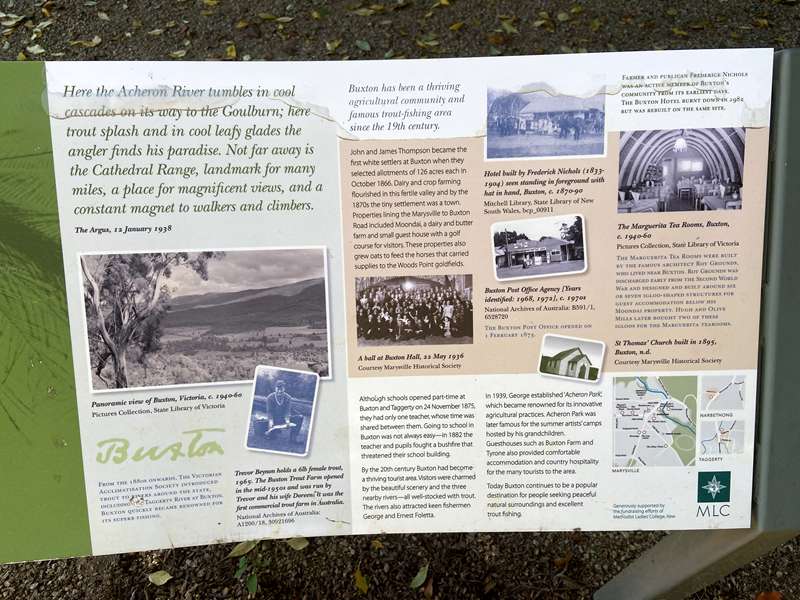
Here the Acheron River tumbles in cool cascades on its way to the Goulburn; here trout splash and in cool leafy glades the angler finds his paradise. Not far away is the Cathedral Range, landmark for many miles, a place for magnificent views, and a constant magnet to walkers and climbers.
The Argus, 12 January 1938
Buxton has been a thriving agricultural community and famous trout-fishing area since the 19th century.
John and James Thompson became the first white settlers at Buxton when they selected allotments of 126 acres each in October 1866. Dairy and crop farming flourished in this fertile valley and by the 1870s the tiny settlement was a town. Properties lining the Marysville to Buxton Road included Moondai, a dairy and butter farm and small guest house with a golf course for visitors. These properties also grew oats to feed the horses that carried supplies to the Woods Point goldfields.
Although schools opened part-time at Buxton and Taggerty on 24 November 1875, they had only one teacher, whose time was shared between them. Going to school in Buxton was not always easy - in 1882 the teacher and pupils fought a bushfire that threatened their school building.
Trevor Beynon holds a 6lb female trout, 1965. The Buxton Trout Farm opened in the mid-195os and was run by Trevor and his wife Doreencit was the first commercial trout farm in Australia. National Archives of Australia: Al200/18, 30921696
In 1939, George established 'Acheron Park', which became renowned for its innovative agricultural practices. Acheron Park was later famous for the summer artists' camps hosted by his grandchildren. Guesthouses such as Buxton Farm and Tyrone also provided comfortable accommodation and country hospitality for the many tourists to the area.
Today Buxton continues to be a popular destination for people seeking peaceful natural surroundings and excellent trout fishing.
Taggerty (at Taggerty Little River Day Visitor Area, 3306 Maroondah Highway, Taggerty)
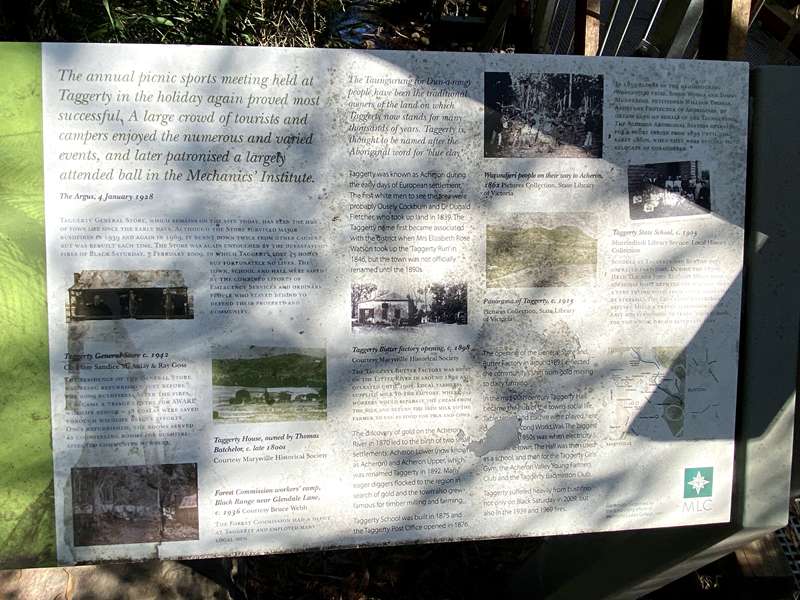
The Taungurung (or Dun-u-rung) people have been the traditional owners of the land on which Taggerty now stands for many thousands of years. Taggerty is thought to be named after the Aboriginal word for 'blue clay'.
Taggerty was known as Acheron during the early days of European settlement. The first white men to see the area were probably Joseph Cockburn and Dr Dugald Fletcher, who took up land in 1839. The Taggerty name first became associated with the district when Mrs Elizabeth Rose Watson took up the "Taggerty Run" in 1846, but the town was not officially renamed until the 1890s.
The discovery of gold on the Acheron River in 1870 led to the birth of two small settlements: Acheron Lower (now known as Acheron) and Acheron Upper, which was renamed Taggerty in 1892. Many eager diggers flocked to the region in search of gold and the town also grew famous for timber milling and farming.
Taggerty School was built in 1875 and the Taggerty Post Office opened in 1876.
The opening of the General Store and Butter Factory in around 1891 reflected the community's shift from gold mining to dairy farming.
In the mid-20th century Taggerty Hall became the hub of the town's social life. The biggest change in the 1950s was when electricity came to the town. The Hall was then used as a school, and then for the Taggerty Girls Gym, the Acheron Valley Young Farmers Club and the Taggerty Badminton Club.
Taggerty suffered heavily from bushfires, not only on Black Saturday in 2009, but also in the 1939 and 1969 fires.
During the 2009 Victorian Bushfires, on Saturday February 7, our Taggerty community was changed forever. On that day we lost friends and family from neighbouring towns, our local wildlife and 48 homes. The livelihood of our farming community was heavily impacted by the loss of stock, infrastructure, fencing and equipment. On that day and during the next 3 weeks we left a part of us behind as we watched the fire sit on our doorstep, f.5km from the centre of town.
In the days, weeks and months that followed we, the Taggerty community bonded together. We served more than 13,000 community cooked meals at the CFA station to local and interstate fire crews out on the line. We worked shifts to cook, serve and clean up and then went home to watch the line of fire on the southern boundary of our town. At the wildlife triage centre set up in the town centre, with the support and guidance of AWARE Wildlife Rescue we cared for more than 60 injured wildlife. In total we cared for 48 koalas, 22 wombats and many small native creatures as well as 2 deer. We welcomed Marysville residents who stayed with us for a while and the students of the Marysville Primary School who joined our children at the Taggerty Primary School until their school was rebuilt. We gathered at the Hall to hear the latest fire briefing and as time moved on we kept gathering - at the store, in homes, the Hall and the school.
On February 7, 2019, ten years after that day, we gathered again. As in previous years, we met in the heart of Taggerty to commemorate, to remember what we achieved together and reflect on all that changed as a result of the events 10 years earlier. We remembered the wonderful people in our community who worked tirelessly to make a difference. We remembered the many kind people from outside our community who stood with us on that day and beside us in the following days, weeks, months and years. We remember the generosity of heart and the soul-lifting comraderie we saw locally, nationwide and from around the world, and we say thank you.
Fire is part of our Taggerty story now. Indeed, it is part of rural folklore in Australian country towns and fire has always been a part of our land's heritage. In the bush, fires destroy and then regenerate forest and flora, creating new growth.
In Taggerty, we have experienced new growth and for this we are grateful. Like the mighty red gums beside the picturesque Little River, we have known fires, we live on and we will continue to gather, because together we are stronger than when we stand alone.
Narbethong (Opposite CFA Fire Station, Maroondah Highway, Narbethong)
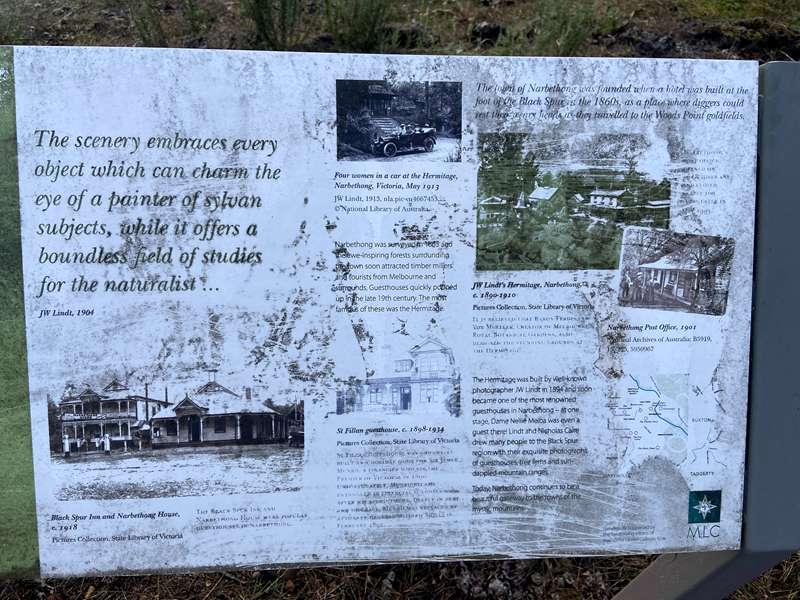
The scenery embraces every object which can charm the eye of a painter of sylvan subjects, while it offers a boundless field of studies for the naturalist?
- JW Lindt, 1904
Narbethong was surveyed in 1865 and the awe-inspiring forests surrounding the town soon attracted timber millers and tourists from Melbourne and surrounds. Guesthouses quickly popped up in the late 19th century. The most famous of these was the Hermitage.
The Hermitage was built by well-known photographer JW Lindt in 1894 and soon became one of the most renowned guesthouses in Narbethong - at one stage, Dame Nellie Melba was even a guest there! Lindt and Nicholas Caire drew many people to the Black Spur region with their exquisite photographs of guesthouses, tree ferns and sun-dappled mountain ranges.
Today, Narbethong continues to be a beautiful gateway to the towns of the mystic mountains.
Location
Murchison Street, Marysville 3779 View Map


