Marysville - Beauty Spot Natural Features Reserve Walk



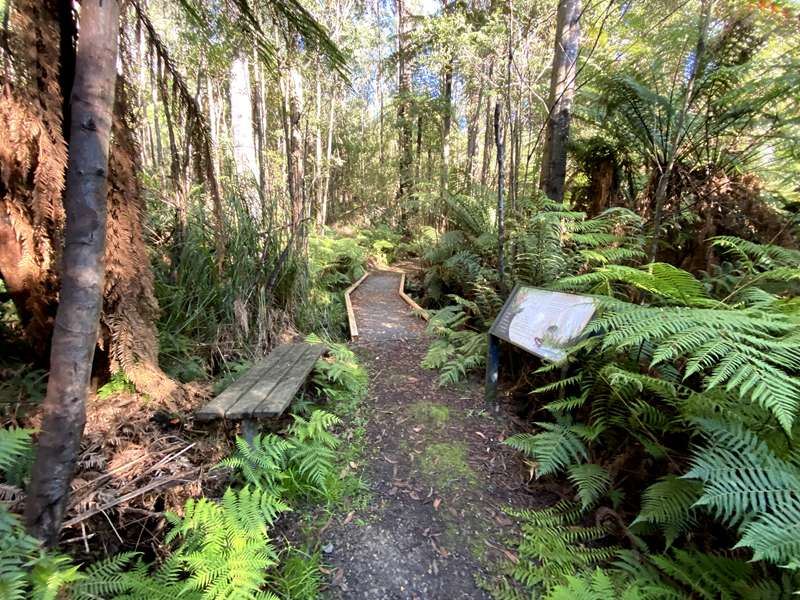
The Beauty Spot was first recognised for its beauty back in the late 1800s, and this easy nature trail has long been one of Marysville's most loved short walks. The trail follows winding Leary Creek, deep among the tree fern groves which are a feature of this walk. A number of interpretive signs along the way highlight the flora and fauna that inhabit the forest.
From the car park, which has a shelter with a table, this gently-graded trail leads into a shady fern-filled gully. At the major intersection veer left and follow it along to the next junction.
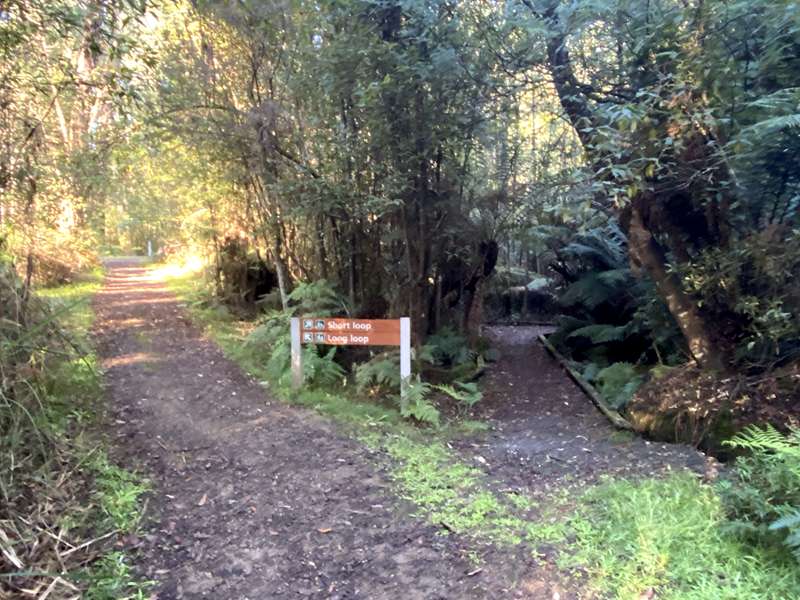
The shorter 500m wheelchair accessible circuit heads right and crosses Leary Creek twice on small timber bridges before arriving back at the car park.
The 1.5km circuit continues left from the junction to explore deeper into the gully before rejoining the shorter loop and returning to the car park.
Beauty Spot Trail takes you deep into the ferny gully of Leary Creek and is represented by the tree fern emblem. These markers will help guide you along the trail.
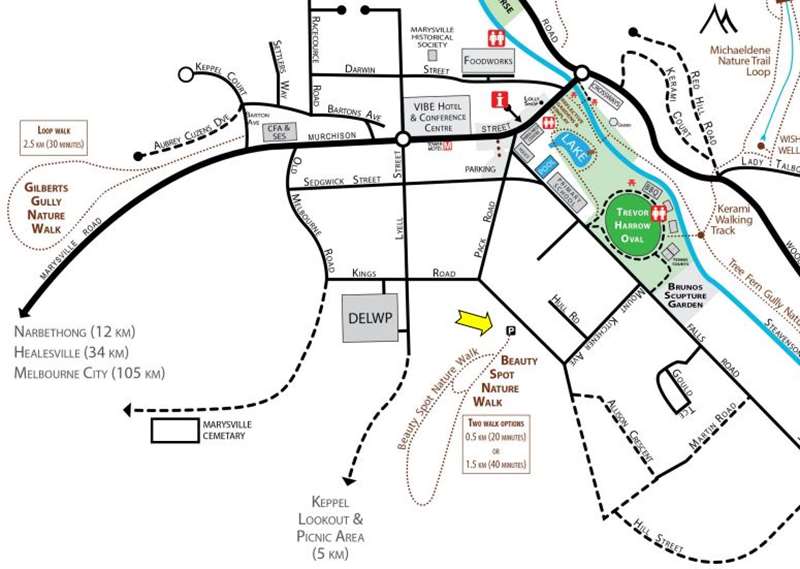
The Beauty Spot carpark is located on Kings Road, in the Marysville township, and offers the walker a beautiful stroll through a fern filled valley, via a beautifully designed walking path.
The two walk loops offer the visitor a 0.5km short loop return walk or 1.5km long loop return walk, with an easy grade pathway, and lovely bridges. Flora and fauna are abundant and world class signage make learning easy and fun.
Features
- Easy grade walking track
- Excellent bridges
- Raised wooden platforms
- Elevated walkways in wetter areas
- Lovely streams
- Lots of flora and fauna
- Excellent directional signage
- Signage teaches you about the local flora and fauna
- Inside Marysville's boundary
- 10 minute walk from the shops
Access for Dogs:
Bicycles, motorbikes and pets are not permitted.
Beauty Spot Natural Features Reserve Interpretive Signage
Life on the forest floor
The varied colours, textures and plant life found on the forest floor are always a welcome companion on a stroll along the Marysville Trails.
Alongside these more obvious features is a range of clues as to the animals that use the tracks - usually when we're not around.
One of the most obvious signs of life on the forest floor are the earthmoving operations undertaken by powerful diggers like wombats, echidnas and lyrebirds. Freshly dug over, or widely scattered earth along the track edge is a sure sign something has visited here recently.
Signs of wombat activity are easy to spot as they dig wherever they go. Sometimes it's superficial scratchings to mark out their territory or shallow holes dug into embankments to forage for plant roots. Wombats are renowned for the burrows they dig where they spend the great bulk of their time. Wombats have up to 12 burrows within their territory and use 3 or 4 of these as their main burrows. More than one wombat will often use the same burrow, but usually at a different time.
One of the other signs of wombat activity is piles of cube-shaped dung perched prominently as territory markers. The unique shape of the dung conveniently helps keep the marker in place.
While you will be lucky to actually spot a lyrebird in the bush, there's often a good chance you will hear them. Listen for a strong and complex, lyrical singing communicated throughout the forest. This is the song of the male lyrebird as it stands on an open mound in dense forest delivering its courtship display.
The lyrebird's song is a remarkable mix of both its own call, embellished with any number of other sounds it has heard - particularly other bird calls.
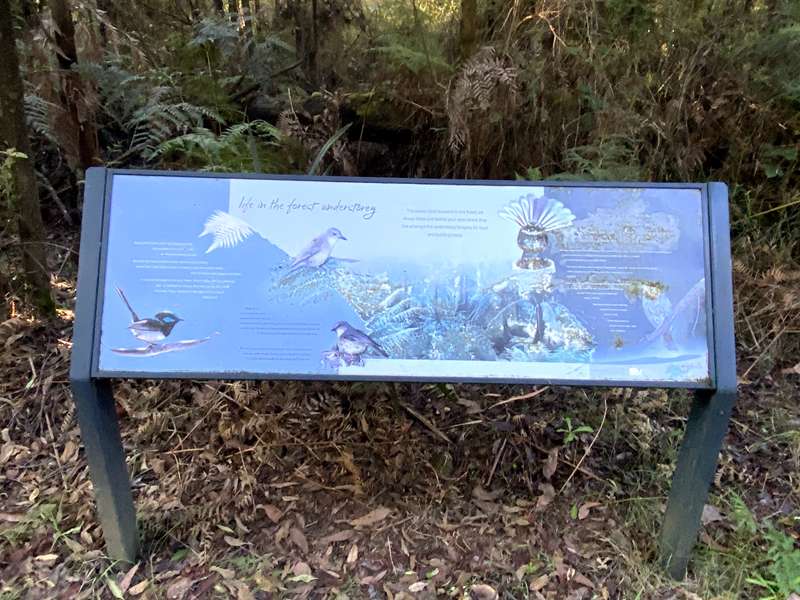
Life in the forest understorey
The easiest birds to watch in the forest are always those just before your eyes where they live amongst the understorey foraging for food and building nests.
Many of the birds you'll see foraging on the ground and in low bushes are small insect-eating species. Birds like the Eastern Yellow Robin and the Superb Fairy-wren feed on insects and other small critters with the aid of their dagger-like beaks.
In contrast the beak of the Grey Shrike-thrush tells of a different diet. In addition to insects, they feed on spiders, small mammals, frogs, lizards and the eggs and young of other birds. While the Grey Shrike-thrush may seem unremarkable with their grey plumage often hiding them from sight, a different story emerges when they burst into song. They have a strikingly beautiful and melodic call that can roll on for minutes and include mimicked calls of other birds.
With their brightly coloured chests, Eastern Yellow Robins often catch your eye. With a sudden flash of colour they swoop to grab an insect to feed themselves or their young back in the nest.
The abundance of insect life in the understorey along the Beauty Spot Trail makes this valley a perfect foraging ground for insectivorous birds like fantails and thornbills.
The Grey Fantail (left) is one of the easiest forest birds to recognise as it darts around the forest canopy picking off insects on the wing. It displays amazing aerial acrobatic skill, with a constantly fanned tail providing precise flight control. The tail can also be used in a display of aggression - especially during the breeding season when predation by nest robbing birds like currawongs is a serious problem.
While you may sometimes catch a Brown Thornbill on your own level, the best spot to look for them is at the top of the shrub layer or in the lower canopy of trees. Here they feed on insects with the occasional dessert of seeds, nectar or fruit. Often they travel in groups and so easily catch your attention.
Life after the bushfires
On 7 February 2009, this area was burnt when a fire front forming part of the Victorian Black Saturday fires swept through Marysville. The process of bushland renewal well underway.
To begin to imagine how the forest here will regenerate over time, it's useful to see how a similar forest recovered in the wake of the 1983 Ash Wednesday fires. In the wake of bushfires, visitors to Marysville were able to watch as the landscape recovered and the forests gradually regained their former beauty. This walk around the Beauty Spot was reconstructed as part of the renewal process undertaken in the wake of the fires by the Department of Sustainability and Environment.”
Wetland life
As you stand here there is a good chance you'll be able to hear a chorus of frog calls rising from the moist undergrowth. The Beauty Spot is the perfect breeding ground for frogs due to its combination of water in which tadpoles can grow and prolific insect life on which the adult frogs can feed. Frogs call to define their territory as well as to attract a mate. This helps explain their constant croaking at certain times of the year.
The most easily recognised frog call you'll come across here is that of the Pobblebonk - otherwise known as the Banjo Frog. It's named after its distinctive 'bonk' call, which is likened to a banjo string being plucked.
Other frequently found frogs here include the Common Froglet with its cricket-like chirping and the Southern Brown (Ewing's) tree frog. The tree frog is an agile climbing and jumping frog that flourishes in flooded grassland or marshes. It is a voracious insect hunter capable of leaping to catch a fly in mid-flight!
Life in the Forest Canopy
So much of the activity in the bush takes place up in the forest canopy.
Large colourful and noisy birds like parrots are easily spotted.
Listen for one of the most common forest bird calls - the seemingly unending, piping single note of the pardalotes as they forage for scale insects under leaves.
Watch also for wattlebirds as they make their raucous journey protecting their precious nectar supplies
This area is especially attractive to birds like King Parrot, Gang-gang Cockatoos and Yellow-tailed Black Cockatoos as there are plenty of tree hollows for them to nest and roost in. Unlike other songbirds (passerines), whose claws always stay firmly positioned beneath their wings, parrots actively use their feet as tools to help them clasp their meals as they eat it. They can do this because of the arrangement of their toes. Whereas most passerines like Striated Pardalotes (right) have three toes pointing forward and one back, parrots have a more balanced arrangement with two forward, two back. This allows the claw to function as a pincer that can easily grip a variety of objects.
Wattlebirds use their size to aggressively ward off other honeyeaters from their nectar supplies of shrub flowers and eucalypt blossoms. Smaller honeyeater species like the spinebills, can however coexist with the wattlebirds. This is because they don't need as much food and can 'sneak' into flowering plants if there is enough foliage cover for them to hide in.
Life in the forest after hours
With more than 80% of Australian animals being nocturnal, it's no surprise that birds are the most likely creatures you'll see in the bush during the daytime. Nighttime spells a changing of the guard as possums, gliders, bats and bush rats emerge to attend to business.
While most birds sleep at night, meat-eating birds like the Powerful Owl emerge to hunt for their next meal. With predators like these, gliders and possums need to be cautious about leaving the security of their tree hollows at night. Swooping silently through the forest branches, the owl's vice-like claws can also clamp onto roosting birds if yellow-bellied gliders are in short supply.
If you hear sounds come from the forest floor, the chances are a native Bush Rat is at work seeking out a meal of insects or feeding on leaves, fruit and fungi. The rats will build nests in soft soil, rock crevices or fallen logs. This is because they are placental mammals that give birth to large young who rely on the warmth and protection of the nest.
If the noises come from higher, you might be listening to an Eastern Pygmy Possum busy hunting insects in the branches, or snacking on some nectar. The possum has an advantage over the ground-dwelling Bush Rat because as a marsupial the young can be carried securely inside the mother's pouch.”
Life in the streams
It's unlikely you'll see them, but it's good to know they're here. This creek is home to the Barred Galaxias – a critically endangered small, brightly coloured, orange fish that is now only found in upper reaches of some mountain streams in central Victoria. The Barred Galaxias is a scaleless fish that grows up to 150mm in length and may live for up to 15 years. It is the only native fish in creeks where it is found. Barred Galaxias feed on insects they find in the water and breed by laying 'sticky' eggs under large rocks. They are best distinguished from the more common Mountain Galaxias by their bright orange-yellow colour and the black vertical bars on the sides of the body.
Unfortunately for the Barred Galaxias, they suffer from the introduction of Brown and Rainbow Trout that have been released into rivers and creeks due to their popularity with anglers. When a trout ventures into a new site, it preys on the smaller galaxias and to a lesser extent competes for the same food and space. To protect the Barred Galaxias habitat, a trout barrier has been constructed next to the Marysville Visitor Information Centre. The barrier keeps the upper reaches of this creek free from these introduced species.
Review:
A lovely short walk through a tree fern gully along well formed paths and boardwalks which has interesting information signs about the environment. There is plenty of shade which makes it ideal for warmer days.
Photos:
Location
22 Kings Road, Marysville 3779 View Map
Web Links
→ The Best Family Activities in the Yarra Valley
→ The Best Waterfalls in Melbourne and Victoria for Family Visits


