Little Desert - Keith Hateley Nature Walk


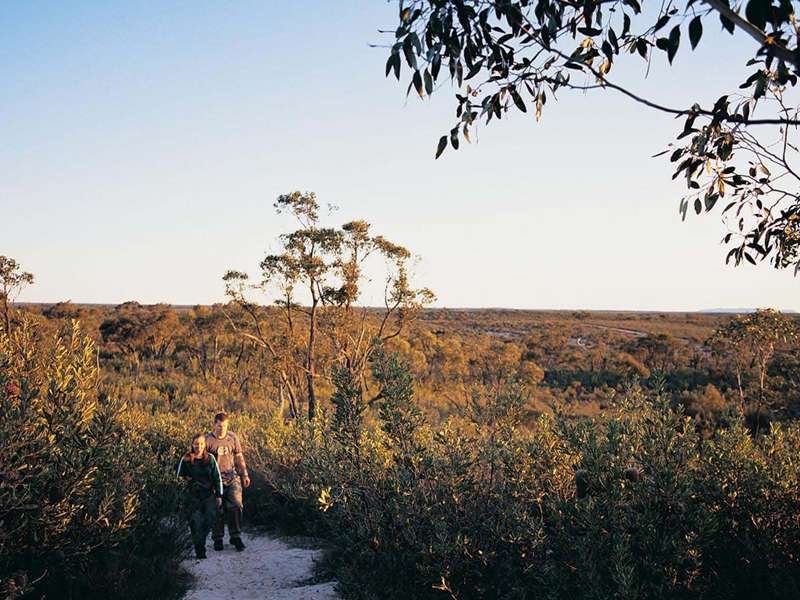
The Keith Hateley Nature Walk is a short, self-guided introduction to the plants and wildlife of Little Desert National Park. It starts at Sanctuary Picnic Ground, about 10 km south of Kiata. Follow the Parks Victoria walk notes to learn about the plants and birds of the reserve, including the rarely seen Malleefowl.
Time: About 30 minutes
Terrain: Low woodland and scrub
Track: Easy, self-guided nature walk
Start/Finish: Sanctuary Picnic Ground, Kiata South Road, Little Desert VIC 3418
Getting there
Located at the Little Desert National Park approximately 375km north-west of Melbourne, this 30-minute nature walk is situated 10 km South of Kiata. The road is accessible by 2WD. The easy walk begins at the Kiata Sanctuary Picnic Ground.
Keith Hateley Nature Walk Details
Kiata Lowan Sanctuary was the original name given to this area prior to the establishment of the Little Desert National Park. Keith Hateley was a local resident and major campaigner for the conservation of the Little Desert for the protection of the Malleefowl or Lowan. Lowan is the Wergaia word for Mallee hen.
Keith Hateley Nature Walk notes and map
Use all your senses; listen to the birds singing and the breeze rustling the trees. Smell the fragrance of the bush. Look at the many different greens of the bushland and the sunlight filtering through the branches. Take some time to simply breath and connect.
We hope you enjoy this little exploration of this pocket of the Little Desert National Park. Numbered pegs along the way relate to these notes.
1. Mallee and echidnas
An old clump of Yellow Mallee (Eucalyptus incrassata), a multi-stemmed tree with ridged woody fruits. The large stump is the trees trunk hidden beneath the ground. New branches sprout from the trunk after fire, severe frost or drought.
Watch for echidna scratching’s and finger-sized holes along the track. Echidnas, (Yulawil in Wergaia language) have long claws for digging and a hard pointy ‘nose’ for probing into ant nests.
Echidnas rarely drink as they get their moisture from the bodies of ants and termites which they extract by using their long sticky tongue.
2. Living brooms
Broom Honey-myrtle (Melaleuca uncinata), earned its name from European settlers who would use the branches and foliage to sweep their homes. In more recent times, it has been used to make broom-brush fences.
3. Stringybark
This Desert Stringybark (Eucalyptus arenacea), So named because of its stringy bark, is the only stringybark species found in the Park. It is important to the threatened Red-tailed black-cockatoos which are specialist feeders.
Red-tailed black cockatoos rely almost entirely on the tiny seeds of Stringybark and Buloke trees (Allocasuarina luehmannii) for food.
4. Living cycles - boom to bust!
Many young native pines can be seen growing around here. These Oyster Bay Pines (Callitris rhomboidea) have clumps of woody cones or seed containers that are an important food source for parrots and cockatoos.
Severe frosts and droughts cause problems for growing plants. Some Mallee plants send out new shoots and leaves after such natural disasters, while others must start fresh from the seed. Bushfires usually trigger the beginning of their life-cycle in the new ash bed.
5. A different broom
Broom Baeckea (Baeckea behrii). At first glance it may appear very similar to the Broom bush your saw earlier, but if you look carefully, the Broom Baeckea has shorter leaves and more widely spaced fruits.
Baeckea flowers are like those of its relative the tea-tree; both are members of the Myrtaceae plant family.
6. Wallowa
Wallowa (Acacia calamifolia) is a tall, upright shrub reaching a height up to four meters. It’s narrow eight-centimeter-long leaves are bright green with a hooked tip. Yellow flowers are produced in summer. It provides shelter and food for many animals, and its seeds are a favourite food of Malleefowl and Bronzewing Pigeons.
Springtime here is June to November. A good time to look for Spider Orchids (Caladenia spp.), Greenhood Orchids (Pterostylis spp.) and Sun Orchids (Thelymitra spp.). Not so common in drier years.
7. Malleefowl - the remarkable thermometer birds
Twenty metres along the side track is a Malleefowl mound. Unused for many years, but recently re-used. (it may be dormant now).
Malleefowl are called ‘thermometer birds’ as they spend about ten months of the year building and regulating the temperature of their mound using their tongue to measure temperature in the mound.
An active pair of Malleefowl will dig out a cone shaped hole and then rake-in organic matter including leaves and bark to fill the hole. Following rain the surround soil is scratched back in covering the wet leaf matter causing it to compost (decompose) and heat up.
Eggs are then laid over a period of weeks into the open nest area of the composting chamber of the mound. The male decides if the chamber is the right temperature and how far to open or close it.
During that period the temperature inside the egg chamber is kept at 33 degrees Celsius by the male balancing the internal heat – opening and closing the mound to let rain in, heat out or additional warmth from the sun and by varying the amount of sand covering the eggs.
They are constantly attending the mound and take about 3 weeks a year off. In dry years breeding does not take place.
Can you see any signs of active Malleefowl working this mound?
Retrace your steps to continue along the main track.
8. What is all this shrubbery?
Note the wide variety of small shrubs along the track. Some of the more common plants found here are Flame Heath (Astroloma conostephioides), a favourite food for emus, and Fringe-myrtle (Calytrix tetragona).
If there are any emu droppings around look carefully at them. Partly indigested Flame heath flowers can often be recognised in emu droppings. The emu gives a free ride to the seeds which are spread by the wondering emu.
The springtime flowers of the nearby Fringe-myrtle are a treat to see and range in colour from white to vivid pink.
More orchids can be found here in good spring seasons. Look for Pink Fingers (Caladenia carnea) and the Leopard Orchid (Diuris maculata) as they are the most common.
9. A tough life with spikes
Carefully feel the needle shaped leaves of the Desert Hakea (Hakea muelleriana). They have a hard-outer layer called a cuticle.
This and a woody seed cone are an example of adaptation to a dry climate of summer heat and wildfires.
10. The cycle of life – an ageing unburnt struggling mess
This messy bush has order and purpose. Plant remains are vital parts of habitat. It provides homes for plants including lichens, and a host of insects, spiders, lizards and small animals which in turn serve as food for birds and mammals.
Eventually, the dead plants rot down, releasing nutrients for living plants to use. Fire is the missing trigger in a cycle many plants and animal’s need for ongoing renewal. Fire is often a fresh start.
11. Different soil – different plants
Notice a change in the vegetation? The track has left the sandy soils that favour Desert Stringybark, and moved into clayey soils that support Yellow Gums (Eucalyptus leucoxylon).
These larger trees, Yellow Gums, have light mottled bark and are important habitat with larger hollows for parrots, bats and goannas to shelter and breed in. Parrots and Rosellas cannot breed without them. Many hollows take more than 60 years to develop.
Another distinctive tree with dark trunk and long, hanging branchlets is the Drooping She-Oak (Allocasuarina verticillata). Take a close look at the leaf-teeth leaves of this tree. The tiny scales form rings around the branchlets and reduce water loss through the leaves.
12. A rare one
Little Desert National Park is an important place protecting rare plants and animals. Keep a look out for the dark green shrub called the Hairy-pod Wattle (Acacia glandulicarpa). This is a rare plant with a very limited distribution. It is found only in a few areas of this park; near Dimboola and Nhill and further afield in South Australia.
Several other rare plants including this Whipstick Westringia (Westringia crassifolia) occur within the Little Desert National Park.
Location
Sanctuary Picnic Ground, Kiata South Road, Little Desert 3418 View Map


