Lake Eildon National Park Perfect Cure Creek Nature Walk


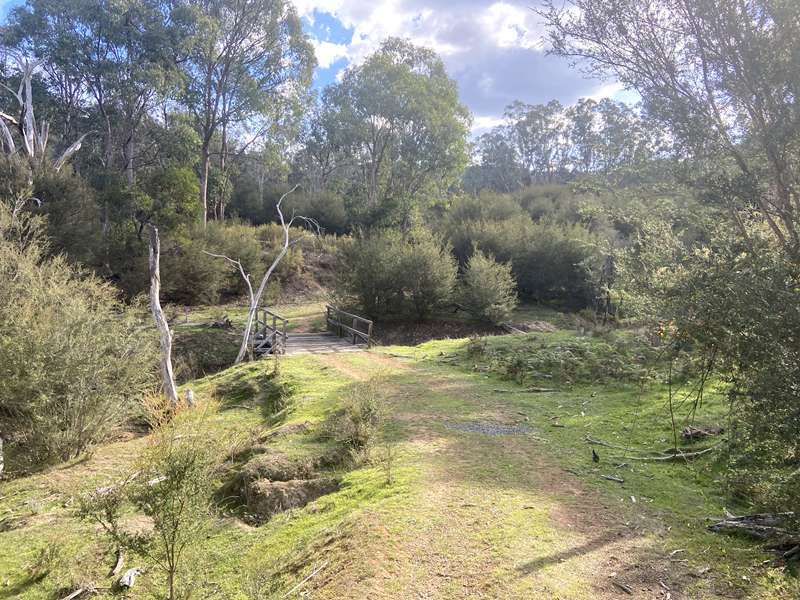
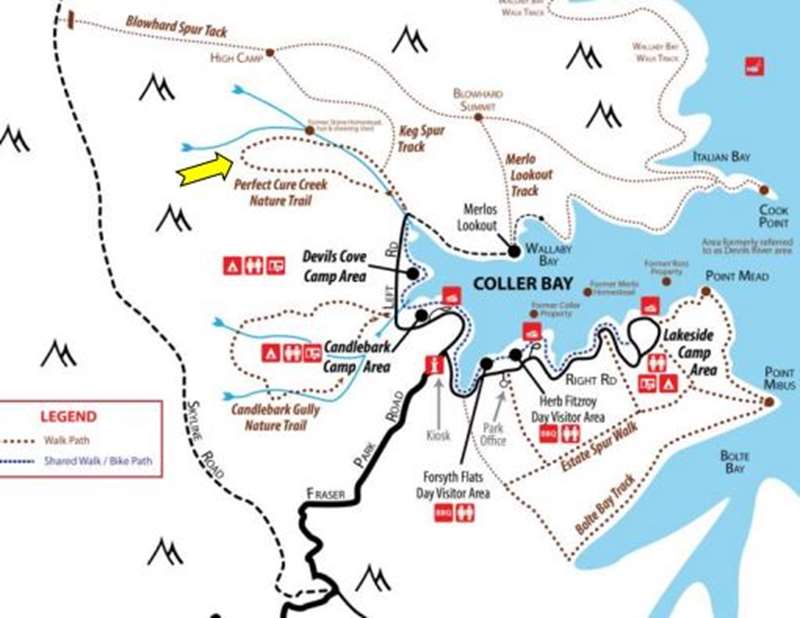
Perfect Cure Creek Nature Walk is located on the west bank of Coller Bay (Fraser Block) in Lake Eildon National Park in Central Victoria.
The walk starts from the gravel carpark area 200 metres past Devil Cove Camp Area (where the road crosses the Perfect Cure Creek). The walk track is a 1.5 km good grade loop walk that takes you through beautiful bushland. Flora and fauna abound and there are areas of historical value dating back to the gold mining days of the 1800s.
Two undercover Day Visitor Areas with BBQ facilities are located nearby (Forsyth and Herb Fitzroy). Candlebark Camping Area also has an undercover BBQ area, however the site is only open during peak periods.
The walk takes around an hour and is suitable for families. It is also popular as a night walk under torch light where nocturnal wildlife is more visible.
In 1956, the Big Eildon Dam project, was finished, expanding the water holding capacity of the new Lake Eildon over seven times when compared to the earlier Sugarloaf Weir. Fraser Block was established at Coller Bay on the lake's western bank, 25 minutes from Alexandra and Eildon. Fraser Block affords locals and visitors easy access to camping areas, nature walks, water access and all year fishing.
Features
- Beautiful bush setting
- Well formed track
- Gold mining relics
- Interpretive signage
- Lovely small bridges
- Beautiful flora and fauna
- Camping nearby
- Seats located along the walk
- Close to Forsyth Day Visitor Area
- Close to Herb Fitzroy Day Visitor Area
- 25 minutes from Alexandra
- 25 minutes from Eildon
- Multiple bush walking tracks
FROM ALEXANDRA
1. Travel east on the Goulburn Valley Highway towards Eildon, for 2 km.
2. Turn left at UT Creek Road.
3. Travel 9 km to Haines Saddle.
4. Descend 3 km to the office.
5. Turn left and follow the road to where it becomes gravel.
FROM EILDON
1. Travel north on the Skyline Road for 10 km, until you reach Haines Saddle.
2. Descend 3 km to the office and intersection.
3. Turn left and follow the road to where it becomes gravel. The smallish parking area is just past the Devils Cove Camping Ground.
Walk Start: Google Maps GPS: S37.169210, E145.840451
Review:
An interesting walk with lots of interpretative signage along the way.
After a short distance the Perfect Cure Creek Nature Walk branches off to the left while the Keg Spur Walk branches to the right.
The trail crosses Perfect Cure Creek towards the end of the walk. Do not attempt to cross the creek if it is in flood. There are also mine shafts in the area, so please keep to the track.
Perfect Cure Creek Nature Walk Interpretative Signage
A park in the making
This fertile valley has been home to the Taungurung People for thousands of years. Scar trees lie below the lake, and there is anecdotal evidence of a large, sophisticated system of fish traps and weirs along many local waterways.
Perfect Cure Creek and the Delatite Valley offered ideal farmland to the Europeans arriving in the 1800s. As farming expanded, so did the demand for water.
In 1929, the valley was dammed, flooding the town of Darlingford and surrounding farms. The reservoir was expanded in stages until the Great Eildon Dam was constructed in the 1950s, creating Lake Eildon.
The semi-cleared land remaining around Coller Stone and Bolte Bay, plus surrounding hills and wildlife, were protected as Fraser National Park in 1957. In 1997, Lake Eildon State Park was added to Fraser to create Lake Eildon National Park, encompassing 277.5 square km of lakeshore, hills and forest.
In 2020, the people of the Taungurung Nation were granted Aboriginal title to the Park, which is now jointly managed through their Recognition and Settlement Agreement.
Life with the mob
These cleared flats are a favourite feeding ground for Eastern Grey Kangaroos marram.
In winter, kangaroos can be seen feeding throughout the day. In summer, they seek shade in the hottest part of the day, returning to open grassy areas to feed in the cool of dawn and dusk.
Kangaroos breed throughout the year, but births peak in summer. Competition between males (bucks) over females (does) occasionally leads to fights.
The young (joeys) are born weighing less than one gram! They climb into the pouch and attach to a teat. Joeys first leave the pouch at around nine months old, but do not become totally independent for another eighteen months.
Fruits of past labour
Along the creek banks you can see a few European fruit trees.
They are descended from the orchards established around homesteads like Stone’s, Glen Hope, and Benara now submerged in Lake Eildon’s Coller Bay.
Their seeds were spread by animals like birds and foxes, and washed along the creek where they germinated.
Many of these fruit trees have been removed, but a few still remain.
A tale of fire and stone
To your left is the site of Stone’s original homestead, which burned down in the 1920s. All that remains are a few bricks and depressions where buildings once stood.
After the fire, the Stone family moved closer to Alexandra and ran the property from there.
The rest of the farm buildings and the shearing shed survived until the 1960s. Sadly, they became unsafe due to vandalism and had to be demolished.
The perfect cure
Very few gold nuggets were found in the district. Most of the gold was won by digging it out of the rock by hand.
However, Giovanni (John) Roberto Merlo found a 5oz (142g) gold nugget along this section of the creek, which was likely named after this “perfect cure”.
Merlo operated a very successful mine here in the 1880s, before turning to farming. The son of an Italian wine merchant, he also established a small vineyard on the property.
Glen Hope comprised of around eight buildings, most with roofs of bark shingles, probably made from Stringybark trees. Today, the homestead lies beneath the waters of Coller Bay, below Merlo’s Lookout.
Friend or foe?
Past revegetation programs did not always consider whether species were endemic - native to that specific place. As you walk, look out for three trees that are native to the surrounding region, but not endemic to this creek:
- Blue Gum is found in the park but only grows naturally up on the ridges
- Buxton Gum is only found in the Acheron and Yarra River valleys
- Swamp Gum grows in the Goulburn River catchment but does not occur naturally in the park
The underminers
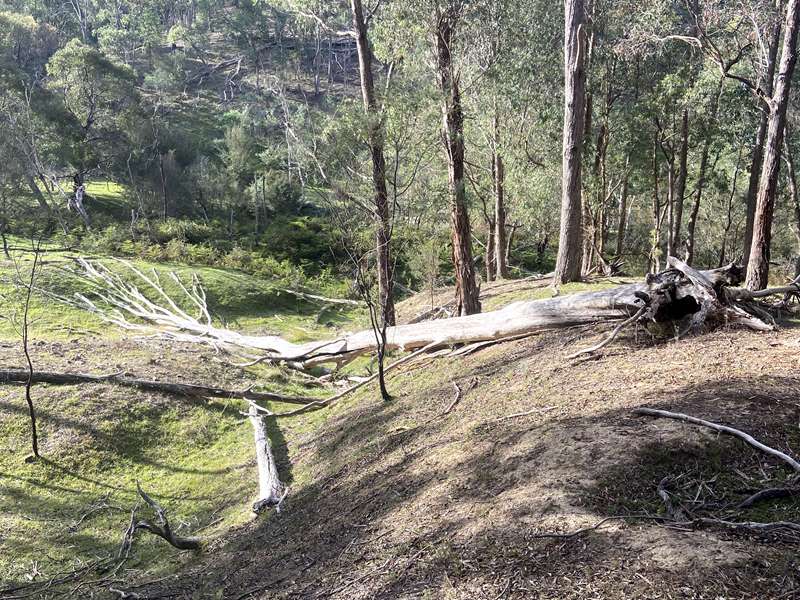
Looking down this gully you can see erosion caused by the removal of vegetation for farming and mining, and by burrowing.
Tunnels made by Common Wombats (Vombatus ursinus), warrin and European Rabbits (Oryctolagus cuniculus) make the ground more vulnerable to erosion.
Tunnel erosion occurs when rainwater runs into a burrow and washes away the soil beneath the surface. Eventually, the tunnel becomes too large to support the ground above it, and the roof of the tunnel collapses.
As the soil washes away, more soil becomes exposed and the process continues. Without roots to hold it in place, more and more soil is washed away, leading to the type of gully erosion you can see downstream.
Meet the locals
Here, the track roughly divides the cleared gully from uncleared bushland. The vegetation between the trail and the top of the ridge is typical of the dry forest found in this area.
Can you identify these five dominant local eucalypt trees by their leaves?
- Broad Leaf Peppermint (Eucalyptus dives) yuluk - minty-smelling leaves
- Red Box (Eucalyptus polyanthemos) - young pointy egg-shaped leaves, long adult leaves
- Yellow Box (Eucalyptus melliodora) - young rounded egg-shaped leaves, long adult leaves, popular with bee-keepers for honey production
- Long-leaved Box (Eucalyptus goniocalyx) bandi - young round leaves, long adult leaves
- Red Stringybark (Eucalyptus macrorhyncha) dhulangj - fibrous bark used by Taungurung people to produce rope and twine burrdi-am
A rest in the shade
Look around for areas of bare earth or flattened vegetation among the Tea Tree, (Kunzea ericoides) wullip and Bracken Fern, (Pteridium esulentum).
These spots or pads are where kangaroos and wallabies rest.
Eastern Grey Kangaroos marram are the largest marsupials found in the park. They have grey-brown fur, pale chests, and very long pale ears.
Swamp Wallabies yarengoorn are smaller, stockier, and less often seen, but walk quietly and you might see one of these shy animals.
Yarengoorn have very dark brown fur (they are sometimes known as Black Wallabies), rusty-orange fur on the belly, chest, and between the ears, and a white tipped tail.
Cherry ripe
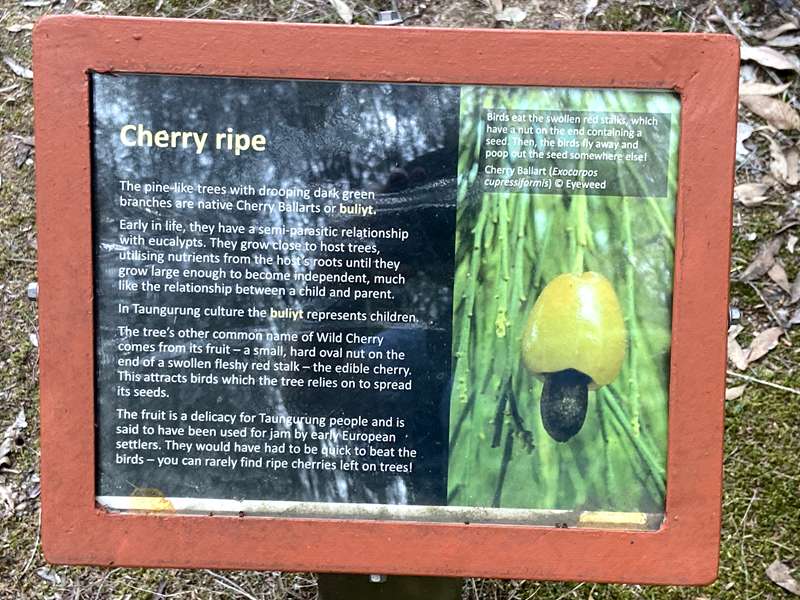
The pine-like trees with drooping dark green branches are native Cherry Ballarts or buliyt.
Early in life, they have a semi-parasitic relationship with eucalypts. They grow close to host trees, utilising nutrients from the host’s roots until they grow large enough to become independent, much like the relationship between a child and parent.
In Taungurung culture the buliyt represents children.The tree’s other common name of Wild Cherry comes from its fruit - a small, hard oval nut on the end of a swollen fleshy red stalk - the edible cherry. This attracts birds which the tree relies on to spread its seeds.
The fruit is a delicacy for Taungurung people and is said to have been used for jam by early European settlers. They would have had to be quick to beat the birds - you can rarely find ripe cherries left on trees!
Mistletoe’s deadly kiss
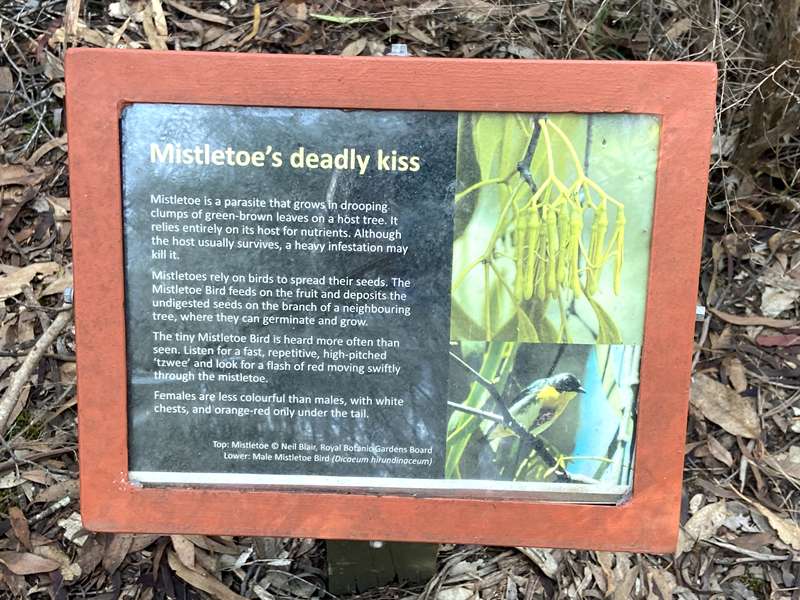
Mistletoe is a parasite that grows in drooping clumps of green-brown leaves on a host tree. It relies entirely on its host for nutrients. Although the host usually survives, a heavy infestation may kill it.
Mistletoes rely on birds to spread their seeds. The Mistletoe Bird feeds on the fruit and deposits the undigested seeds on the branch of a neighbouring tree, where they can germinate and grow.
The tiny Mistletoe Bird is heard more often than seen. Listen for a fast, repetitive, high-pitched “tzwee” and look for a flash of red moving swiftly through the mistletoe.
Females are less colourful than males, with white chests, and orange-red only under the tail.
Gold fever
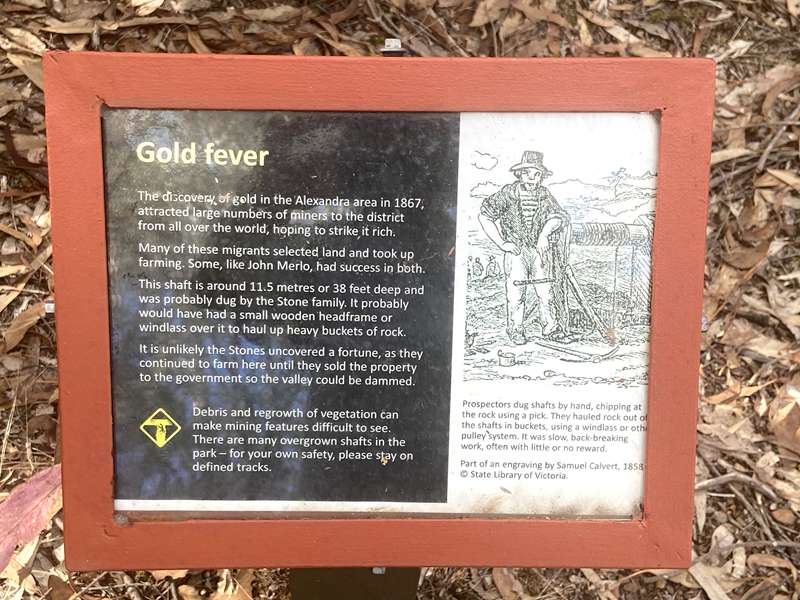
The discovery of gold in the Alexandra area in 1867, attracted large numbers of miners to the district from all over the world, hoping to strike it rich.
Many of these migrants selected land and took up farming. Some, like John Merlo, had success in both.
This shaft is around 11.5 metres or 38 feet deep and was probably dug by the Stone family. It probably would have had a small wooden headframe or windlass over it to haul up heavy buckets of rock.
It is unlikely the Stones uncovered a fortune, as they continued to farm here until they sold the property to the government so the valley could be dammed.
Debris and regrowth of vegetation can make mining features difficult to see. There are many overgrown shafts in the park - for your own safety, please stay on defined tracks.
Scented candles
The large Eucalypts growing along the creek are Candlebarks (Eucalyptus rubida). They are relatively fast growing trees which occur naturally in the gullies.
Rubida means red and refers to the red tinge of the older peeling bark. Underneath, the newly exposed bark is smooth and white. With their white trunks and flaking bark, they resemble dripping candles.
In summer, their fragrant white flowers attract a wide variety of insects, birds and mammals. Their sweetly scented leaves are sometimes eaten by koalas goorbil.
What’s in a log?
Have you ever had a close look at a log?
Examine one carefully, and you’ll discover that it’s home to all kinds of mosses, fungi, lichens, and many creatures and organisms too small for the human eye to see.
Many of these tiny lifeforms break down the wood and return nutrients to the soil.
Insects provide food for animals. Birds use bark, twigs and cobwebs to build their nests. Small reptiles and animals use logs for shelter, warmth and protection.
You can help protect these precious microhabitats by bringing firewood or coals from a sustainable source outside the park or using a portable camping stove.
Gold, silver and black
There are two different types of wattles along this section of track: Silver Wattle (Acacia dealbata) and Blackwood Wattle (Acacia melanoxylon).
Silver Wattle has a feathery leaf with a silvery hue. Young Blackwood Wattles garrang start life with true leaves, but as they age, they develop enlarged and flattened leaf stalks or “phyllodes” instead.
Phyllodes are thought to be an adaptation to tough conditions. They photosynthesise like true leaves but reduce transpiration (water loss).
The Taungurung people crush Blackwood phyllodes and mix them with a little water to wash their hands. Blackwood Wattle has a good shape and is relatively long lived for an acacia. It is highly prized for furniture making.
In contrast, Silver Wattle is untidy, short-lived, and has timber that is often full of grub holes. However, both put on a spectacular display of golden flowers from mid-winter to spring.
Wandering wombats
Have you noticed any large burrows along the way? They are most likely made by wombats warrin. Wombats are common in the park - there might be one sleeping under your feet!
Wombats maintain several burrows, including three or four regular residences, and some used only occasionally. They can have several branches and be up to 20 metres in length.
Wombats don’t mind sharing their burrows, but not their feeding grounds. They are strictly vegetarian, eating shoots, leaves and roots.
They are mainly nocturnal, but can often be seen grazing near their burrows in winter or wandering up to 3kms away.
The wombat’s closest relative is the koala, and like all marsupials, the female has a pouch. Joeys are born in late autumn and carried in the pouch for six to nine months.
Photos:
Location
Frasers Park Road, Eildon 3713 View Map
Web Links
→ Fraser Block Perfect Cure Creek Nature Walk Brochure (PDF)


