Lake Eildon National Park Candlebark Nature Walk


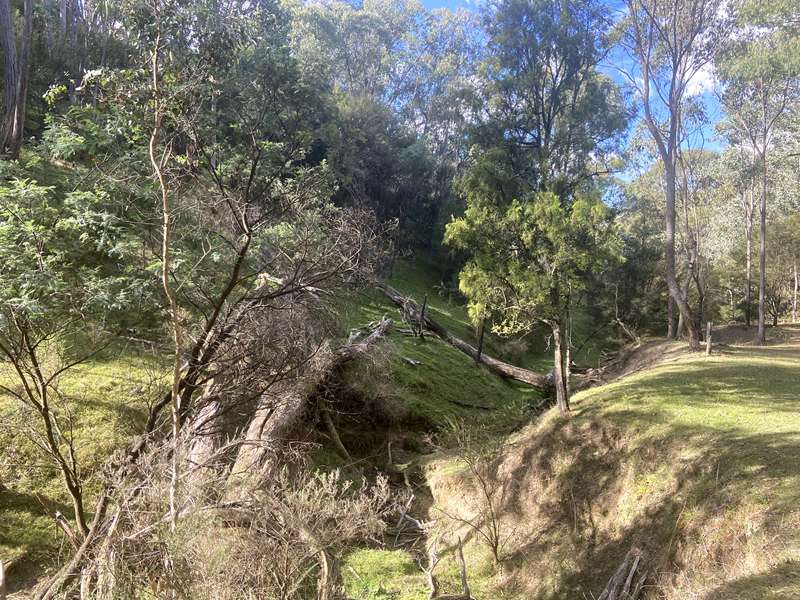
Candlebark Nature Walk is located in Fraser Block on the west bank of Coller Bay of the Lake Eildon National Park. The walk starts near the Candlebark Camp Area and continues for 2 kilometres.
The walk track is of good grade and takes the walker through beautiful Australian bushland where flora and fauna abound. There are areas of historical value dating back to gold mining days in the mid 1800s.
Two undercover Day Visitor Areas with BBQ facilities are located nearby (Forsyth and Herb Fitzroy). Candlebark Camping Area also has an undercover BBQ area, however this camp site is only open during peak periods.
The walk takes around an hour and is suitable for families. It is also popular as a night walk under torch light, when nocturnal animals venture from their homes and forage for food. This includes owls, possums and gliders.
In 1956, the Big Eildon Dam project, was finished, expanding the water holding capacity of the new Lake Eildon over seven times when compared to the earlier Sugarloaf Weir. Fraser Block was established at Coller Bay on the lake's western bank, 25 minutes from Alexandra and Eildon. Fraser Block affords locals and visitors easy access to camping areas, nature walks, water access and all year fishing.
Features
- Beautiful bush setting
- Well formed track
- Gold mining relics
- Interpretive signage
- Lovely small bridges
- Beautiful flora and fauna
- Camping nearby
- Seats located along the walk
- Close to Forsyth Day Visitor Area
- Close to Herb Fitzroy Day Visitor Area
- 25 minutes from Alexandra
- 25 minutes from Eildon
- Multiple bush walking tracks
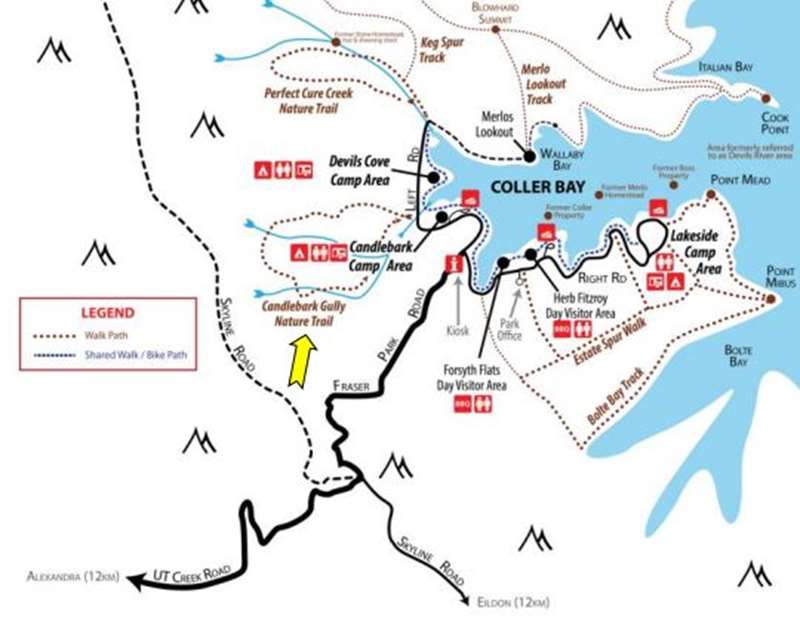
FROM ALEXANDRA
1. Travel east on the Goulburn Valley Highway towards Eildon, for 2 km.
2. Turn left at UT Creek Road.
3. Travel 9 km to Haines Saddle.
4. Descend 3 km to the office.
5. Turn left and follow the road for 1 km to the carpark on the right (just before the entrance to Devil's Cover Camp Area).
FROM EILDON
1. Travel north on the Skyline Road for 10 km, until you reach Haines Saddle.
2. Descend 3 km to the office and intersection. Turn left and follow the road for 1 km to the carpark on the right (just before the entrance to Devil's Cove Camp Area).
Walk Start: Google Maps GPS: S37.176306, E145.838778
Review:
The best way of finding the start of the walk from Eildon is to drive past the Candlebark Camping Area for about 150m and there will be a parking area on the side of the road. Directly across is the start of the walk. Drive carefully because we so a lot of wallabies on the road.
This is a really nice walk with plenty of interesting elements and many informative signs (see below).
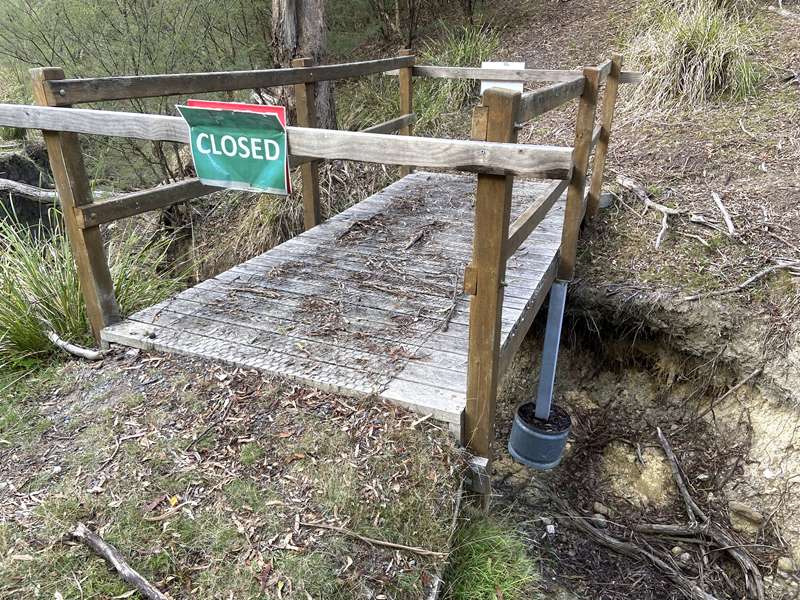
The walk is a loop which means you can go either direction. HOWEVER, a bridge over a creek has been damaged by flooding and has been closed off. This means it is much easier to find the route if you take the right hand branch and go around in an anti-clockwise direction. When you reach the closed off bridge, continue for another 100m along a fertile green flat and do a U-turn around a clump of trees to return back to the start point.
Candlebark Nature Walk Interpretative Signage
An open eucalypt forest
After passing through a passage of shrubs you find yourself entering an open Eucalypt forest.
This area of the park is dominated by three common Eucalyptus species: Red Stringybark Dhulangi, Red Box and Long-leaved Box Bandi.
Taungurung people used the bark of Dhulangi to produce rope and twine.
Use Your Nose
Another common group of Eucalypts in this area are the Peppermints Yuluk.
As their name suggests, the leaves have a minty smell which makes them easy to identify.
Can you find both Broad-leaved and Narrow-Leaved Peppermints along the trail?
A home of wood and stone
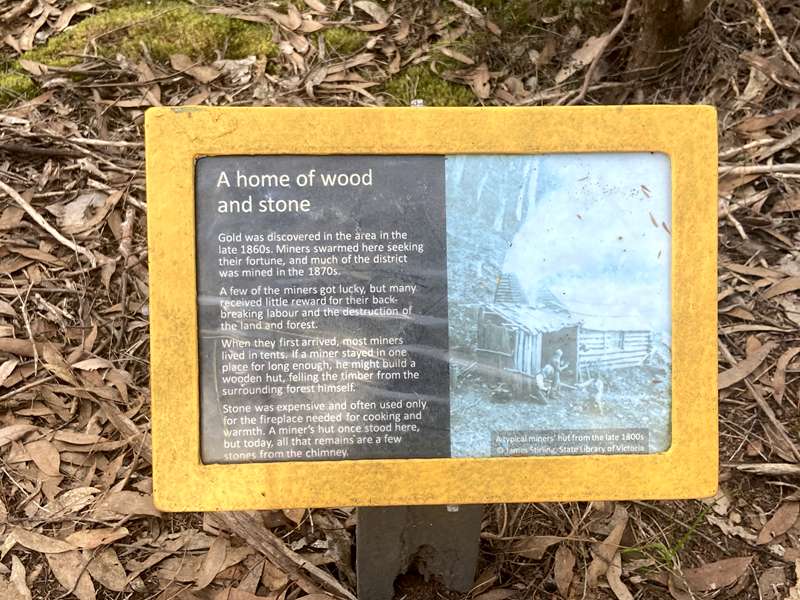
Gold was discovered in the area in the late 1860s. Miners swarmed here seeking their fortune, and much of the district was mined in the 1870s.
A few of the miners got lucky, but many received little reward for their back-breaking labour and the destruction of the land and forest.
When they first arrived, most miners lived in tents. If a miner stayed in one place for long enough, he might build a wooden hut, felling the timber from the surrounding forest himself.
Stone was expensive and often used only for the fireplace needed for cooking and warmth. A miner’s hut once stood here, but today, all that remains are a few stones from the chimney.
Rich rewards from poor soil
When miners found gold or a quartz reef at the surface, they dug shallow trenches to determine the exact direction and length of the mineral-bearing material.
From this, they could tell whether to dig a large surface pit or a deep mine shaft to extract the maximum amount of gold.
Can you see old trenches under the bridge and further along the trail?
Australian soils are typically shallow and low in nutrients, particularly in disturbed ground. Native plants, such as the Maidenhair fern, adapt well and make the most of every fertile space.
Reminders of a golden era
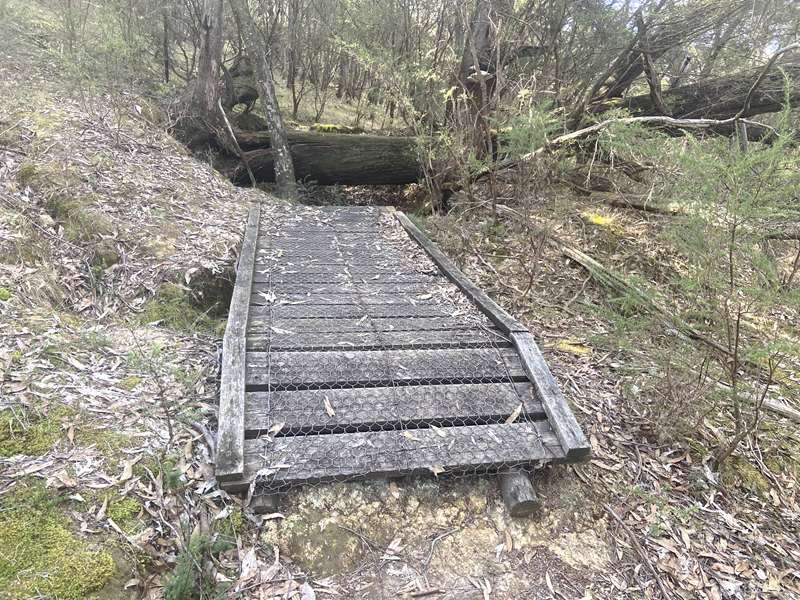
There are many obvious signs of gold mining around Lake Eildon, like this old mine shaft. The size of the trees growing in old shafts suggests how much time has passed since mining.
Another common feature are mullock heaps. These mounds of earth removed from mines and creek beds make the area appear hillier than it was originally. They are often the final remaining sign of mining in an area.
Debris and regrowth of vegetation can make mining features difficult to see. There are many overgrown shafts around the park - for your own safety, please stay on defined tracks.
Moisture holding moss
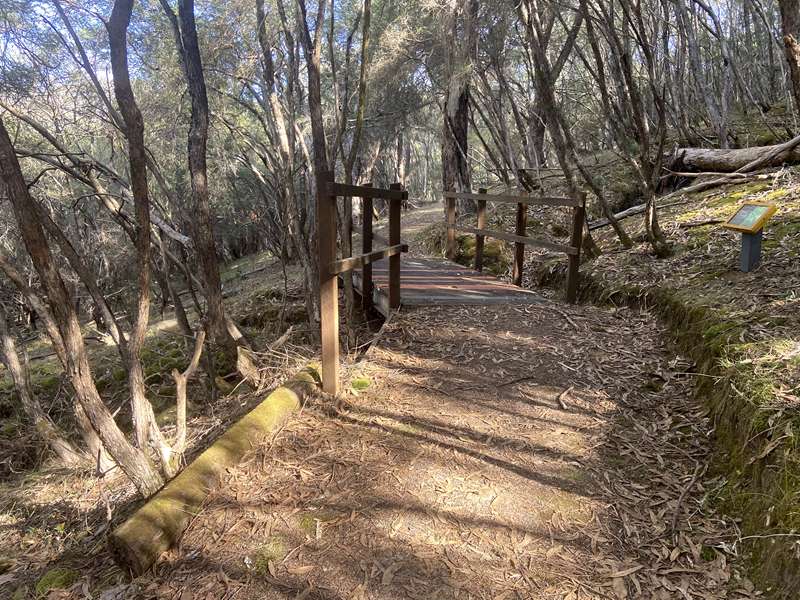
Extensive banks of moss like this are a common feature along the trail. Here, the moist habitat supports a range of orchids and other wildflowers which form a colourful display in spring.
Some only bloom for a week or two, like the Pink Fingers and Common Bird Orchids. Others last for months, like the Tall Sundew, a carnivorous plant that traps insects in its sticky tentacles, and absorbs their nutrients.
Old clearing, new growth
Before becoming a national park in 1956, the Fraser area of Lake Eildon had been mostly cleared for agriculture and grazing.
However, the forest here has regrown. A few large trees escaped the clearing, providing vital seed for natural regeneration.
Adaptable, fast-growing species move in quickly to colonise areas affected by clearing or fires.
Acacias, like Silver Wattle, can help to replace lost nutrients in the soil, helping nature to restore the balance. Can you see how Silver Wattle gets its name?
Watery lifelines
Much of the life in this dry forest is found along the creek lines, like here at Ferny Creek.
The dense vegetation in this riparian zone provides shelter and food for a host of insects, birds and lizards.
The prickly brambles here are European Blackberries. Although they are invasive, blackberries can provide useful food and habitat. Their tasty fruit, similar to the native raspberry nebigup, is popular with many animals.
Sit quietly and you may catch a glimpse of Grey Fantails, Fairywrens and Brown Thornbills foraging around the creek.
Kangaroo trails
During the hottest part of the day, kangaroos marram seek the shade of wooded areas, returning to grasslands to feed in the cool of dawn and dusk.
Kangaroos and wombats warrin often follow the same path when moving from place to place. Can you see a well-worn track nearby?
These animals are very common here, so keep your eyes and ears open. They may be closer than you think!
New life from felled trees
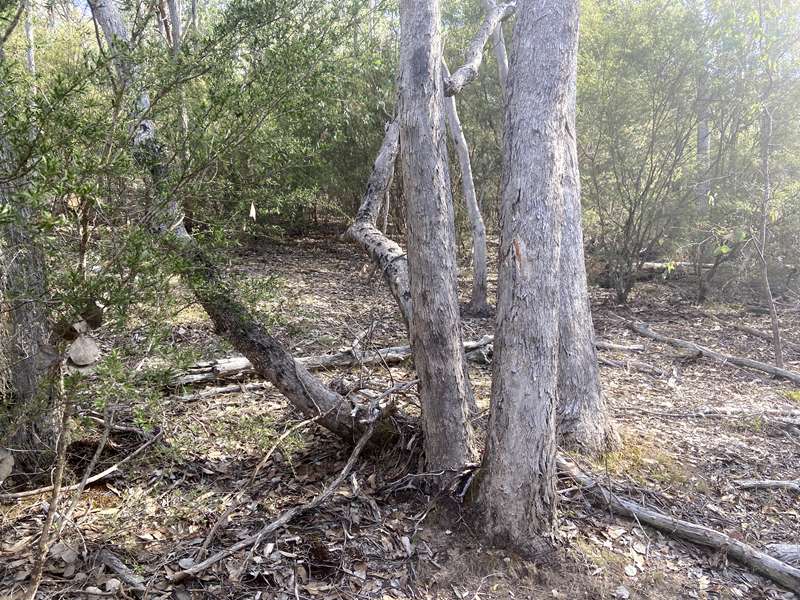
Gold mining used a lot of wood.
Miners cut down trees for cooking and warmth, to fuel quartz kilns and steam-powered crushing batteries, and to build homes, headframes and timber supports for mine shafts.
However, many Australian trees have a special kind of root called a lignotuber that allows the tree to regenerate after a fire or being chopped down.
Several new stems may sprout from the old stump. This process is called “coppicing”. The trees around you with multiple trunks have regrown in this way.
Daylight robbery
The pine-like trees with drooping dark green branches here are Cherry Ballart or Bulity. Early in their life, they have a semi-parasitic relationship with Eucalypts. They grow close to host trees, utilising nutrients from the host’s roots until they grow large enough to become independent.
Another common parasite is mistletoe, which grows in drooping clumps of green-brown leaves on its host tree. Mistletoe relies entirely on its host for nutrients. The host tree usually survives, but a heavy infestation of mistletoe may kill it.
Both Cherry Ballart and mistletoe rely on birds to spread their seeds. The shy Mistletoe Bird feeds on the fruit of mistletoes and deposits the undigested seeds on the branch of a neighbouring tree, where it can germinate and grow.
Ants and ant-eaters
Look around. Can you see several ant nests on the ground nearby, as well as raised solid termite mounds?
These are homes to millions of industrious workers, busily collecting and storing food.
Look closer and you may see scratch marks around the ant nests yaba yaba, made by an Echidna Gawarn.
Echidnas have an excellent sense of smell, electro-sensors in their snouts, sharp claws for digging, and a long sticky tongue - all useful tools for finding a tasty meal of ants, earthworms, beetles or other insects.
Echidnas are shy and well-camouflaged, making them hard to spot unless they are moving. Listen for them snuffling around the forest floor.
Life goes on
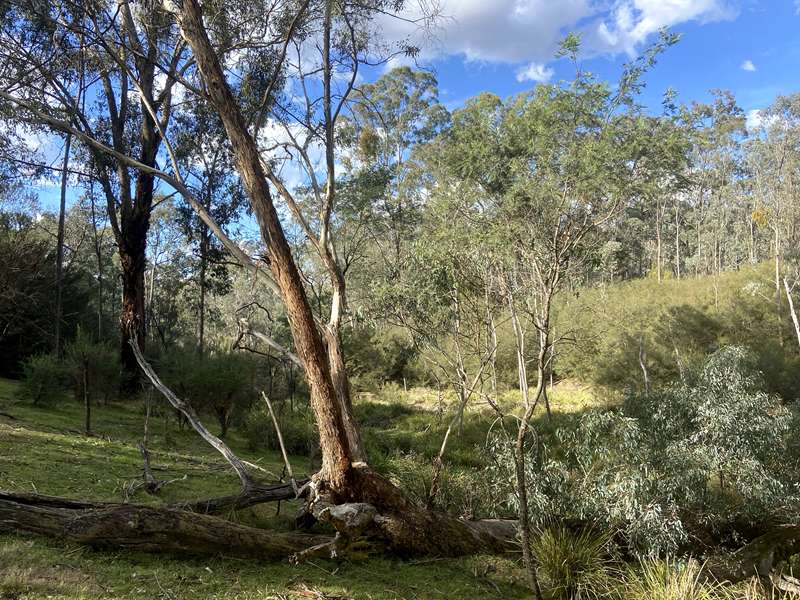
In the gully to the left of the track, a large Yellow Box tree has fallen, exposing a fan of broken roots. Enough roots have remained in the soil for the tree to continue growing. Trees naturally want to grow upwards so new branches have sprouted along the fallen trunk, giving the appearance of separate trees.
Blackwood Wattle Garrang are common in this area. The flowers are an important food source for Sugar Gliders Dadho, which also eat the gum - the clear sap produced by wattles.
Garrang is an important tree for the Taungurung people who use the tree for cooking, grind the seeds into flour and crush the leaves and mix them with water to make soap. These tall trees allow gliders, such as Greater Gliders Durnong, to move safely and freely through the forest.
From rushing water to water rushes
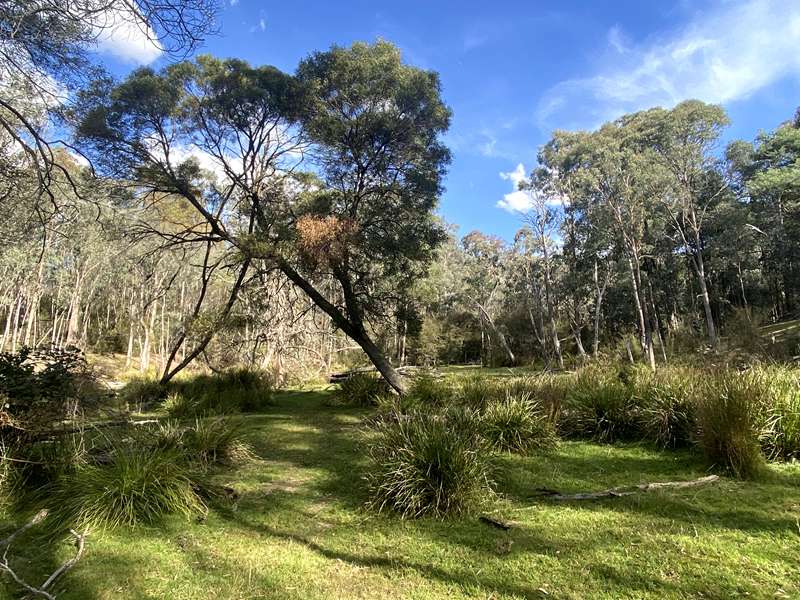
A large fertile flat has formed here, where two creeks merge. Over time, water carrying material eroded from the hills has deposited these rich soils.
Tussock-like reeds and rushes, such as the Spiny-headed Mat Rush Gumayl, are common here in areas of fresh water.
Gumayl is important to Taungurung people, providing seeds and nectar for food, and fibre for making mats, nets garrtgirrk and baskets binak.
Its dense growth also provides a well-protected home for the Superb Fairywren. Can you spot the beautiful blue plumage of the male as he hops and flits around?
A home among the gum trees
This large dead tree was killed by ringbarking, which involves removing a section of bark all the way around the trunk. This kills the tree by cutting off its nutrients and water supply.
Until the 1950s, this technique was widely used in Australia to clear land for agriculture.
However, trees can provide important habitat, even when dead. As a tree decomposes, it forms hollows which provide crucial homes and nest sites for animals like possums walert, bats and parrots nelawon.
A good hollow can take over 100 years to develop, so it is important to have trees of mixed ages in the forest to ensure an ongoing supply.
The ground beneath our feet
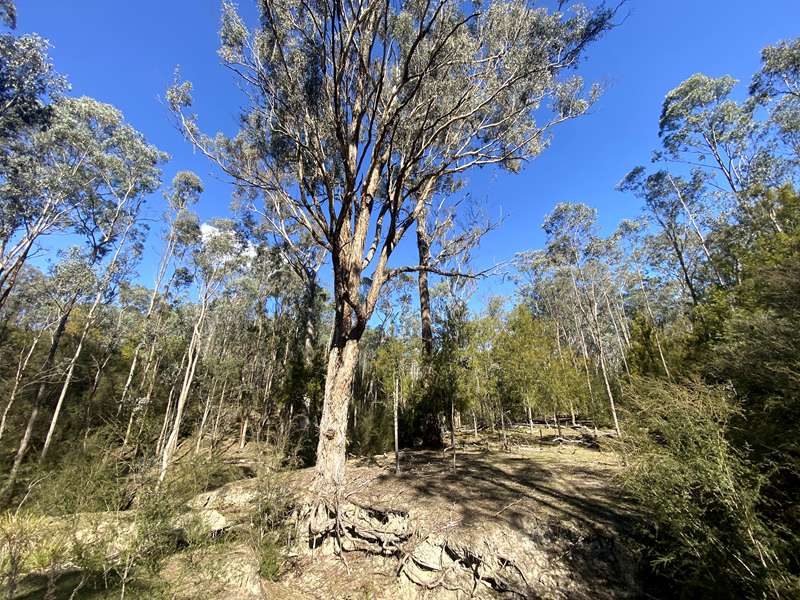
Have you ever wondered what you are standing on?
The exposed creek bank here shows a type of rock known as ‘plum pudding’ or ‘puddingstone’.
It consists of water-worn boulders and pebbles held together by grains of sand, rock and clay eroded from the hills and deposited along the creek bed over hundreds of thousands of years.
Increased water run off caused by tree clearing has accelerated the natural rate of erosion in this gully. Natural revegetation is gradually beginning to stabilize the banks and slow down this rapid erosion.
The honey tree
The large tree here is a Yellow Box, named for its yellow-grey bark and smooth yellow trunk beneath. It produces abundant creamy-white or pink flowers in spring or early summer.
Its botanical name means “honey-scented eucalypt”.
Bees feeding on Yellow Box flowers produce a popular aromatic honey, pale amber in colour, with a mild and smooth flavour. Have you tried it?
Near the base of the tree you can see a burl. Trees may form these abnormal growths in response to stress, such as injury, disease, fungi, or insect damage.
Some Eucalypts develop burls around unformed buds. Every burl is unique, and people imagine all kinds of shapes in them. What does this one look like to you?
An eerie screech
The raucous screech of cockatoos often echoes through the gully as they feed high in the Eucalypts. The forest canopy is quite open, due to past tree clearing, allowing these large birds to move around freely.
These social, intelligent, long-lived birds nest in tree hollows. Their strong beaks are ideal for tearing open tough seeds and nuts, pulling up roots and digging insects out of bark.
A flock of noisy cockatoos is easy to locate. Can you see or hear the two common species here?
The white Sulphur-crested Cockatoo Gaan has a very harsh drawn-out screech.
The Yellow-tailed Black Cockatoo Nguma has a slightly softer “kee-ow”.
What is in a name?
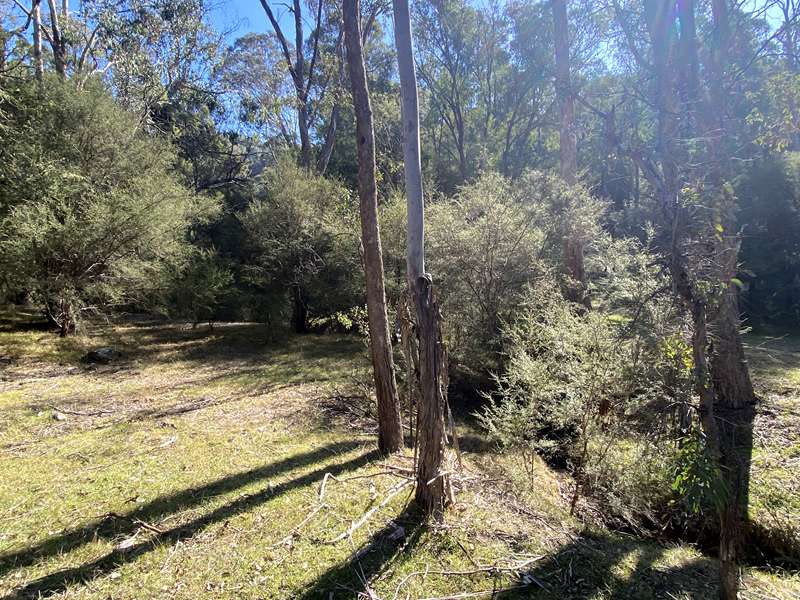
The magnificent stand of trees with glowing trunks along this gully are Candlebarks (Eucalyptus rubida). Rubida means red, and refers to the red tinge of the older peeling bark. Underneath, the newly exposed bark is smooth and white.
With their white trunks and flaking bark, they resemble dripping candles.
Like the Yellow Gum, the sweetly fragranced Candlebark is popular with bees. In summer, its flowers attract a wide variety of insects, birds and mammals, and its leaves are sometimes eaten by Koalas Goorbil.
Creatures of the night
Many Australian animals are nocturnal, and spend the day sleeping in a safe place.
Under the cover of darkness, they emerge from their nests and hollows to feed. At night, the forest comes alive with hunting and foraging possums, gliders and owls.
Why not return at night and see what you can spot? Spotlighting opens up a whole new world. Use a torch with a red filter and walk quietly to minimise disturbance to nocturnal animals.
Look up among the leaves and tree trunks for possums walert and gliders, and down on the ground for bandicoots and rodents.
Owls, like the Boobook Muk Muk, are sometimes seen sitting out in the open on exposed branches or dead trees.
Photos:
Location
Frasers Park Road, Eildon 3713 View Map
Web Links
→ Fraser Block Candlebark Nature Walk Brochure (PDF)


