Kyeema Crash Site Memorial (Mount Dandenong)


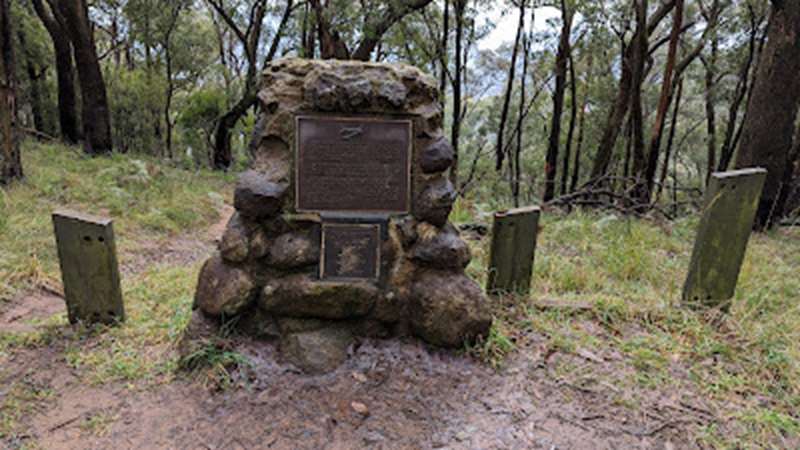
There is a cairn at the site which commemorates eighteen people who were killed in the crash of the "Kyeema". The plaque on the cairn was unveiled on the 40th anniversary of the disaster.
The "Kyeema" was one of Australian National Airways DC-2 passenger aeroplanes and was flying from Adelaide to Melbourne. It crashed into Mount Dandenong obscured by fog apparently because the crew had mistaken either Sunbury or Gisborne for Daysleford, and believed they were leaving cloud cover for the approach to Essendon when they crashed.
As a result of the enquiry, Flight Checking Officers were appointed to airports to monitor the progress of aircraft, advise pilots of their position in relation to other aircraft, and alternative aerodromes. This was the birth of air traffic control in Australia. It was also decided to install a radio beacon system at airports so that pilots could receive instant information on their course rather than waiting for a ground radio operator.
Location: Park in the carpark along Osprey Track (sometimes named Osprey Road on some maps). Kyeema Track leads from the carpark towards Burkes Lookout. Almost immediately, there is a track with a gate on the right which leads down a short distance to the cairn and information board.
The plaque on the cairn reads:
Fifty metres below this point on 25 Oct. 1938, Australian National Airways' DC-2 "Kyeema" plunged to destruction while the mountain was enveloped in cloud. All 18 persons on board perished.
From the recommendations of the subsequent enquiry have evolved the air traffic control systems in use throughout Australia today.
This plaque, placed by the Mount Dandenong Historical Society with assistance from C. Gramp & Sons, Thos. Hardy & Sons, S. Smith & Son, Australian Federation of Air Pilots and Forests Commission of Victoria, was unveiled on 25 Oct. 1978 to mark the 40th anniversary of the disaster.
Kyeema VH-UYC
Crew and Passengers
Captain Alfred Webb
Junior Captain Allan Steen
Air Hostess Elva Jones
Cadet Pilot Philip Pring
Leonard Abrahams K.C.
Alfred Cain
Hans Gloe
Stella Gloe
Gordon Goddard
Hugo Gramp
Thomas Hardy
Charles Hawker M.H.R.
George Ling
James Massie
Vaughan Pate
Elizabeth Schrader
Lancelot Shirley
Sidney Hill Smith
The information panel reads:
DC-2 Kyeema Crash Site
-embed01.jpg)
The Dandenong Ranges
The Dandenong Ranges has always been a popular destination. The Wurundjeri people, traditional owners, traversed the mountain ranges as part of their lifestyle seeking shelter, food and attending gatherings. European settlement resulted in many people moving to the area to set up their homes.
Today the Dandenong Ranges welcomes around two million visitors each year in their search for recreation, arts, crafts and the surrounding beauty of the National Park and gardens. History and various achievements lie within the forested slopes – one of which is the tragic crash of DC-2 Kyeema on Tuesday October 25th 1938.
Low Cloud Swallows Plane
Mount Dandenong rises 633 metres above sea level. This area and Burkes Lookout, which is slightly lower, is often shrouded in mist and fog which hide its tall trees from view.
DC-2 Kyeema was on a regular morning flight from Adelaide to Melbourne's Essendon Airport. The crew, led by Captain Alfred Webb, Junior Captain Allan Steen and supported by Air Hostess Elva Jones and Cadet Pilot Philip Pring, ensured comfort to its 14 passengers. These included a Federal Government minister, wine industry leaders, a couple on honeymoon and members of the legal fraternity.
Although aviation had technically progressed, pilots still relied on visual sighting and ground speed checks. On that fateful day the resultant poor visibility created by low cloud and a navigational error is believed to have led to the Kyeema overshooting the Essendon airstrip. As it passed by and headed off course, cloud and fog shrouding Mount Dandenong and the ranges closed around the plane. As a result, the Kyeema crashed into the side of Mount Dandenong. There were no survivors.
Significant Disaster Changes Aviation History
While the death of those on board was tragic, it was not in vain. After the crash, an investigation and public enquiry led to the development of Australia's new Air Traffic Control system, with an improved airway network and accurate navigational information – a system that is regarded as amongst the safest in the world. It also led to the establishment of the Department of Civil Aviation.
Dedicated Search Unearths History
Forty years had elapsed and no memorial had been erected when the question was asked: "Where is the site of the Kyeema crash?" Trees had grown taller, some had fallen over, fires had occurred and leaf litter had built up around the site.
Location of the exact site involved the tireless work of a number of dedicated individuals, together with the (previous) Forest Commission Department. With the use of old photographs, newspaper clippings and discussions with locals who had witnessed the crash, the exact site and pieces of the wreckage were located.
Under the guidance of the Archaeological Society a watchcase, aviation instruments, glass, nuts and bolts and remains of a passenger seat were unearthed.
A memorial cairn and directional marker were erected to permanently mark this historically significant site.
Respectful Silence
When visiting this site please take a few minutes to pause and reflect on the positive outcomes and sacrifices of those 18 persons.
Location
Osprey Track, Mount Dandenong 3767 View Map
Web Links
→ Kyeema Aeroplane Crash


