Jumping Creek Nature Walk (Warrandyte North)


.jpg "Jumping Creek Nature Walk (Warrandyte North)")
This nature walk is a 1.9km circuit and takes you about 30–60 minutes to complete. The trail begins at the northern end of the picnic area and follows the river for a short distance, travels along ridges and gullies, then winds through attractive forests before returning to the carpark.
The numbers refer to numbered posts along the track. Please keep to the track so disturbance and damage to the area is minimised.
Jumping Creek Nature Walk Map
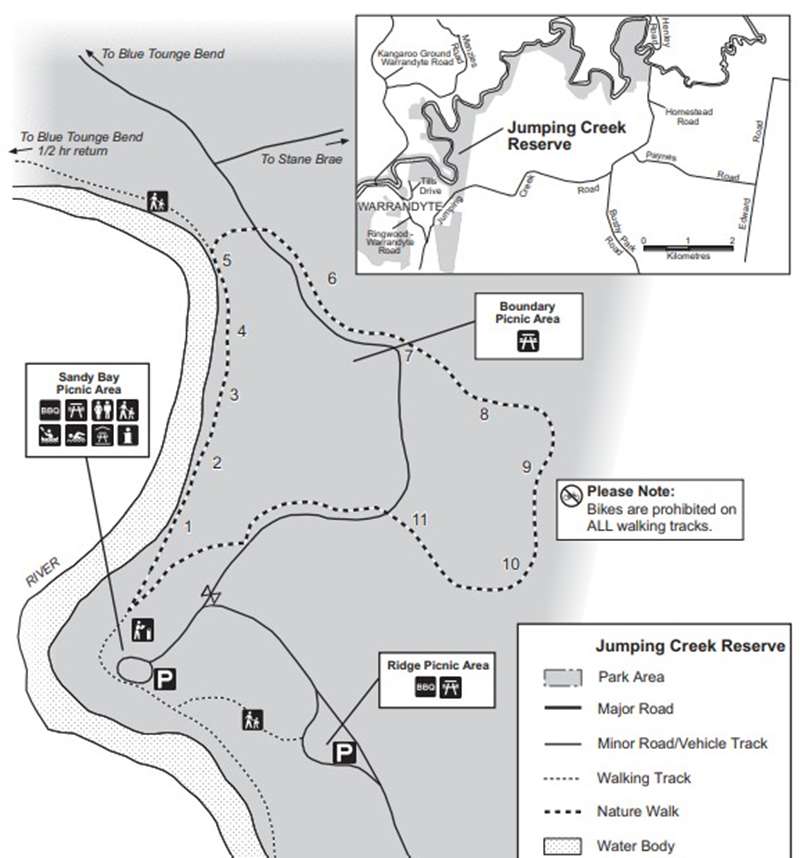
1. Anyone home?
-embed01.jpg)
The large hole in the ground is the home of a wombat. The wombat is a marsupial and the female carries its young in a backward-facing pouch.
Each wombat has a number of burrows – look for one currently in use. As they are mainly nocturnal mammals you probably won't see any wombats on this walk.
One problem they have in the Warrandyte area is finding suitable sites for their burrows. Most burrows are in the alluvial soils along the Yarra River rather than the surrounding rocky hills as they are easier to dig.
2. Which gum's a gum?
Eucalypts are almost exclusive to Australia and are very common in this park.
There are four main types of eucalypts. Using the table below, try to identify the different types of trees along the trail. All you need to do is examine the bark carefully.
You should find examples of all four types.
- The Gum Group – trunks and limbs are smooth (white or grey), bark is shed in long ribbons or large thin flakes.
- The Box Group – bark is scaly, flaky and a bit fibrous.
- The Peppermint Group – bark is greyish and finely interlaced or trellis-like.
- The Stringybark Group – bark is thick with long-fibred strands.
The Manna Gum is host to a range of inhabitants, including possums, antechinuses (marsupial "mice"), tree-creepers, spiders, beetles and bats.
3. Rocks
Here the underlying rocks are exposed at the surface, showing the main rock type in this area – mudstone, a sedimentary rock consisting of successive layers of material laid down under water.
The trees and other plants around you have adapted to survive in this very shallow soil. The tree roots penetrate cracks in the rocks for support and to reach water and nutrients.
The crevices of the rocks are home to both reptile and insect species. Keep an eye out for skinks scurrying back into a gap amongst the rocks.
4. River Rapids
Look towards the bend in the river and you will see that one side of the bend has a steep slope and the other a gentle slope. Where the water flows fastest around the outside of the bend it erodes rock and soil, where it flows more slowly on the inside of the bend it deposits its load of silt and sand.
In these slower flowing sections of the river water plants and reeds such as Phragmites australis colonise and work to trap silt and other debris. This process assists to stabilise and build the bank of the river. Here a deep soil develops, and many trees (in this case mainly Black Wattles) can grow.
5. Burgan
The trees in this gully are a type of tea-tree called Burgan (Kunzea ericoides). It is common throughout the park. Its canopy is so dense that light reaching the forest floor is greatly diffused. Few other plants grow there, except for mosses, lichens and fungi.
Birds and small animals seeking grubs and insects, which live in the moist conditions under the leaf litter, cause the scratchings on the forest floor.
As you head up the hill and away from the river you will notice a striking change in the tree types, the primary reason being a change in soil type from rich alluvial soils to clays lacking in nutrients and water.
6. Lichen and moss
At this point you can observe the beginning of nature's revegetation process. Where there was once a track, the erosion of topsoil and compacted clay beneath has made revegetation difficult, but you can see one of nature's primary soil producers at work. You may see flat grey patches (lichen) and look for green furry ones (mosses). In the hotter summer months these plants will dry out and lose intensity in colour.
These plants aid revegetation by:
- Slowing the flow of water, as well as holding the surface of the easily erodible clay together.
- Breaking down the clay to help form the soil.
- Forming a rough surface, catching plant litter and seed.
Look straight ahead into the distance and you will see a large old dead tree. Hollow-bearing trees provide shelter and nesting opportunities for arboreal marsupials and birds.
When these wonderful old trees drop their limbs, the fallen logs become habitat for many small mammals, insects, reptiles and spiders. The rich, organic soil, which results as the log rots, provides a unique habitat for fungi, seedlings, mosses and ferns.
-embed02.jpg)
Stop and think next time you decide to cut down a dead tree or remove a fallen log. Imagine all of the native animals which call it home.
8. Aboriginal Heritage
Many of the flora species which can be found in this area played an important role in the lives of the indigenous inhabitants. The following are just a few examples.
Cherry Ballart (Exocarpus cupressiformis) – It might look like a small cypress tree, but it has small amounts of sweet, juicy fruits which would have provided a springtime snack. The sap of the tree was used as a snake bite treatment while the leaves were used to create a smoke for repelling insects during the warmer summer months.
Burgan (Kunzea ericoides) – the straight, quick-growing Burgan was used for making spears and poles.
(Bracken) Pteridium esculentum – The underground stems, which are fibrous and contain a starchy white pith, had to be processed before they were eaten. They were roasted in hot ashes, beaten into a paste, water added and made into "cakes" or a "type of bread" and then cooked on the coals. The above-ground parts were not eaten. The young juicy green stems were rubbed onto the skin to relieve the stinging and itching of insect bites.
The long leaves of sedges (such as the ones at this site), rushes and lilies were collected to make baskets and mats. They were also soaked and beaten to free the fibres to make string.
9. Kangaroos & Wallabies
Walk through this area quietly and you may be lucky enough to see Swamp Wallabies or Eastern Grey Kangaroos grazing or resting under trees.
Swamp Wallabies are smaller and have darker coats than kangaroos. If you are especially lucky they may be curious enough to stop and have a good look at you too! Look for flattened patches of grass where kangaroos or wallabies may have rested or slept recently.
Also, look out for evidence of wombats. These nocturnal animals like to mark their territory by leaving their scats on elevated surfaces such as a rock or log. Their scats are a distinctive "cube" shape.
10. Cherries, Coppice & Scribbly Gum Moth
Here, we see great relationships shared by trees and insects, sometimes beneficial to just one party, or sometimes to both.
The trees with pine-like branches are Cherry Ballart (Exocarpus cupressiformis). This plant is partly parasitic on the roots of surrounding plants, and bears sweet fruit like small cherries.
You will notice that the large eucalypt tree shows coppice growth—they have several trunks sprouting from the same point in the ground. These trees have regrown from a parent tree either killed by fire or cut down for timber.
The ability to sprout new growth is an adaptation often found in Australian trees, enabling them to survive wildfires. Thick fibrous bark also protects some eucalypts from fire by providing insulation.
If you turn around, and face back toward the river, you should find a winding pattern on the trunk of a tree. This is the work of the aptly named "Scribbly Gum Moth". The scribbles are caused by moth larvae feeding on photosynthetic tissue within the tree trunk.
11. Regeneration methods
You may notice small sections of the park which are fenced. These areas are called exclusion or revegetation plots. The aim of these is to keep rabbits out of an area which is home to significant flora species or has been recently revegetated.
Rabbits are an introduced species which cause a considerable amount of damage to natural areas. They compete with our native animals for food, inhibit the growth of native plant species and are the cause of significant erosion.
Fire is another method used for the regeneration of native flora species. Australian plants have adapted to fire over many centuries through fire experiences from lightning strikes and use of fire by local Aborigines. Many of these plants also need fire to properly complete parts of their life cycle, such as seed germination.
Access for Dogs:
Dogs and horses are not permitted.
Photos:
Location
Jumping Creek Road, Warrandyte North 3113 View Map


