Hurstbridge Heritage Trail (Hurstbridge)


The Hurstbridge Heritage trail, which is 3.6km long, comprises 30 sites of historical significance, spanning early settlement to the mid 1900's. Each site has an informative sign, many with great old photos. Follow in the footsteps of those who have contributed to our history and imagine their lives.
There's no real start or finish, just pick up the trail where you like and enjoy a 1 hour easy walk around our town.
You can also visit the Hurstbridge History room located at Allwood House during their open hours.
Map of Trail
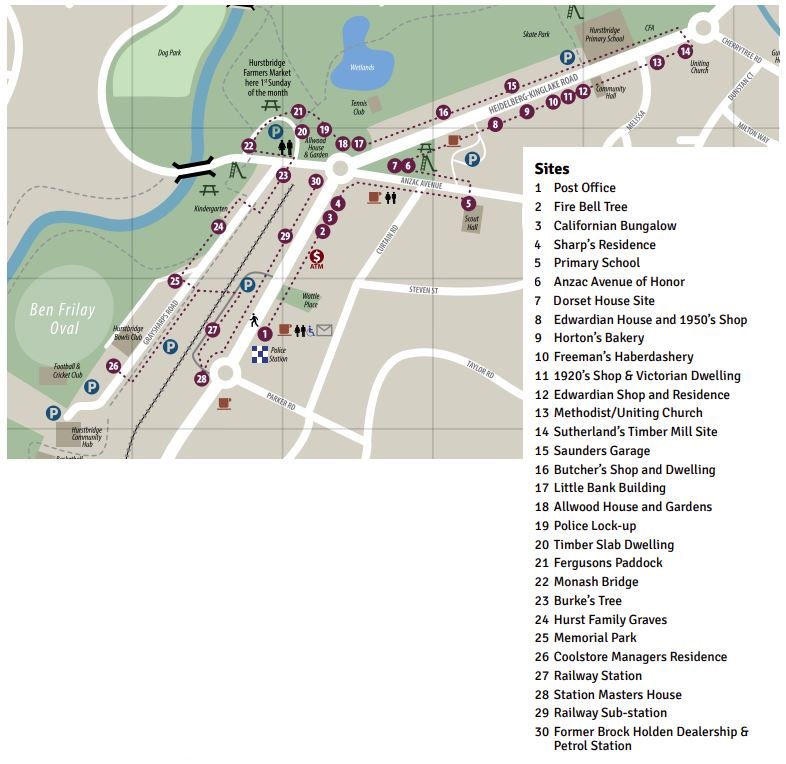
Heritage Trail Sites
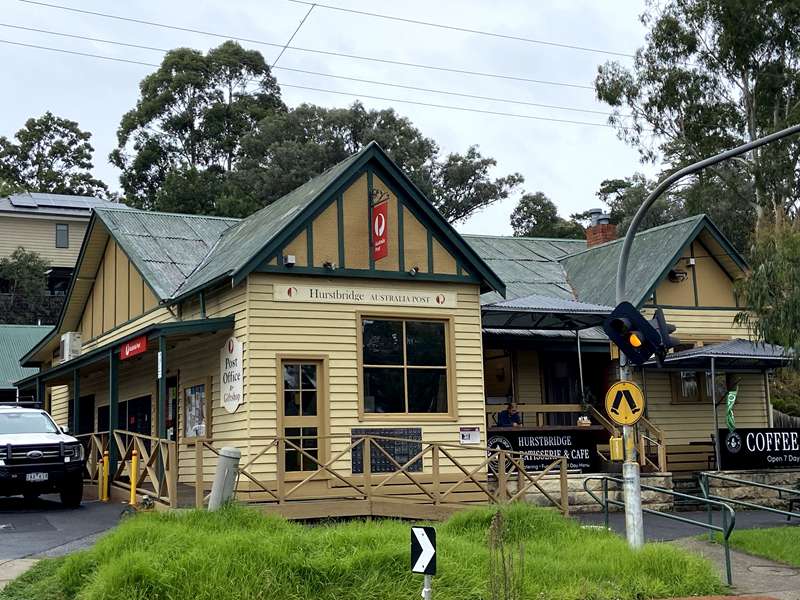
1. Post Office
2. Fire Bell Tree & The Main Street
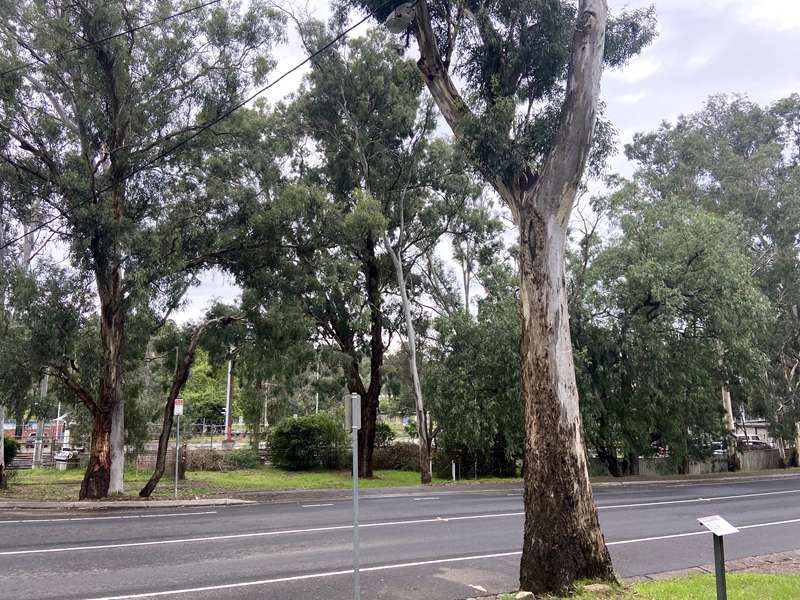
This Yellow Box (Eucalyptus Melliodora) once held a bell in the lower fork which was rung as a fire warning and to gather in the farm workers at Allwood.
This photograph taken c1918, shows the forked tree above the line of people. This tree is now well over 100 years old.
The main street, previously named Amos Street, was typical of a country town with a mix of retail businesses and residential homes. This early growth of the township was as a result of the Railway extension to Hurstbridge. Easily sub-division on the land either side of the main road, were developed by the Hurst/Gray family; land from Anzac Ave to Cherry Tree Road, and the Taylor family who owned land opposite the station from Taylor Road to Anzac. The pattern of mixed use development remains a strong feature of the town today.
3. Californian Bungalow
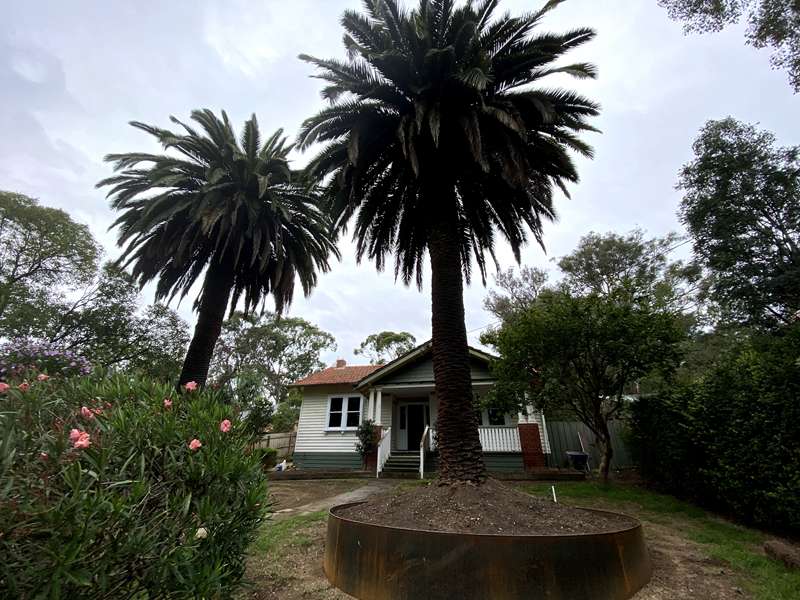
This residence, built in 1924 for the local blacksmith David Gordon Graham, is of great local interest as it is the only Californian bungalow actually built in the Hurstbridge township.
It was an extremely popular design of the era with many examples of the style found in Melbourne's eastern and south-eastern suburbs.
The garden was designed and planted out by William (Bill) Gray of Allwood for Mr Graham and included the Canary Island Palm still seen at the front of the house.
4. Sharp's Residence
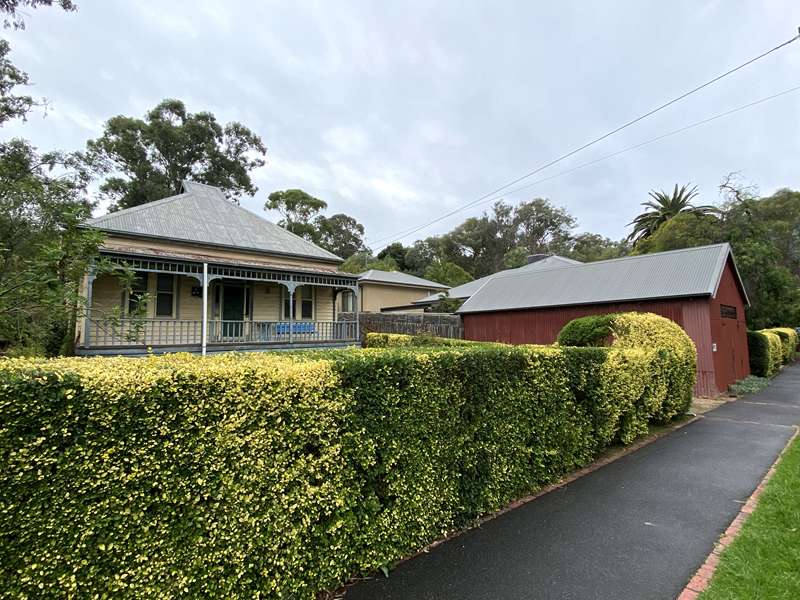
This attractive Victorian weatherboard home was built circa 1900 for the blacksmith in the town. The red shed (which was reconstructed in 2015 as part of a unit development), served as the original blacksmith's shed. It was also used as a temporary police station before Roy and Edna Sharp bought the property in 1924.
Roy and Edna Sharp ran the Hurstbridge Motor Garage, they would transport people around like a taxi service, they also ran a bus service to Kinglake, until the size of the bus was deemed too large and unsafe to travel that winding road.
As of 2015, the residence remains in the Sharp family as the home of Roy and Edna's son Keith (dec) and his wife Gwenneth Sharp. The Red Shed was rebuilt using the original iron, by builder Steve Lovelace in 2015 as part of a unit development.
5. Primary School
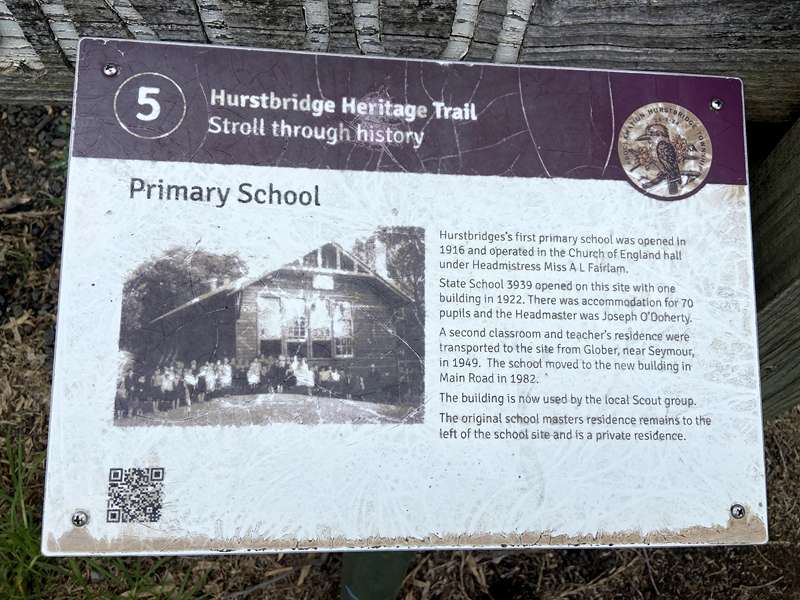
Hurstbridges's first primary school was opened in 1916 and operated in the Church of England hall under Headmistress Miss A L Fairlam.
State School 3939 opened on this site with one building in 1922. There was accommodation for 70 pupils and the Headmaster was Joseph O'Doherty.
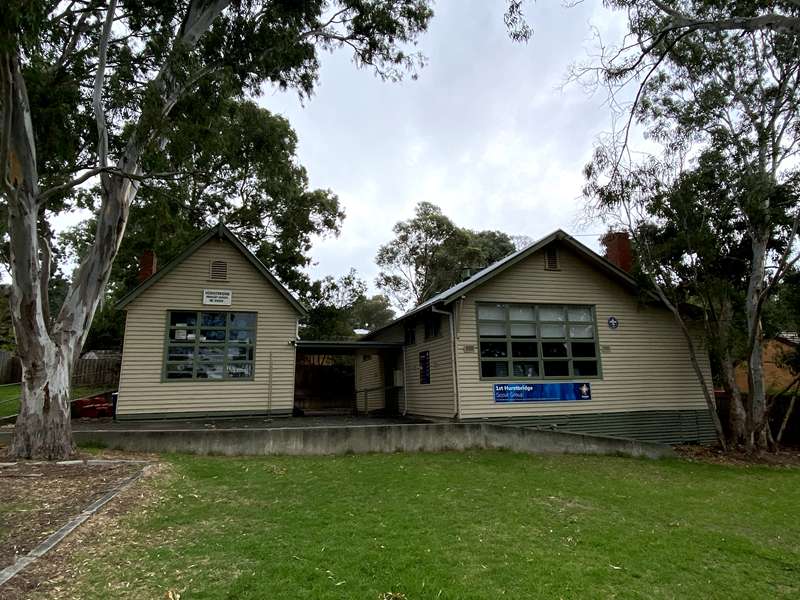
A second classroom and teacher's residence were transported to the site from Glober, near Seymour, in 1949. The school moved to the new building in Main Road in 1982.
The building is now used by the local Scout group. The original school masters residence remains to the left of the school site and is a private residence.
6. Anzac Avenue of Honour
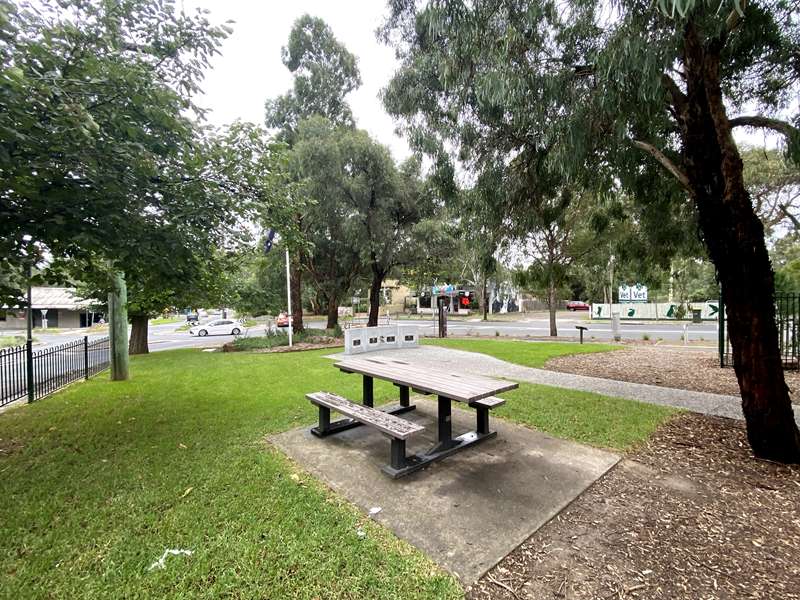
On Saturday 31 August 1918 residents and visitors from the city gathered at Dorset House to honour the soldiers who died or fought in the First World War (1914-18) from the Hurstbridge District.
Fifty trees were planted and the street was formally named Honour Avenue. The planting ceremony was followed by afternoon tea at Dorset House.
The trees planted, London Planes and Elms, were donated by Mr Charles Verse, local builder and farmer actively involved in the local community, and then Councilor William Gray, local orchardist and nurseryman. Only a few (Elms) of the original plantings remain, as seen in this park. After the Second World War, Honour Avenue was renamed Anzac Avenue. Anzac Memorial Park was established in 1991.
7. Dorset House Site
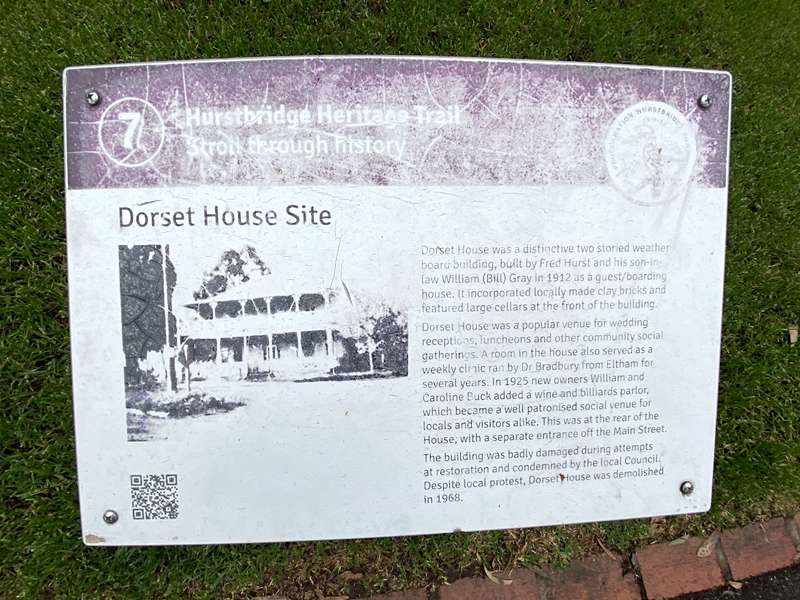
Dorset House was a distinctive two storied weather board building, built by Fred Hurst and his son-in-law William (Bin) Gray in 1912 as a guest/boarding house. It incorporated locally made clay bricks and featured large cellars at the front of the building.
Dorset House was a popular venue for wedding receptions, luncheons and other community social gatherings. A room in the house also served as a weekly clinic ran by Dr Bradbury from Eltham for several years. In 1925 new owners. William and Caroline Buck added a wine and billiards parlor, which became a well patronised social venue for locals and visitors alike. This was at the rear of the House; with a separate entrance off the Main Street.
The building was badly damaged during attempts at restoration and condemned by the local Council. Despite local protest, Dorset House was demolished in 1968.
8. Edwardian House and 1950's Shop
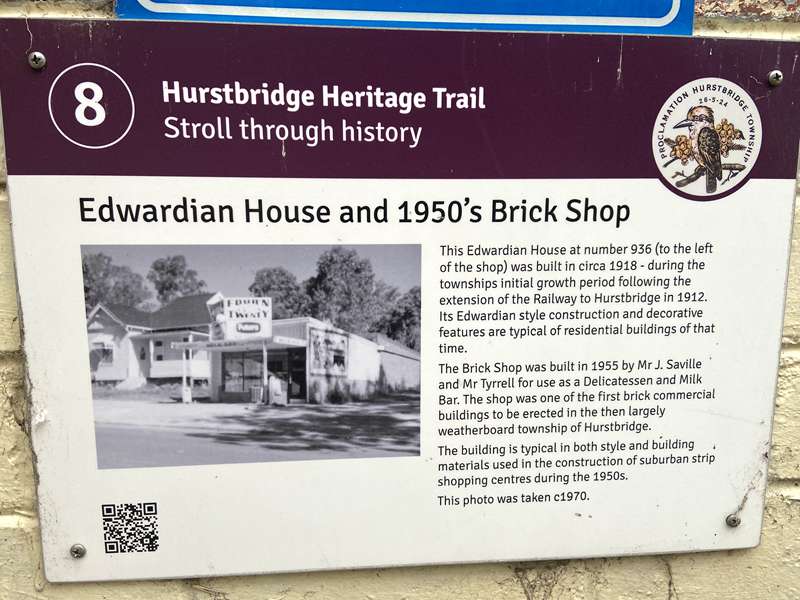
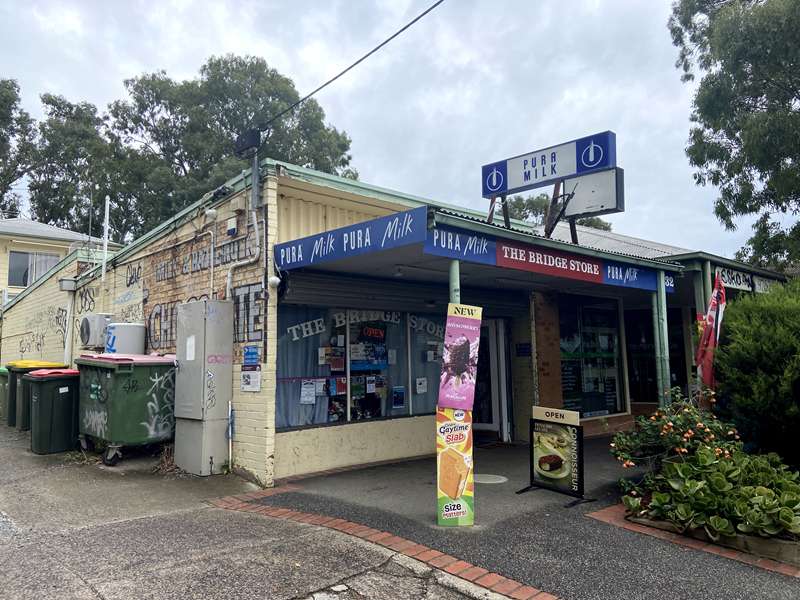
This Edwardian House at number 936 (to the left of the shop) was built in circa 1918 - during the townships initial growth period following the extension of the Railway to Hurstbridge in 1912. Its Edwardian style construction and decorative features are typical of residential buildings of that time.
The Brick Shop was built in 1955 by Mr J. Saville and Mr Tyrrell for use as a Delicatessen and Milk Bar. The shop was one of the first brick commercial buildings to be erected in the then largely weatherboard township of Hurstbridge.
The building is typical in both style and building materials used in the construction of suburban strip shopping centres during the 1950s. This photo was taken c1970.
9. Horton's Bakery
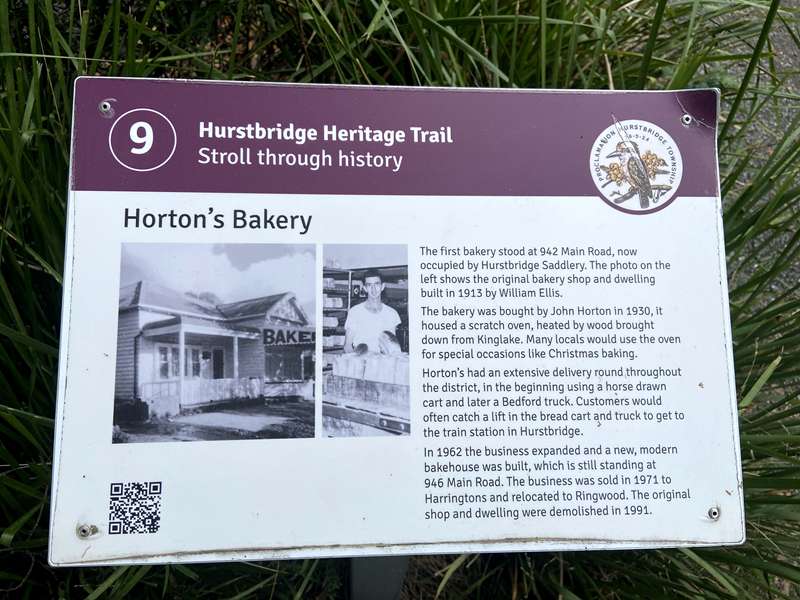
The first bakery stood at 942 Main Road, now occupied by Hurstbridge Saddlery The photo on the left shows the original bakery shop and dwelling built in 1913 by William Ellis.
The bakery was bought by John Horton in 1930, it housed a scratch oven, heated by wood brought down from Kinglake. Many locals would use the oven for special occasions like Christmas baking.
Horton's had an extensive delivery round throughout the district, in the beginning using a horse drawn cart and later a Bedford truck. Customers would often catch a lift in the bread cart and truck to get to the train station in Hurstbridge.
In 1962 the business expanded and a new, modern bakehouse was built, which is still standing at 946 Main Road. The business was sold in 1971 to Harringtons and relocated to Ringwood. The original shop and dwelling were demolished in 1991.
10. Freeman's Haberdashery
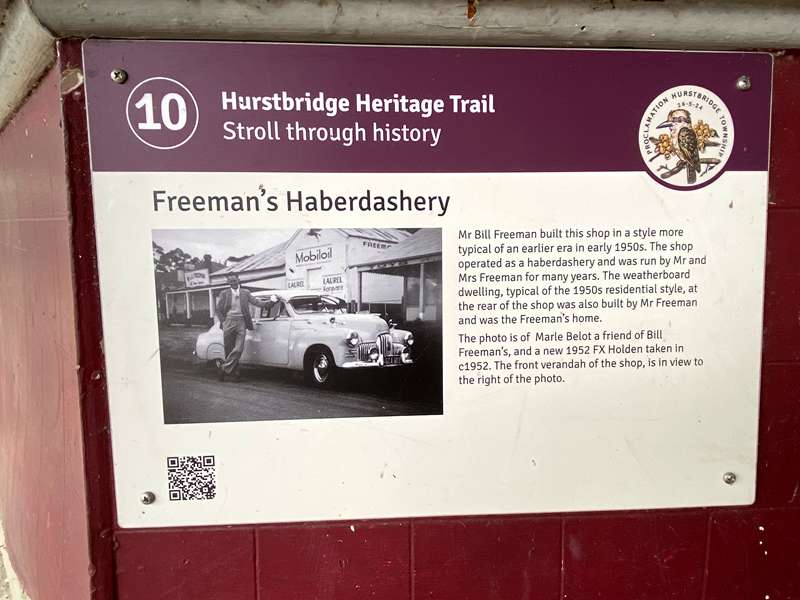
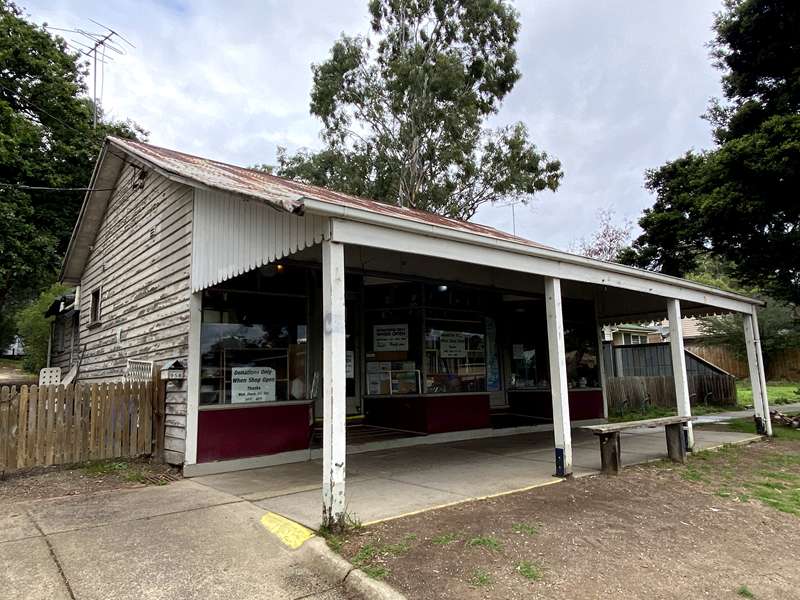
Mr Bill Freeman built this shop in a style more typical of an earlier era in early 1950s. The shop operated as a haberdashery and was run by Mr and Mrs Freeman for many years. The weatherboard dwelling, typical of the 1950s residential style, at the rear of the shop was also built by Mr Freeman and was the Freeman's home.
The photo is of Marle Belot a friend of Bill Freeman's, and a new 1952 FX Holden taken in c1952. The front verandah of the shop, is in view to the right of the photo.
11. 1920's Shop & Victorian Dwelling
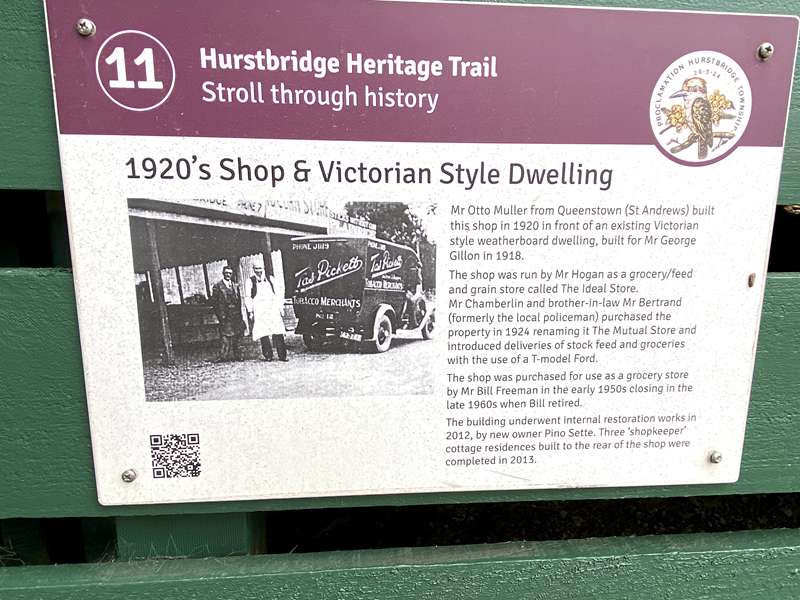
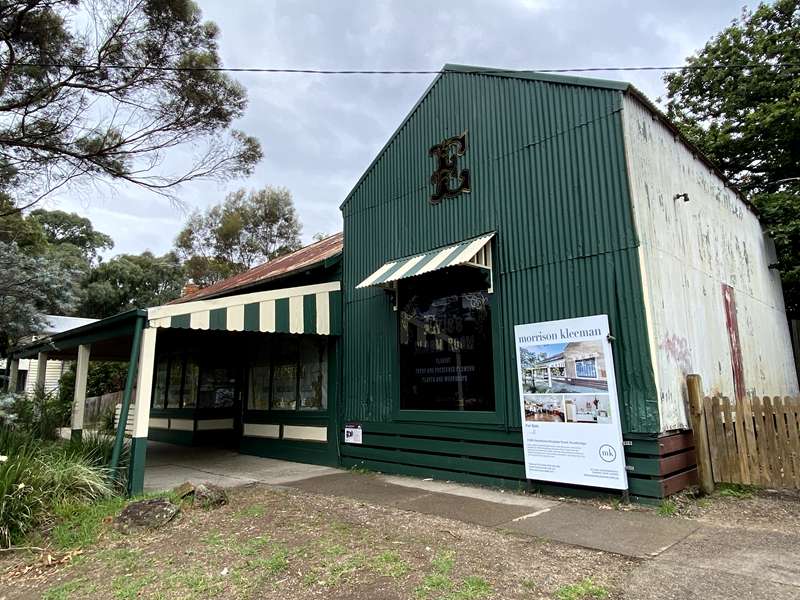
Mr Otto Muller from Queenstown (St Andrews) built this shop in 1920 in front of an existing Victorian style weatherboard dwelling, built for Mr George Gillon in 1918.
The shop was run by Mr Hogan as a grocery/feed and grain store called The Ideal Store.
Mr Chamberlin and brother-in-law Mr Bertrand (formerly the local policeman) purchased the property in 1924 renaming it The Mutual Store and introduced deliveries of stock feed and groceries with the use of a T-model Ford.
The shop was purchased for use as a grocery store by Mr Bill Freeman in the early 1950s closing in the late 1960s when Bill retired.
The building underwent internal restoration works in 2012, by new owner Pino Settee Three 'shopkeeper' cottage residences built to the rear of the shop were completed in 2013.
12. Edwardian Shop and Residence
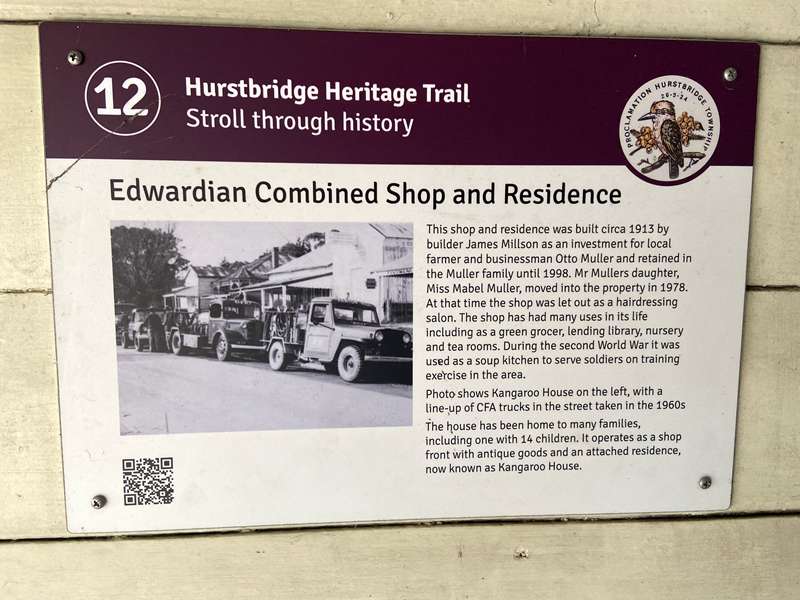
This shop and residence was built circa 1913 by builder James Matson as an investment for local farmer and businessman Otto Muller and retained in the Muller family until 1998. Mr Mutters daughter, Miss Mabel Muller, moved into the property in 1978. At that time the shop was let out as a hairdressing salon. The shop has had many uses in its life including as a green grocer, lending Library, nursery and tea rooms. During the second World War it was used as a soup kitchen to serve soldiers on training exercise in the area.
Photo shows Kangaroo House on the left, with a line-up of CFA trucks in the street taken in the 1960s.
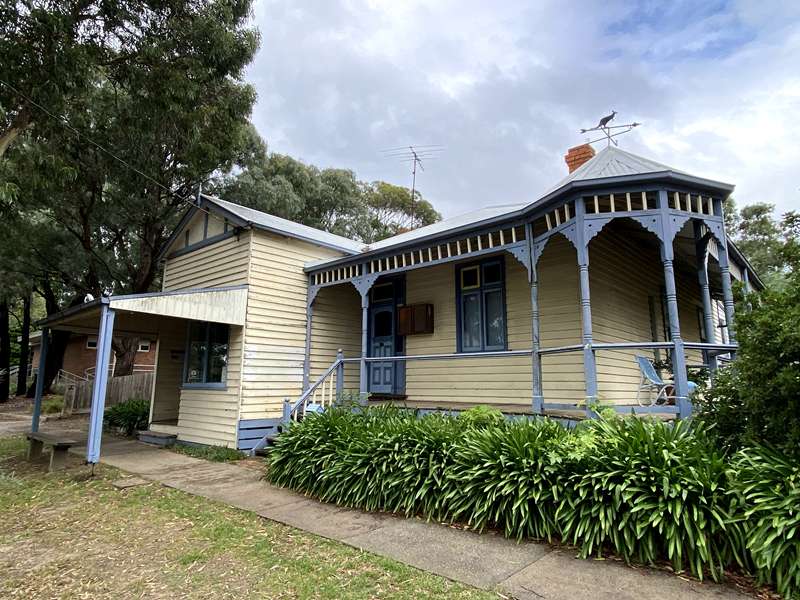
The house has been home to many families, including one with 14 children. It operates as a shop front with antique goods and an attached residence, now known as Kangaroo House.
13. Methodist/Uniting Church
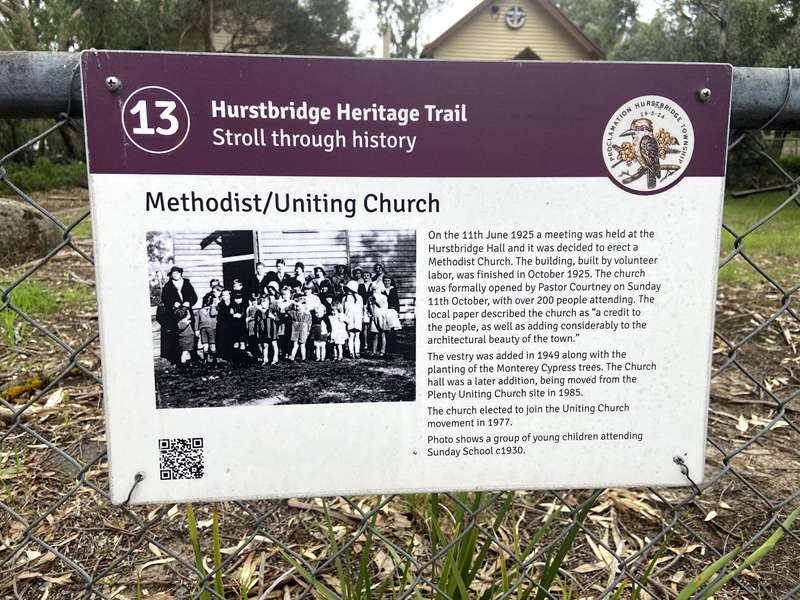
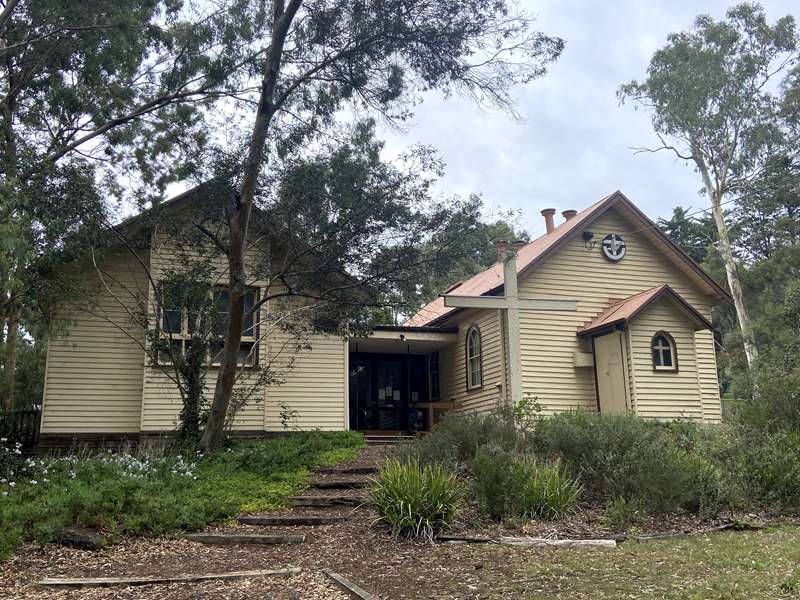
On the 11th June 1925 a meeting was held at the Hurstbridge Hall and it was decided to erect a Methodist Church. The building, built by volunteer labor, was finished in October 1925. The church was formally opened by Pastor Courtney on Sunday 11th October, with over 200 people attending. The local paper described the church as "a credit to the people, as well as adding considerably to the architectural beauty of the town."
The vestry was added in 1949 along with the planting of the Monterey Cypress trees. The Church hall was a later addition, being moved from the Plenty Uniting Church site in 1985.
The church elected to join the Uniting Church movement in 1977.
Photo shows a group of young children attending Sunday School c1930.
14. Sutherland's Timber Mill Site
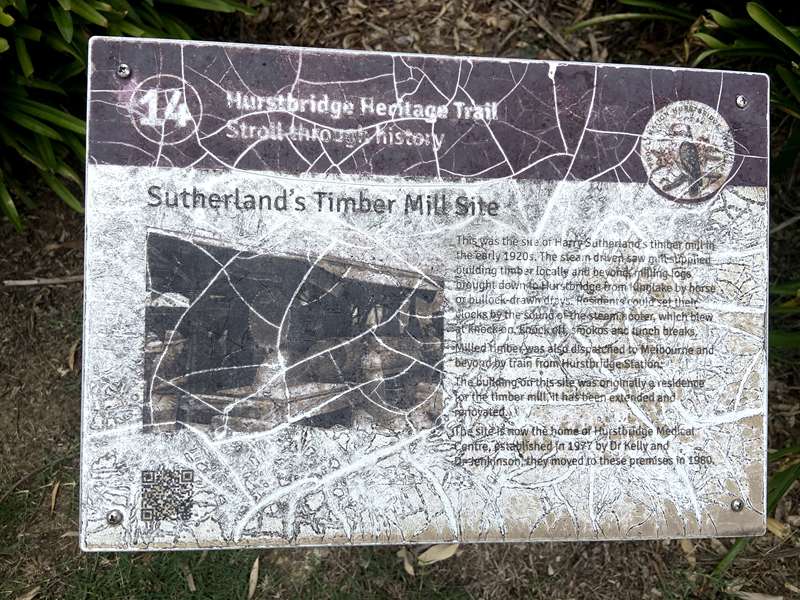
This was the site of Harry Sutherland's timber mill in the early 1920s. The steam driven saw mill supplied building timber locally and beyond, milling logs brought down to Hurstbridge from Kinglake by horse or bullock drawn drays. Residents could set their clocks by the sound of the steam hooter, which blew at knock-on, knock-off, smoko and lunch breaks.
Milled timber was also dispatched to Melbourne and beyond by train from Hurstbridge Station.
The building on this site was originally a residence for the timber mill; it has been extended and renovated.
The site is now the home of Hurstbridge Medical Centre, established in 1977 by Dr Kelly and Dr Jenkinson; they moved to these premises in 1980.
15. Saunders Garage
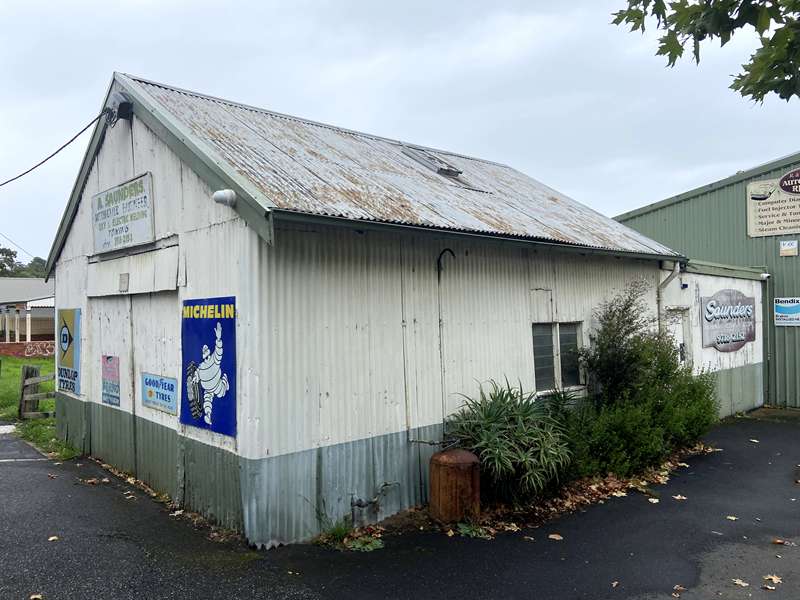
This galvanised-iron building, now a Main Street landmark, was built circa 1918 as a commercial workshop, and one time was the premises of the local water tank maker. It has operated as a motor mechanics workshop since 1952 when Alan and June Saunders purchased it.
16. Butcher's Shop and Dwelling
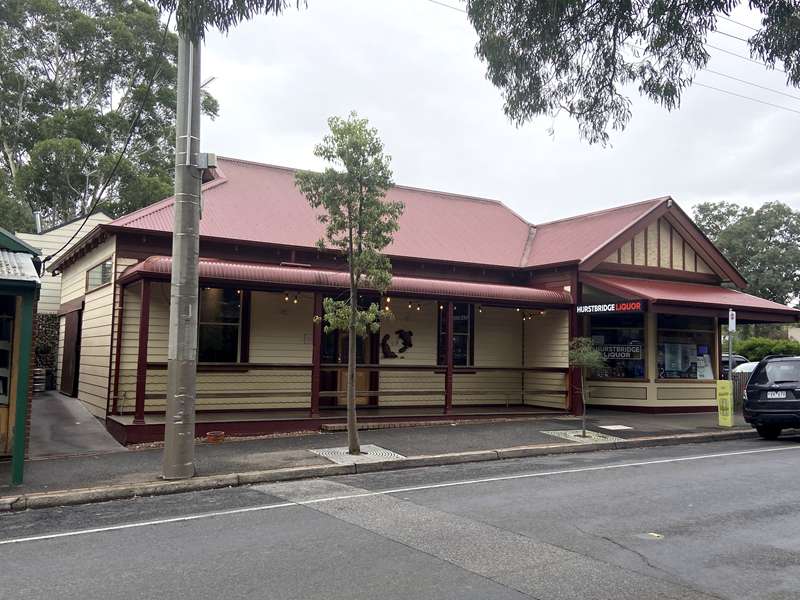
This building was erected in 1913 for James Ryan, butcher as one of the first buildings on the William and Frances Gray's Allwood subdivision along the Main Street The Grays subdivided this part of their land in anticipation of the township's growth following the extension of the railway to Hurstbridge the year before. Colin Sinclair took over the butcher's shop in the 1940s and continued this business until 1982, when the Stubley family purchased the property
17. Little Bank Building
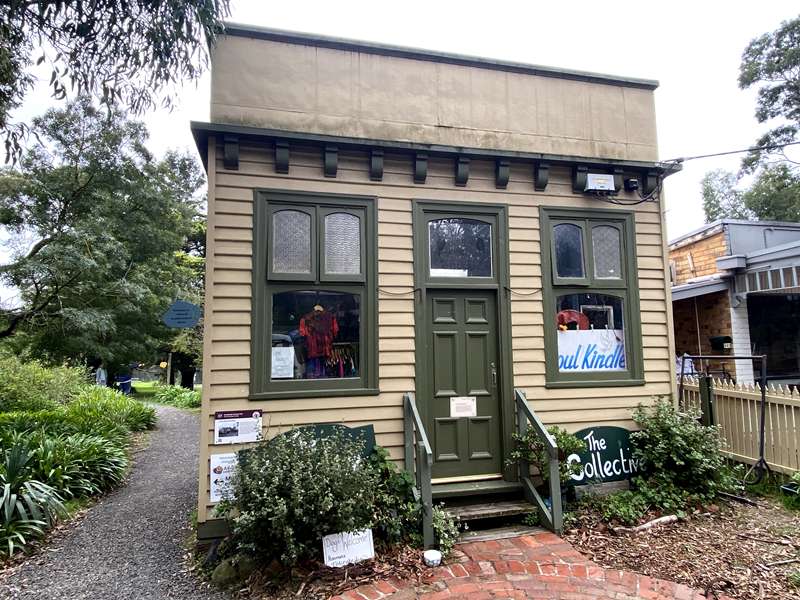
Formerly owned by the Commercial Bank of Australia, the little bank was one of only a handful of portable branch buildings able to be towed by horse or bullock teams from site to site as required.
It was moved to Hurstbridge around 1917 and it operated as a bank branch until the early 1980s. In 1985 it was moved to Allwood grounds when its previous site (where the vet clinic now stands) was sold and the building was considered by the bank to be surplus to its requirements. Today it is used as a outlet for local crafts people and artisans, as part of Allwood Neighbourhood House.
18. Allwood House and Gardens
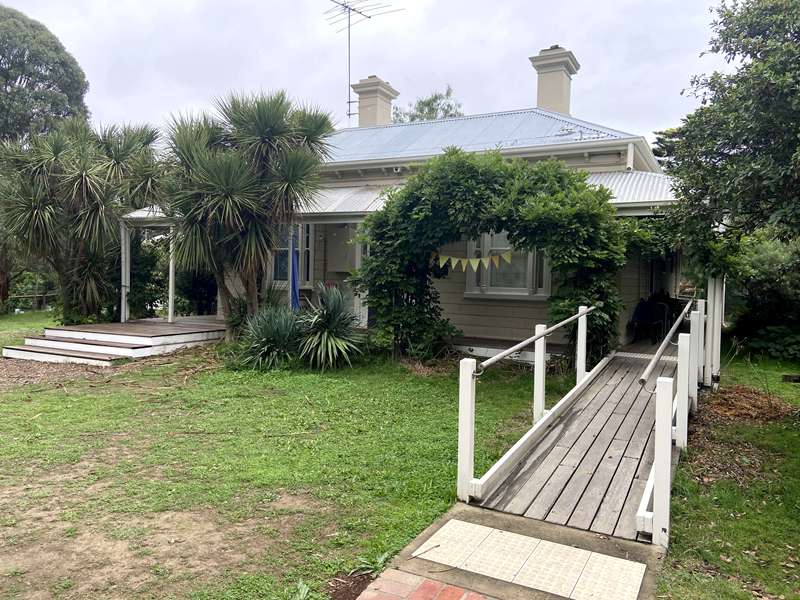
Allwood House is a weatherboard Victorian dwelling which was moved to its present site and refurbished by local builder and orchardist, Charles Verso, in 1894 for the Hurst Family. In 1897 it became the home of Frances Ellen Hurst and her new husband, William (Bill) Gray, following their marriage.
William (Bill) Gray developed the extensive Allwood Nurseries from where he exported fruit trees overseas. He and another early local nurseryman, Patrick Burke, both played an important part in the development of the area's successful fruit-growing industry.
The Allwood House Gardens contain many of the original plants selected and planted by William (Bill) Gray. They were a typical selection of the day where plants which were regarded as unusual or exotic, as well as hardy, were of great interest to Victorian horticulturists and gardeners. Look through the gardens for the prickly pear, agave Americana, cordyline, palms, japonica, citrus, peppercorns, conifers and cyprus trees.
Purchased by the Eltham City Council in 1994 from Sheila Ferguson (nee Gray) and since used as Allwood Neighbourhood House.
19. Police Lock-up
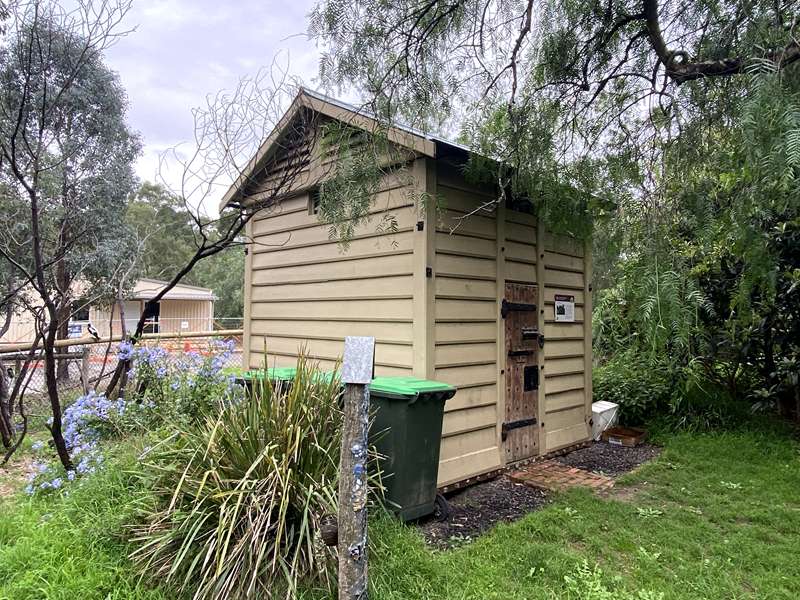
This single cell Police Lockup dates from the late 1800s when these lockups were issued to rural police stations from Government workshops. The buildings arrived on site in the form of a flat pack, including the iron inner cage, with each piece numbered. Police Station staff were required to assemble the building on site. This Lockup was first moved to Hurstbridge, from Warrandyte, in 1917 to the then police station. It moved again in 1952 when the typical rural style Police Station was built in 1952. As can be seen to the left of the photo the Lockup was positioned behind the Hurstbridge Police Station.
The Lockup was moved to its current position in the Allwood Garden in 2005, due to the demolition and rebuild of the Hurstbridge Police Station the Lockup was found to be surplus to requirements.
20. Timber Slab Dwelling
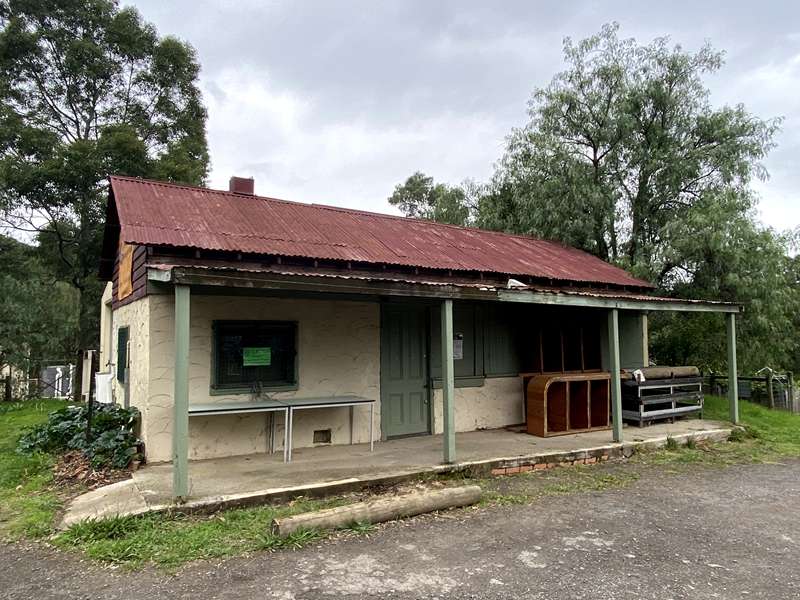
This is the site of an original slab dwelling (shown in the photo) erected in 1841 by early white settler, Cornelius Sharp Haley, as part of the lease conditions on the 65 hectare cattle run he named Allwood.
On 4 October 1866, 34 year old Henry Facey Hurst, then manager of Allwood cattle run, was shot and fatally wounded during a struggle with the bushranger Robert McClusky (alias Robert Burke), in the kitchen of this dwelling. Robert Hurst's father purchased the property from Cornelius Haley in 1857.
The slab dwelling was later demolished and the building now standing here dates from the early 1950s, when it was built for dairy farmers Gordon and Sheila Ferguson (nee Gray) for use as a dairy.
21. Ferguson Paddock
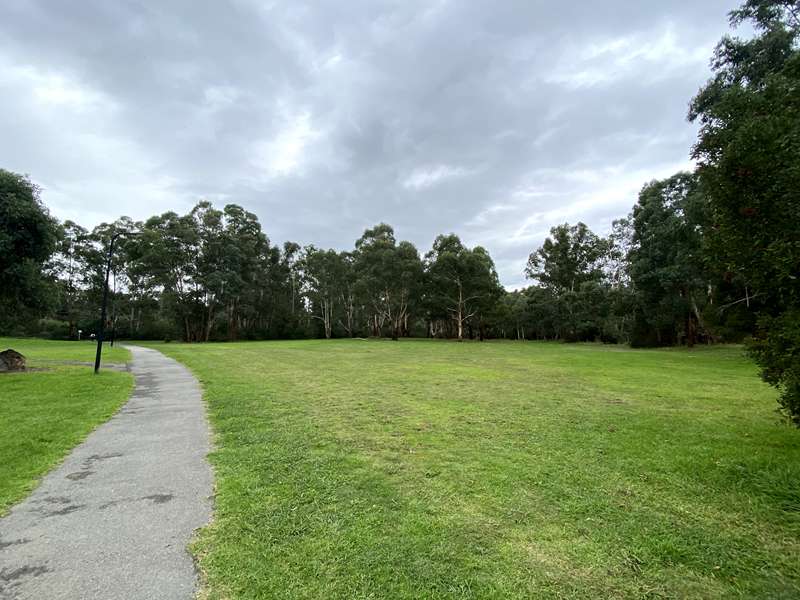
Fergusons Paddock was once part of the original Allwood run. It was then part of a property William (Billy) and Ellen Gray planted with orchard fruit trees known as Allwood Nurseries. As shown in the photo.
The property was later passed down to Sheila Ferguson, the daughter of William and Ellen Gray (nee Hurst), who along with her husband Gordon Ferguson, ran a dairy farm on the property.
The Shire of Eltham purchased Fergusons Paddock for passive recreation from Mrs Sheila Ferguson in 1975.
The site contains a memorial site to racing car legend Peter Brock, who was born and raised in Hurstbridge. Today the paddock is used for recreation with a trail running alongside the Diamond Creek. It is also the site for the Hurstbridge Farmers Market.
22. Monash Bridge
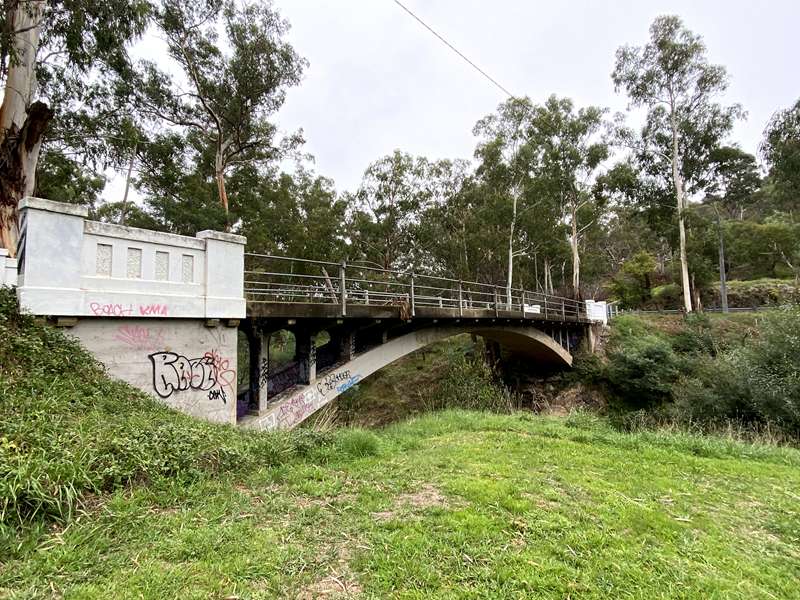
The Monash Bridge was the third bridge to be built to cross the Diamond Creek in this area. It replaced a wooden trestle bridge built in 1895 by Mr Jack McDonald. The bridge known as Hurst's Bridge was built in c1858 by the Hurst family and was situated upstream near the confluence of Arthurs Creek.
Plans were drawn by J.A. Laing, design engineer, and constructed by the Reinforced Concrete and Monier Pipe Construction Company, of which Sir John Monash, notable engineer, educator and soldier, was a partner. It was funded by the Shires of Eltham, Heidelberg and Whittlesea. Construction of the bridge commenced in December 1916, with many local men employed in its construction. It was opened by Mr Rouget, MLA, on 3 November 1917.
Sheila Ferguson, the last resident to occupy Allwood House, claimed to be the first person onto the bridge after its opening, pushed in her pram by her mother.
23. Burke's Tree
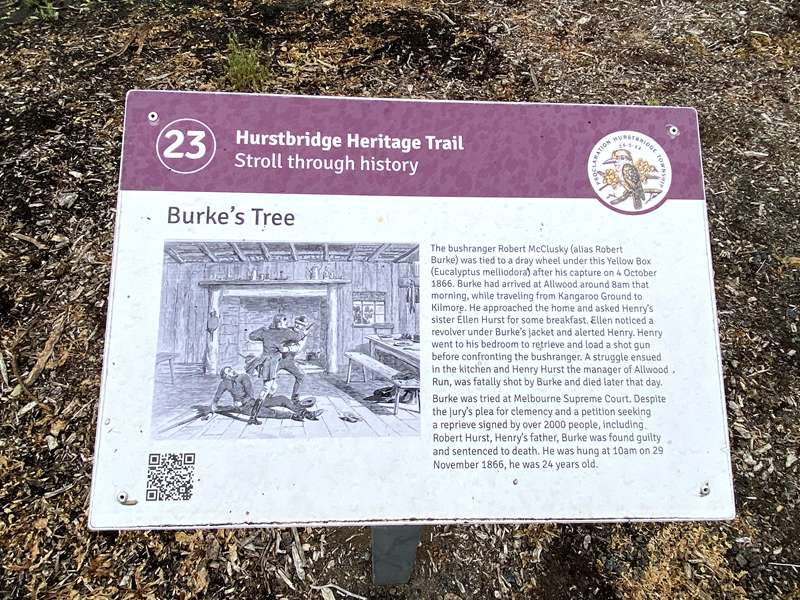
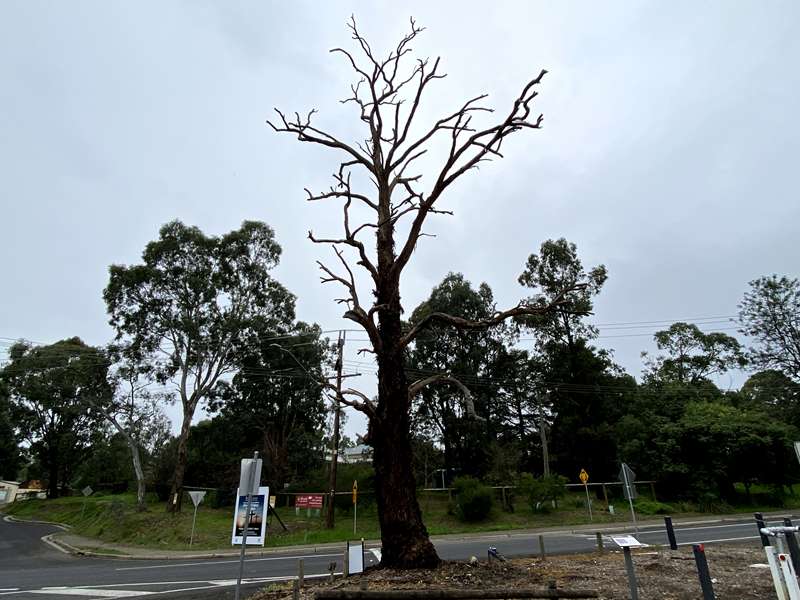
The bushranger Robert McClusky (alias Robert Burke) was tied to a dray wheel. under this Yellow Box (Eucalyptus melliodora) after his capture on 4 October 1866. Burke had arrived at Allwood around 8am that morning, while traveling from Kangaroo Ground to Kilmore. He approached the home and asked Henry's sister Ellen Hurst for some breakfast. Ellen noticed a revolver under Burke's jacket and alerted Henry. Henry went to his bedroom to retrieve and load a shot gun before confronting the bushranger. A struggle ensued in the kitchen and Henry Hurst the manager of Allwood Run, was fatally shot by Burke and died later that day.
Burke was tried at Melbourne Supreme Court. Despite the jury's plea for clemency and a petition seeking a reprieve signed by over 2000 people, including Robert Hurst, Henry's father, Burke was found guilty and sentenced to death. He was hung at 10am on 29 November 1866, he was 24 years old.
24. Hurst Family Graves
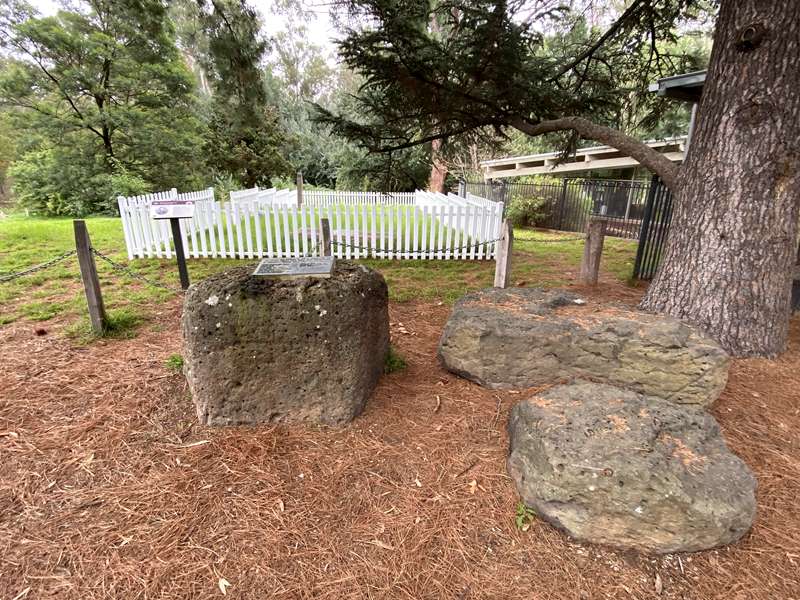
Friends and neighbours of the Hurst family donated the funds for the headstone to the family following Henry Hurst's untimely death from a pistol wound in 1866.
Laid to rest here are (note: details corrected from the plaque);
Henry Facey Hurst 1866,
Son of Robert and Frances Hurst, age 32.
Robert Hurst 1873 Henry's father aged 67.
James Spencer 1874 first husband of Sarah Ellen Hurst, age 28
Mary Catherine Hurst 1875
Daughter of Frederick and Catherine Hurst, age 5 days old,
Sarah Ellen Brailsford (nee Hurst, formerly Spencer) 1877,
Sister of Henry Hurst, age 34.
Frances Hurst (nee Facey), 1880 Mother of Henry Hurst, age 73.
Edward Robert Hurst, 1891.
Brother of Henry, who fell from a horse age 47.
Emily Spencer (nee Hurst) 1897, sister of Henry Hurst, age 51.
Frederick George Hurst 1927,
Youngest brother of Henry Hurst, age 86.
Joseph Abbott, date unknown
Stockhand for the Hurst family at Allwood run.
Ashes scattered here include the remains of;
Catherine Hurst, Frances Ellen Gray (nee Hurst), Bill Gray, Sheila Ferguson (nee Gray)
25. Memorial Park & Commemorative Sign
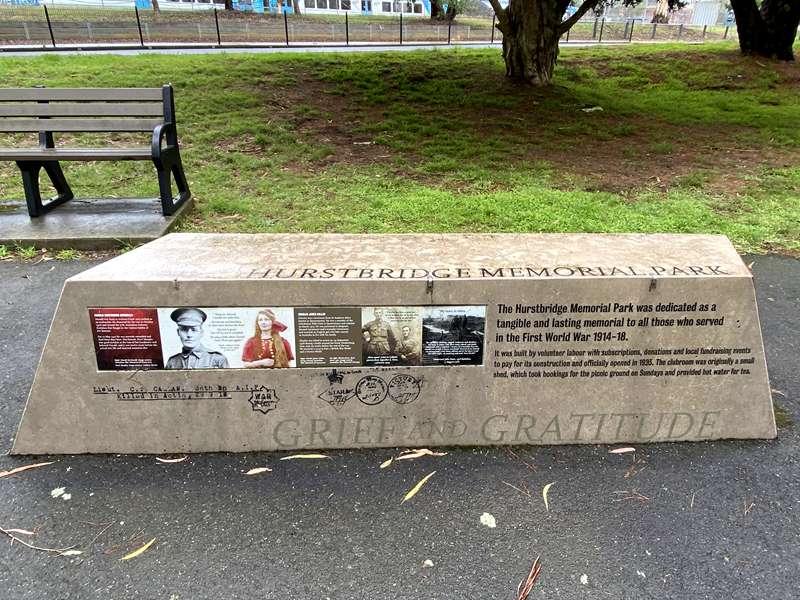
In 1920 the Progress Association and other prominent locals decided that a tangible, lasting memorial to all those that served in the First World War was needed.
In 1921, ten acres of Bob Sharps' orchard was purchased and the fruit trees removed to make way for a new sports oval. The new oval and park grounds were named Memorial Park and constructed entirely by volunteer labour with funds raised within the community. The park was a popular spot for visiting day trippers, for picnics and sporting pursuits.
The oval was later named Ben Frilay oval in recognition of the tireless community work by resident Ben Frilay. In 2015, as part of centenary funding, an additional commemorative sign was placed at the entrance to Memorial Park.
26. Coolstore and Managers Residence
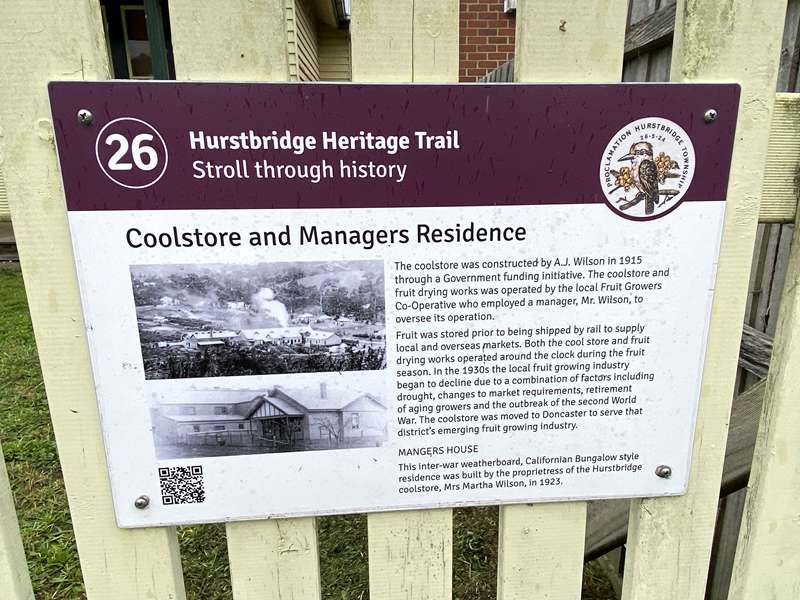
The coolstore was constructed by A.J. Wilson in 1915 through a Government funding initiative. The coolstore and fruit drying works was operated by the local Fruit Growers Co-Operative who employed a manager, Mr. Wilson, to oversee its operation.
Fruit was stored prior to being shipped by rail to supply local and overseas markets. Both the cool store and fruit drying works operated around the clock during the fruit season. In the 1930s the local fruit growing industry began to decline due to a combination of factors including drought, changes to market requirements, retirement of aging growers and the outbreak of the second World War. The coolstore was moved to Doncaster to serve that district's emerging fruit growing industry.
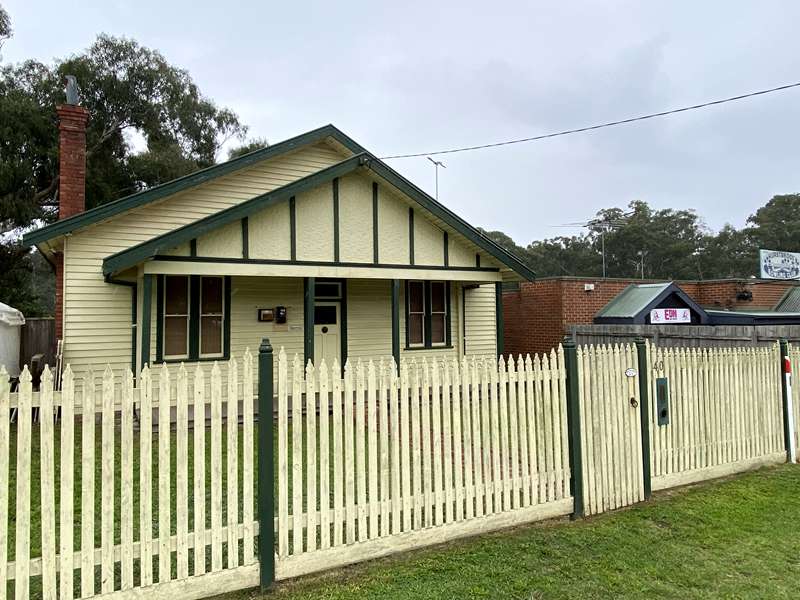
MANAGERS HOUSE
This inter-war weatherboard, Californian Bungalow style residence was built by the proprietress of the Hurstbridge coolstore, Mrs Martha Wilson, in 1923.
27. Railway Station
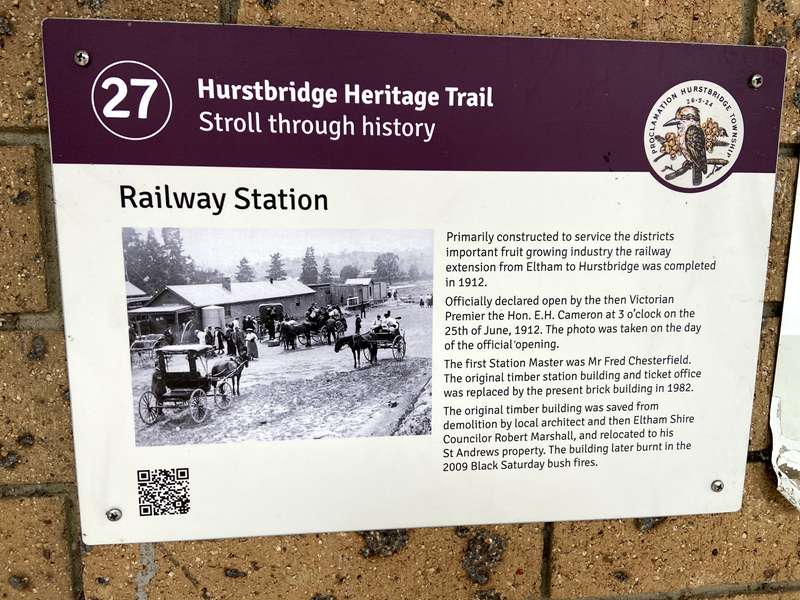
Primarily constructed to service the districts important fruit growing industry the railway extension from Eltham to Hurstbridge was completed in 1912.
Officially declared open by the then Victorian Premier the Hon. E.H Cameron at 3 o'clock on the 25th of June, 1912. The photo was taken on the day of the official opening.
The first Station Master was Mr Fred Chesterfield. The original timber station building and ticket office was replaced by the present brick building in 1982.
The original timber building was saved from demolition by local architect and then Eltham Shire Councilor Robert Marshall, and relocated to his St Andrews property. The building later burnt in the 2009 Black Saturday bush fires.
28. Station Master's House
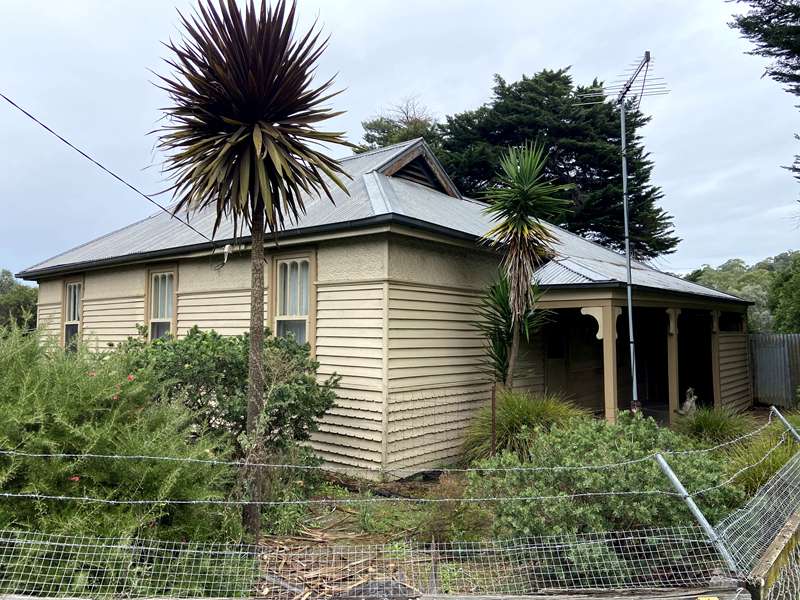
This weatherboard house was constructed in c1920 and was originally one in a row of four railway employee's houses, built in the typical style of railway houses of the era. Its first occupant was Fred Chesterfield the station master of Hurstbridge station. The windmill palm at the front would have been planted circa 1920.
It is worth noting that most of the early buildings in Hurstbridge were weatherboard, probably because the local stone was not deemed suitable as a building material and timber was plentiful.
Many farm outbuildings were constructed of wattle and daub and later brick.
The photo taken from Thorns Hill, c1920 shows the railway station and the station masters residence on the far right.
29. Railway Sub-station
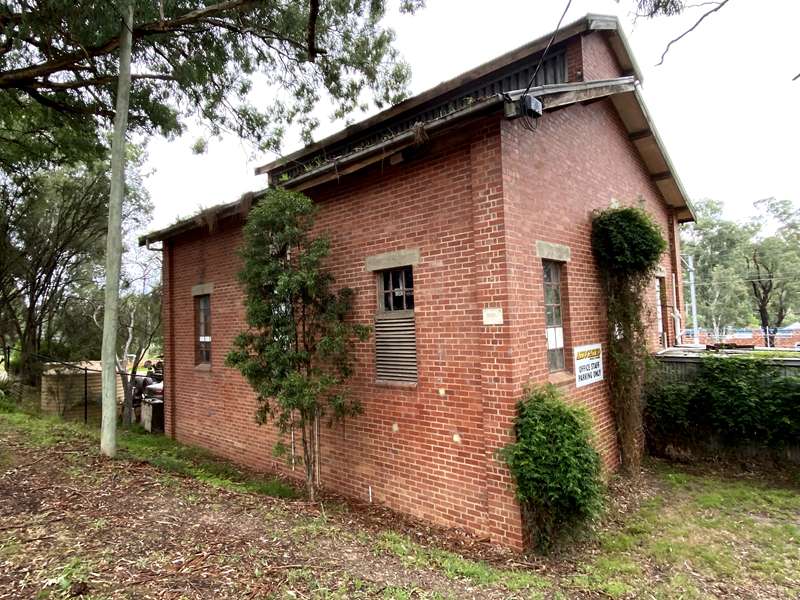
This redbrick electric sub-station was built in 1926 for the purpose of converting electricity from AC (alternating current) to DC (direct current) to electrify the rail system in the local area. The official celebration for the electrification of the line was held on 14 August 1926, where "Hurstbridge Electrification, 1926" badges were given out.
After the sub-station was built, steam locomotives were replaced with the Taite Electric trains, or red rattlers as they were affectionately known.
These railway sub-stations, were gradually replaced by mercury arc rectifier units under a modernisation program that started in 1949.
The building was decommissioned as a sub station in the late 1960s, and today it is privately leased for commercial use.
30. Former Brock Holden Dealership & Petrol Station
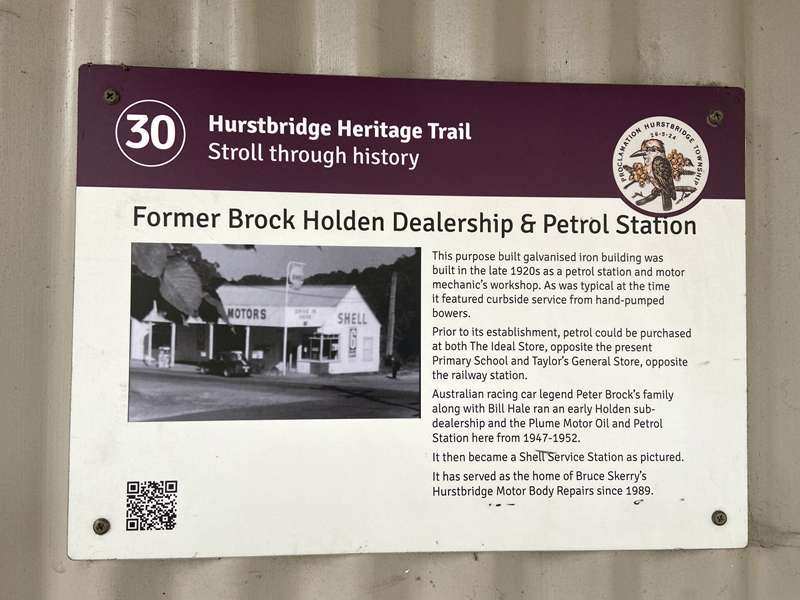
This purpose built galvanised iron building was built in the late 1920s as a petrol station and motor mechanic's workshop. As was typical at the time it featured curbside service from hand-pumped bowers.
Prior to its establishment, petrol could be purchased at both The Ideal Store, opposite the present Primary School and Taylor's General Store, opposite the railway station.
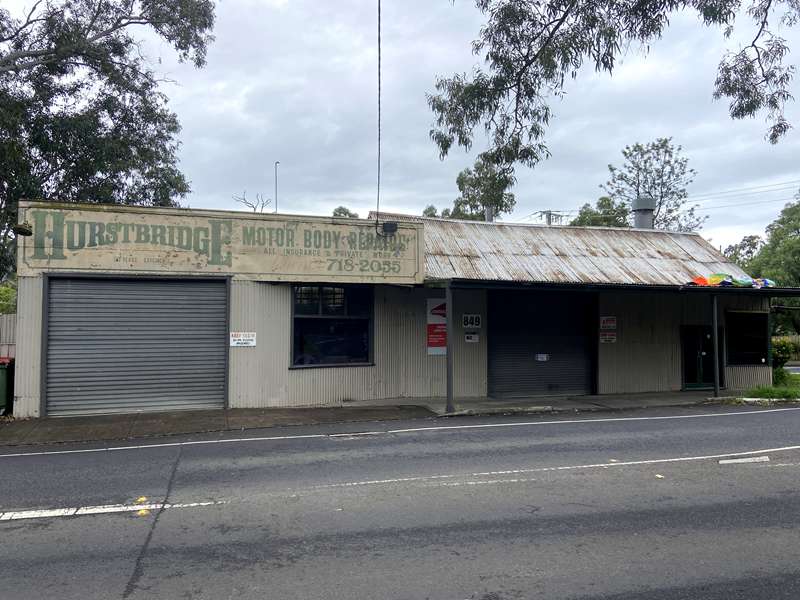
Australian racing car legend Peter Brock's family along with Bill. Hale ran an early Holden sub-dealership and the Plume Motor Oil and Petrol Station here from 1947-1952. It then became a Shell Service Station as pictured. It has served as the home of Bruce Skerry's Hurstbridge Motor Body Repairs since 1989.
Photos:
Location
794 Heidelberg-Kinglake Road, Hurstbridge 3099 View Map
Web Links
→ Hurstbridge Heritage Trail Map (PDF)


