Hepburn Springs - Mineral Springs


The Hepburn Springs area has seven significant springs - Soda, Locarno, Sulphur and Wyuna Springs are in the central area of Hepburn Mineral Springs Reserve and Argyle Spring is to the east and Liberty and Golden Springs are to the north.
Facilities
Soda, Locarno, Sulphur and Wyuna: Car parking, toilets with wheelchair access, tables and seats, tap water, BBQs, graded walking tracks. Adjacent Spa Resort.
Argyle: Rustic log seats
Golden: None
Liberty: None
History
In April 1838, Captain John S. Hepburn, who had travelled overland from Sydney with convict servants, took up a large grazing holding on the southern slopes of Mt Kooroocheang, naming the property 'Smeaton'. A family home was built there in 1849 and still stands today. Surprisingly, the spring Hepburn found was some 25 kilometres due west, in country which would have had few tracks at the time. Hepburn managed to interest the government analyst in the medicinal properties of the water.
Following Hepburn's discovery of the Pavilion Spring, mining commenced in the Argyle Gully Spring Creek Area, and the Soda, Sulphur and Wyuna Springs were rapidly uncovered by miners, followed later by Liberty, Golden and Argyle Mineral Springs. But the miners didn't develop these springs. In fact, mining by sluicing, particularly hydraulic sluicing, followed by a very thorough "clean up" by Chinese miners circa 1857, caused grave concern for the future of the springs. This lead Dr. Rosetti, later to become one of the first doctors at Daylesford Hospital, and Mr B Buttner, an apothecary (chemist), to call a public meeting to protect these mineral springs. Thus the Hepburn Springs Reserve, the first of its kind in Victoria, was created in 1865.
The sale of mineral water was permitted from 1868, followed by the construction of a bottling works which commenced operation in the late 1880s. A wooden pavilion was constructed in 1897, and replaced by the present brick pavilion in 1908.
By November 1911 the springs had ceased flowing, and this was traced to the nearby North Frenchmans Gold Mine which had struck a strong flow of gaseous mineral water, cutting off the flow to the pavilion. The mine was closed due to flooding and a new spring appeared in the creek bed, which was eventually sealed and piped to the pavilion by the end of 1912.
1926 marked the commencement of dances in the pavilion, causing some controversy among some residents who felt that "the promiscuous dancing" would keep away those visitors who did not approve of it.
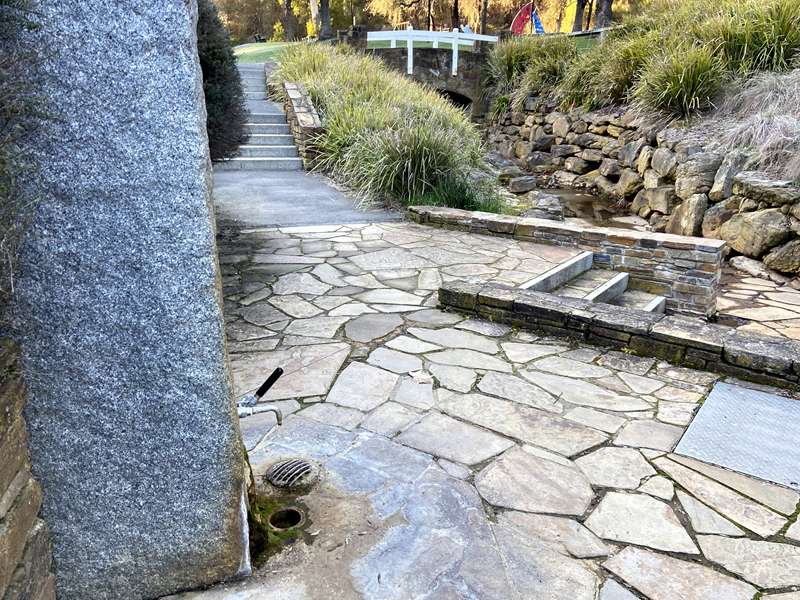
Locarno, a more recently appearing spring, was named after a resort town in Switzerland's Italian speaking canton of Ticino. In 2002 the spring was refurbished, and the existing stone plinths were created.
How To Get There
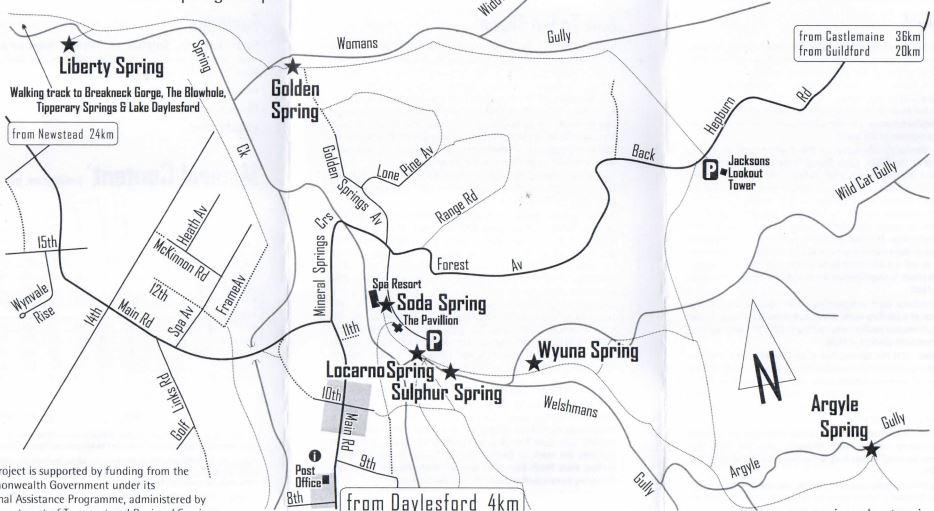
Soda, Locarno, Sulphur and Wyuna Springs are located in the Hepburn Mineral Springs Reserve. Head north from the main street of Daylesford (Vincent St), following the signs to Hepburn Springs. In Hepburn Springs, continue straight ahead at the Newstead turn-off. The road declines steeply before turning sharply to the right. Turn right into the Hepburn Spa Resort entrance, drive past the resort and the pavilion to the Springs Reserve carpark.
From here, walk down to the creek. Locarno Spring is set in a depression next to the creek bed. Mineral water pours continuously from many outlets near the bases of the sculptured stone plinths.
To reach Soda Spring, turn right at the creek and follow the footpath. The spring's hand-pump is visible on the right opposite the main entrance of the Spa Resort.
Soda Spring
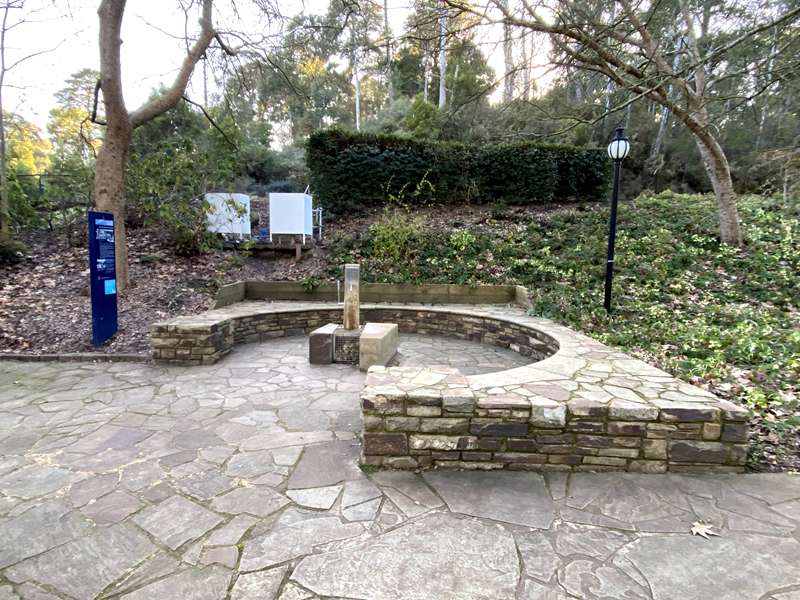
In 1930, the Geological Survey drilled eight bores in the Hepburn Mineral Springs Reserve. The bore construction followed a dry season and enquiries of the Mines Department about reductions in spring flow that were experienced.
Five of the bores were abandoned, either because fresh water was encountered or because they were too near existing springs and it was feared the bores might affect their flow. (One that was drilled 40m to the south of here struck fresh water.)
The remaining three - Soda, Sulphur and Wyuna - were fitted with hand pumps and have since assumed the status of 'spring'.
Soda's mineral water
The mineral waters throughout the Hepburn Springs Reserve tend towards a sodium bicarbonate type. The Soda Spring water, when compared to the other mineral springs in the reserve, contains the lowest levels of chloride, calcium and silica. The water comes from a bore. Mineral water was struck at between 5-8 metres, just beneath a layer of fill from the alluvial workings of the gold miners. The bore was redrilled in 2002 to a depth of 11.5 metres.
To reach Sulphur, Wyuna and Argyle Springs, follow the creek upstream from Locarno (Spring Creek is underground for a short distance). Sulphur is located 130m upstream, Wyuna is a further 110m upstream. Both are fitted with a semi-rotary hand-pump.
Sulphur Spring
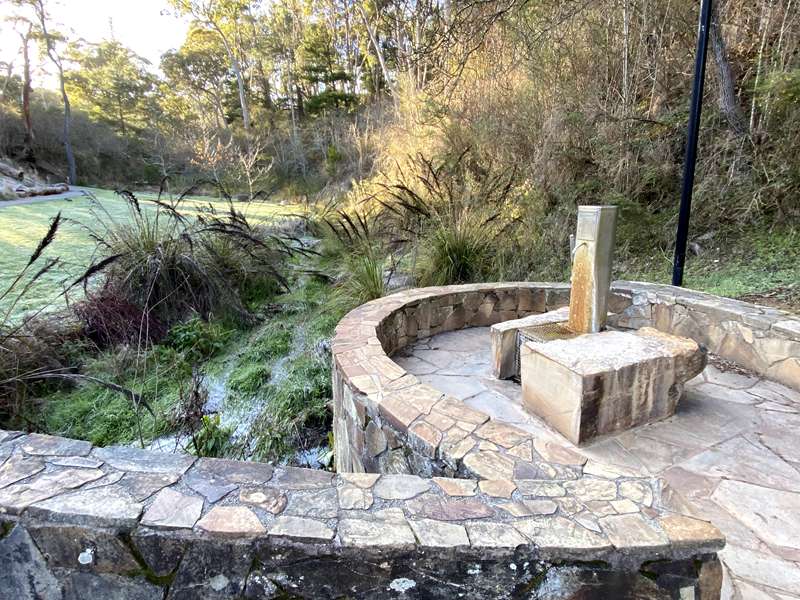
In 1930, the Geological Survey drilled eight bores in the Hepburn Mineral Springs Reserve. The bore construction followed a dry season and enquiries of the Mines Department about reductions in spring flow that were experienced. Five of the bores were abandoned, either because fresh water was encountered or because they were too near existing springs and it was feared the bores might affect their flow. The remaining three - Soda, Sulphur and Wyuna - were fitted with hand pumps and have since assumed the status of "spring".
Sulphur's mineral water
Sulphur Spring is a sodium bicarbonate natural mineral water or "soda water". Despite it's name, Sulphur Spring actually has, at 9 mg/L, the lowest level of sulphate (504) of the five springs at Hepburn.
The original bore here at Sulphur reached a depth of 5.2 metres. Each of the original Hepburn fives bores were replaced in 2007 with deeper bores that develop more effervescent water. This one now goes 20 metres in depth.
Interestingly, the original bores were not Included in the Geological Survey's numbering system (nor the groundwater database), but details were recorded in unpublished reports.
Wyuna Spring
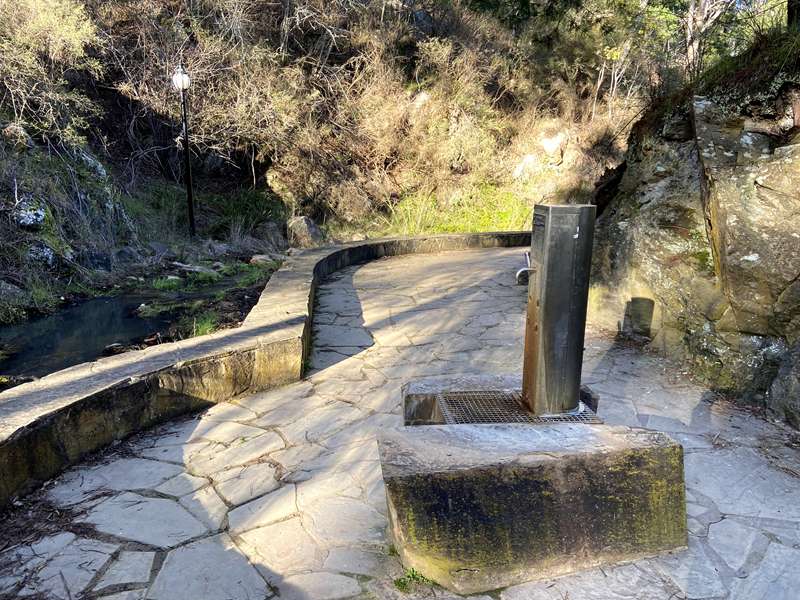
The hand pump here at Wyuna is positioned atop a bore, one of eight, that was drilled by the Geological Survey in 1930 following a dry season. About five metres from the hand pump is where the "old" Wyuna Spring was originally identified in 1910 by Dunn of the Geological Survey.
Soon after the "old" Wyuna Spring recommenced flowing about 1911, its eye was "domed" (covered with concrete) and its waters were piped down the valley to the bottling cellar at Pavilion Spring. The flow of water from the "old eye" increased after the closure of the North Frenchmans mine in 1911. Its water was noted for its sulphurous character.
Wyuna's mineral water
Wyuna Spring is a sodium bicarbonate natural mineral water or "soda water". The original bore supplying the mineral water to the hand pump was drilled to a depth of only 2.4 metres before good mineral water was struck. In 2003, a new bore was drilled to a depth of 27.5m. When compared with the other four Hepburn springs, Wyuna Spring contains the highest level of sodium. The mineral water from the "old eye" is still piped to the Pavilion Spring.
To reach Argyle Spring, cross Argyle Creek at Wyuna, walk 100m upstream and cross a low footbridge. The path then makes a fairly steep ascent of about 20m before descending to the bottom of a narrow gorge, followed by a steep 25m climb, and once again a steady descent to cross the creek over a footbridge (approximately 700m from Wyuna). Note the old adit (mine entrance). Cross a small side gully over a low footbridge and climb the steps to a track high above the gully, finally making a gentle descent to the mineral spring (approximately 1.4km from Wyuna), which is fitted with a standpipe and the familiar semi-rotary hand pump.
Argyle Spring
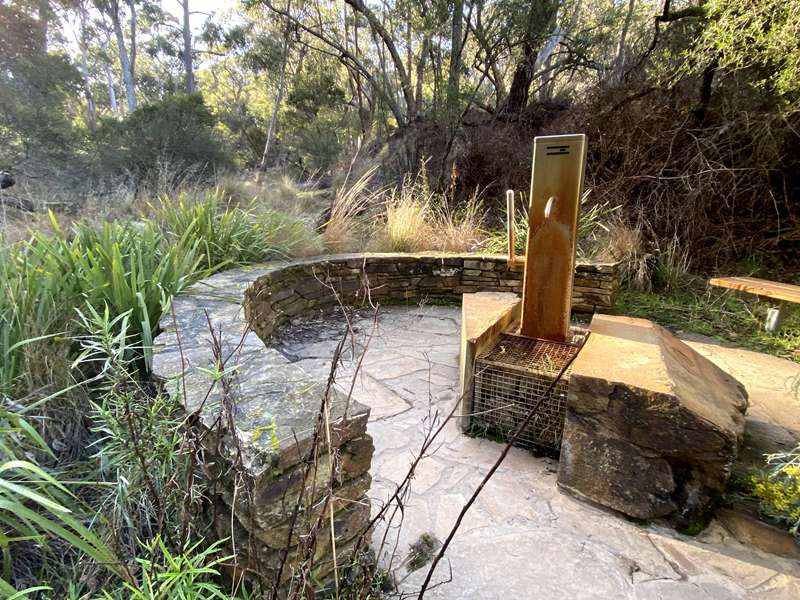
For many years, mining interests clashed with those of the health-giving and tourism industries, coming to a head during the great de-watering period 1910-1914.
Not all the springs were affected equally or at the same time: "There is still a spring flowing near the baths, while the Argyle spring, within the reserve, is in splendid condition." (The Argus, 19 December 1911.)
Proponents of the mineral springs continued their protests against further mining applications however: "Another mining lease... has been refused. The area applied for was in the neighbourhood of the Argyle Spring..." (The Argus 22 July 1912.)
In April 1914,The Daylesford Advocate, in an article entitled "What injured the spring?" reported that mineral water "proved a very valuable asset to the Daylesford public (the tourist traffic is variably estimated as bringing 40,000 to 50,000 pounds per annum* to the district)." * Worth about $4.5M to $5.5M in todays values.
Argyle Spring mineral water
William Baragwanath, field geologist for the Geological Survey, noted in his 1906 "Sketch Plan of Mineral Spring at Argyle Gully", that the flow of water was 2 gallons in 8 minutes 55 seconds, equalling 323 gallons per day.
In March 1915, the Daylesford Advocate noted that "The Argyle Spring is given great attention, and the recent improvements effected there have been much appreciated!"
Parks Victoria completed an upgrade to the spring in 2017, with improved signage, landscaping and pump, enabling visitors to once again enjoy the light and sweet tasting Argyle mineral water.
To reach Golden Spring and Liberty Spring: From the Hepburn Mineral Springs Reserve (above) drive or walk back to the entrance to the Spa Resort. Diagonally across the road is a narrow, steep sealed road. This is Golden Springs Avenue. Follow this road to the end, past Lone Pine Ave, and park on the gravel. A signpost indicates the track to Golden Mineral Spring. Follow the walking track steeply downhill. After approximately 180m you should see the spring beside the path.
Note: The path onwards to Breakneck Gorge (2.2km) / Liberty Spring is currently closed due to storm damage.
Golden Spring
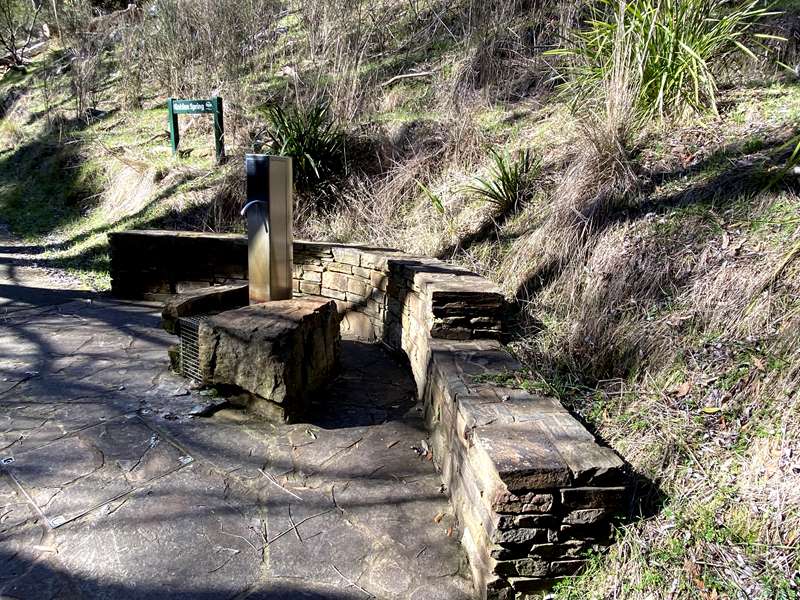
Several bores have been drilled at Golden Spring - with varying degrees of success.
An early bore was drilled in 1929, probably using the hand rig operated by the Mines Department. The typical bore construction at that time was 90mm 'gun barrel' steel casing seated into hard rock. Golden Spring was unusual in that it had a screw-on steel cap, probably because water flowed freely from the bore. The bore construction leaked though, with water seeping through the rock wall into the gully below.
In 2000 a new bore was drilled to replace the 1929 one. Neither bore was more than 5m deep. These shallow bores exhibited a pattern of bacterial contamination and fresh water incursion.
In 2007 this replacement bore, located about 2.5m east of the old bores, was drilled through weathered bedrock into fresh interbedded sandstone and shales.
Golden Spring mineral water
Whilst the rock material encountered in the drilling of the 2007 bore was strongly weathered and kaolinised, the water flowing from the bore maintained a consistent bicarbonate taste and was distinctly gassy. Testing and tasting of the water was carried out during the drilling process to ascertain the quality of the water encountered. Initially it was thought that drilling to 25m-30m would suffice, however the bore descends much further - to 78m!
Access for Dogs:
Dogs are permitted on leash.
Mining versus Mineral Water
Though instrumental in discovering most of the local mineral springs, the miner's first goal was, naturally enough, finding gold. Innumerable shafts, adits and tunnels were dug around the springs and within their water catchment in the relentless search for gold.
The mines that operated below the water table created depressions in the water level around their workings, affecting the flow of the spring waters - sometimes more than 2 kilometres away.
Conflict between mining interests and the local community, commerce and tourist industry reached its peak during Hepburn's most significant period of dewatering; 1910-1914.
The great dewatering of 1910-1914
By 1910, local citizens had noticed a recognisable pattern between spring flow (or lack thereof) and mining activities. In August, the Progress Association petitioned the Minister for Mines, opposing the extension of mining leases.
In early 1912, the Director of the Geological Survey, Dr EJ Dunn, recommended that all mines around the springs should be closed down and, on January 30th, State Cabinet paid the owners of the North Frenchmans Mine 250 pounds compensation to cease operations.
Throughout 1912 and 1913, the springs at Hepburn (Pavilion) remained dry. In July 1914, a deputation to the Minister for Mines and the Minister for Lands sought the closing of the Frenchmans Reef Mine. The mine closed in October 1914 due to poor returns and the flow of mineral water at Pavilion Spring gradually returned.
Drinking Natural Mineral Water
Water from natural mineral springs is untreated. Water in mineral springs is tested regularly but its quality and safety cannot be guaranteed. For further information: www.betterhealth.vic.gov.au or DELWP general enquiries: 136 186
Minerals and trace elements...
Potassium - for overall mental health, e.g. combats depressions and hysteria
Bicarbonate - balances the pH in the blood stream
Iron - for blood (enables red blood cells to carry oxygen, also vital for the formation of haemoglobin)
Sodium - fluid mineral (helps prevent stomach disorders)
Sulphate - purifies the liver
Magnesium - for nerves, muscles and the proper function of the kidneys Calcium - for bone tissue and muscle function
Calcium - for bone tissue and muscle function
Silica - for skin, hair and bone formation (not found in processed food)
Lithium - decreases abnormal brain activity and protects brain cells against normal wear & tear
Chloride - for glands (e.g. inflammation, prevents skin disorders etc.)
Natural mineral water contains many of the minerals, trace elements and micro-nutrients missing from modern processed foods that are necessary for health, strength and general well-being. Balneotherapy (mineral water used externally, in spas for example) can also relieve stress-related illnesses.
How mineral springs are formed
The water in our mineral springs starts out as rain. Much of the rain water evaporates again fairly quickly or runs off into streams to be eventually carried back to the sea.
Some of the water, however, seeps into the ground to enter an aquifer - consisting of fractured rock which holds water - where it is stored.
This groundwater in the aquifer flows very slowly; percolating throughout all the cracks and holes in the rock to eventually come out at a natural spring.
Minerals and carbon dioxide
So why is the natural mineral water around the Central Highlands different to other drinkable groundwater?
Essentially, it is the right balance of the minerals and the gas, carbon dioxide, that make it so special.
The aquifer is made of tiny grains of different minerals; the groundwater naturally reacts with some of these. The wrong balance of minerals makes the water brackish; the right balance makes it excellent drinking.
Carbon dioxide is a natural component of ground-waters. When it mixes with water in large quantities, the water becomes pleasantly effervescent (fizzy). The lack of air underground also means the water contains no harmful aerobic bacteria.
Did you know...
... that water makes up about 60% of an adult's body weight and up to 75% in a child?
Water is crucial to our health and survival, transporting important substances through-out our bodies and flushing out wastes and toxins. Without adequate water, our bodies would cease to function - a loss of 3% causing fatigue, a loss of 10% can be life threatening.
And did you know that adding carbon dioxide to water not only makes it effervescent, it also increases its acidity?
Water Types
Natural mineral water... a naturally carbonated (effervescent) groundwater that is rich in minerals and beneficial trace elements absorbed from the rock through which it has flowed. The water fell as rain many years ago.
Spring water... a groundwater that is very similar to rain water, low in minerals and trace elements. It may be only weeks since it fell as rain.
Drinking / Tap water... usually rain water (though it can be groundwater), caught and stored in reservoirs, that is chemically treated for safe distribution through pipes to consumers.
For more information about mineral springs in Victoria, see "From The Spa Country, A Field Guide to 65 Mineral Springs of the Central Highlands, Victoria", published by Edward and Maura Wishart
Photos:
Location
Mineral Springs Reserve Road, Hepburn Springs 3461 View Map


