Hepburn Springs - Argyle Spring Walk


Explore Country through a cultural journey featuring artworks that share stones of significance, connecting you with the land.
The Argyle Spring Walk, in Hepburn Regional Park, is 2.8 km (60 minutes) return. It is Grade 3: Suitable for most ages and fitness levels. Some bushwalking experience recommended. Tracks may have short steep sections and gravel surfaces.
Djaara (Dja Dja Wurrung People) invite visitors to connect with Country and Dja Dja Wurrung Culture on the Argyle Spring Walk which features a cultural art and interpretive trail.
Called Nyerna Djayi Wurreka, which means 'listening to Country speak' in Dja Dja Wurrung language, the trail, starting from the carpark at the eastern end of the Hepburn Mineral Springs Reserve, features eight 'pause points' encouraging people to stop and reflect on the surrounding environment, and its relationship with Djaara art and culture.
Argyle Spring Walk Map
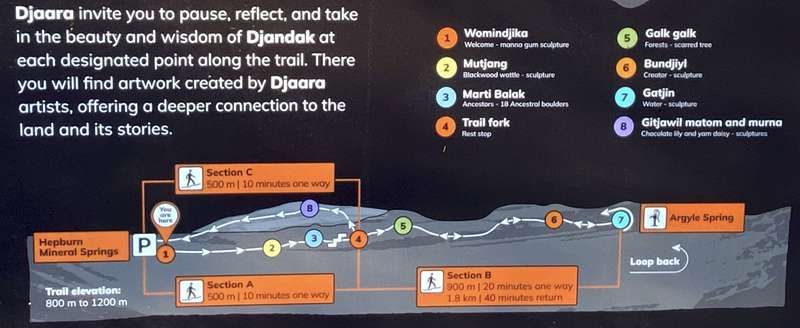
The walk begins at the carpark at the eastern end of Mineral Springs Reserve Road where there is a shelter with tables, BBQs and toilets.
Pause Points
1. Womindjika
Welcome - manna gum sculpture
Designed and painted by Sharlee Dunolly-Lee, Djaara woman. Sculpted by Colin Harrison.
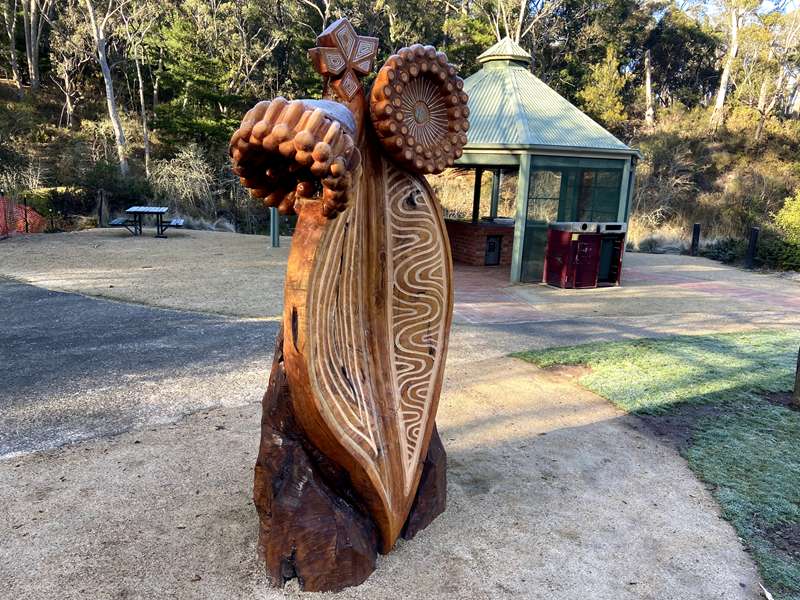
Artist statement
This design depicts a long, narrow eucalyptus leaf and flowers of the manna gum tree (Eucalyptus viminalis), also known as ribbon gum and white gum. It is a plant used in ceremony by Dja Dja Wurrung to represent the wisdom of Elders. It is the largest tree in the bush so 'sees all' and gives you gifts.
Manna, also known as lerp, is a hard and sweet sap which is formed from holes of a white sugary cocoon made by an insect in its early stages. It falls to the ground and can be eaten as food.
Manna gum sap is also made into gum for plugging holes in baskets. The nuts or buds of the manna gum usually form in groups of three. The three buds represent the past (Djaara Ancestors), the present (us), and the future (our descendants).
The oil content in the leaves of the manna gum has medicinal properties. It can be used to help repel insects, control odours, and alleviate a fever. The bark falls off in ribbons which can be used as twine and for making bags. The heavy inner bark is removed to make wooden bowls. Koalas prefer to eat the leaves of the manna gum.
2. Mutjang
Blackwood wattle - sculpture by Andrew Saunders, proud Djaara and Yorta Yorta man
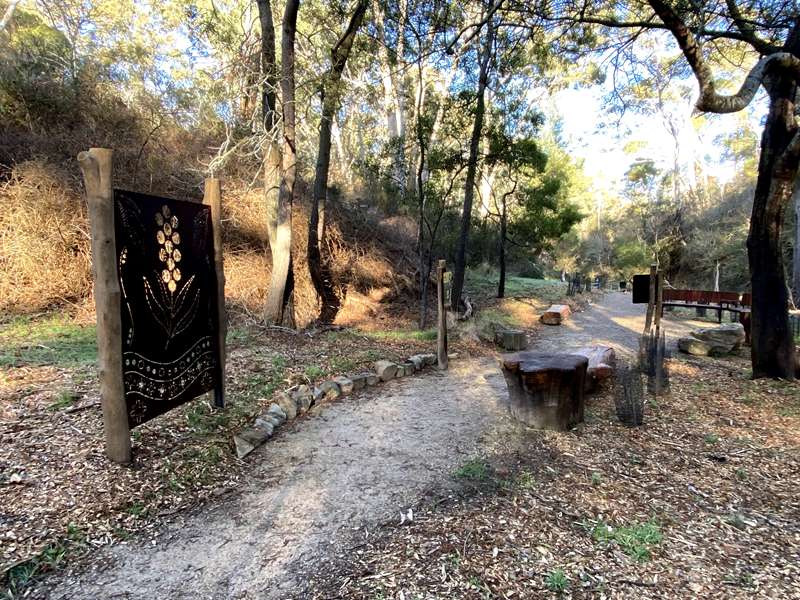
A tree of cultural significance - For thousands of years, blackwood wattle (Acacia melanoxylon) trees have held great significance for Djaara (Dja Dja Wurrung People), the Traditional Owners of Djandak (Dja Dja Wurrung Country).
Mutjang is one of nearly 1000 species of Acacia (wattle) in Australia. Acacia is Australia's largest genus of flowering plants. Mutjang is deeply intertwined with the cultural, spiritual, and daily lives of Djaara People and community.
Cultural importance - The iconic blackwood wattle is much more than a tree. For Djaara, it is a source of food, medicine, and materials. The seeds and sap are used in traditional foods, while the bark and leaves serve medicinal purposes. Its wood is an essential resource for making tools, weapons, and shelter.
Blackwood wattle in ceremonies - Blackwood wattle often plays an important role in cultural ceremonies, where its leaves are burned to cleanse and protect. These ceremonies are a powerful way for Djaara to welcome visitors to Country, connecting people to Country and our Ancestors.
Take a moment to reflect on the season: are the wattles around here flowering? Are their seed pods present? Is sap oozing from their bark?
3. Marti Balak
Ancestors - 18 Ancestral boulders
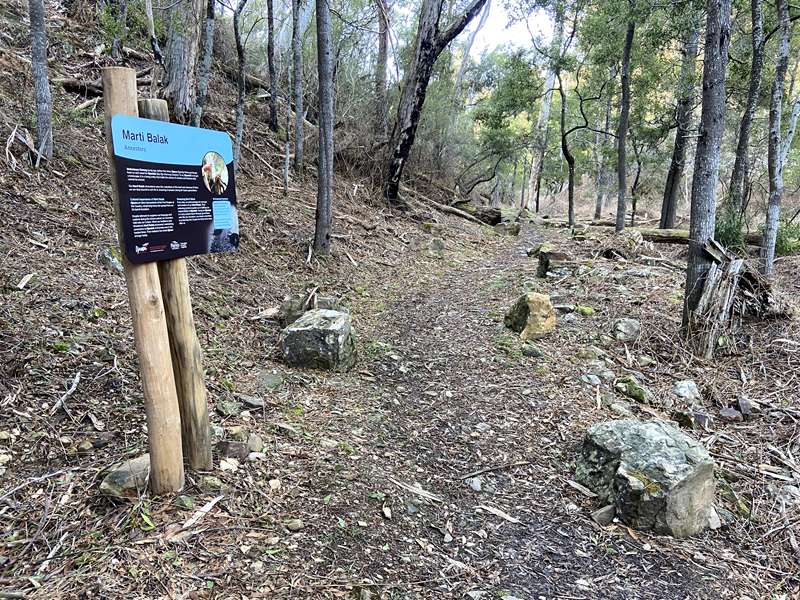
Malamiyayu Gurang (Long ago, before this time), Djaara (Dja Dja Wurrung People) lived on and cared for Djandak (Dja Dja Wurrung Country). To us, Djandak is not just a landscape; it is a living entity that holds the stories of creation and histories that cannot be erased.
Our Marti Balak (Ancestors) were the custodians of this land and, because of them, we are duty bound to care for it, ensuring it remains strong for future generations.
Cultural importance of Marti Balak Djaara are direct descendants of the First Peoples of this County, comprising many clan groups from our 18 Apical Ancestors.
Despite attempts to suppress our language and customs during the mission period, our Ancestors held onto our Culture. When our traditions were threatened, Marti Balak persevered, maintaining connections to Djandak and kinship even in the hardest times. Their resilience has made Djaara stronger today.
Honouring Marti Balak - Every day, we acknowledge the strength and wisdom of our Marti Balak. Their enduring presence guides us in fulfilling our responsibility to Djandak. Caring for Djandak is a duty passed down through generations and, like our Ancestors, we remain committed to protecting this Country for those who come after us.
18 Ancestral boulders
Djaara today are direct descendants of 18 Apical Ancestors. The 18 boulders here represent our Apical Ancestors. Pause and reflect on those who have come before you. Imagine their stories.
4. Trail fork
Rest stop
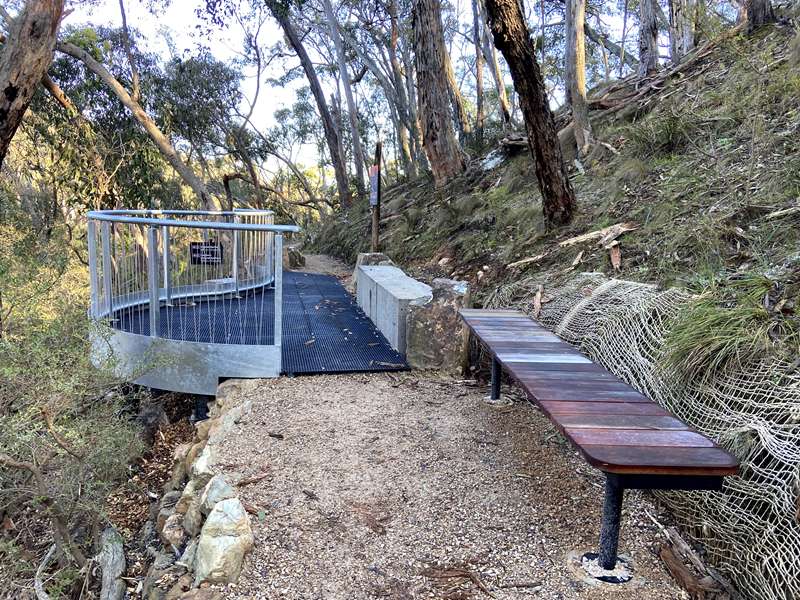
5. Galk galk
Forests - scarred tree
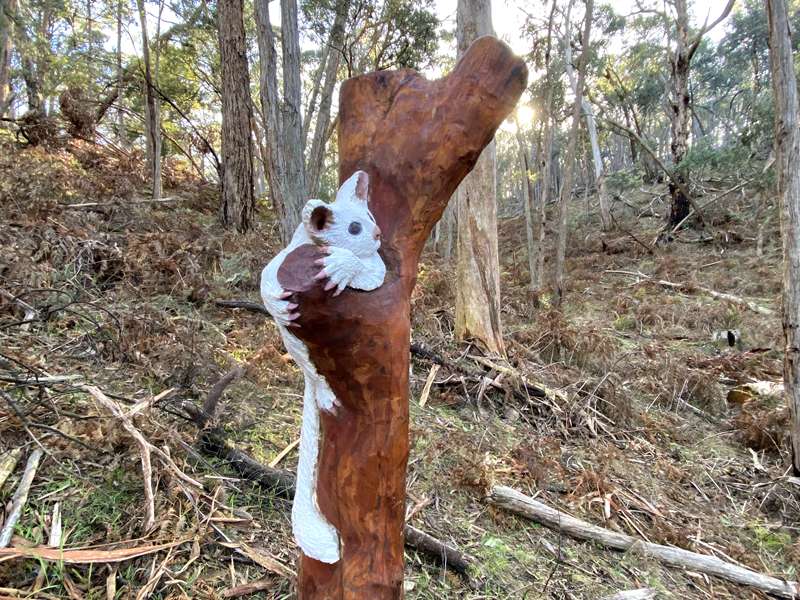
The cool, wet forests of southern Djandak (Dja Dja Wurrung Country) are renowned for their biodiversity. Characterised by tall canopies and rich undergrowth filled with ferns, mosses, grasses and wildflowers, these forests thrive in a cool and moist climate, supporting diverse plant and animal life. They provide critical habitats for numerous species and foster a delicate balance within the ecosystem.
Cultural importance - Djandak's landscapes carry Djaara's (Dja Dja Wurrung People's) dreaming stories, songlines, trade routes, and totemic relationships. Galk Galk Dhelkunya (healing forests) is the way we draw on the wisdom of our Ancestors to connect with and heal Country. By engaging with these landscapes; we are caring for Country and honouring Bundjiyl's (Creator's) Lore.
Scarred trees - Forest resources hold cultural significance for Djaara. The practice of collecting bark and creating scuffed trees still occurs today, serving as a testament to our Ancestors' sustainable methods. Bark is used to create tools, bowls, shelters and canoes. It is harvested without killing the tree, so the tree can stay healthy for future generations. This practice reflects our philosophy of caring for Country while using Country's resources.
Look up: what can you see? Take a moment to appreciate the towering trees and vibrant undergrowth. Reflect on the importance of these forests, not only as a resource but as sacred spaces that hold our stories and traditions.
6. Bundjiyl
Creator - sculpture by Melissa Taylor, proud Djaara and Yorta Yorta woman
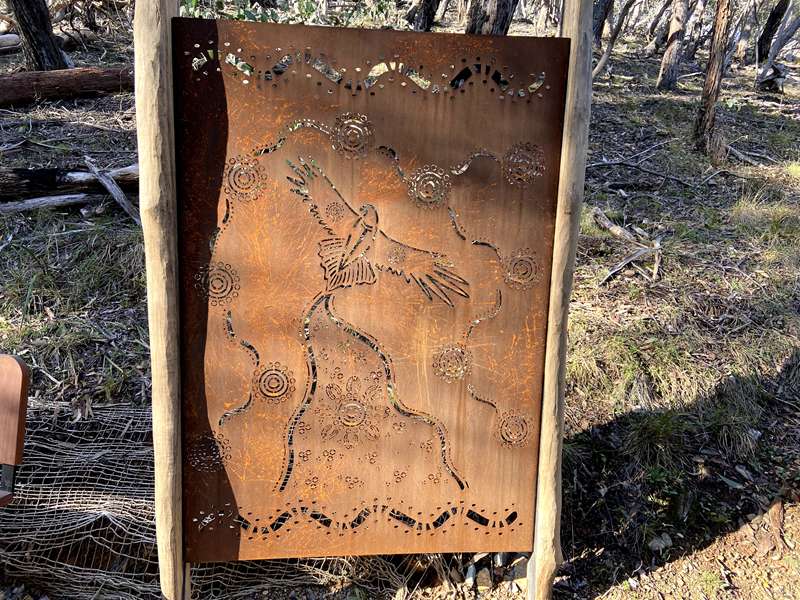
Bundjiyl is a powerful creator spirit and protector for Djaara (Dja Dja Wurrung People). As a symbol of strength and guidance, Bundjiyl embodies the deep relationship between Djaara and our Ancestral lands, reflecting our connection to nature, Culture, and spirituality.
Bundjiyl in art and ceremony - Bundjiyl is featured in Djaara art and ceremonies, depicted as a wedge-tailed eagle. These representations honour Bundjiyl's role as creator and protector, watching over Country from the sky and maintaining our Cultural Lore.
Cultural importance - Bundjiyl is central to Djaara creation stories, shaping Djandak (Dja Dja Wurrung Country), its people, and animals. As a guardian of all life, Bundjiyl offers wisdom to those who listen, and Bundjiyl's presence in the sky reminds us to care for Country. These teachings, passed down through generations, shape Djaara values and teach our youth to respect Country.
Raise your gaze and listen closely: can you see or hear Bundjiyl, the majestic creator spirit? Take a moment to reflect on this extraordinary being, as it soars above, watching over the land, carrying with it timeless wisdom.
7. Gatjin
Water - sculpture by Sharlee Dunolly-Lee, Djaara woman
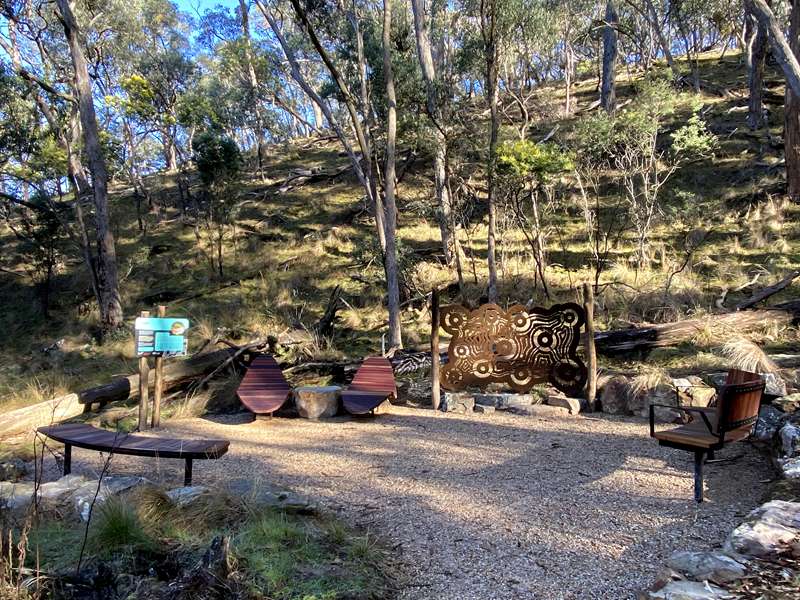
The health of gatjin (water) is vital to the wellbeing of Djaara (Dja Dja Wurrung People) and Djandak (Dja Dja Wurrung Country). Rivers and creeks have always been culturally important for Djaara. Protecting and interacting with gatjin nurtures the deep connection between Country, community, and Spirit.
Cultural importance of gatjin - Today Djandak and its waterways remain central to Djaara's cultural identity and aspirations. Our rivers are the veins of Country, and provide food and medicine, and places to camp, hunt fish, swim and hold ceremonies. Waterways are integral to our creation stories. Many Cultural Heritage sites, including burial and birthing sites, and middens, are connected to gatjin.
Cultural practice - Gatjin is integral to various cultural practices, including ceremonies and rituals. These practices may involve offerings or the use of gatjin in traditional healing, emphasising its role in maintaining cultural traditions and communal identity.
Sit quietly by the water's edge and breathe with its gentle flow... Reflect on its nourishing journey. Let this moment with gatjin bring you peace and renewal, just as gatjin renews all life it touches.
Artist statement
Many thousands of years ago, this land was in turmoil as volcanoes roared. Molten fury, incandescent rock and rivers of lava reshaped the terrain, while thick smoke shrouded a sunless sky for decades. Later, where the volcanoes once roared, water would go underground, boring through long-dead volcanic arteries, and filtering through layers of the mineral-enriched rock.
Today, Victoria's Central Highlands is etched with rivers such as the Loddon - which carves through deep gorges and lush eucalyptus forests, cascading over Sailors and Loddon Falls, flowing north into the Murray. The rivers represent renewal, healing, memory, and the life-force in the energy of all things. It symbolises knowing where you need to be - flowing forward with strength and purpose into a positive future despite challenges
The natural mineral waters in the Hepburn Springs region are typically rich in minerals such as calcium, magnesium, sodium, potassium, bicarbonate, chloride, and sulfate Argyle Spring mineral spring water, also known as 'soda water', contains sodium bicarbonate and sulphate due to the erosion of its deposits deep underground, nourishing those who drink it.
This sculpture also contains minerals and elements allowing it to strengthen over time. The design symbolises water, which is considered the lifeblood of Djaara Country. The sculpture is mode of iron, copper, chromium, and nickel alloyed steel. It depicts mineral water seeping to the surface as metal-saturated bubbles when heavy rain fills billabongs, creeks and rivers. The rusted patina mirrors the journey of minerals in the springs, symbolising life and protection.
8. Gitjawil matom and murna
Chocolate lily and yam daisy - sculptures
Chocolate lily sculpture By Suzanne Taylor, proud Djaara woman
Murna sculpture by Sharlee Dunolly-Lee. Djaara woman
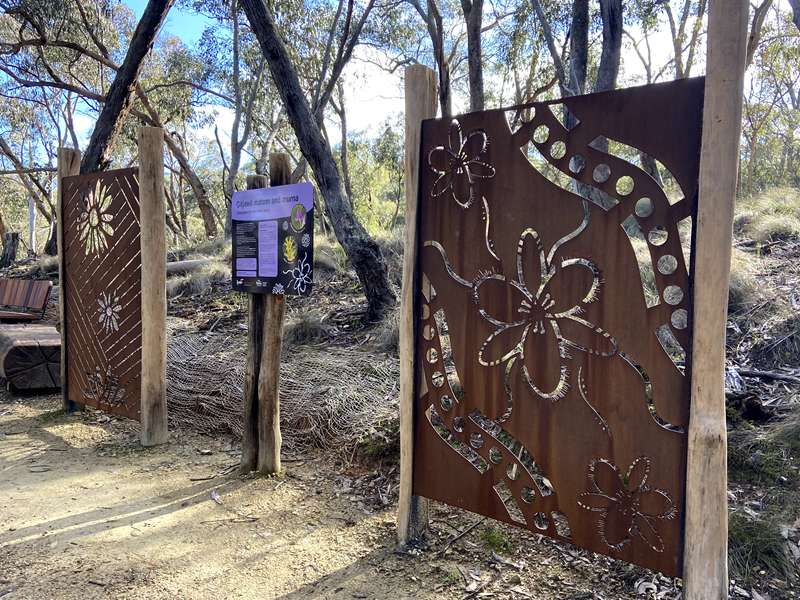
These key food and fibre plants for Djaara (Dja Dja Wurrung People) were once abundant across Djandak's (Dja Dja Wurrung Country's) open grassy forests and woodlands. They are integral to our identity, providing sustenance, medicine, and fibre for generations.
Cultural importance - Food and fibre plants connect us to our Ancestors and to Country, They represent nourishment, cultural expression, traditional knowledge, and environmental stewardship.
Food and fibre plants in practice - Many orchids, lilies, and daisies on Djandak produce underground tubers that were once a dietary staple These starchy tubers, with varying flavours, can be enjoyed raw or cooked, offering a versatile and nutritious food source.
As you walk, connect with Country. Feel the warmth during flowering season, and perhaps catch the sweet scent of chocolate from the gitjawil matom. The bush's vibrant colours remind us that these plants continue to nourish both the land and our People.
Artist statement - The design depicts the murna, also known as the yam daisy (Microseris lanceolata), which is an important food source to Djaara. It symbolises resilience and strength, and represents the will to thrive in harsh conditions.
Traditionally, flowers mark the beginning of duck courtship and nest building. Women collect seeds while the malleefowl lay their eggs.
Murna roots are traditionally roasted, they are nutrient-dense, and rich in prebiotics. High in fibre, antioxidants and minerals, murna can support gut health, regulate blood sugar, and boost immunity, while providing long-lasting energy.
Cultural practices and ceremony are being revived as we relearn how to grow this valuable crop.
Argyle Spring Walking Tour
Dumawul operates the 1.5-2 hour Argyle Spring Walking Tour.
This is an experience that invites everyone to connect deeply with Djandak (Dja Dja Wurrung Country). Here, the voices of Country and the knowledge of Djaara come together, guiding you through a journey to understand the natural world, its cycles, and its stories.
Djaara invite you to pause, reflect, and take in the beauty and wisdom of Djandak at each designated point along the trail. There you will find artwork created by Djaara artists, offering a deeper connection to the land and its stories.
Photos:
Location
Mineral Springs Reserve Road, Hepburn Springs 3460 View Map
Web Links
→ www.parks.vic.gov.au/places-to-see/sites/hepburn-mineral-springs-to-argyle-spring-trail


