Heathmont Historic Walk (Heathmont)


A 4.6km walk around Heathmont with historical themes. The start location is on the eastern side of Heathmont Railway Station.
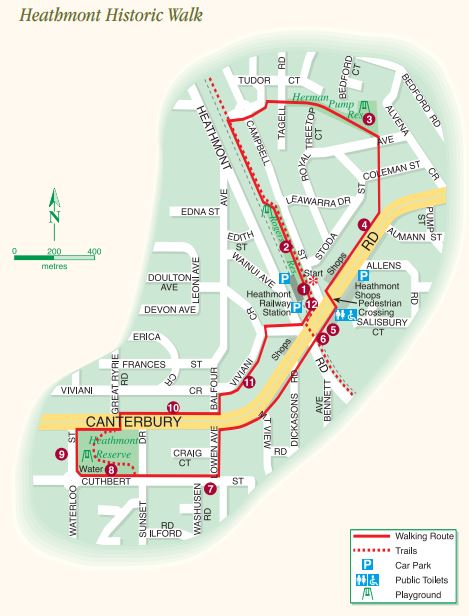
Route Description:
1. Heathmont Railway Station - Start at Heathmont Railway Station, which was built in 1926 so that orchardists could get their fruit to the city markets more quickly. Land developers McLean & Cotter named the area after local features - the plant "heath" (Epacris impressa) on a "mont" (or mountain).
-embed09.jpg)
2. F.J.C Rogers Reserve - This was established in the 1960's as a native plant reserve, named after Fred Rogers who was an author, lecturer, Principal of Ringwood State School and also founding president of Maroondah's The Society for Growing Australian Plants group. Local flora includes orchids, heath, wattles, eucalypts and kangaroo grass. There is a playground in the reserve.
-embed01.jpg)
Continue along the Heathmont Rail Trail northwards and turn eastwards into the end of Myrtle Avenue. There is a laneway into Herman Pump Reserve beside 31 Myrtle Avenue.
3. Herman Pump Reserve - Herman Pump arrived in Australia in 1890. He married in 1896 and bought land in the area, developing it into an orchard of apples, pears and cherries. His farmhouse was the only house on Canterbury Road east of Wantirna Road. The beautiful park has a playground.
-embed02.jpg)
This reserve is named after Herman Pump (1874-1954), who arrived from Denmark in 1890 with only 5 shillings in his pocket and immediately commenced work in the orchard of his uncle in Doncaster.
In 1896 Herman purchased 50 acres between Bedford Road and the railway line in Heathmont and set about clearing the land to establish his own orchard, which produced apples, plums, pears and cherries.
A civic-minded person, Herman was president of the Heathmont Progress Association, the Ringwood Cool Stores Committee, and the Heathmont Railway League, which successfully argued for the establishment of the Heathmont Railway Station, which was opened in 1926.
A man of many interests, Herman Pump was a foundation member of Ringwood Bowling Club and the Horticultural Society, and president of the Heathmont Cricket Club for 27 years.
A laneway leads from opposite the park, beside 26 Royal Avenue, all the way to Canterbury Road.
4. Uniting (Methodist) Church - Land was purchased in 1948 and the Methodist Church opened in 1952 in what is now the front south building and was soon also used as the local primary school. In 1977 "Uniting Church" was formed when Methodists, Presbyterians and Congregationalists combined.
-embed03.jpg)
Toilets and a water tap are located along the shopping strip beside Canterbury Road.
5. Railway Bridge - For years the roadway was a single lane and dangerously narrow. In 1942 a petrol tanker went through the railing and onto the train tracks, losing its load and causing a large fire. The bridge has since been rebuilt several times.
-embed04.jpg)
6. Harpers' Bush - At 200 Canterbury Road, next to the train line, John and Joan Harper donated 4 hectares of bush in 1987 to Trust for Nature (Vic). The Harpers continued to have a keen interest and involvement in the community.
-embed05.jpg)
7. Washusen Road - Heathmont's pioneer development was based on orchards. Many families were German. One local example was the Washusen orchard of 24 acres on land bought in 1913. A large community gathering in 1966 farewelled the Washusens, the last of the orchardists, as Heathmont changed from orchard to residential suburb.
8. Heathmont Reserve - Cricket and tennis, both very popular with the early orchardists, were first played near the station. Famous Heathmont sportsmen have included test cricketer Ian Callen, national baseballer John Ramsden, football player and coach Ron Barassi and world record distance runner Ron Clarke. There is a playground and water tap at the reserve.
-embed06.jpg)
9. Presbyterian Church - The St Andrew's Church building opened in 1959, and after the 1977 forming of the Uniting Church, it was re-dedicated as a Presbyterian Church.
-embed07.jpg)
10. Anglican Church - Land was bought in 1950, and services were held from 1953 and a building opened in 1955. Early memories include the use of a Washusen truck for Sunday School picnics to Frankston.
11. Heathmont Pre-school Centre - This, the first local public building, was built in 1952 by the Heathmont Advancement League "an association of residents working for the educational and
civic improvement of Heathmont and for the preservation of its natural beauty".
-embed08.jpg)
A short distance away at Viviani Reserve is a basic playground.
12. Shopping Centre - As you walk back to the station, imagine the first Heathmont "General Store" which operated out of Miss Elizabeth Marden's front room in 1923.
Location
99 Campbell Street, Heathmont 3135 View Map
Web Links
→ Heathmont Historic Walk Guide and Map (PDF)


