Graytown Prisoner of War Camp


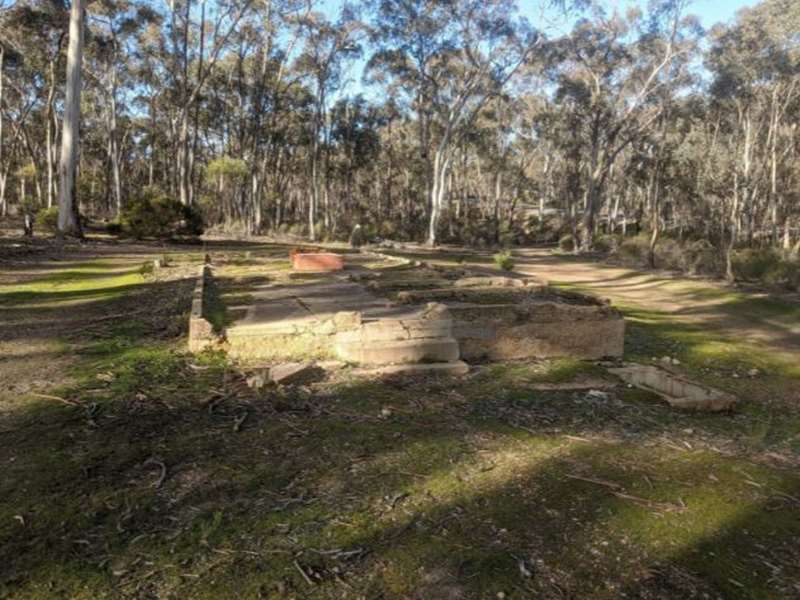
Hidden away in the Heathcote-Graytown National parks lies the remains of a 'Prisoner of War' camp from World War Two. German prisoners captured after the battle between the HSK Kormoran and HMAS Sydney off the coast of Western Australia were transferred via Freemantle and Murchison to the Graytown timber cutting camp. The German Prisoners spent their time in the camp collecting firewood to address the firewood crisis of the time. In their downtime many prisoners worked on upskilling, painting, and drawing and cooling off with swims in the nearby creeks.
Still standing today the barbed wire fence marks the remainder of the site, with cement foundations laid by Italian and Finnish internees scatter across the site. The old tennis courts and market gardens long overgrown still discoverable by the stonework paths. A short trip from both Heathcote and Nagambie this is a great site to explore some forgotten Australian wartime history.
There is an unmarked 1km trail around the site. You may follow it to complete a loop or stick to the old roadways for surer footing. Be careful when exploring the site to avoid injuring yourself or damaging the historical features.
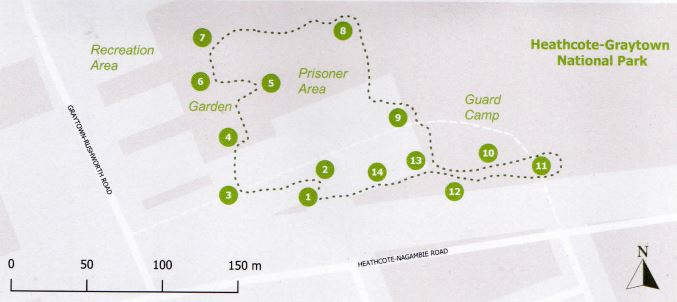
Track Notes
1. Entry - The trail starts at the current Parks Victoria signage located in the carpark.
2. Camp Entrance and Compound Fence -Walking away from the signage along the road you will walk through the original entrance to the camp. To your left you will see the historic barbed wire fence. Follow this fence for this portion of the trail.
3. View of Garden - Now overgrown, there was once a market garden which provided fresh produce, eggs and poultry for the guards and prisoners alike.
4. Foundations - The foundations of this end of the camp make up the showers, toilets, dental clinic and other unknown buildings. Follow the line on the map to the next features.
5. Mess and Canteen - With over 250 prisoners being fed each night there was a dedicated staff of prisoners as waiters and chefs who would provide hospitality. The waiters would play music during dinner service and practice during the day.
6. View of Recreation area - Looking behind the market garden is where the recreation area and tennis court once was. Follow the road way from this point.
7. Guard Tower - Barely visible the stump holes of where the guard tower once stood can be seen in the ground to the left of the path. The perimeter was guarded all the time with electric lighting at night. Continue along the road towards the dam.
8. View over prisoner camp - From this point you can look over what was once a cleared camp, now a scrub covered forest. Follow the road toward the carpark and loop back to the next feature.
9. Guards Mess and Canteen - This collection of foundations makes up the Guards mess and canteen. Social events held in the mess including dances with the local community raised funds towards the war effort.
10. Guards camp - The hill above here is where the guards camped.
11. Guards shower block - This is the foundation of the guards shower block. The guards entrance to the site was at the bottom of the hill.
12. Latrines - More latrines can be seen in the bushes here. Be careful!
13. Office blocks - This is where the camp site was administrated from.
14. School - Located just a few metres away from the camp was a school yard. With an initial objection appeased the school had a working relationship with the prison camp. Prisoners would drop off candies and even ships in bottles for the children whilst being transported from the site.
Site Information Panel:
During the Second World War, Prisoner of War (POW) camps were established at Dhurringile, Murchison (Camp 13) and Graytown (Camp 6).
Camp 6 Graytown
Approximately 250 Italian and then German Prisoners of War (POWs) were detained at Camp 6 Graytown POW Camp and not released until January 1947. The German POWs were mostly crew members from the German raider ship 'Kormoran' that sunk HMAS Sydney off the Western Australian coast in 1941. Some Finnish seamen were also held at Camp 6 Graytown. The wreckages of the Kormoran and HMAS Sydney were not found until March 2008.
The Camps
Internment camps were established for three reasons - to prevent residents from assisting Australia's enemies, to appease public opinion and to house overseas internees sent to Australia for the duration of the war. Most prisoners of war in Australia were sent from overseas, very few were captured here.
Each compound was enclosed by a double row of wire fencing two metres high, with coiled barbed wire in between. Guard towers were erected at the corners of the compounds, and the whole perimeter was illuminated during the hours of darkness. Prisoners were held in timber framed barracks with galvanised iron roof and walls, about twenty in each building. Kitchens, mess huts, shower blocks, laundries and latrines were all located within the compound. Each camp was divided into two or more compounds to facilitate as far as possible the separation of nationalities.
Little physical evidence of the camps remains today other than some building foundations and wire from the camp fences.
Prisoners or Internees
During World War I and World War II, Australia held both Internees and Prisoners of War.
Many records do not make a clear distinction between civilian internees and military prisoners of war. The terms 'prisoner' and 'internee" were often used for both groups. Prisoners of war were members of enemy military forces who were captured or had surrendered, whereas internees were civilians. In many cases internees and prisoners of war were accommodated in the same camps.
There were differences, however, in the rights of these two groups and the way they could be treated by Australian authorities. For example, prisoners of war could be made to work while internees could not. Internees also had to be paid for any work they undertook.
Timber Cutting
The surrounding forest has been used for timber cutting from early settlement.
Prisoners at the POW camps were engaged in cutting firewood for the camps and for use in the hospitals in Melbourne. After the Second World War the demand for firewood decreased as oil heaters and later natural gas was used for heating in metropolitan areas.
In the early 1950s post cutting became the main focus of the local timber industry. Throughout the 1960s to the 1980s the demand for posts, strainers, stays, shed poles and round rails for horse and cattle yards was higher than the supply.
The camp was later used as a depot by the Forest Commission. In 1981 a number of state forest areas were added to the parks and reserve system, primarily for conservation purposes. Timber cutting in the park ceased in 2002 with the declaration of the Box-Ironbark Parks and Reserves, including Heathcote-Graytown National Park.
Review:
An interesting area to explore with quite a lot to find including foundations and remains of barbed wire fences. We had trouble following the trail exactly because nothing is marked but managed to find a lot including a red bellied black snake which was at the bottom of a latrine.
Location
Cnr Polkinghorne Street and Heathcote-Nagambie Road, Graytown 3608 View Map
Web Links
→ Military History Trail


