Gold Heritage Walk (Warrandyte)



The 3.3km loop walk takes you around historic landmarks and remnants of yesteryear when those down on their luck sought riches from the gold-laden hills of Warrandyte. Fourth Hill was stripped totally of its trees and the wood used to fuel stamping batteries used for crushing the quartz.
Many of the old sites still remain today and your walk will take you into an area that was once rich in gold, and is now rich in history. During the winter months there is plenty of fungi.
The points of interest are outlined below.
Map of Walk
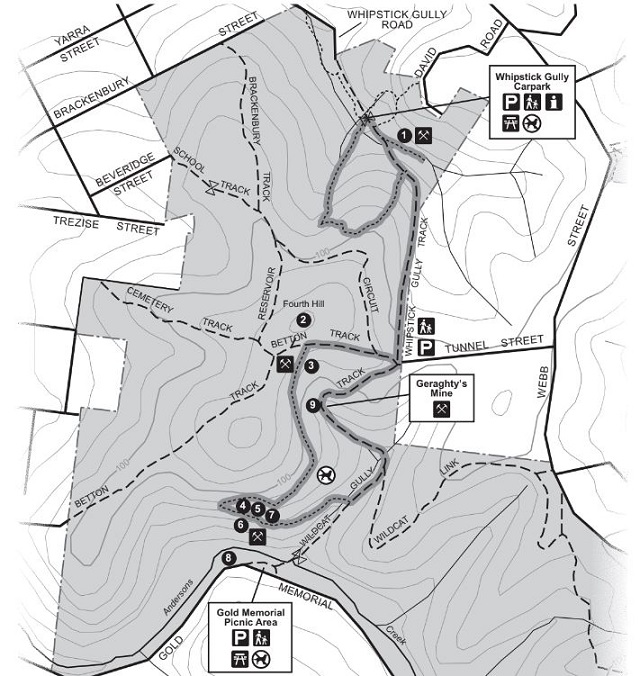
The walk is accessed from Whipstick Gully Road off Yarra Street in Warrandyte. Continue along Whipstick Gully Road to the carpark at the end of the road where there is a a shelter with information panels but no seat. Opposite the shelter is a quarry site which is used for rock climbing and abseiling and requires a permit but there are no fees.
There is an interactive audio information post where visitors can press the buttons to hear short recordings explaining the history of the Victory Mine, traditional gold mining methods, gold panning techniques and what Whipstick Gully sounded like during the 1890s. When we visited it didn't seem to be working.
Points of Interest
1. Victory Mine
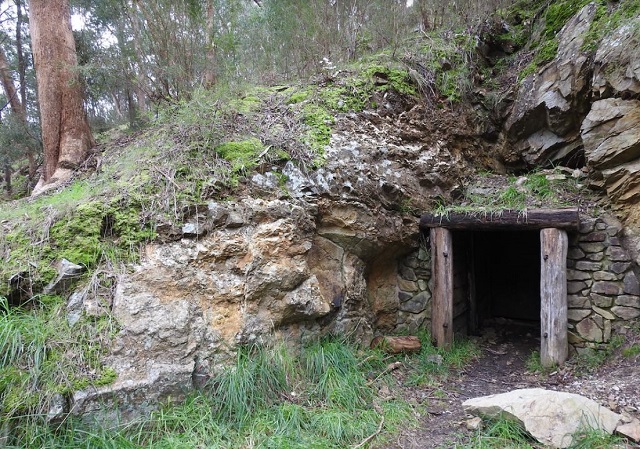
Previously known as Young Colonial, and Warrandyte Claim, the Victory mine produced one of the richest claims since records have been kept. It was worked from about 1896 and produced 1,870 oz in three years. The main shaft was sunk to 220ft. In this area you will also find a number of on-ground information boards.
-embed02.jpg)
The brickwork near the mine entrance is all that remains of an old stamping battery which was used to crush the gold bearing quartz rock. There are a number of unshaded picnic tables in this area.
2. Fourth Hill Summit
-embed03.jpg)
Once the site of Warrandyte's chief water supply. There was once a large Water Trust dam and a fire tower at the summit. This hill top was cleared for mining and burnt by numerous bushfires. With time and some help from the rangers and the Friends of Warrandyte State Park, the bush is tentatively returning.
3. Open Mines
-embed04.jpg)
Originally dug by Europeans, these open mines were often reworked by the Chinese who flocked to the area in search of their fortune. The Chinese were clever at recovering gold missed by the Europeans and they would move in and rework the ground, usually with a great deal of success. For this reason, resentment sometimes formed between the races.
4. Johnson's Mine
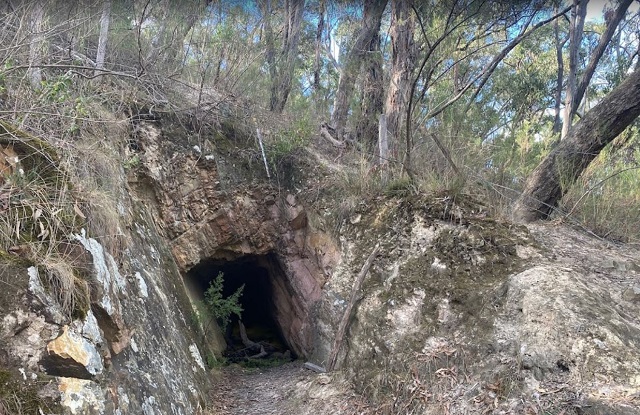
A lot of hard work and expense went into the Johnson's mine adit. Johnson tunnelled straight into the hill for approximately 60m following a small reef, but unfortunately found no sign of gold. The adit then turns to the left for another 20m before being abandoned. An adit is a horizontal or gently inclined tunnel driven from the surface (typically into a hillside or outcrop) for the purpose of intersecting or mining an ore body.
5. Upper Monument Mine
-embed05.jpg)
Another European-built mine. Did you know that the Chinese made circular mines so that 'demons' could not hide in the corners?
6. Miners Hut
-embed06.jpg)
Probably built in the 1950s. Note how one corner of the hut is a tree trunk. This not only gave the structure some stability, but also saved precious man-hours so that time could be spent on important matters - the quest for gold.
7. Monument Mine
-embed07.jpg)
This type of shaft was usually operated by a partnership of two or three men. The two mines you see were in operation until 1960's and were the last working Gold mines in Fourth Hill.
The Monument Gold Mine was the last gold mine to operate on Fourth Hill. The lessees dug 2 shafts and built a galvanised hut...apparently they got a lot of exercise but not much else out of the experience.
On 17th November 1965 this lease was declared void, ending 116 years of Continuous gold exploration and mining on Fourth Hill.
8. Memorial Cairn
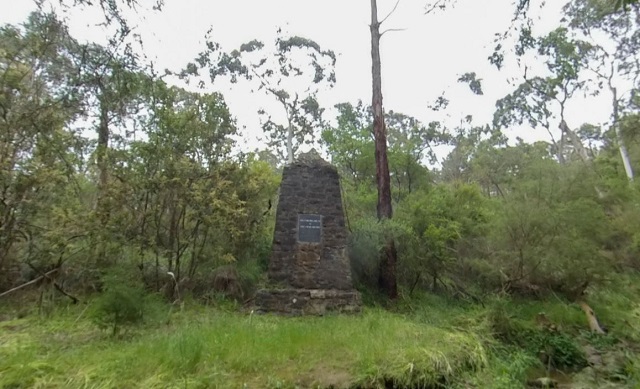
There is a small detour to the cairn which involves crossing Andersons Creek by stepping across rocks.
Erected in memory of Louis Michel and his team who were (arguably) the first in Victoria to find GOLD!
Louis Miehel's own account of how he and W. Habherlin discovered Victoria's first 'publicly acknowledged' gold in 1851 was documented as: ''Do you see anything Bill? Said I. After once or twice saying no- he suddenly exclaimed Your worship, here's the clickerty! 'Eagerly examining the residue we found it to contain 10 small grains of gold... Permit me to add that it was the immediate publication of my discovery that stemmed the tide of emigration to New South Wales.
9. Geraghty's Mine
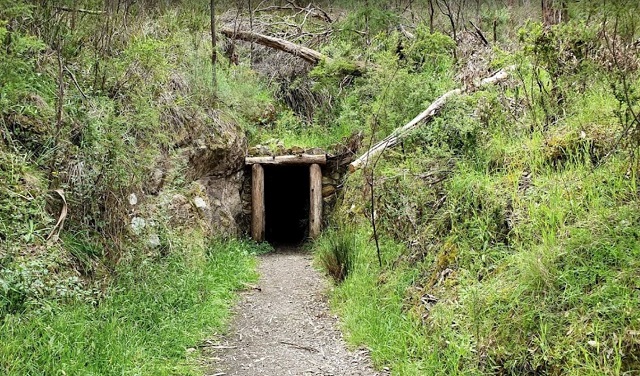
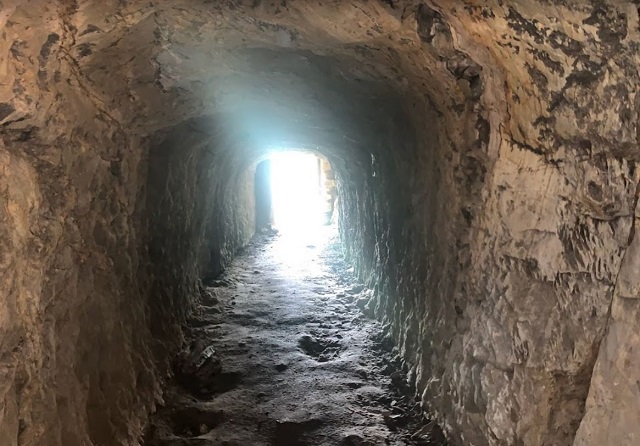
Patrick Geraghty constructed a tunnel to a distance of one hundred and thirty metres between June 1859 and February the following year. It is an extensive mine which branches off in various directions and was even equipped with a light tramway for the speedy transportation of quartz. Quartz mines were mined in sections, leaving large slots (stopes) in the ground where the reef had been.
Public access into Geraghty's mine was closed in 2002. The gate, preventing access, is located about 20 metres within the tunnel.
An extract from 'Digging into History - Goldmining in Warrandyte' by Dianne Baird is:
"Perhaps the most common or well known mines in Warrandyte is Geraghty's Mine located on Fourth Hill dug by the Magnet Gold Mining Company in 1859. Patrick Geraghty arrived from Ireland in 1842. He worked a number of different jobs until 1854 when he became owner of the Royal Hotel in Richmond. The lure of goldfields took Geraghty to Warrandyte where he first ran Geraghty's Inn, then in 1856 opened the Union Hotel (later named the Warrandyte Hotel). In 1859, Geraghty and William Moore registered a claim for a large area (approximately 600 x 200 yards) on Fourth Hill. They began an ambitious project called the Fourth Hill Tunnel Project. The plan was to tunnel into the hill to intersect the rich gold veins believed to be in the quartz. Geraghty and Moore began with an open cut and built a tramway to carry away the rock. They then began to dig a tunnel into the hillside and got to a distance of 400 feet then stopped. Such a big project developed great expectations for success, but surprisingly, Geraghty and Moore abandoned the project. There are no records to explain this decision and Geraghty later took up the more predictable work of running a hotel again.
Geraghty did not strike the reef he was seeking but two other miners (Chatty and Smith) continuing his work in the 1880s were more successful."
Information Panels
Warrandyte Gold
The discovery of gold in nearby Andersons Creek in 1851 sparked one of the most contagious fevers of the nineteenth century...gold fever. People left their families and homes in search of this highly prized metal.
By 1900 there were still several gold mines operating in this gully. The land had been cleared, exposing a bare surface covered with diggings and debris. As you can see the bush has regrown, and now that it is part of the Warrandyte State Park, it is worth its weight in gold!
You are standing at the entrance to 'The Victory Mine', the main mine in Whipstick Gully during the 1890s. At its peak between 1896 and 1899 it produced a good return of 1,870 ounces (53kg) of gold. This was at a time when the first modern Olympics were being staged in Athens and the first X-ray was being taken.
Although the lease changed hands on several occasions, the mine operated until 1929 when the Mines Department gave permission for "night soil" to be dumped in the shaft, which was some 67 metres (220 feet) deep. Major flooding in 1934 caused the local council to look elsewhere for a sanitary depot.
The path to the Victory Mine leads to a honeycomb of tunnels which lie not beneath the ground you are standing on; created by miners trying to follow the seams of gold found in the rock.
Stamping Battery
-embed01.jpg)
Imagine steam engines hissing, coughing and thumping; the crashing din of stamping batteries; the piercing, shrill note of steam whistles and the loud voices of the miners ... These were the sounds of Whipstick Gully a century ago.
The brickwork in front of you is all that remains of an old stamping battery which was used to crush the gold bearing quartz rock.
Prospecting
Prospecting is permitted in the bed of Andersons Creek which is located off Gold Memorial Rd. Only non-mechanical hand tools are permitted, excavations must be backfilled and vegetation must not be disturbed.
Safety
The walking track is steep in parts and may be slippery especially after rain so watch your footing.
Access for Dogs:
Dogs are prohibited.
Photos:
Location
Whipstick Gully Road, Warrandyte 3113 View Map
Web Links
→ Gold Heritage Walk Map (PDF)
→ Warrandyte State Park


