Forrest History Walk


The Forrest History Walk is a one-hour walk to discover Forrest's fascinating history.
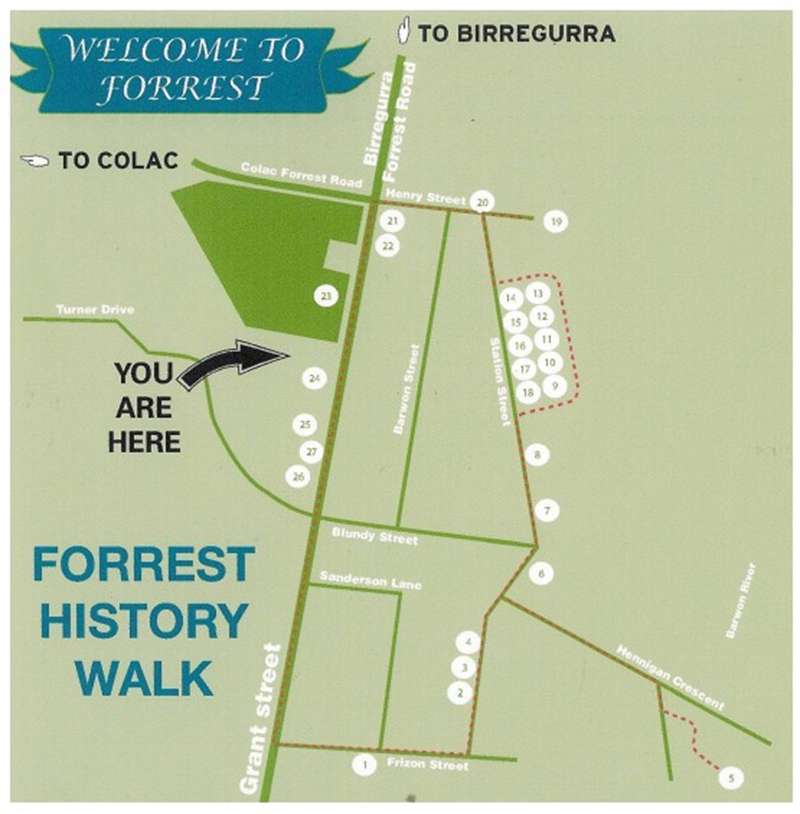
Twenty seven plaques have been installed around the town (see link to map below), with photos and information which we hope will stimulate your interest and imagination. Regrettably, most of our early buildings, such as the railway station, no longer exist. We have drawn on the memories of older residents for much of this information.
Further, an inseparable part of Forrest history was the many timber mills located out in the bush during the early part of the last century, sometimes, little townships in themselves, with school, store and post office. Many kilometres of tramlines, crossing spectacular trestle bridges, brought timber to the Forrest rail head in trains drawn first by horses and later, steam locomotives. Even amongst its growing farming community, most Forrest residents, at some time in their lives, took part in the timber industry based on the Otway forest.
Thanks to Ken Widdowson for the History Walk Brochure.
Forrest History Walk Map
Site 1 - Forrest Sawmills
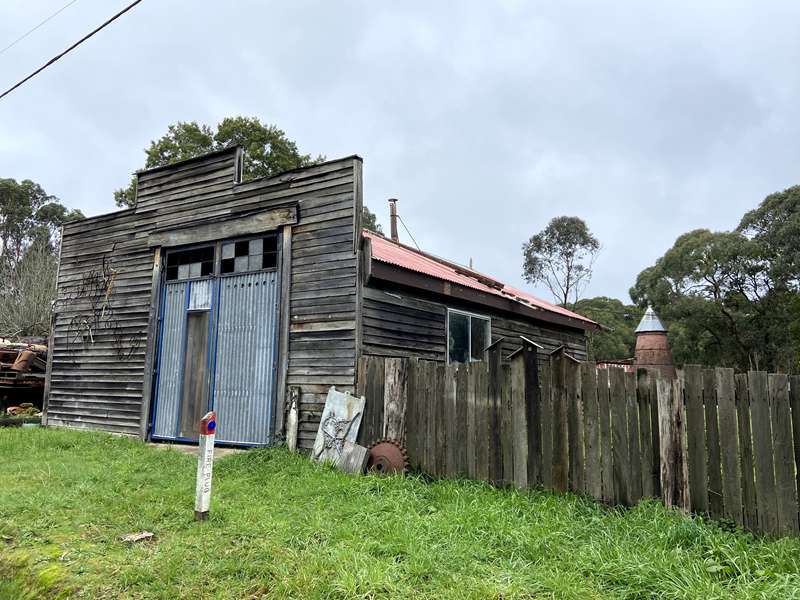
Following the devastating bush fires of 1939 the Government decreed that operating sawmills were no longer safe in the bush. This is the site of one of the first sawmills established in the township itself.
Forrest developed into a major sawmilling centre a few years after its foundation in the early 1890s.
At first the mills were located in the bush to the south but, after the devastating 1939 bushfires, were removed to the town. There were three town mills in Forrest and two others nearby at Yaugher and Barramunga.
In 1946, Alf Frizon bought a small sawmill plant from Daylesford and set it up here. Alf and his sons, Frank, and later Cliff, operated this mill until 1972, when they took over Henry's sawmill in Station Street (Site 7).
At its peak this mill was producing around 7,000 super feet (16 cubic metres) of sawn timber a day. The mill used a Blackstone 135 hp marine diesel engine to run a twin saw breaking-down bench, two ripping benches and a docking bench. (Private. No inspection available.)
Sites 2, 3 and 4
While nothing remains today, this area was the town centre for the first 60 years of the last century. Before the automobile and television a small country community relied a lot more on the activities they could generate themselves for their entertainment and leisure. Dances, shows, performances and sports days were popular, regular events.
Site 2 - Methodist Church
The erection of places of worship followed soon after the settlement of Forrest by timber workers and farmers. The Methodist Church was the first, built in 1900.
A Home Missioner conducted the services and was accommodated in a house next door. His house was later moved to another site to escape the late-night noise from the nearby Public Hall.
Later the church was also used for fortnightly Presbyterian services. It was decommissioned in the 1980s, sold and removed.
Behind the church were Forrest's first tennis courts, built on land donated by the Sanderson family. Forrest had two tennis teams in the District Association.
Site 3 - Original Community Site
While there is nothing to see now, this was once the main community site of Forrest. The first Public Hall was erected on this site in 1900 using timber donated by town sawmiller Alex Sanderson.
The hall was a popular spot for dances, feature balls and later as a cinema. The consumption of alcohol was not permitted, although some drinking went on behind the hall.
Local musicians such as Mrs Craswaller, Florrie Cherie, Bob Mulhare and Fiddler Fletcher provided the piano and violin music for the regular Saturday night dances.
In the 1930s music was provided by the Mickey Mouse Band, comprising: Rose Seebeck – piano, Neta Seebeck – saxophone, Arthur Ure – cornet, W. White – drums and John Seebeck – vocals.
The hall, fully decorated for a forthcoming ball, burnt down in 1963.
Site 4 - Odd Fellows Lodge Hall
The Odd Fellows Lodge was formed around 1915 as a friendly society providing sickness and funeral benefits to members. It erected an assembly hall next to the Public Hall. The Lodge put on dances in its hall which became as big an event as the Sports Day Ball held in the Public Hall.
The Lodge was known as the Buffaloes and operated virtually as a men's club until 1974 when new Commonwealth Health Benefits Schemes made friendly societies redundant. The hall was also used by the Forrest Anglers Club.
Note, as you walk down the hill, that the entire frame of the original timber worker's house at No. 46 was reputedly constructed from a single, great Otway tree.
Site 5 - Timber Mill Tram Lines
(The 300 metre walk to Site 5, the only steep stretch, to an attractive riverside site, can be omitted if you wish.)
Take the Hennigan Crescent walking track and follow the path to the river. Here we see the only visible remains of one of the tram lines which brought thousands of super feet of sawn timber from mills located out in the bush. Century old bearers and a rail spike can be seen near the plaque. This photo shows the locomotive "Tom Cue" just past this spot returning from the station yard. Note the roof top of the house behind the engine. Only a plum tree marks the site.
With their magnificent gum trees the river banks are a popular leisure spot for visitors and locals. The paths on either side of the river lead to the foot of the West Barwon Dam (1 km) and on to Lake Elizabeth (7 km).
Over a hundred kilometres of tramlines were constructed in the early 1900's to bring sawn timber from bush mills to the Forrest railhead.
One tram line from the Barramunga mills came along Station St. (See photo Site 3).
Earth works for another, the one following the course of the West Barwon River, bringing timber from Henry's and Sanderson's mills, can still be seen here. After crossing the road it travelled on a spectacular trestle bridge over a gully before reaching the Station yard.
Timber workers' cottages flanked either side of this gully. Timber work was dangerous. For example, Alex Sanderson, a timber mill owner, and his son Marshall were killed in 1907 when a bridge over the Barwon River collapsed and the locomotive and four trucks of timber on which they were riding plunged into the river.
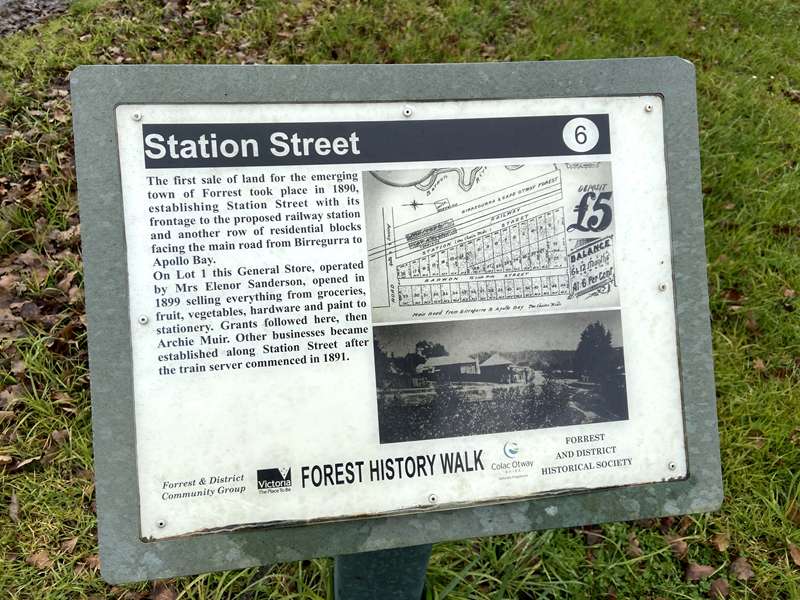
Site 6 - Station Street
Before automobiles, the whole focus of the town was the railway station and associated timber yards. As a consequence, the principal businesses lined Station Street, with the first sale of town lots taking place from 1890.
The first sale of land for the emerging town of Forrest took place in 1890, establishing Station Street with its frontage to the proposed railway station and another row of residential blocks facing the main road from Birregurra to Apollo Bay.
On Lot 1 this General Store, operated by Mrs Elenor Sanderson, opened in 1899 selling everything from groceries, fruit, vegetables, hardware and paint to stationery. Grants followed here, then Archie Muir. Other businesses became established along Station Street after the train service commenced in 1891.
Site 7 - Timber Milling
Timber milling, along with dairy farming in the surrounding area, became the lifeblood of Forrest for almost a century. However as fewer trees became available the industry declined. The decision in 2006 to conserve the entire public forest area as the Great Otway National Park led to the timber industry's final demise.
Site 8 - Mrs Frizon's Sweet Shop
The next historic timber building on the left, in Station Street, is the site of Mrs Frizon's shop, established in 1924. She sold mainly confectionary and ice-cream but also drapery and for a time a café service was offered.
A billiard table was also installed which contributed to the social life of Forrest.
The Forrest post office was originally conducted at the Terminus Hotel and then later moved to the railway station and managed by railway staff. When the porter's position was abolished in 1943, the postal business was transferred to Mrs Frizon's shop at the left-hand end.
In conjunction with the post office there was a fully manned, manual telephone exchange, only replaced by automatic connections in 1972.
Operators of the Shop and Post Office after the Frizon's were David and Thyra Park, Bill Dixon and Clem and Patricia Pesket.
Sites 9–18
Plaques describing the former businesses along Station Street and the Forrest Railway Station yards can be found on the notice board located in the picnic area.
You might like to note as you walk there the sites described; Number 26, residence and sheds behind, of the former Whitehead Bus Service. Number 16, the former Bank and Electrical Shop. Number 14, the site of the Forrest Bakery. Number 12, originally Green's General Store and further on, at Number 6, the former site of the Forrest Butcher's Shop.
Looking across at the quiet scene surrounding the tennis courts, we can imagine how different it was in the early days of Forrest with the bustling scene of the arrival of the train at the Railway Station, turning the steam engine at the turntable, the daily arrival of the popular "Tiger" and the constant work associated with loading and unloading timber from the mills onto rail carriages for shipment to the city.
In earlier days there was also the transfer of passengers from the train to coaches which took them on the gruelling eight-hour trip to Apollo Bay.
Site 9 - The Whitehead Bus Service
Most of the well remembered business sites along Station St. no longer exist.
Furthest to the left, at No. 26, could be seen the Whitehead Bus Company established by Frank Whitehead Snr. A fully equipped workshop and garage was located at the rear of the house.
The main role of the bus service was to take students to High School. Son, Bill Whitehead, would collect them from Barwon Downs and Forrest in the morning and take them to Colac, returning them in the afternoon. During the day he worked as a panel beater for Ray Duff on Grant St.
Site 10 - Bank and Electrical Shop
Fronting the street at No. 16 was the Commercial Bank, opened in 1903 in a small wooden building operating as a sub branch of the bank at Deans Marsh. It functioned until the mid 1950's. Half the premises was once used as a barber's shop.
With the coming of electricity to Forrest in 1955 half became an electrical shop supplying electrical equipment. Jackie Jenner was the electrician who wired up most of the houses in Forrest.
By 1981 this attractive old building was described by the Shire as being "in ruinous condition" and its demolition was ordered.
Site 11 - Forrest Bakery, 14 Station St
Bread supplies for Forrest originally came from Birregurra on the train until a local bakery was set up in 1905 by Nicholas Shannahan.
He was succeeded by George Wills until 1914 when Bill Fletcher bought the business and ran it in association with his general store situated next door. Bakers here were Messrs Keane, Gregg and David Pitkethly. The latter purchased the bakehouse outright in 1951 and he worked it until 1964 when he built new premises. But a fire soon after completion destroyed the building and that was the end of bread baking at Forrest.
During the time of the Pitkethly family, who lived at No. 10, the house which still exists two doors along, the bakery expanded to the point where it supplied shops as far afield as Birregurra and Deans Marsh with daily deliveries. They had their own delivery van for this purpose.
Site 12 - Forrest General Store
Ask any older Forrest resident and they will tell you that "You could buy almost anything at Green's General Store—from curtains and dress material to hardware and tools."
The store was established by the publican William Pengilley in 1906 and run by Tom Penman initially. It had a series of owners including Bill Fletcher in 1912, William Green, Norm and Val Neale, and William and Lillian Barwood. It closed around 1970.
Part of the store and residence still exists as the timber building opposite, at Number 12.
When the Greens owned the store they gave a bonus of jumbo sweets to those who paid their account on time. This was bad news for the children of Mrs Frizon down the street because their mother always paid cash!
Site 13 - The Butcher's Shop
The Forrest Butcher's Shop at No. 6 was started in 1902 by Fred Sprigg. But the best remembered operators were the Muir family; Archie 1915–1918 and James and sons 1918 to 1943.
Like in this photo, deliveries were made on horseback or bicycle but later in a van. Gouleys followed the Muirs and in 1957 relocated the butchery to the main street on the site of the present General Store as a better location.
Forrest also had its own abattoirs on the hillside above the road about 1 km back towards Barwon Downs.
Site 14 - Railway Station
In response to the demand for closer settlement and better communications, Parliament approved a railway from Birregurra to Forrest. The line was opened in June 1891.
The line was surveyed to Barramunga, five kms further on, but terrain and yard space were deemed unsuitable so Forrest became the terminus and the dense bushland was soon transformed into a flourishing township.
Trains carrying both passengers and supplies or timber ran 6 days a week. The railway was the life blood of Forrest to the 1940's for travel, postal services and essential supplies.
Site 15 - The Station Buildings
Nothing remains of the Forrest station, which stood where the tennis courts are now, facing this way.
One of the earliest buildings erected in Forrest was the Station Caretaker's residence which adjoined the Station.
The Station also served as the Post Office until 1943. As goldmining decreased and with the onset of the depression, by the 1940's timber shipments and consequent rail services had greatly diminished.
Reduced use and winter damage to the line and bridges in the 1950's resulted in the line's closure in 1957 when continued maintenance could not be justified.
Site 16 - The Railway Stacking Yard
A major part of the railway yards was occupied by timber stacks awaiting shipment.
Here we see, centre, a tram truck which has arrived from Sanderson's bush mill behind a steam locomotive being unloaded onto a rail skid before being transferred to a rail truck. This is a view looking south. The old sheds in the background are supply stores for horse feed. Station Street can be seen in the background.
Site 17 - The Tiger
As road travel began to replace rail, a more economic solution was sought in the 1930's. The Railways introduced a converted Dodge car for passenger and mail service between Birregurra and Forrest. The car was painted yellow and black for safety purposes and was known as The Tiger.
It became very popular with Forrest residents and is still remembered fondly by many townspeople even today. A second and larger rail car was also used at holiday times.
In the post-war prosperity of the 1950's, more people preferred to use their own car and The Tiger was withdrawn in 1952.
Site 18 - Coach Travel
Coach travel played an important part in the life of early settlers, visitor and holiday makers. For example, under pressure from Lorne holiday resorts, the route of the Birregurra to Forrest train line was diverted through Deans Marsh to provide a coach link to the coast. Likewise, at Forrest, passengers off the train transferred to a coach for Apollo Bay. The coach ran three times a week, a journey of eight gruelling hours.
The drivers were Albert Cawood, Tom Mitchell, Tom Loury, Charlie Clark, Dan Halliday, Tom Eales, Bob Moriss, Harry Noach and Jack Kenneady.
By 1930 the horse drawn coaches were replaced by motor services.
Site 19 - Sports Field and Cow Paddock
This vacant paddock was once another of the major social centres of the township of Forrest in the early days. The annual sports day attracted hundreds of people from the district and others coming by special train. The Hotel was nearby for refreshment. Down at the river was the popular township swimming hole. Here was also the virtual town common for townspeople to graze their cows.
Sport has always played an important part in the community life of Forrest. By the mid 1890's an annual sports day was organised in the paddock ahead, originally called Bartlett's Paddock but later it became known as Hurley's.
Hundreds of people arrived by special train to take part and observe the events which included foot running, wood chopping, sawing and tug of war. But the ground was never provided with facilities and by 1926 sports events were moved to the present Yaugher Recreation Reserve. The Forrest & District Historical Society records that the inaugural sports meeting was held on 27 February 1896, with special trains bringing spectators from Colac, Geelong and surrounding districts.
To the right was the Pub Paddock where a Mr White charged 1 shilling per week for townspeople to graze their cows. Others simply roamed the streets.
Cows were rounded up around 4 pm, often by the children after school, and taken home to be milked. They were kept in the house yard overnight. Behind the cow paddock was the popular township swimming hole.
Site 20 - The Terminus Hotel
Forrest was not always the sedate township we know today. In fact it resembled a frontier town with its large and itinerant population of hardy timber workers who had no hesitation settling arguments in the time honoured way, using their fists and then resuming drinking together again at the bar once matters were resolved. The Hotel and nearby boarding houses were home to many workers as well as providing a hostel for visitors.
The Terminus Hotel was established in 1892 by William Pengilley, son of Thomas Pengilley, the founder of the Birregurra Hotel.
Its location was convenient to the railway station and travellers. It also operated as a store and post office initially. It had two bars, a dining room and nine bedrooms. The original timber hotel was rebuilt in the 1920s. It burnt down in 1996, at which time the present structure was built.
During the era of six o'clock closing, locals can remember an after-hours drinking area for favoured guests called "The Cupboard". The hotel served for many years as the after-game venue for the local football and cricket teams.
Site 21 - The Blacksmith's Shop
This was the site of the original blacksmith shop established by Jones and Jones in 1901. It is easy to forget that in the days before automobiles everyone, men, mothers and children, were all horse people—able to handle misbehaving horses, to catch, harness and travel to school or shops.
Dorothy Frizon was often reminded by her mother of the day in May 1919 when she brought her home, newly born, from Colac in a horse and jinker in the teeming rain with an oil skin to keep her dry.
The Blacksmith's Shop was the equivalent of the modern service station that kept everybody on the road; in particular it played an important part in the mail coach services. It worked until the late 1920's. The Forrest property records show the blacksmith's shop on Grant Street was established around 1901 and was occupied by a succession of blacksmiths including Jones, Tom Spice and Tom Curtis.
No picture has been found of the original blacksmith's shop but it is remembered as a very large corrugated iron shed as it accommodated coaches and carts along with its blacksmithing activities. The blacksmith, Tom Curtis, also ran the coach service to Apollo Bay.
Site 22 - Former Catholic Church
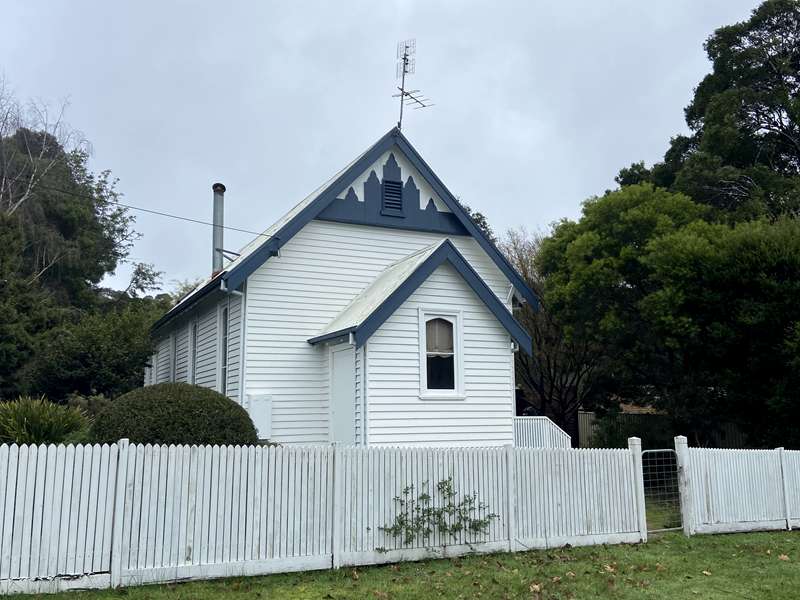
Catholics in Forrest had to wait until 1925 for the construction of this church, having attended Barwon Downs until then. All the churches in Forrest had ladies guilds and men's support groups which contributed strongly to the social and religious life of the town.
The church was decommissioned and sold to private owners in 1981. It was later renovated and opened as The Feral Art Gallery and Coffee Shop, featuring paintings, sculpture and glasswork by many local artists. A series of popular concerts was commenced at the Gallery.
The building is now a private residence (no inspections available).
Sites 23 & 25
The School and the Anglican Church remind us that before Forrest existed there was a small settlement at Yaugher where the recreation reserve is now, about 2 kms back towards Barwon Downs. Its timber mill and railway station were demolished but the church and school were relocated here.
Site 23 - Forrest Primary School
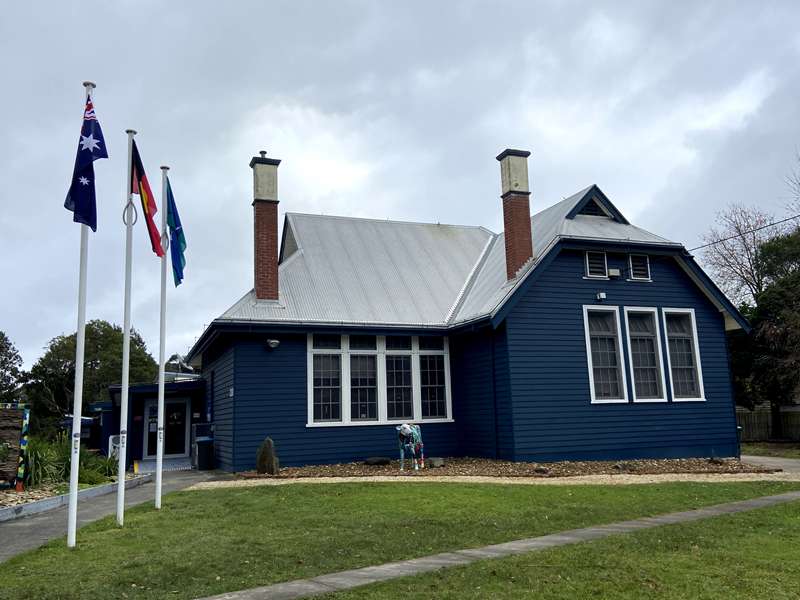
The first school was established at Yaugher in 1885, near the present football ground. But by 1906, as Forrest became established, it was decided to move the school to this site.
In the early days there was no catching up with friends and playing after school as most students had to go home and help with the milking, having already separated the cream and done other work before coming to school. An extra room was added in 1916. An active Mothers Club was formed in 1944 and not only contributed much to the welfare of the school but became the primary point of social contact for young families.
In recent years the school has been modernised to include an art and drama room. The school now has a unique structure which includes a maternal and child health centre, family day care, a kindergarten and primary school.
Site 25 - St James Anglican Church
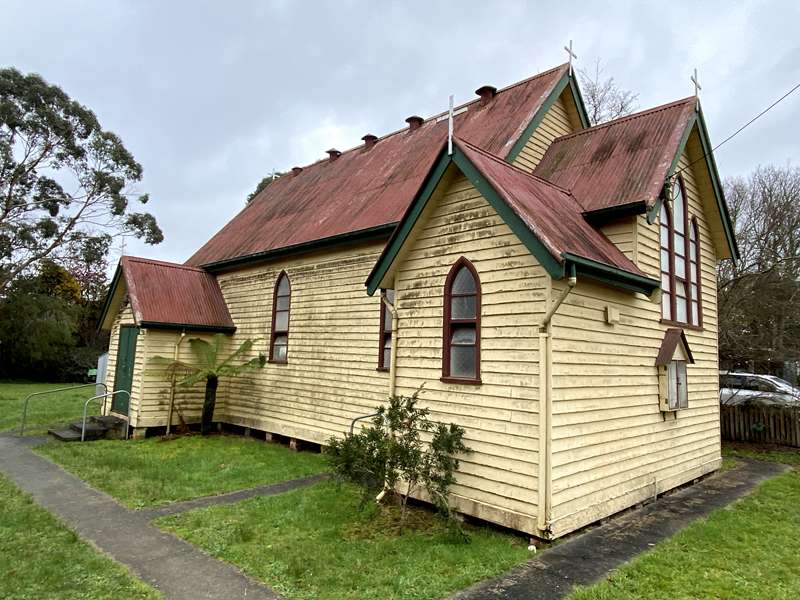
Like the school nearby, St James Anglican Church was originally located at Yaugher on the property of Mr Alf Blundy across the road from the homestead. It was dedicated in February 1889 but unfortunately lost in a bushfire in 1906.
The present church was built in 1907 at the instigation of Archdeacon A. Peacock. The land was donated by the founder of the Terminus Hotel, William Pengilley. During the 1920s a vicarage was built (the house to the left).
Over the years the St James Church and its associated organisations have played an important role in the community. For example, in 1931 the St James Ladies Guild organised the Forrest Show, which consisted of exhibits involving cookery, fancy work, photography, flowers, plants and vegetables. The show was held in the Public Hall and ran for about 10 years.
St James is now shared with the Uniting Church with alternate weekly services.
Site 24 - Jennings Shop
May Jennings' Milk Bar remains in the memory of many local residents because it was conveniently on their way to and from school and a good spot to spend any pennies they had been able to earn.
In the 1950s a popular shop in the main road, directly opposite, was May Jennings' Milk Bar, particularly for pupils going to and from school.
It was built in 1945 by Eric Jennings. In 1950 a diesel generator was installed to run the refrigerators and provide power. The family lived in the house next door. Public toilets were added at the rear in the 1950s to cater for passing tourist buses.
The shop was sold to the Riordan family in the late 1950s and some years later was destroyed by fire.
Sites 26 & 27
These sites provide good examples of how the focus of the town moved from Station Street, with its railway buildings, timber mills and businesses to the main road where local and passing motor vehicles now determine most of the town's current services. But faster cars and refrigeration have made it difficult to sustain even these services in competition with those available in nearby Colac.
Site 26 - Former General Store
By 1927 the horse-drawn mail coach to Apollo Bay was replaced by Tom Sim's motor service and from then on there was a need for auto maintenance.
In 1928 Terry Brady built Forrest's first motor garage here and leased it to Bob Leslie, Forrest's first motor mechanic.
A general store was incorporated from 1947, run by Annie Whelan. Later operators were Hec Stephenson, Louis & Vida Bray, Keith & Lynette Clarkson, Les Gould, Joe & Mary Little, Bill Bennett, N. & V. Greaves, Rose & Jim Fell, T. Coverdale, Peter Hunt and Janelle Johnston.
The postal service was moved here in the 1970s.
Site 27 - A Changing Town
The arrival of the motor vehicle brought about many changes at Forrest.
Logging trucks replaced the bush tramways. Cars replaced the rail service. The focus of the town moved from Station Street to the main road.
Road service became important. Fred Pearse opened Otway Motors in the 1940s in the old shed seen to the right, while Frank Whitehead Snr. had a large vehicle maintenance shed on the corner directly opposite.
Faster cars and refrigeration made weekly shopping trips to Colac an alternative to shopping locally. The township supports only one store now, opposite, providing banking, post office, newsagency, groceries and hot food.
But the car is also bringing many more visitors to Forrest. As the northern gateway to the Great Otway National Park, the township is finding a new identity.
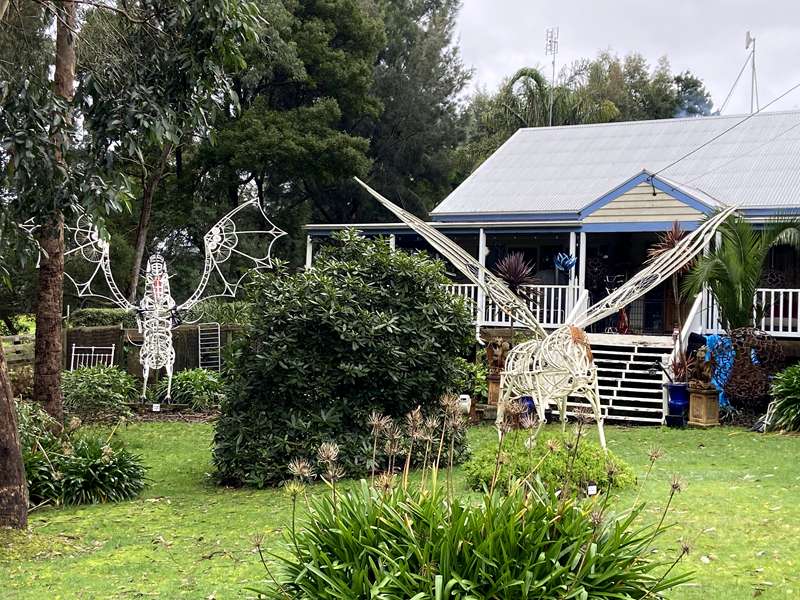
Bonus site: At the corner of Grant Street and Frizon Street, is an interesting private site with spectacular metal sculptures in the yard.
Photos:
Location
Birregurra-Forrest Road, Forrest 3236 View Map
Web Links
→ Forrest Website
→ Forrest History Walk Brochure (PDF)


