Fitzroy Gardens Walk (East Melbourne)


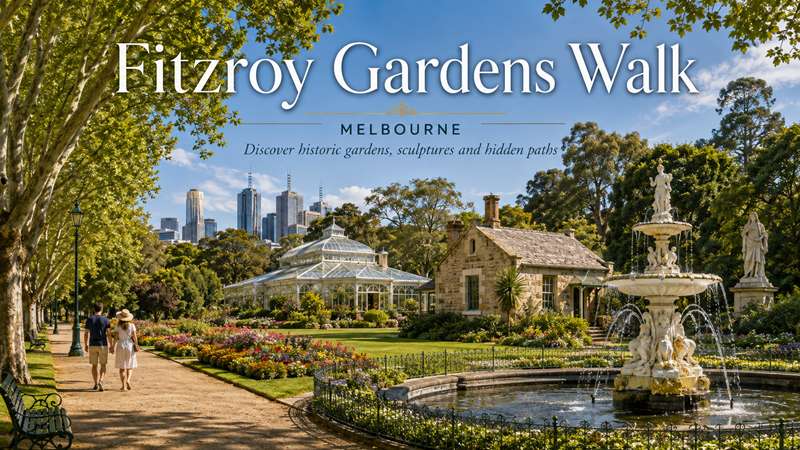
Elm lined paths, heritage listed buildings and an abundance of lush plantings. Explore this wonderful environment on this 2km (1.5 hour) walk.
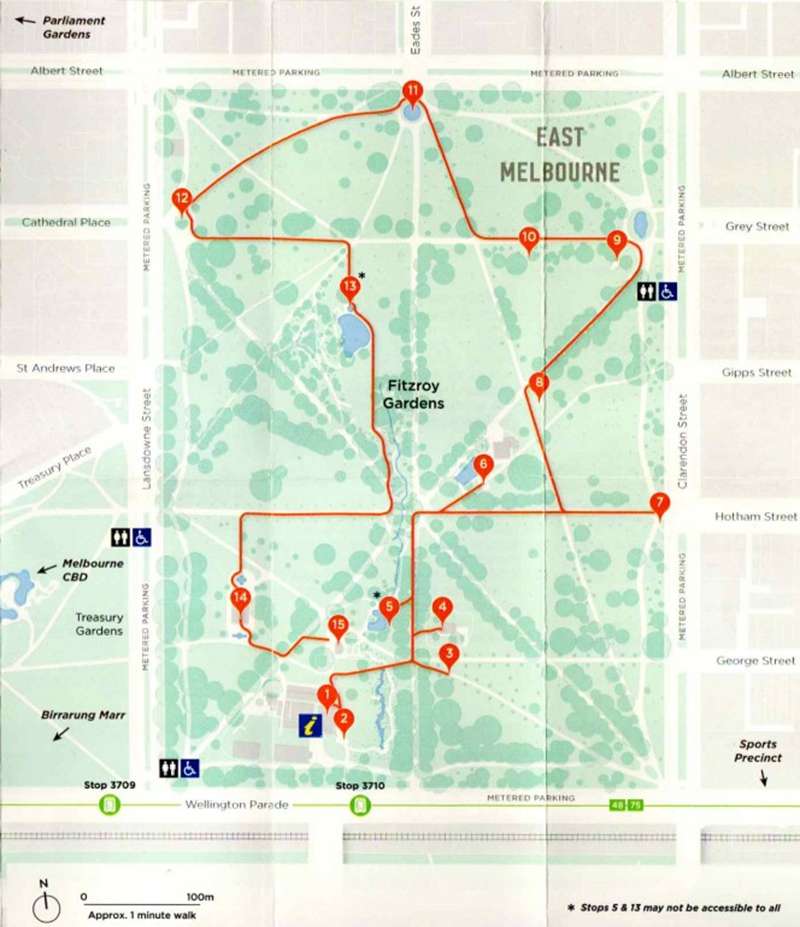
Fitzroy Gardens Walk Map
Fitzroy Gardens is on Wurundjeri Woi-wurrung Country. It is one of Melbourne’s most historic and beautiful gardens. The open, 64-acre space was laid out in 1859, following traditional Victorian era design, and named after Sir Charles Augustus Fitzroy, Governor of NSW.
Start your walk at the Fitzroy Gardens Visitor Centre (1), where you can access visitor information and purchase from a locally sourced retail range. Pop into KereKere Green café to grab a coffee. Close by you will find information about the underground Stormwater Harvesting System (2).
Next stop you’ll spot the Scarred Tree (3), one of six identified across the city. Scars were created when Aboriginal people removed bark to make canoes, containers, shields and temporary shelters.
Nearby you will find Sinclair’s Cottage (4). This Italian Romanesque-style home was built in 1866 for head gardener James Sinclair.
On your left, follow the hidden path across the wooden bridge, down a few small steps. Here you’ll find The Boy on the Turtle (5), the 1850s statue by an unknown artist.
At the next stop channel your inner child by visiting the Model Tudor Village and the Fairies’ Tree (6). The tiny, rambling village was gifted in 1947 from the people of Lambeth in England, in appreciation for food parcels from Australia, sent during WWII. Nearby is the Fairies’ Tree, sculpted in 1934 by Ola Cohn, and featuring a range of Australian animals and petite fairies.
Heading towards Clarendon Street, follow the path uphill to the sandstone sculptures, Boy and Pelican, and Mermaid and Fish (7), both by artist William Leslie Bowles, which guard this entrance to the garden and won first prize in the Fitzroy Gardens Sculpture Competition, held in 1935.
Retracing your steps you’ll see the historic Rotunda (8), built in 1873, and also known by the name ‘Temple of Winds’.
Heading towards Clarendon Street, you will find another 19th century structure graces the garden. The Bandstand (9), was constructed in 1864 to host musicians playing for the crowds who flocked to the gardens.
Take a hard left and loop back downhill to visit the Children’s Playground (10), the giraffe swing and dragon slide. You’ll find the hidden path to it on your left.
After the playground, visit Melbourne’s oldest surviving public artwork. River God Fountain (11) was created in 1862 by Charles Summers, one of the most important Victorian sculptors of the period, to celebrate the development of a permanent water supply for Melbourne.
Next head towards Lansdowne Street to wander along the People’s Path (12). It features 10,000 terracotta bricks decorated for the 1978 Craft Festival.
Take a hard left back towards the middle of the garden, where you will see the Dolphin Fountain (13), created in 1982 by June Arnold.
Visit the Spanish mission-style Conservatory (14), built in 1930. The striking peach coloured building hosts a beautiful rotating display of plants inside. It’s free to visit from 9am-5pm daily.
Close by you’ll spot Cooks’ Cottage (15). The cottage was a gift from philanthropist Russell Grimwade, brought from Yorkshire, England to commemorate Melbourne’s centenary in 1934. You can visit daily from 10am-4pm.
Other Charming and Historic Parks and Gardens
BONUS Treasury Gardens
A quick walk from Fitzroy Gardens, this heritage-listed garden was set aside as a public reserve in 1851. Wander the tree-shaded paths, featuring contrasting evergreen foliage of conifers, palms, and Moreton Bay figs against a background of deciduous elms, oaks, and poplars. A pretty pond hosts a population of native ducks, and nearby you’ll spot the Victorian Emergency Services Memorial and a monument to John F Kennedy. You can also visit the Family Violence memorial, facing Lansdowne Street, adjacent to the northern edge of Treasury Gardens. It’s a lovely contemplative space.
BONUS Birrarung Marr
Birrarung Marr was a modern addition to the city’s green spaces, replacing railway yards with a public park in 2002. The name comes from the Woi Wurrung language - ‘birrarung’ means ‘river of mists’ and ‘marr’ relates to ‘the edge’. The park features Aboriginal art installations, celebrating the diversity of Victoria’s indigenous culture, as well as ArtPlay, a children’s arts centre and gallery.
BONUS Parliament Gardens
This small triangular park near Parliament train station has excellent views of Parliament House, Eastern Hill and St Patrick’s Cathedral. Here you will find the bronze statues that commemorate Aboriginal activists Pastor Sir Douglas Nicholls and Lady Gladys Nicholls, as well a vibrant row of flowering jacaranda trees. Don’t miss the striking Coles Fountain, built in 1981 from stainless steel and bluestone.
Location
Cnr Clarendon Street and Grey Street, East Melbourne 3002 View Map


