Eldorado Historic Sites Walk


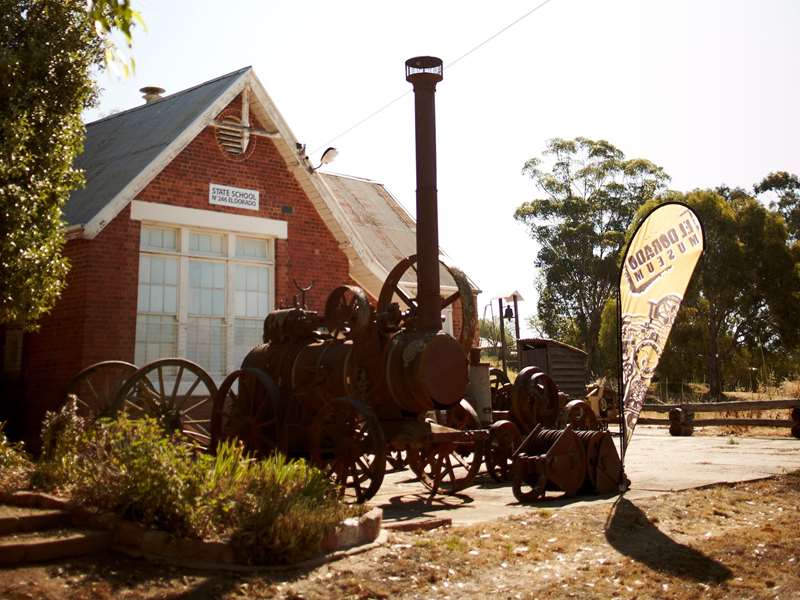
Eldorado is an authentic Australian country town where you can immerse yourself in the natural beauty of the Chiltern-Mt Pilot National Park, take the Woolshed Valley tour and learn about El Dorado's rich history. A memorable, unique experience - your visit will be relaxing, peaceful and inspiring.
In 1840, long before gold was discovered, settler and former Royal Navy man, Captain William Fury Baker, named his holding of rich green pastures alongside Reedy Creek, El Dorado. Here, Baker had found his utopia – his “pot of gold” – and the means to a rich life. Little did he know that hidden beyond the boundary of his property lay vast wealth with several floors of alluvial gold and tin and that the miners to come would adopt the name El Dorado for the town.
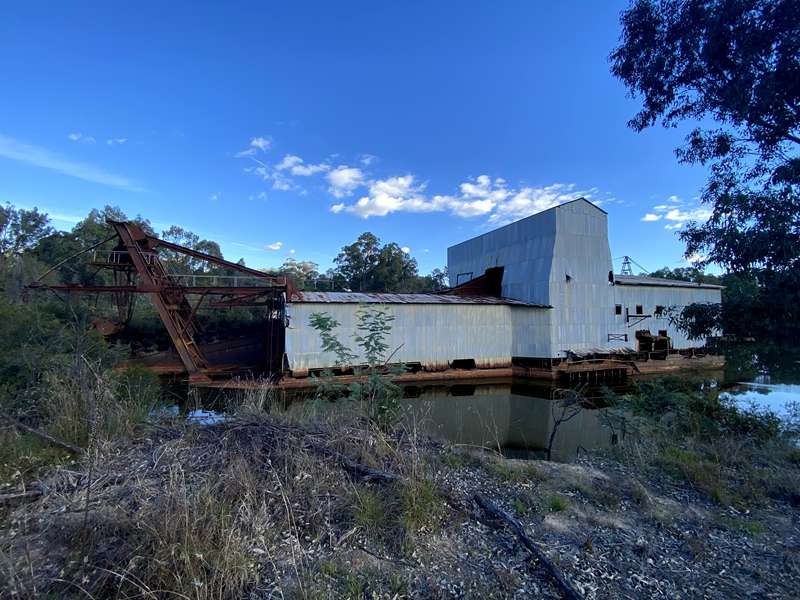
While little of the original architecture remains in the town, you will find cottages, churches, historic buildings, almond orchards, ancient fig trees and other relics that are reminders of a bygone era. Explore the El Dorado Museum, Reid’s Walk, and Cock's El Dorado Gold and Tin Mining Dredge, the largest in the southern hemisphere, once a 2142 ton ‘floating monster’ which now rests on the outskirts of town.
This self-guided tour throughout the town of Eldorado takes you through 31 of Eldorado's mining and commercial sites of the 1850s to 1950s.
The route is shown on interpretive signs displayed on 18 of the sites.
Pick up a map from the Wangaratta Visitor Information Centre at 104 Murphy Street, Wangaratta, download the brochure here or use the map below.
Eldorado Historic Sites Walk Map
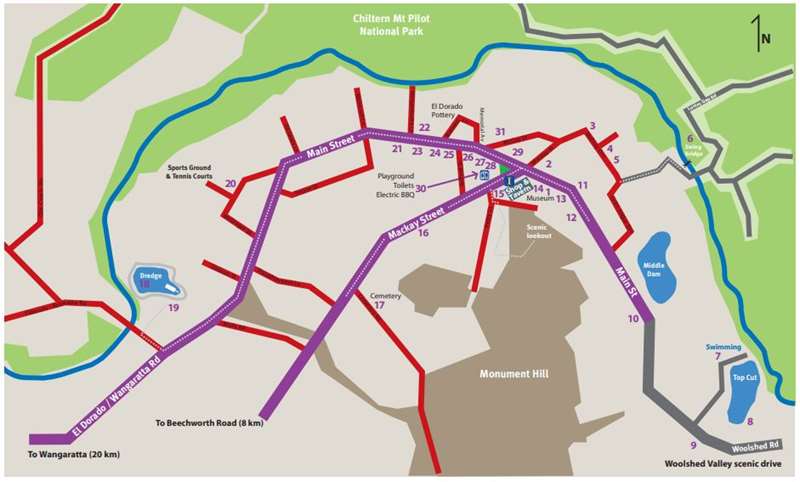
Eldorado Historic Sites Walk Sites
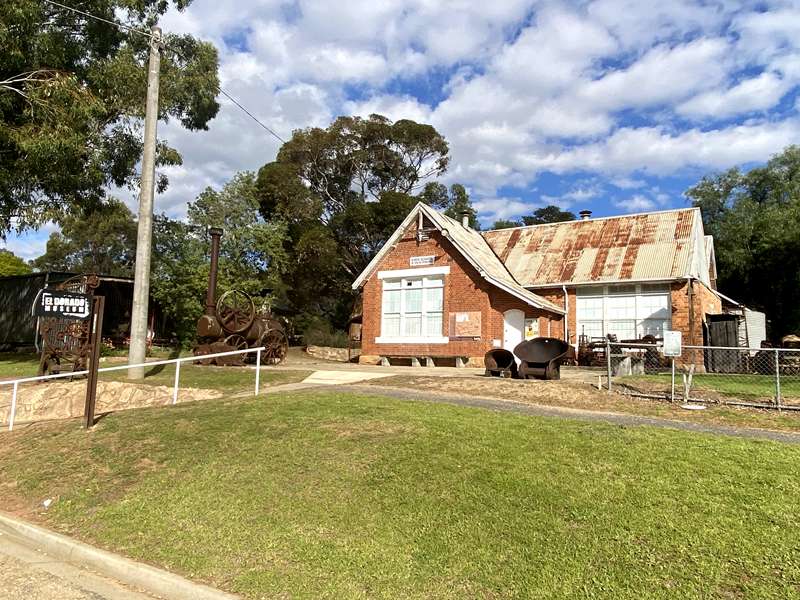
1. El Dorado Primary School Building / The Museum
2. Athenaeum - Rechabite lodge
During the middle to late 1800s, some of the business houses on this, the eastern side of MacKay Street and from the main intersection were:
Crameri—hairdresser
William Charles Hollow—men’s wear shop
Fanny Bawden and her daughter May—shop and post office
The tennis courts are located on part of the old Athenaeum reserve.
Continuing north were:
A. Fealy
Rechabite Lodge
William Charles Hollow, son of Joseph Jr and Eliza Jane nee Oates, was the grandson of Joseph Hollow, one of the first tributers of the McEvoy mine (No. 1 shaft). William continued in his drapery store until 1924.
Fanny Bawden nee Hollow was the wife of William Bawden. William and his father John were also first tributers in the original McEvoy mine founded in 1859. May Bawden was postmistress from 1906–1923.
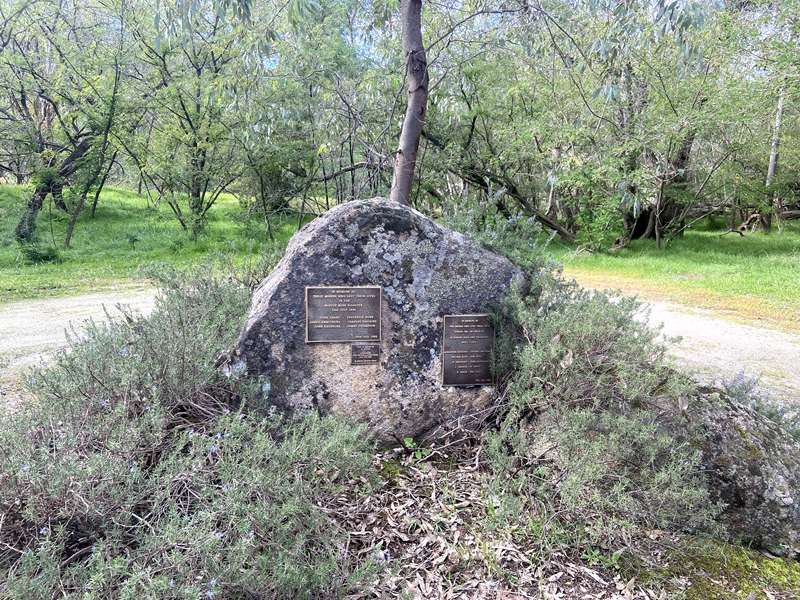
3. Mc Evoy Mine Shaft No. 3
Slightly north of here was the location of the poppet head of the McEvoy mine.
This was the scene of El Dorado’s worst mining accident in 1895, when six miners lost their lives. On Saturday, 20 July about 3.45 a.m., a displacement of a clay bed broke through into the main workings.
John Kneebone and James Thompson were overcome by the inrush of slum which entered the crosscut 202 feet from the main drive, between 800 and 900 feet from the shaft. The other four men, John Edgar Crane, Fredrick Bork, Charles Augustus Dawkins and James Armstrong, were entombed and died from asphyxiation. Their bodies were recovered on Friday, 2 August.
The McEvoy mine, established 1859, worked deep alluvial beds. This type of mine was subject to flooding, as its main drives usually lay beneath an old buried watercourse.
After the disaster, the bottom workings were abandoned and operations commenced at 70 feet from the surface. In 1897 this shaft was closed and another, on the northern side of the creek, was opened. James Trainor lost his life in this last shaft, on 23 February 1900.
The McEvoy mine closed for all time in 1901.
4. Martell's Albion Hotel - Fealy's Ironmongery and store
The Martell family; Francis Sr and his sons Louis & Albert, were publicans of the Albion Hotel in El Dorado from c.1869 to at least 1908. During this period the hotel was destroyed by fire and rebuilt.
Francis Sr arrived at the Ovens Goldfields in 1853. Before moving to El Dorado he conducted the Victoria Hotel at Woolshed on Reid’s Creek and lived for a time at Sebastopol, east of El Dorado. The Albion Hotel was also a depot for stage coaches to Beechworth and Melbourne.
Rose Martell—Billiard Room:
This may have been run by Francis’s mother Rose or his sister Rose, born 1866, Woolshed.
Alfred George Fealy—Ironmonger, General Storekeeper, JP:
Alfred George Fealy was always known as George Alfred. In 1869 he and Mr Morton had an ironmongery business in El Dorado. By 1870 George was trading on his own. He later enlarged his business to include a general store. His brother William was in partnership with him from c.1871 until 1874, when William acquired land at Carraragarmungee.
George continued the store until the early 1900s. The Fealy home was opposite their shop and has since been removed to the western end of the township, renovated and is occupied today.
5. Cock's Pioneer - Offices and Tin Shed
The workshop was on the opposite side of the road.
The Cocks Pioneer Electric Gold and Tin Sluicing Company was formed in 1899 and began operating in 1900. Production up to 1909 was £120 000 worth of gold and tin concentrates, won from 2,100,000 cubic yards of dirt.
Re-formed in 1914 as Cocks Pioneer Gold and Tin Mines NL, the company won 81,462 ounces of gold and 1,073 tons of tin, from 10,000,000 cubic yards of dirt. The mine closed in 1929.
Re-formed again in 1934 as Cocks Pioneer Gold and Tin Mines (1934) NL, the production figures until closure for the last time in 1941 were, 17,645 ounces gold and 360 tons of tin, from 5,850,000 cubic yards of dirt.
On the opposite side of the road, approximately where the windmill stands, was the location of blacksmith and coffin maker, William DeLaRue.
The tailings dumps behind the McEvoy Memorial site were the result of sluicing operations by Cocks Pioneer. The dredge’s most easterly workings were to the left, past the acacia trees.
6. Swing Bridge Mining Embankment
7. Top Cut
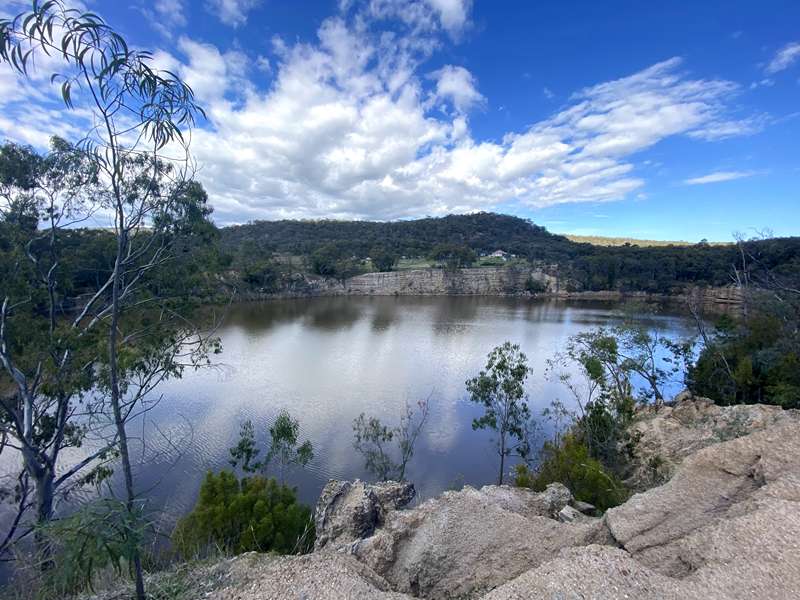
8. Cock's Pioneer's first power house
9. Wesleyan Church
10. Mine Locations
11. Sub Station site
12. St Augustine's Church
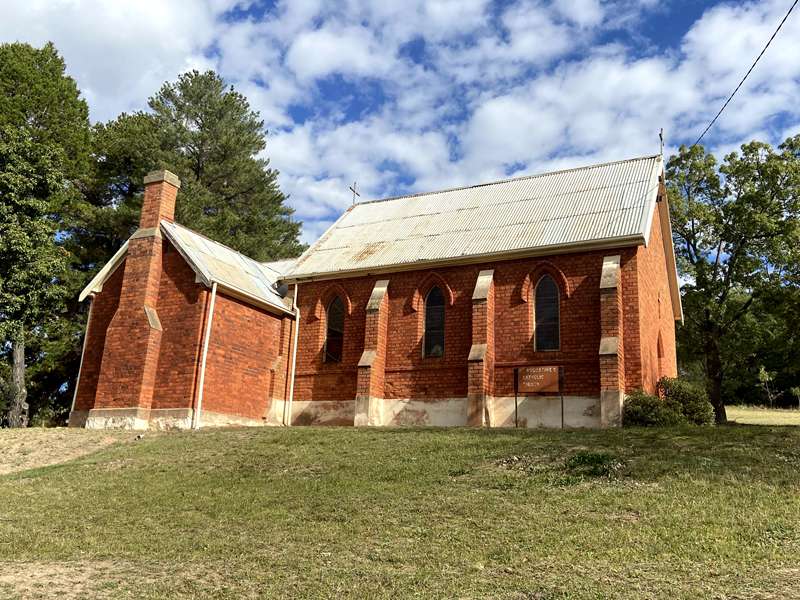
13. Wesleyan Church
14. El Dorado general store
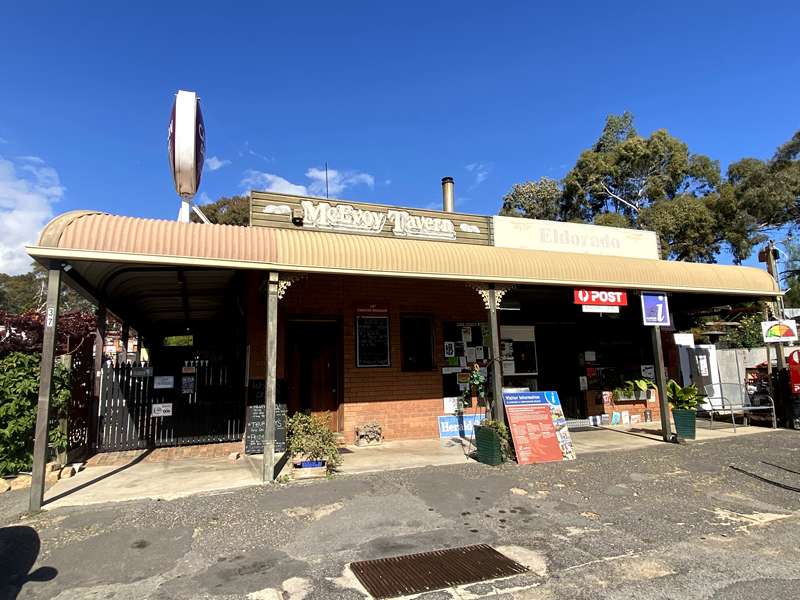
15. Congregational / Independent Church
On 28 April 1879 the first meeting of the committee of the Congregational/Independent Church of El Dorado, was held at Mr Armstrong’s home.
A weatherboard church building was officially opened in May 1871, although services had been conducted since January the same year. Previously services had been held in the Oddfellow’s Hall (MUIOOF lodge).
The church building was 36 feet long, 22 feet wide and had side walls 13 feet high. The roof was gothic pitch with projecting eaves and a neat porch stood in front. The interior was lined with pine. The entire cost was under £300.
By 1874 the Rev T. Miles reported he had three outstations, 137 services were held and the average attendance was 191. By 1886 El Dorado’s population had decreased and attendances had dropped. By 1887, no one preached at the church, which had been one of the oldest stations of the Congregational/Independent Church in Victoria.
During 1890 the building was dismantled. Some of the timber was used in the home of William and Fanny Bawden.
16. St Jude's Anglican Church
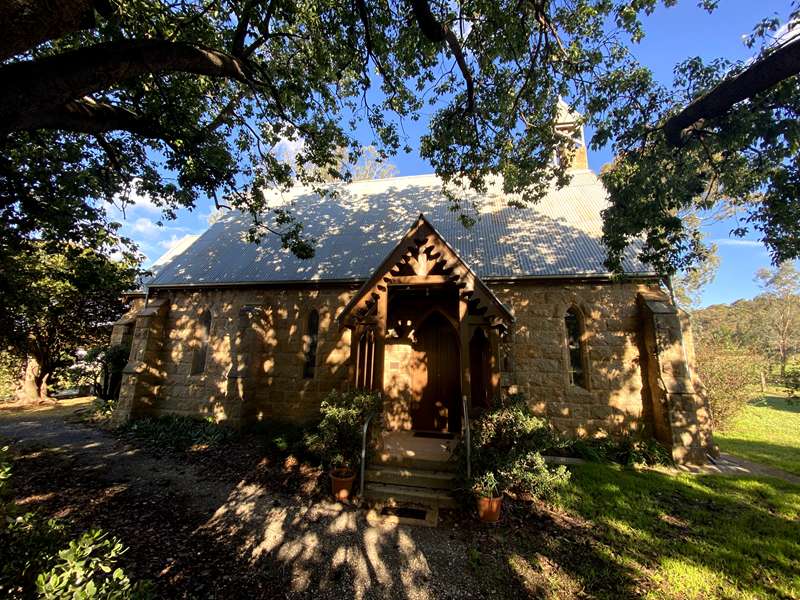
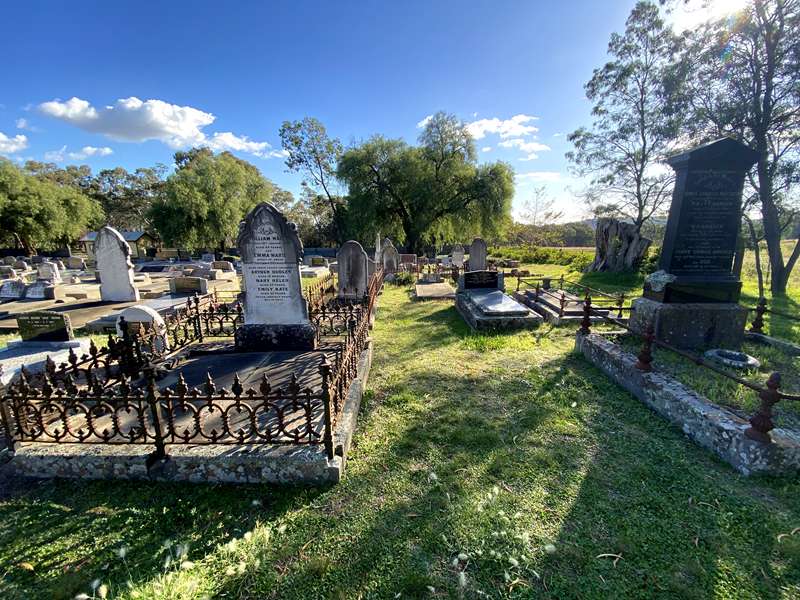
17. El Dorado Cemetery
18. Cock's El Dorado Gold Dredge
19. Tin Pot Shaft
20. Centennial Park
The park was gazetted c.1890.
Newspaper reports in 1870 tell of horse race meetings in an area that may have been on or near the current park. In that year an old course was abandoned and the new area was on the open country south of the Great Extended Company’s claim. Purses for the race meeting in 1870 were £300.
The annual Prince of Wales sports were held from c.1885. Attendance in 1896 was 800.
As well as horse races, the sports included foot races and novelty events, one of which was:
Truckers Race “With full truck to be run sixty yards, turn trucks and return to standing point. To be run in pairs.”
Open to all men engaged in El Dorado mines prior to 1st October 1896.
Annual sports continued until c.1960. Other sports played on and around the current field were: Australian rules football, cricket, polocrosse, bike racing and tennis.
In 1959 the Australian National polocrosse final was held at Centennial Park, El Dorado.
21. Young's / Milne's butcher shop - Hazelbrook's Cottage
22. Stone Culvert built after WW1
23. Ward's Paper shop
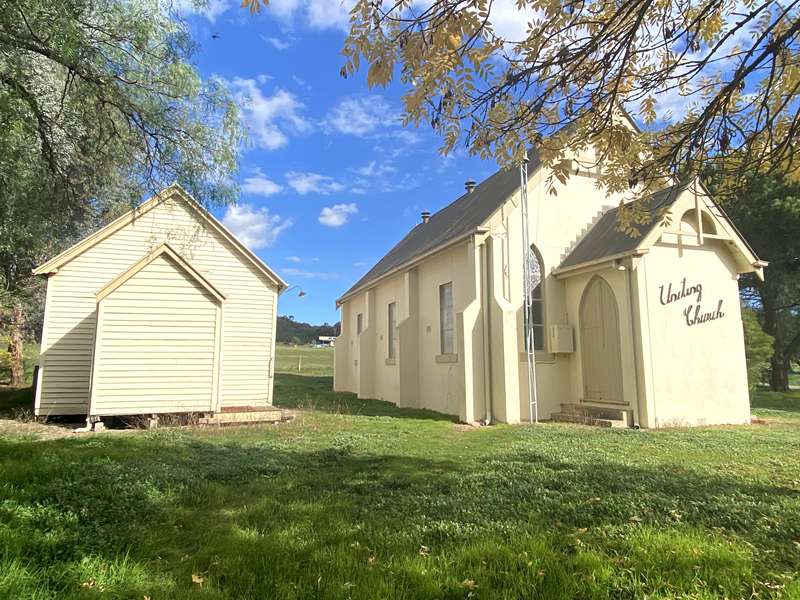
24. Methodist / Uniting Church
25. Schuppe's Bake House
Johan Henry Charles Schuppe was a baker in El Dorado from at least 1871 until the early 1900s. This was the site of his bakehouse, at the lower end of the block, to the left. His shop was on the corner of McCoy and Main streets. Indications of a cellar have been found on the original bakehouse site. Many old buildings of the township were known to have cellars.
In 1871, at least four other bakers also operated in El Dorado. They were:
James McRae
John Thomas Phillips
Rose Ann James
William Schneider
Later, Charles Schuppe’s bakery shop was taken over by Mr E. (Ted) Cunningham who baked in Charles’s old oven until such time as Ted built the current bake house c.1915. He sold to Leo McKoy c.1920. The bake house, shop and dwelling are still referred to as ‘McKoy’s’.
Bread deliveries from the McKoy shop entailed four horses, two bread carts, a gig, a couple of bikes and shank’s pony! A bread carter was employed for most of the life of McKoy’s bakery.
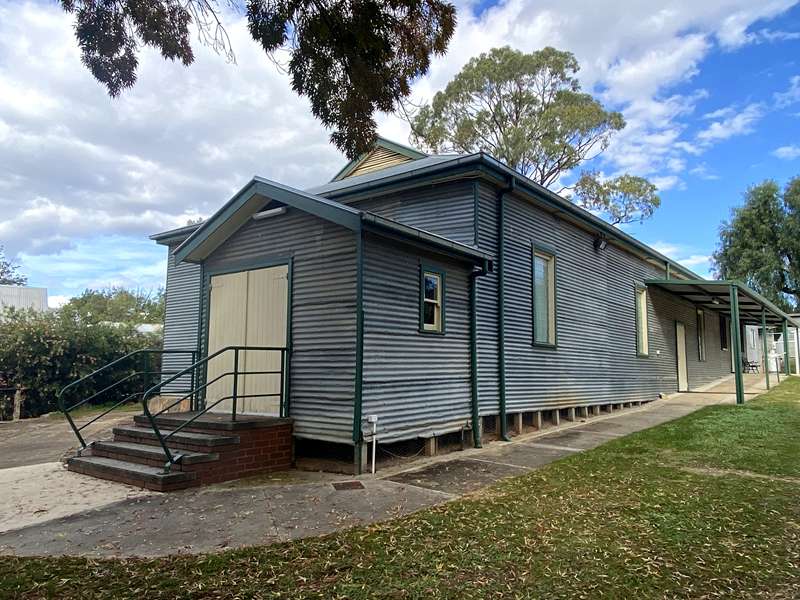
26. El Dorado Memorial Hall - Soldiers' Memorial Hall
27. & 28. Police Station - MUIOOF Lodge
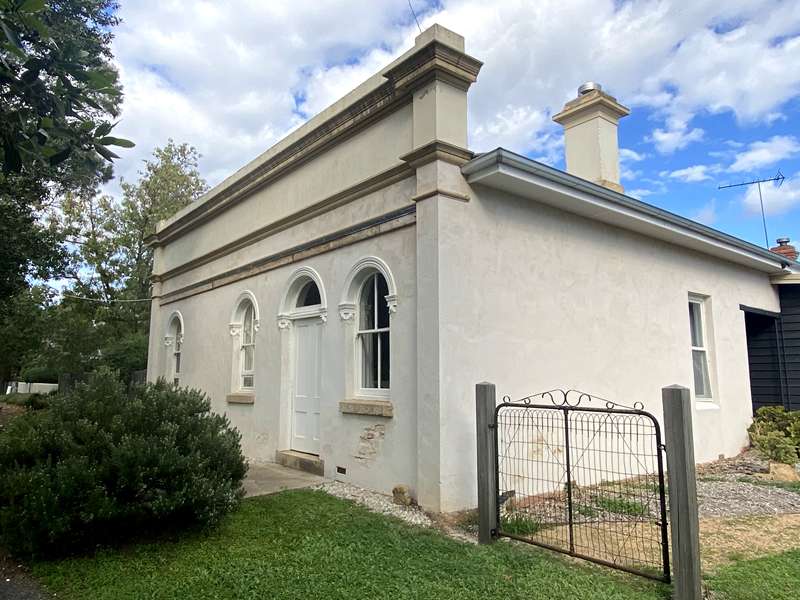
El Dorado Police Station was housed in this building. The facade, up until recently, showed the painted sign—Police Station. The original sign was of raised concrete.
Police were residing in El Dorado in 1857. In 1859 the station was closed but by 1866 police were again part of the El Dorado scene. The date of this building has not yet been proven.
Mounted police manned the station until at least 1913. The station remained a one man station until its demise in 1922.
There were stables for the horses, a store room, and a lock up.
Since that time the building has been used as a private residence, although at one time a shop operated from the right hand front room and the post office was run from the left front room. Additions have since been made to the rear of the original building.
To the left of this building and next to the Gun House park, the Manchester Unity Independent Order of Oddfellows’ (MUIOOF) meeting hall once stood. This branch of the lodge, at its peak, had 115 members. Established in 1867 the El Dorado MUIOOF lodge closed in 1913.
29. Star Hotel
30. Gun House Park
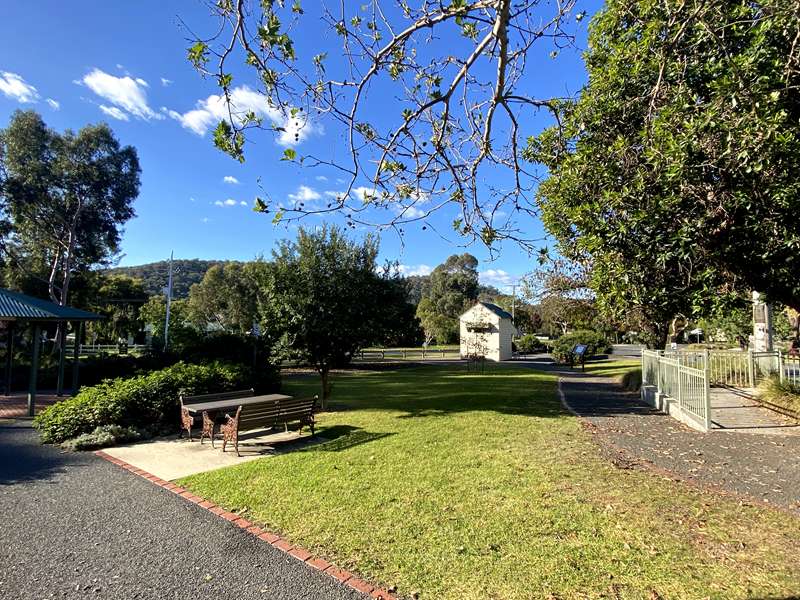
31. Cock's El Dorado Gold Dredging Company NL - Construction site of dredge
A colourful Mining History
A shepherd named Howell first discovered gold in Reid’s Creek, downstream from Beechworth in November 1852.
The first real rush to Woolshed Valley occurred in 1854 before mining extended down the Valley to El Dorado. Woolshed was perhaps one of the most famous and colourful of all the diggings of the goldfields.
The Woolshed Goldfields
The Woolshed Valley Goldfields were centred around the districts of Woolshed, Sebastopol and Reid’s Creek.
Said to be named after part of the lease holding belonging to David Reid, the Creek is referred to by many names: Reid’s Creek, Reidy Creek, Woolshed Creek, El Dorado Creek and Ready Creek.
Woolshed Falls was once the centre of the richest gold field in Victoria. Miners flocked to the area once word got out that there was gold in the hills of North East Victoria. At the height of the gold rush more than 8,000 gold diggers, many Chinese, had dug the banks of the Creek. In 1857 gold production peaked, 14,000 ounces of gold was transported to Melbourne each fortnight.
Over 400,000 ounces of gold left Beechworth between 1852 and 1866.
1850’s Mining towns
When gold was discovered in Woolshed Valley the towns of Napoleon Flat, Sebastopol, Devil’s Elbow and Woolshed soon flourished servicing between 6,000 and 7,000 miners.
Sebastopol and Woolshed alone stretched along the Valley for kilometres. Today none of the towns exist and little trace is left. Among the nine named hotels the Hibernian and the Britannia were the largest, with entertainment such as balls and concerts three nights a week and regular visits from Ashton’s Circus.
In 1857 Sebastopol Flat boasted 83 businesses including restaurants, hotels and a brewery as well as blacksmiths, tent makers and jewellers. Sebastopol was visited by Victoria’s first tin smelter.
Chinese Diggings
Along the Creek are numerous diggings some with rounded differences.
European and Chinese diggings were different in shape mainly due to cultural beliefs. Europeans were rectangular. Chinese diggings were round and did not have corners as they believed evil spirits hid in them.
You can still find the digging sites today.
El Dorado Mining History
The township of Eldorado was founded on mining and for over a hundred years it witnessed a variety of mining methods.
After gold was discovered in 1855 the town began to grow. By 1857 there were 21 business houses listed in the Ovens Directory and an early mining application map showed 75 buildings – by the 1870s there were around 2,000 people living in El Dorado.
Sinking to the depths!
While gold rush activities extended along the entire length of the Woolshed Valley, significant gold and tin mining occurred in and around the actual township area. In time, deep mining shafts sunk to depths of 100 metres became common.
In 1858 close by the township known as El Dorado Flat, Kneebone & Company began their first shaft which they dug to 21m at the eastern end of the valley. A second shaft (Kneebone No.2) a short distance downstream, bottomed at 63m.
In 1860 McEvoy & Company’s first shaft sunk through two rich floors of wash at 18m and bedrock at 27m. The McEvoy mine included four different shafts over its life.
In 1860 Wellington Gold & Tin Mining Company established a mining operation north of the township. A 1.5m wide seam of washed sediment was located at 60m and ran for a length of 400m. These were the first four mines and they continued for a number of years. The McEvoy finally closed in 1901.
Disaster!
Disaster occurred in the McEvoy No.3 shaft in 1895, where six miners died. There was another death in the No.4 shaft in 1900. An inflow of mud filled the drive in which the miners were working – they were entombed while several others escaped. Billy Caws with poignant messages written to their families were found thirteen days later when their bodies were uncovered: “Goodbye all” – J Armstrong, “Write to my poor mother” – C Dawkins.
Photos:
Location
136 Main Street, Eldorado 3746 View Map
Web Links
→ Eldorado Historic Sites Walk Map


