Eldorado - Eldorado Dredge



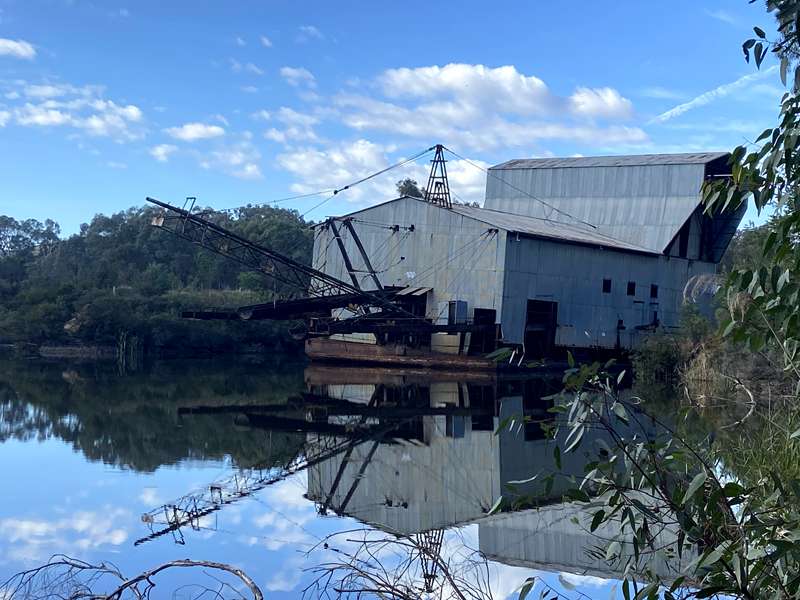
The Cock's large bucket dredge began production in 1936 and it worked the alluvial gold and tin until 1954. In its 18 years of operation the dredge produced 70,664 ounces of gold and 1,383 tons of tin concentrate.
The largest dredge in the Southern Hemisphere, it was a floating monster weighing 2,142 tons and pulling the third most amount of power from the State Electricity Grid after Melbourne and Geelong.
By the time it was decommissioned it had dredged 30,000,000 cubic metres from the river flats of the Eldorado Plain. It remains a formidable sight and graphically illustrates the extent of the mining operation in and around the town.
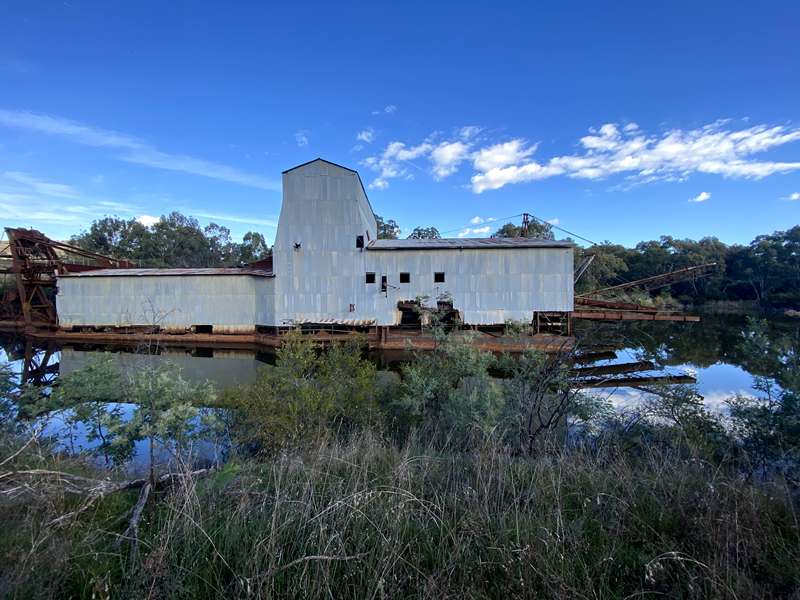
Cock's Eldorado Dredge is one of only two complete bucket dredges in Victoria and the largest, most intact gold dredge in Australia.
Getting There:
Eldorado is about 290 kilometres north-east of Melbourne. Take the Hume Highway and exit at Wangaratta. Two kilometres north of the town, turn right for Eldorado at the North Wangaratta Football Club Oval, just past the North Cedar Caravan Park.
Continue past the Vine Hotel for about 200 metres and take the road which veers to the left. Eldorado is about 10 minutes drive from here. The dredge is on the left, about one kilometre before the township. Watch for the sign.
Cost:
Free
Review:
The dredge is massive and a truly impressive monstrosity. You can walk across the gangway and look inside the massive innards of the dredge. There is an easy 750m (15 minute) walk around the pond with boards which tell you about the dredge, its operation and the environment. You can also see the dredge from different vantage points. There is an unshaded picnic table.
A hint to those visiting the Information Centre in Eldorado. I made the BIG mistake of suggesting that the dredge was "stuck" in the lake and copped the dirtiest look imaginable plus a history lesson explaining that it wasn't stuck. Don't mention the work "stuck" unless you want to spoil your day.
Photos:
Interpretive Signage at Site
THE COCKS ELDORADO DREDGE
The Cocks Eldorado Dredge is important in the history of the State, as the only gold dredge that survives intact from the main dredging era of Victoria’s gold mining history, 1900–55. In Australia, it is the only remaining bucket dredge of the “Age of Giants”, when massive, deep-digging gold dredges proliferated around the world.
The dredge is a very important part of Eldorado’s history, representing the last phase of a golden history that stretched back to 1855. The dredge was the backbone of the town’s economy for many years, providing employment and the indirect benefits that flow from major industry.
GOLD DREDGES IN AUSTRALIA
The first gold bucket dredge to work in Australia was Mr Garland’s No.1 Dredge on the Macquarie River in NSW in 1898. Bucket dredging began in Victoria in 1900, and continued until the mid-1950’s (and later, at Maldon). North East Victoria was the most heavily dredged region of Australia, peaking in upper reaches of the nearby Ovens Valley, where over 50 bucket dredges worked.
The Cocks Eldorado Dredge was the largest to be built in Australia when it was launched in 1936. Eventually weighing over 2500 tonnes and with a pontoon length of nearly 70m, it was far larger than the earlier generation of wooden-hulled dredges that typically had pontoon lengths of 20–25m. Electrically powered and built by Thompsons & Co. of Castlemaine & Williamstown, it was hailed as a great advance in local engineering production.
In 1942, the Tronoh Dredge was launched at Harrietville, near Bright, Victoria. Weighing over 5000 tonnes and with a total length of about 170m, it was the largest ever constructed in Australia, and one of the largest in the world at the time. It was dismantled in the mid-1950’s, and shipped to Malaya to dredge for tin. Today, a small steel dredge at Maldon, which operated in the 1960’s–70’s, is the only other intact gold dredge surviving in Victoria.
GOLD DREDGES AROUND THE WORLD
Bucket dredging for gold used technology initially developed on the New Zealand goldfields, and exported around the world. Large-scale dredging was carried out in most major gold and tin producing countries, notably the USA, Malaysia (tin), Canada, Australia, the USSR, etc. Today, giant bucket dredges still operate in places such as Siberia, Malaysia and Indonesia, but the trend is towards smaller, more flexible suction-cutter dredges. Around the world, only a handful of intact historic bucket dredges remain, as mute testimony to the “Age of Giants”. The Eldorado Dredge is one of these.
DREDGING
In the early phase of the gold rushes, rich alluvial gold could be worked by simple hand methods.
Larger scale ground sluicing developed as poorer grade deposits were opened.
Hydraulic sluicing later enabled large amounts of soil to be processed.
Dredging was the next technological development that enabled profitable, large scale mining of river valley deposits.
ELDORADO MINING
Eldorado sits on a bed of sandy gravel deposited in a valley between granite hills. The gold was washed over time from the hills surrounding the upper reaches of Woolshed & Beechworth.
The massive machine is the culmination of the many forms of mining in this area.
DEEP LEAD MINING – 1855 TO 1900
Original mining in Eldorado was by shafts and drives to mine the deep lead. One shaft, sunk by the McEvoy Company, was the site of a major disaster in which six miners were entombed by an inflow of slum and water. This marked the end of deep lead mining.
HYDRAULIC SLUICING 1900 TO 1941
In 1900 Cocks Pioneer Electric Gold & Tin Sluicing began hydraulic sluicing operations. A hose and nozzle directed a jet of water against a bank of gravel causing it to collapse and wash down to sluice boxes and pumps. Electricity for the sluices and pumps was generated by a local powerhouse, one of the first in rural Victoria.
Sluicing continued until 1941, handled by the local Cocks Pioneer company, recovering 117,379 ounces of gold and 1,618 tons of tin concentrate.
THE CONSTRUCTION OF A TITAN
Cock’s Eldorado Gold Dredging N/L required the services of an experienced designer and engineer to create the dredge.
Douglas Percy Fletcher designed and supervised the construction of the Eldorado dredge. He was born in Epsom, England on 29 August 1883 and died at Tenterfield NSW on 29 August 1948.
He came to Australia with his parents when he was 6 years old. As a young man he joined the Royal Australian Navy as an Engine-room artificer on HMAS Challenger. He later joined Ruwolt’s Engineering and became manager of their plant at Bright, Victoria.
In 1913 he went to the Philippines as an engineer in gold mines and sugar mills. In 1926 he moved to Malaya and Siam building tin and gold dredges for Werf Conrad, a Dutch engineering firm. He returned to Australia where he practised as a mining engineer and consultant.
He was awarded a fellowship by the Mining & Metallurgical Institute of Australia for services to the mining industry.
Fletcher bought draught horses from Carlton & United Breweries to perform many tasks around the site, including the grading of the dry dock in preparation for the construction of the pontoons.
The pontoons were riveted together requiring exceptional care to ensure watertight joins. The pontoons were then floated to deeper water for the fitting of the superstructure. Pre-fabricated components were carried by specially constructed railway sidings and transported to the site for erection. The pontoons, as well as the boiler and machinery, were all assembled on site.
DREDGE DETAILS
The Hon. E.J. Hogan M.L.A., Minister for Mines, officiated at the opening of the Cock’s Eldorado Gold Dredge. The dredge had been operational for some weeks but was not formally opened until 1 May 1936.
The proceedings were viewed by a crowd of officials and residents, while Fox Films took “a talkie” of the proceedings. During its early years of operation it was the largest gold dredge in the Southern Hemisphere.
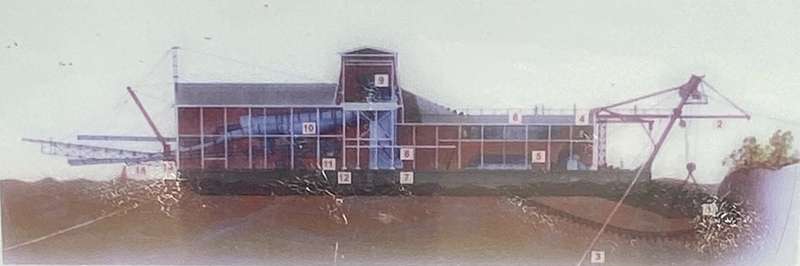
Diagram labels
1. Bucket ladder and band – the bucket band rotated on the bucket ladder, similar to a slow moving chain-saw.
2. Foregantry – an elaborate structure containing pulleys and cables which supported the bucket ladder.
3. Mooring cables – held the dredge in place and provided the anchor points for dredge movement.
4. Control room – winch operators work area. The winch operator controlled most of the actions of the dredge.
5. Winches and motors – provided the power for all movement and operations of the dredge.
6. Meter board – electrical control centre for all dredging operations.
7. Water tank – supply point for water on the dredge. Clean water was essential for all processing operations.
8. Top tumbler motor – 200hp motor which rotated the top tumbler and bucket band.
9. Top tumbler & gears – pivot point around which the buckets rotated and unloaded their contents into the screen.
10. Rotary screen – used for filtering coarse gravel and stones from the alluvium.
11. Jigs – the processing devices used to separate gold and tin ore from the alluvium.
12. Collection tank – gold and tin ore was collected here for further processing on-shore.
13. “Dunny” – one of the few amenities on board – the winch operator also had a stove.
14. Chutes & launders – used for the removal of overburden and unwanted alluvium from the dredge.
DREDGE SPECIFICATIONS
All steel construction built by Thompsons Engineering and Pipe Company. Almost totally Australian construction and design.
Pontoon length – 210 feet (64m) x 65 feet (18m) beam at stern and 50 ft (15m) at bow.
Overall length – 328 ft (100m).
Weight – 2,100 tons
Capacity of dig – each bucket could carry 12 cubic ft (3.6m³), capable of digging 12,000 tons (12,240 tonnes) of solids per non-stop 24 hour operational day.
LIFE ON THE DREDGE
During its 18 years of operation the dredge became an integral part of the lives and lifestyle of the people of Eldorado. It normally operated 24 hours a day in three 8 hour shifts, except for weekly shut-downs on Thursday and Sunday for maintenance.
In its most productive days up to nine men worked on the dredge each shift. There were seven people running shore based operations, but they probably worked one shift per day, except for emergency repairs and breakdowns.
The noise from the dredge was deafening and could be heard up to 10 km away. If it stopped at night people would wake up wondering what was wrong.
Working conditions were poor and unsafe. The men had to work in a very noisy environment, next to machinery with many exposed moving parts. They also had to negotiate steep ladders and narrow catwalks.
Despite the conditions, no deaths or serious injuries were recorded on the dredge. Crewman Ted Feely was drowned when an earthen bank collapsed on his boat as he was greasing the bucket band.
END OF AN ERA
During the 50s, the dredge could not return sufficient profit and dredging ceased on 13 August 1954. The final docking in the pond before you was completed on 24 August 1954.
The company tried unsuccessfully to sell the dredge. In 1984 it passed into government hands. Lobbying by local preservation groups also helped to save the dredge, which is now listed with both the National Trust and the Historic Buildings Council.
THE FUTURE
A conservation strategy in 1994 suggested the temporary refloating of the dredge, preparing a gravel bed, lowering it to the bed and using a cathodic protection system to control corrosion. The dredge would appear to float, but would be supported by the raised bed. The cathodic protection system has been installed.
THE TOP TUMBLER
You are standing opposite the “top tumbler”, which was driven by a powerful electric motor and provided the rotation of the chain of clam-shell dredge buckets. This point divides the mining operation from the processing operation.
To your right, the bucket chain descended up to 30m below the surface of the pond, continuously excavating the gold-bearing gravels. This forward half of the dredge also contained the lifting gantry, for raising and lowering the bucket-chain, and the controls for the motors that drove the winches, which controlled the motion of the dredge via cables to the shore.
To your left, the buckets emptied into a large, revolving, perforated barrel called a “trommel”. This separated the finer gravels containing the gold from the coarse river pebbles. The material was then treated in on-board “jigs” to separate the gold.
Buckets of gold
When it was built in 1936, the Eldorado dredge was the biggest in the Southern Hemisphere.
The Argus newspaper compared the huge size of the dredge with Parliament House in Spring Street — 100 metres long and nearly 20 metres tall.”
The Eldorado dredge worked like a slow-moving chain saw, each of the 110 buckets in the chain gouging a third of a cubic metre of earth from the pond - hopefully containing gold. The buckets and booms were operated by 14 electric motors totalling 670 kilowatts.
The massive steel-framed machine was made in Castlemaine by Thompson & Co and assembled on site in 1936. It operated until 1954 by which time it had recovered 2.2 tonnes of gold.
WELCOME ABOARD!
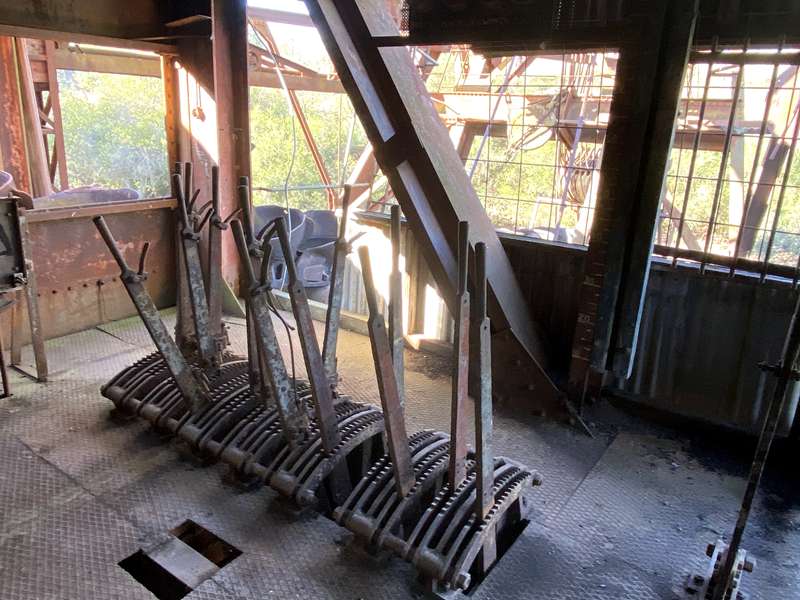
The bridge end of the Control Room was the preserve of the Winchman, who controlled the dredge with a series of levers and switches. The winchmen manned this position day and night, through all weathers. In winter, a small wood heater near the control levers was kept alight, but was small comfort when icy winds blew through on bitter, winter nights.
The Eldorado Dredge was powered by electricity, supplied via a floating cable from the shore. The substation and switchboard along the wall distributed the power to the various electric motors.
Dredge motion was controlled by winches, connected via pulley blocks and strong cables to the shore. There were port and 2 starboard cables to enable the dredge to move sideways across the working face. A headline provided forward pressure for digging.
Another winch raised and lowered the bucket chain, enabling full digging depth to be reached in stages, and repairs and maintenance to be undertaken.
THIS DREDGE IS A SHIP – A ‘SHIP OF GOLD’!
It is a common misconception that the Eldorado Dredge extracted its gold and tin from gravels excavated from the pond where the dredge was laid up in 1954. While the dredge did excavate this pond, it was only the end of an 18-year, downstream journey from a position just north of the town centre of Eldorado.
The dredge floated on the pond, and excavated gold-bearing gravels from beneath the valley floor, using a continuous chain of clam-shell buckets. The gravels were processed on board, and the tailings discharged behind it. In this way, the dredge covered enormous areas, effectively moving its pond with it as it worked.
An electric cable extended out to the dredge. The heavy cable had to be supported on floats, to stop it sinking into mud at the bottom of the pond.
WORKING ON THE DREDGE
The dredge had an on-board crew of between 5 and 13 men per shift, working 3 shifts around the clock. On-shore, a team including Superintendent, engineer, electrician, blacksmith, pumpman, office staff, storeman, driver, etc kept the operation going. In 1939, 78 men were employed by the company.
Routine maintenance was carried out on day shift on Thursdays, with Sunday day shift also available. The dredge shut down for two weeks over Christmas and New Year, for annual holidays.
THE BOWELS OF THE MONSTER
You are looking down into the gold and tin recovery area. Here, 70,644 ounces (over 2 tonnes!) of gold and 1383 tons of tin concentrate was extracted from about 27 million cubic metres of earth, between 1936 and 1954.
The dredge required constant maintenance. Moving parts such as bearings and pulleys needed greasing regularly, and screens needed clearing. There were always minor repairs needing urgent attention, or wearing parts that needed replacement. Pumps had to be unclogged, and water quality monitored constantly. The crew of the dredge had to react quickly to problems, to avoid major breakdowns of the dredge, or loss of gold. Their working conditions were primitive, and in some areas dangerous.
VISITING DAY
“Thursday was visiting day and it seems the ladies of the district came to view the workings of the dredge. They weren’t very popular with the crew because they put on airs and graces and looked down at the working conditions and state of the dredge.”
FOR THE TECHNICALLY-MINDED
Jigs are gravity-recovery appliances used for separating the denser, heavier gold from the lighter gravel and sands.
THE DEPTHS OF HELL…?
While the Eldorado Dredge was a very familiar place to its workers, the inside of the working dredge could be a frightening experience for the casual visitor, particularly on night shift.
Gargantuan features and darkened corners, shadows of moving machinery, the shrieking of metal straining against metal, the deep rumble of the trommel, the clatter and crash of the electrical switching, the clank and grind of the bucket chain, the hum of the motors, the clanging of bells and a thousand other noises, the heaving and shuddering of the dredge, all contrived to provide an experience closer to Dante’s Inferno than a “modern” industrial complex!
Location
Wangaratta-Eldorado Road, Eldorado 3746 View Map
Email Enquiry
Web Links
→ Eldorado Dredge Heritage Story (PDF)
→ El Dorado Museum Association on Facebook
→ El Dorado Tourism Business Group on Facebook


