Edwards Point Walk (St Leonards)


Edwards Point Walk is a scenic 3.4 km circuit through Edwards Point Wildlife Reserve at St Leonards on the Bellarine Peninsula.
The walk combines coastal woodland, saltmarshes, lagoons, a boardwalk and beautiful views across Swan Bay and Port Phillip Bay. The reserve protects important habitat for native wildlife, including migratory shorebirds and the critically endangered Orange-bellied Parrot.
Distance: 3.4 km circuit
Time: Approximately 1 hour
Difficulty: Easy
Terrain: Mostly flat walking tracks, sandy paths, a boardwalk and a possible beach section.
Start/Finish: Edwards Point Wildlife Reserve car park, 9 Beach Road, St Leonards.
Edwards Point Walk Map
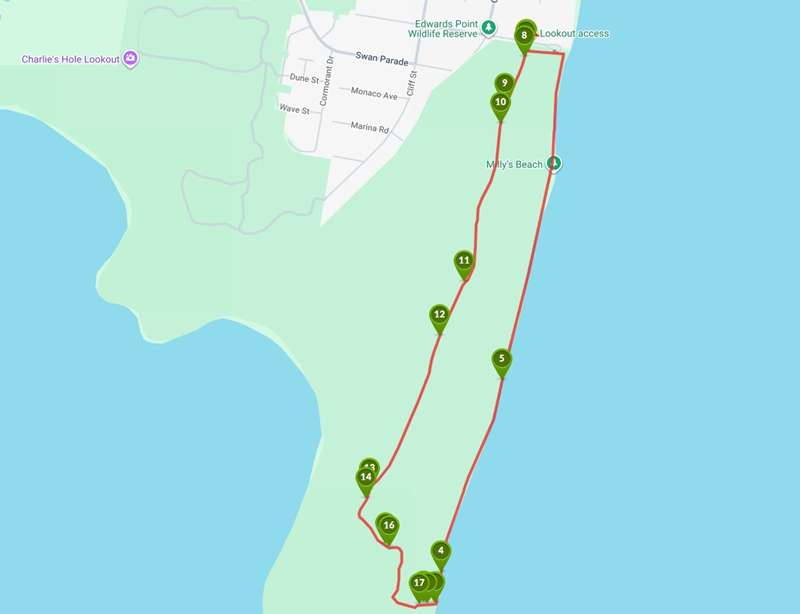
Interactive Map
Points of Interest on Map
1. Conservation
Edwards Point protects the last remaining stand of coastal woodland on the Bellarine Peninsula. Take care. Please note dogs are now not permitted (see Parks Victoria link). Photo: Michelle Lothian
2. Knobby Club Rush
Very hardy and successful near coasts. It helps to bind sandy soil, is also good for getting rid of polluted water. Aboriginal people used this in combination with sedges for weaving.
3. Seat on the coast
As soon as you reach the beach there is a seat where you can rest for a moment. You might spot a dolphin or banjo shark if the water is calm.
4. Beach walk
If the tide is out you can return to Beach road via the beach.
5. Dog Whelk and Cockle Shells
Shells can tell some interesting stories. Dog whelk (right) drill holes into cockles through their shell and then into their flesh. The flesh weakens from pressure, the shell opens. Dinner time.
6. Start of the walk
At the start of the walk there is a very good information board giving details about the walk.
7. Picnic Bench
Just inside the gate there is a picnic bench in a lovely setting. A good spot for lunch when you return.
8. Coastal Woodland
This is the last remaining section of coastal woodland on the Bellarine Peninsula. There is a vast array of indigenous plants along the way.
9. Gnarled Tree
This particular tree cannot be missed on the walk. It tells the story of a hard and windswept life.
10. Beetle crossing
Watch your step as you walk along the path. You might encounter very interesting insects braving the open plains of the pathway to find food on the other side.
11. Bench
A bench immersed in local flora, where you can sit and take time to spot some of the abundant wildlife that this coastal woodland supports.
12. Small Leaf Clemitis
From July to November you will see cream, star-shaped flowers in abundance. Male and female flowers are borne on separate plants. The Aborigines cooked and kneaded the tap root to make dough.
13. Marshes
Great views of water filled marches great the walker when you leave the coastal woodland.
14. Pelicans
Look up! Pelicans normally fish together. They herd fish into a central position, and then plunge their bills into the water to capture a fish.
15. The boardwalk
This fabulous boardwalk allows the walker to explore life in and around the lagoons.
16. Beaded Glasswort
Beaded glasswort is abundant around the boardwalk. Their seeds are a major winter food source for the very rare Orange-bellied Parrots who migrate to Swan Bay from Tasmania each winter.
17. Grasses and sedges
Grass skinks and tiny birds shelter and forage among grasses and sedges. Butterflies lay eggs on sedges, a food source for their caterpillars.
Walk Route:
The walk starts at the Beach Road car park and follows a relatively level track through coastal woodland dominated by Coastal Tea-tree and Wirilda.
After approximately 1 km, the track emerges from the woodland and reveals sweeping views across Swan Bay and its surrounding saltmarshes.
The walking track continues through coastal vegetation before crossing a boardwalk over a lagoon. The surrounding glasswort shrubland provides important food and habitat for native birds, including the critically endangered Orange-bellied Parrot.
Depending on the season, visitors may spot pelicans, swallows, migratory wading birds and other coastal wildlife.
At the Two Bays Lookout Walk junction, turn left towards the beach. When tidal conditions permit, walkers can return along the beach to the Beach Road starting point.
Highlights include:
- Coastal Tea-tree and Wirilda woodland
- Views across Swan Bay and Port Phillip Bay
- Saltmarshes and coastal lagoons
- Boardwalk through wetland habitat
- Birdwatching opportunities
- Coastal vegetation and wildflowers
- Quiet sandy beaches
- Opportunities to see migratory shorebirds
The coastal areas are exposed to the weather, so bring drinking water, hats and sunscreen.
Check tide conditions before attempting the beach section. If the beach is inaccessible, return via the inland walking track.
Facilities at the starting point include:
- Car parking
- Information board
- Picnic table
Access for Dogs:
Dogs are not permitted in Edwards Point Wildlife Reserve.
Location
9 Beach Road, St Leonards 3223 View Map
Web Links
→ www.parks.vic.gov.au/places-to-see/sites/edwards-point-walk
→ Edwards Point walk, Bellarine Peninsula (Walking Maps)


