Eastern View - The Great Ocean Road Memorial Arch


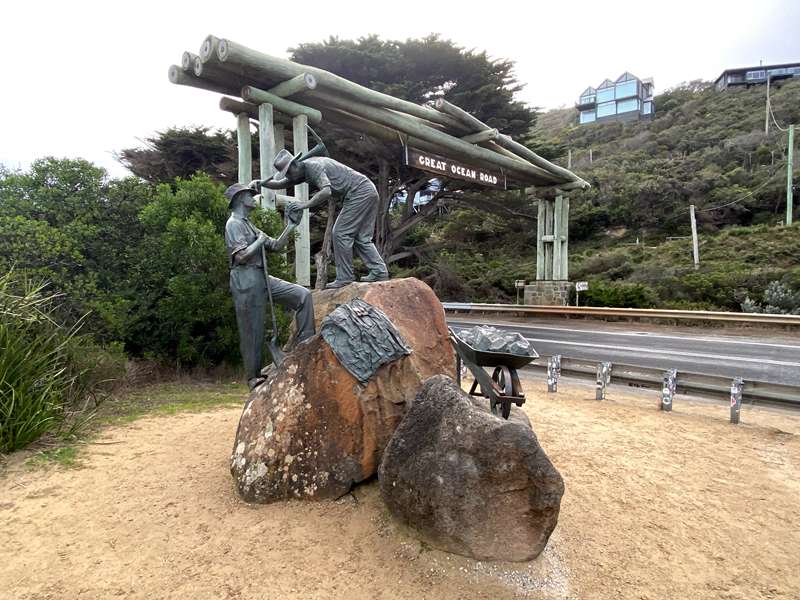
The Great Ocean Road Memorial Arch is one of Australia's most recognisable roadside landmarks and marks the beginning of the iconic coastal drive. Built to honour the returned servicemen who constructed the Great Ocean Road after World War I, the arch reminds visitors that the Great Ocean Road is more than a scenic highway - it is the world's largest war memorial.
The original timber arch was erected in 1939 as a memorial to William B. McCormack, the honorary engineer of the Great Ocean Road Trust, and to the returned servicemen who built the road. Over the years it has been rebuilt several times after being damaged by vehicle impacts, storms and the devastating Ash Wednesday bushfires of 1983. Despite these rebuilds, the original "Great Ocean Road" sign remains mounted on the current arch.
Beside the arch stands the Digger's Memorial, a bronze sculpture depicting three returned servicemen working with picks and shovels. Installed during the 75th anniversary celebrations of the Great Ocean Road, it commemorates the more than 3,000 returned soldiers who carved the road through rugged cliffs and dense forest between 1919 and 1932. Interpretive plaques nearby tell the story of the road's construction and the enormous challenges faced by the workers.
The Memorial Arch is one of the most photographed attractions on the Great Ocean Road and is an ideal place to stop for photographs and to learn about the remarkable history behind this engineering achievement. A small parking area is located on both sides of the road, with pedestrian access beneath the arch and to the memorial sculpture. Visitors should take care when crossing the road, as traffic can be busy and fast-moving.
There are no toilets or drinking water onsite.
Site Information Signage
The Great Ocean Road Memorial Arch
This arch commemorates the building of the Great Ocean Road as a memorial to Victorians who served in the First World War, 1914-1918.
It is the third arch on the site. The original was erected in 1939 and replaced in 1973 when the road was widened. On 16 February 1983 the Ash Wednesday fires destroyed the second arch.
In 1917 the Great Ocean Road Trust, a citizen initiative, was established to build the road and to provide employment for returned servicemen.
From 1919 work proceeded in stages, according to the availability of men and money. A total of three thousand ex-servicemen worked with pick and shovel, using the stone and natural materials of the area. They stayed in well-organised camps complete with vegetable plots, cooks and pianos.
Here, at Eastern View, travellers paid a toll to use the Great Ocean Road from 1922 until 1936 when the government took over the road and its maintenance.
The Great Ocean Road fulfilled a dream to link up the seaside settlements, open up the coast for development and provide the motoring public with 'one of the most beautiful ocean drives in the world.'
Today the Great Ocean Road stretches from Torquay to Nelson. It combines wonderful landscapes and seascapes with the bush of national parks and conservation reserves. Each year 1.2 million vehicles pass under the archway and millions of visitors enjoy vistas and activities along the Great Ocean Road.
The Great Ocean Road started as a project to create work for WWI returned servicemen. Funding came from public donations raised by the Great Ocean Road Trust. The Country Roads Board later completed the road, which linked all the coastal towns along its 241 kilometre length. The road has become a tourist attraction equal to the great coastal roads of the world.
Great Ocean Road
The Great Ocean Road follows the contours of the land – it drops to the coast to give access to beaches and climbs the cliffs to give views over the Great Southern Ocean and Bass Strait. The first sections were built by the Great Ocean Road Trust and handed over to the Government on 2 October 1936.
The road was proclaimed a Tourist Road on 2 December 1936 and renamed the Great Ocean Road on 16 February 1972.
TOIL AND TOLLS
Work started on 19 September 1919 and most of it was done by hand. Among the workers were thousands of soldiers returning from World War 1. Their labours are commemorated by other plaques at this site.
At first, funds were raised by a public trust, then tolls were levied from 1922 to 1934. When control of the Great Ocean Road passed to the Country Roads Board in 1936, the toll-gate was ceremoniously unlocked.
BRIDGES AND ANCHORS
The low-lying road hugs the coast and has to cross creeks and rivers. Many bridges were built with local timber. In the 1950s the timber bridges were replaced with concrete structures.
Rock falls often closed the road for days or weeks at a time. To stabilise 500 000 tonnes of rock at Windy Point, 45 cable anchors from 20 to 40 metres long were installed in 1971.
Civil engineer William Calder was the first Chairman of the Country Roads Board. He had an important role in guiding the development of the Great Ocean Road until his death in 1928. Calder, after whom the Calder Highway is named, often inspected roads on horseback.
The Great Ocean Road gives access to tourism sites such as the 12 Apostles – there were only ever 9 of them and one collapsed on 3 July 2005.
About 7 million people a year visit the Great Ocean Road region, making it one of Australia's most popular destinations. Travelling the road itself is one of the great attractions.
Photos:
Location
689/721 Great Ocean Road, Eastern View 3231 View Map


