Dindi Arts Trail (Kinglake Ranges)


The Dindi Arts Trail is a series of murals, some painted on water tanks, located throughout the Kinglake Ranges, each telling their own unique story.
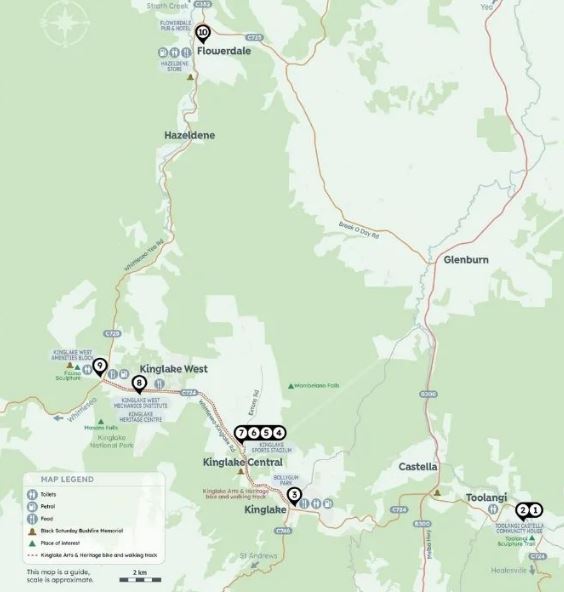
There are 10 different murals spread over six different locations in Toolangi, Kinglake, Kinglake Central, Kinglake West and Flowerdale.
Dindi Arts Trail Map
1. Toolangi murals
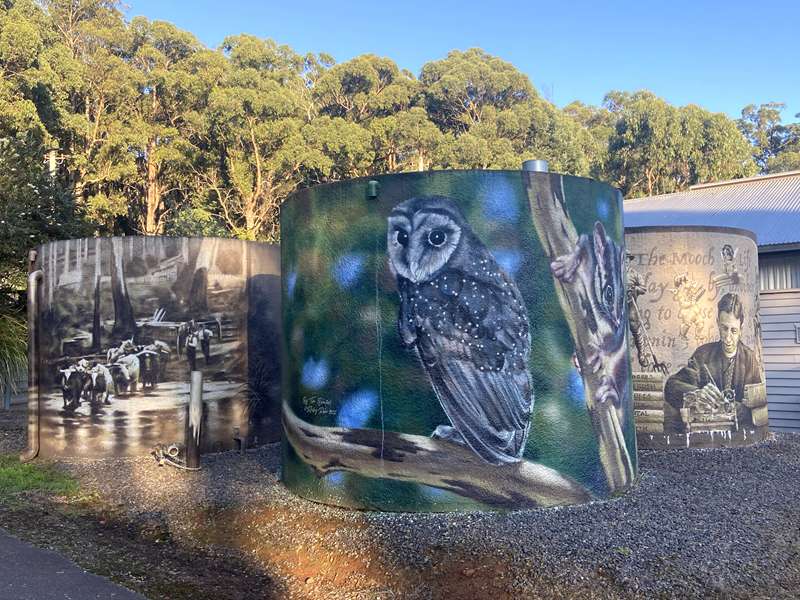
Clarence James Dennis was an Australian born poet and author who made Toolangi his home in 1908. His most famous publication 'Songs of the Sentimental Bloke' was an immediate success in 1915, breaking all publishing records. CJ Dennis is Australia's most prolific poet, publishing a poem every day (over 3,000 poems) in the Melbourne Herald from 1920-1938. This mural shows original characters from CJ Dennis's prose: Digger Smith with his bag of potatoes, a depiction of the Sentimental Bloke and his love, Doreen, and Ginger Mick. The poem 'The Mooch O' Life is in the background.
The Leadbeater's Possum (Gymnobelideus leadbeateri) is Victoria's faunal emblem. It is a forest dwelling marsupial which is dependent on nesting hallows in big old trees, surrounded by regrowth forest in which it, forages for food. It is found only in the Central Highlands of Victoria and is critically endangered due to loss of old growth trees through bushfires, logging and land clearing.
The Sooty Owl (Tyto tenebricosa) nests in large tree hollows which form by natural decay when eucalypts are at least 150-200 years old. They are strongly territorial and mate for life. Their diet includes a range of small to medium sized mammals and sometimes birds, reptiles and invertebrates. Their forest habitat is threatened by wildfire and logging and they are listed in Victoria as endangered.
In the late 1800's the unmade road made it difficult to transport goods. Bullock teams were used to haul felled timber and in this mural local men guide the bullock team as it hauls milled timber palings across the Yea River.
Location: 1717 Healesville-Kinglake Rd, Toolangi (LAT 37.538233 / LNG 145.473992)
2. Dhulangi Taungurung Biik mural
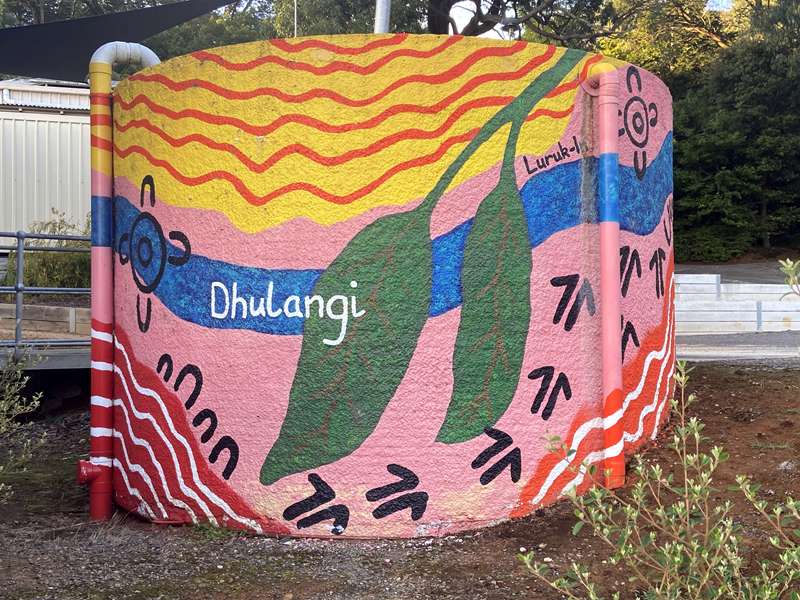
The Dhulangi Taungurung Biik mural expresses connection to biik (country in Taungurung language). The focal point of the mural is the word Dhulangi which is the Taungurung word for stringy bark. Early settlers interpreted the word as Toolangi and so this place was named.
The Yea River is a central point of the design as it is a symbol of strength, knowledge, and represents the enduring life blood of survival of the Taungurung people. In Taungurung language, the word river is Marragero.
The landscape surrounding the doer reflect the colours of the rising and setting sun in reds, orange and yellow. The warmth of the sun is a strong energy lifeforce promoting life for the Taungurung people.
The markings along the Yea River signify members of the community who travel across the land to the river. Each symbol is of a different size to represent all members of the community both young and old. By gathering by the river, each member is able to gain knowledge, strength, heal and protect country.
Biik-nganjin-algaaguk,dulaboork bundima daabak-djak meaning Taungurung are proud and respected people who unite in strength and take care of country.
The contour lines highlight the undulations of the landscape and represents Taungurung people's connection with the landscape - its knowledge, customs and traditions that has remained in place for tens of thousands of generations.
Accompanied by the contour lines, are symbols representing community gatherings where people are sitting in a circle to talk and discuss important business. In each meeting place are rings which indicate the decades of years people have been meeting. The lines radiating out show the direction from which they travel back and forth to this place.
Travelling across the landscape are kangaroo markings, moving as large mobs and/or family groups towards the meeting places. Each footprint is different in size embodying the young and the old from each family group, who continue to travel distances to gather in this significant place.
Location: 1717 Healesville-Kinglake Rd, Toolangi (LAT 37.538233 / LNG 145.473992)
3. Wumindjika Lyrebird mural by Jimmi Buscombe and Tim Honey
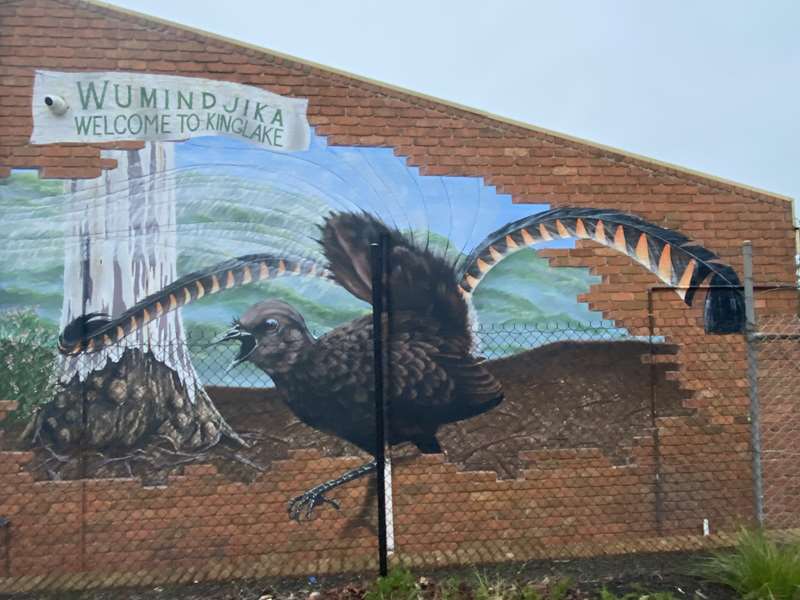
Our Wumindjika lyrebird is singing a song of welcome. Kinglake is on Taungurung country and for centuries Taungurung and Wurundjeri peoples traditionally met on this land. In Taungurung language the word Wumindjtha means welcome.
The male lyrebird is renowned for its elaborate tail, courtship dance and amazing mimicry. The lyrebird is viewed as a bird of peace by First Nations People as it copies sounds and speaks all languages, communicating with all. Superb lyrebirds have been known to imitate car alarms, chainsaws, and any sound within their habitat.
The male lyrebird has 16 tail feathers and two outer feathers, the lyrates, which resemble the shape of a lyre.
The lyrebird is a ground dwelling bird and a great cultivator of the forest floor, increasing the rate of nutrient cycling in the ecosystem.
Have you noticed the cheeky brush-tailed phascogale in the mural? This marsupial is nocturnal and feeds on various insects and spiders.
Location: 4/1 Victoria Rd, Kinglake (LAT 37.532465 / LNG 145.314206)
4. Local fauna and flora mural by Kirrily Anderson
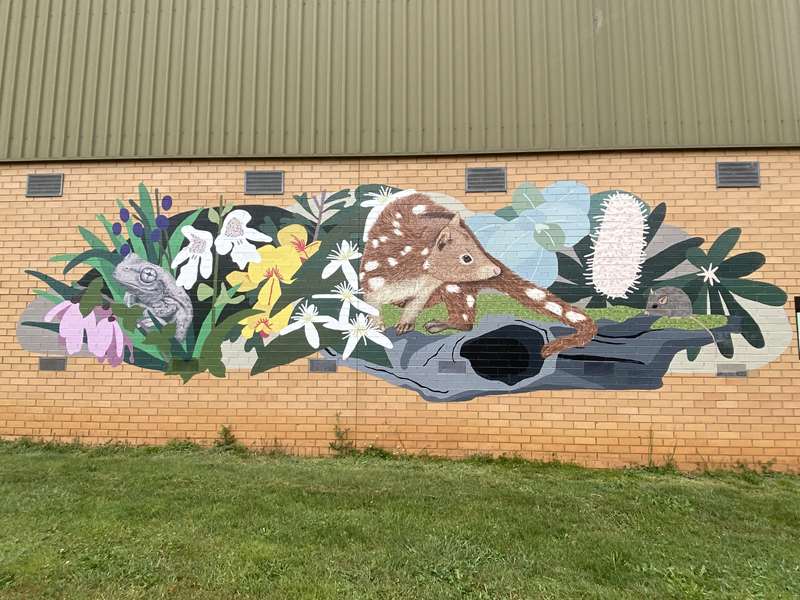
The imagery includes the Spotted-tailed Quoll, the Peron's Tree Frog and an Australian bush rat.
The animals are set within their natural environment which includes a silver banksia, juvenile eucalyptus leaves, Australian clematis, bush pea, Victorian Christmas bush, flax lily and pink bells and a hollow log with moss.
The Spotted-tailed Quoll (Dasyurus maculatus) is a carnivorous marsupial and is listed as a threatened species in Murrindindi Shire due to habitat loss, predators and baiting.
The Peron's tree frog (Litoria peronii) is also known as the emerald-spotted tree frog and forages in trees and shrubs near creeks. It is 30mm-60mm in size and has a distinctive cross-shaped pupil.
The Australian bush rat (Rattus fuscipes) is a small nocturnal animal and is a common indigenous species of rat. They are omnivorous and eat small insects, fruit, seeds, fungi and nectar.
Location: 1 Extons Rd, Kinglake Central (LAT 37.507522 / LNG 145.31452)
5. Bunjil and Waa mural
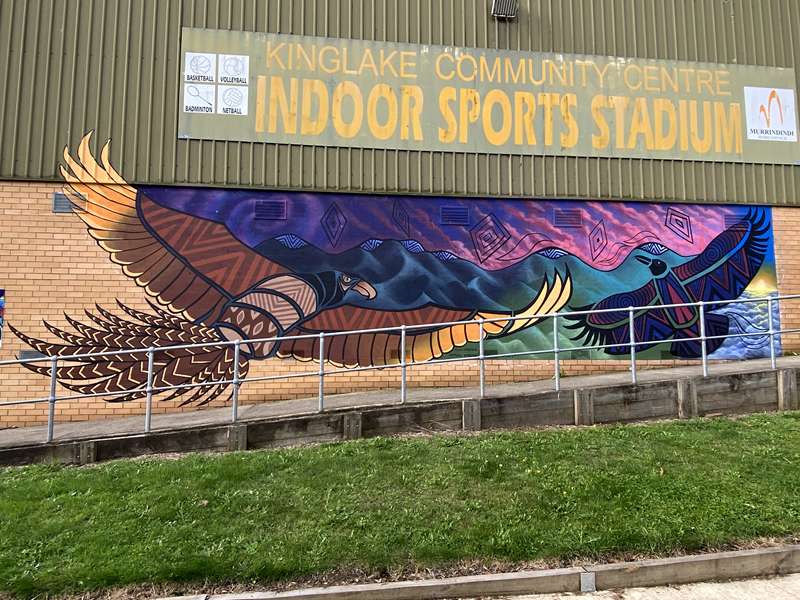
Birds hold an important place in the creation stories of the language groups of the Eastern Kulin Nation - Taungurung is one of these groups, the others being Woiwurrung, Boonwurrung, DjaDjawurrung and Wadawurrung.
The most important of the birds are Bunjil, the Wedge Tailed Eagle - our Creator and Waang (Waa) the Crow - our Protector.
Bunjil and Waang are totems of approximately 70 clans of the Eastern Kulin Nation.
The Great Dividing Range, where Kinglake sits, is a place where Taungurung and Woiwurrung peoples often met to discuss business.
The shields on the nearby pathway symbolise protection of community, cultural identity and the health and wellbeing of First Nations People as they navigate two worlds.
The thin shields were traditionally used for protection in hand-to-hand combat and the two broader shields would have been carved from wood such as silver wattle, black wattle or blackwood.
Wooden shields were used for protection against spears. The Taungurung word for shield is malgarr.
Location: 1 Extons Rd, Kinglake Central (LAT 37.507522 / LNG 145.31452)
6. Ngarrak yilam mural by Aimee McCartney and Tim Honey
-mural.jpg)
Aimee McCartney is a proud Taungurung, Wotjobaluk, Wemba Wemba and Boon Wurrung woman. As a contemporary Aboriginal artist, Aimee's vibrant approach to life coupled with her ancestral and cultural identity allows her to create unique artworks that speak a strong symbolic language.
With assistance from local mural artist Tim Honey, Aimee's recent mural on the wall of the Kinglake Sports Stadium invites the community and its visitors to connect with Taungurung Country and the areas cultural significance.
Centre of the design are concentric circles representing a gathering place which is fitting noting the site is a very popular gathering place for sports activities, markets, Anzac memorials, and meetings. To depict people and community members, Aimee uses U shapes surrounding the meeting place and the meandering creek (gumang) is a symbol of an important life source, nourishing all. On either side of the creek is the Mumong or Yam daisy which was and continues to be an important staple food for the Taungurung people and other members of the Kuhn Nations.
The contour lines highlight the steep mountain range (ngarrak) in ochre colours touched by the warmth of the sun, a strong energy force promoting life and growth The lines also represent Taungurung people's connection with the landscape - its knowledge, customs and traditions that have remained in place for tens of thousands of generations.
On both sides of the design, Aimee has used leaves (djerrang) of trees to emphasise the importance of the bush in smoking ceremonies, which is used to welcome guests onto country and ensure safe passage.. A pivotal part of the design is the blue sky symbolising the openness of the sky in Kinglake and the fresh air available to all and which is vital to the growth of country and its people. The sky is accompanied by stars depicting the Southern cross and paying homage to the ancestors watching over those below.
Location: 1 Extons Rd, Kinglake Central (LAT 37.507522 / LNG 145.31452)
7. Celebration mural
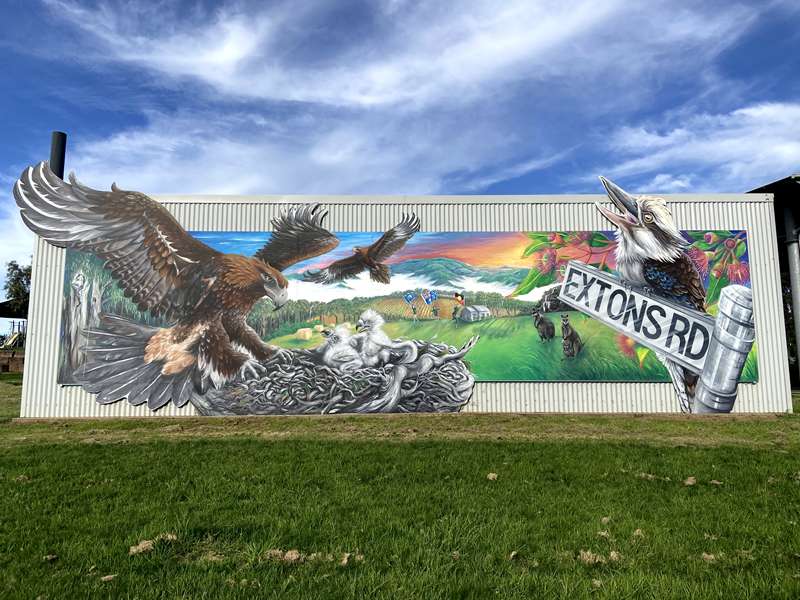
Location: 1 Extons Rd, Kinglake Central (200m up the Arts and Heritage Trail). Located on a shed at the southern perimeter of the Middle Kinglake Primary School. (LAT 37.50580 LNG 145.31333)
8. Kinglake Historical murals by Tim Bowtell and Tim Honey
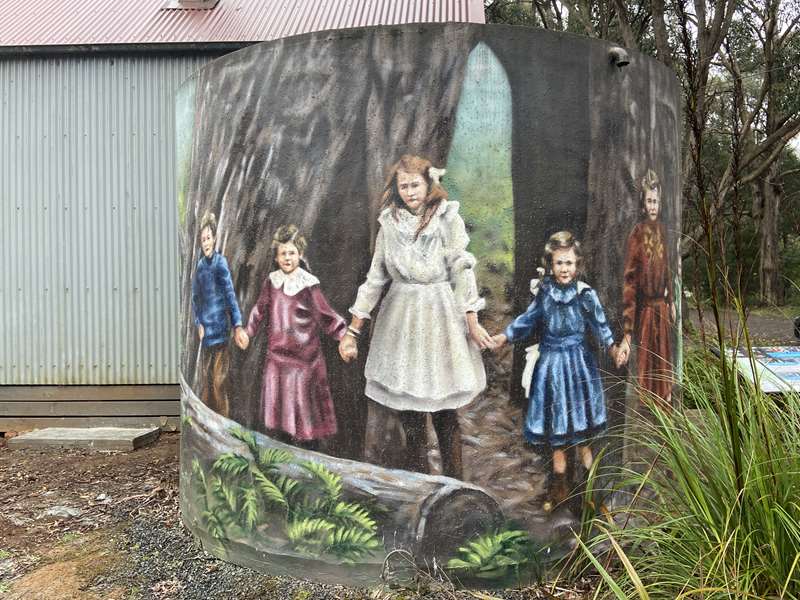
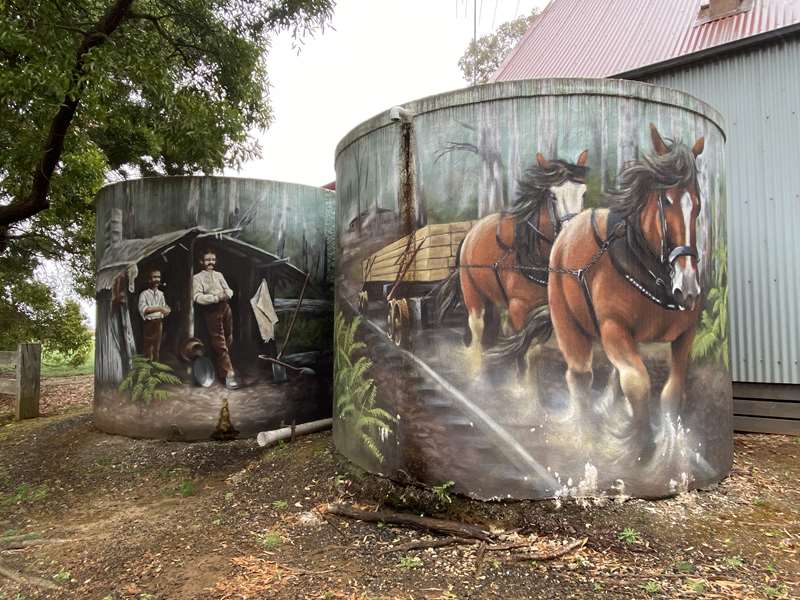
'Mountain Rush' Gold Diggings (circa 1862)
In 1861 gold was discovered in the Mountain Creek on the Great Dividing Range north of Queenstown (now St Andrews) and there were soon over 200 diggers on the 'Mountain Rush' goldfield. Pictured here are Harry Thomson and Maurice Power, both of whom later took up land and established their families in the Kinglake district.
Kinglake Timber Railway (circa 1915)
Sawmills were established in the Kinglatle rainforest from 1890. Damage to the unmade roads by heauy timber wagons resulted in sawmill owners being required to build a wooden railway for horse-drawn trolleys to take sawn timber to the Whittlesea railway station.
Kinglake State School Excursion (circa 1910)
The children of the Kinglake State School were taken on nature walks to the largest tree, known as 'Big Ben', in the nearby bush to see how many of them it took, linking hands, to encircle the tree.
Local midwife, Mary Burton (circa 1900)
Isolated in this mountain district, far from the nearest doctor or hospital, many pioneer families were grateful for the services of Mary Burton at homebirths.
Location: 1055 Whittlesea-Kinglake Rd, Kinglake West (LAT 37.481 / LNG 145.25859)
9. Orchids mural by Barbara Hauser
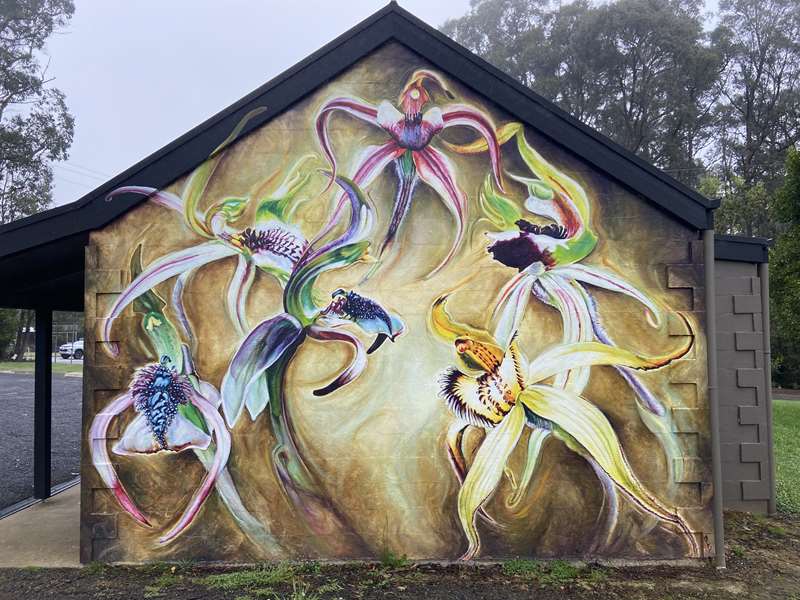
This mural depicts four indigenous orchids found in the Kinglake Ranges. Orchids need to be protected and remain in their natural environment. Removal from their natural habitat usually results in death. They are dependent on complex symbiotic interactions between fungi and pollinators.
A. Caladenia clauigera or Clubbed Spider-orchid
10-40 cm high. Flowers September to November.
B. Caladenia parua or Small Spider-orchid
5-15 cm tall. Flowers September to October.
C. Caladenia oenochila or Wine-lipped Spider-orchid
20-40 cm tall. It is listed as critically endangered and is impacted by habitat clearing, grazing weed invasion and development and relies on microscopic underground fungi to germinate. Flowers August to October.
D. Chiloglottis reflexa or Autumn Bird-orchid 5-15cm tall. It has two broad leaves and a single greenish-bronze or purplish flower with an ant-like callus covering most of the top of the labellum. Flowers March to August.
Location: Amenity Block, Forest Road, Kinglake West LAT 37.47513 / LNG 145.23635)
10. King Parrots mural by Geoffrey Carran and Tim Honey
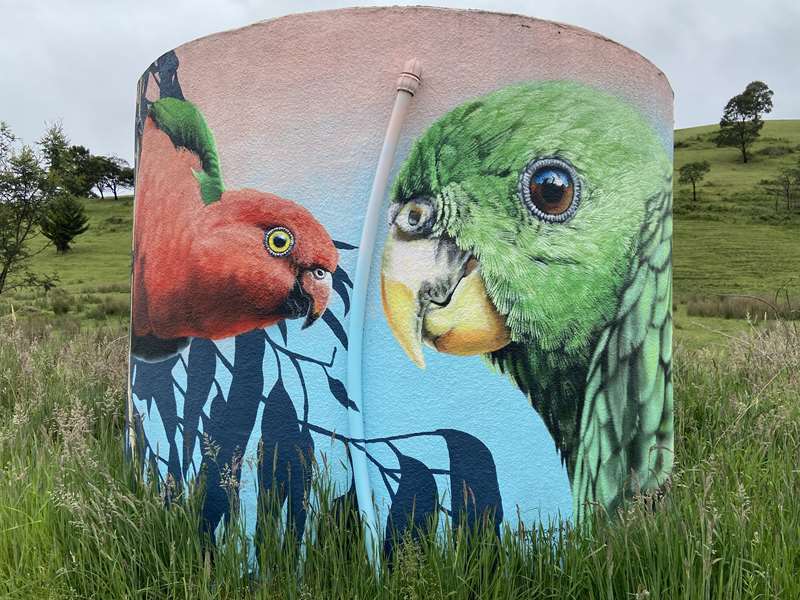
The male King Parrot is the only Australian bird with a completely red head. The female King Parrot has a completely green head and breast. Both birds have a red belly and green back, green wings and long dark blue tail. The birds are 43cm in length including the tail.
While this mural was painted, flocks of King Parrots flew overhead investigating the unfolding artwork. This area offers a natural habitat for the King Parrots who dwell in wet sclerophyll forests where they forage for seeds and fruit. These birds lay their eggs in deep hollows of tree trunks and the breeding season is from September - January.
The town of Flowerdale is located in the aptly named King Parrot Ward of the Murrindindi Shire.
Location: 3325 Whittlesea-Yea Rd, Flowerdale (LAT 37.3195 / LNG 145.28836)
Web Links
→ Dindi Arts Trail on Facebook


