Cobden Connection Rotunda


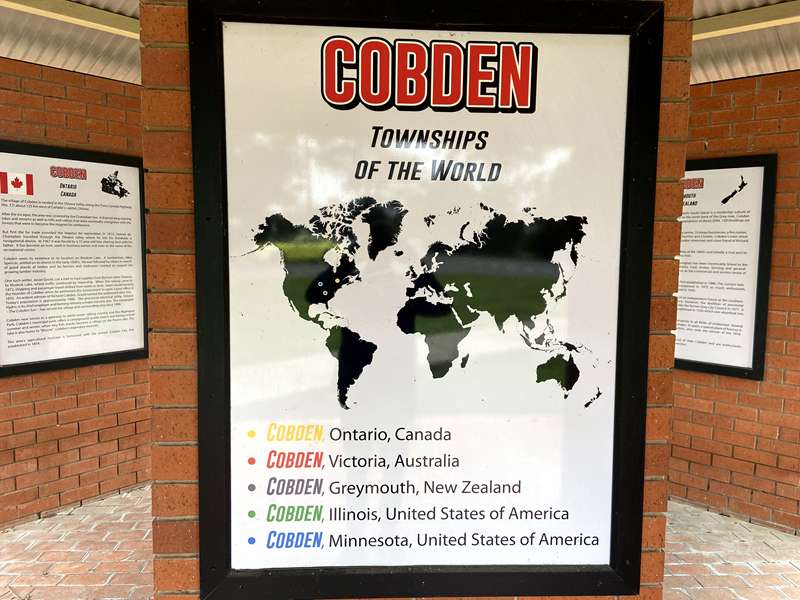
The Cobden Connection Rotunda celebrates the friendship established between five communities around the world that share the name Cobden. These are located in Australia, New Zealand, Canada and the United States, which has two participating Cobdens.
Members of the five communities visited and hosted one another through the Cobden Connection program. Cobden Rotary Club and Cobden Quota Club subsequently worked together to construct the distinctive brick rotunda as a permanent record of the international friendship.
The rotunda was officially opened on 28 June 1998, six years after representatives from the participating communities assembled to commemorate the Cobden Connection on 28 June 1992.
Inside the rotunda are photographs, plaques and information about:
- The five Cobden communities
- International visits and community exchanges
- The history of the Cobden Connection
- Richard Cobden, the British politician and free-trade campaigner after whom the Victorian town was named
- The people and community groups involved in the project
THE HISTORY OF “THE COBDEN CONNECTION”
“In the winter of 1987, while returning to Illinois from a trip to Colorado, I was reading the atlas looking for places perhaps to write to as a Year 10 assignment. I came across Cobden, Ontario and decided that we should write to Canada to exchange information about each other’s towns. The following week, after I presented the assignment, a student, Janet Dale, discovered a Cobden in Australia. I asked the year 10 group if they wanted to make contact to one or both. They replied “Both” and thus began the Cobden Connection exchange.
“About one year later, we received a package from the Cobden Technical School in Victoria. We had thought that no one wanted to respond. We were elated to find the wonderful pictures and essays about Cobden Victoria.
“Shortly thereafter we received a letter from Kevin Johnston who asked if he could visit us in January 1988. We immediately responded “Yes!” and Kevin arrived in January. We arranged an assembly type day where elementary and high school students could come and listen to Kevin speak about Cobden. In the evening there was also a reception for him, and he spoke to the community. Several students also hosted Kevin as their dinner guest, and he went to Church in the community on Sunday morning. Early on the Monday there was another assembly in our gym and Kevin presented us with a flag and an invitation to come down and visit his Cobden. Later in the summer we did. Thirteen students and myself traveled to Australia for a stay and what a wonderful time we had.
“That was in 1988. Since then there has been many exchanges and many additions to our “Connection”. We were to discover Cobden New Zealand, Cobden Minnesota and Cobden Ontario Canada.
“So to date there are 5 Cobdens, all named for one man - Richard Cobden - an English Parliamentarian and Railroad employee. From his name springs the Connection and thus we are all related in this way.
“May the Connection Continue to Grow!”
Carla Winters
Teacher
RICHARD COBDEN 1804-1865
He was an English statesman and political economist who was best known for his achievement of free trade and his efforts toward international co-operation.
He was born the son of a farmer near Midhurst, Sussex on June 3rd, 1804. After early years of poverty and a criminal life in a Yorkshire school, he learned the cloth trade in London. By the time he was 28 years old, he had become the head of a Manchester manufacturing business so prosperous that he was able to turn to public affairs.
He undertook self-directed study and extensive travel on the continent, in the USA and in Egypt. This provided him with a wide knowledge of his own and other societies, stimulated his interest in international affairs and so he developed his broad, warm sympathies with other people. During these early years, though he was initially defeated for parliament, he laboured to institute National Elementary Education, worked for Manchester Municipal improvement and began his fight for free trade which he believed would not only promote prosperity but foster good will among nations.
In 1841 he entered Parliament and became Leader of the Free Trade Crusade which in 1846 effected abolition of the burdensome corn law duties. This action signified the end of the old Mercantile Order and inaugurated the era of free trade under which Britain achieved a new prosperity.
In 1860, Cobden performed his second significant piece of work - he negotiated for England the Anglo-France commercial treaty which committed Britain to Free Trade, reduced French tariffs to reasonable rates and induced the chief European governments to break down long standing trade barriers to effect the greatest freedom of trade that the new commercial era had known.
During his years in Parliament, where he served for most of his life, Cobden supported many domestic reforms such as proposals for the abolition of the newspaper tax, institution of the Penny postage, financial retrenchment and free universal elementary education. He pressed endlessly for disarmament, pleaded for arbitration (and saw an arbitration clause included in the Crimean War Treaty). He urged reform of maritime law. A consistent opponent of the Government’s foreign policy, he protested against high handed dealings with weak states, denounced intervention in foreign disputes and opposed the Chinese and Crimean wars. He participated actively in most of the international peace congresses and at one time largely directed the National Peace society. He was a loyal friend of America (which he visited in 1835 and 1859). He was influential in preserving British neutrality during the Civil War.
He died in London on April 2nd, 1865.
COBDEN MINNESOTA, UNITED STATES OF AMERICA
Cobden Minnesota is the smallest of all the Cobdens with a population of only 65. A railway town, it has a huge grain storage and is a distribution point. The town is also centre to large dairying and agricultural industries.
Another claim to fame is that the town has 2 hotels, fully operational and directly opposite each other in the main street.
Laura Ingalls Wilder, an American author from early this century, wrote about the area in her series of “Little House” books, the most famous being “Little House on The Prairie” which was made into the long running TV show of the same name.
Cobden’s nearest neighbours are Sleepy Eye and Walnut Grove.
Although a small town, it is big on generosity and hospitality.
COBDEN ONTARIO, CANADA
The village of Cobden is nestled in the Ottawa Valley along the Trans Canada Highway (No. 17) about 125 km west of Canada’s capital, Ottawa.
After the ice ages, the area was covered by the Champlain Sea. It drained away leaving lakes and streams as well as hills and valleys that were eventually overgrown with the forests that were to become the magnet for settlement.
But first the fur trade provided the impetus for exploration. In 1613, Samuel de Champlain travelled through the Ottawa valley where he lost his Astralabe, a navigational device. In 1967 it was found by a 15 year-old boy clearing land with his father. It has become an icon, used in business names and even as the name of the recreational centre.
Cobden owes its existence to its location on Muskrat Lake. A lumberman, Allen Spencer, settled on its shores in the early 1920’s. He was followed by others in search of good
COBDEN MINNESOTA, UNITED STATES OF AMERICA
Cobden Minnesota is the smallest of all the Cobdens with a population of only 65. A railway town, it has a huge grain storage and is a distribution point. The town is also centre to large dairying and agricultural industries.
Another claim to fame is that the town has 2 hotels, fully operational and directly opposite each other in the main street.
Laura Ingalls Wilder, an American author from early this century, wrote about the area in her series of “Little House” books, the most famous being “Little House on The Prairie” which was made into the long running TV show of the same name.
Cobden’s nearest neighbours are Sleepy Eye and Walnut Grove.
Although a small town, it is big on generosity and hospitality.
COBDEN ONTARIO, CANADA
The village of Cobden is nestled in the Ottawa Valley along the Trans Canada Highway (No. 17) about 125 km west of Canada’s capital, Ottawa.
After the ice ages, the area was covered by the Champlain Sea. It drained away leaving lakes and streams as well as hills and valleys that were eventually overgrown with the forests that were to become the magnet for settlement.
But first the fur trade provided the impetus for exploration. In 1613, Samuel de Champlain travelled through the Ottawa valley where he lost his Astralabe, a navigational device. In 1967 it was found by a 15 year-old boy clearing land with his father. It has become an icon, used in business names and even as the name of the recreational centre.
Cobden owes its existence to its location on Muskrat Lake. A lumberman, Allen Spencer, settled on its shores in the early 1920’s. He was followed by others in search of good stands of timber and by farmers and tradesmen needed to support the growing lumber industry.
One such settler, Jason Gould, cut a trail to haul supplies from Bytown (later Ottawa), to Muskrat Lake, where traffic continued by steamship. When the railway came in 1872, shipping and passenger travel shifted from water to land. Jason Gould became the founder of Cobden when he petitioned the Government to open a post office in 1850. An ardent admirer of Richard Cobden, Gould named the settlement after him. Today’s population is approximately 1000. The provincial electrical utility, Ontario Hydro, is its chief employer and farming remains a major industry also. The newspaper - The Cobden Sun - has served the village and surrounding area since 1896.
Cobden now serves as a gateway to white water rafting country and the Algonquin Park, Cobden’s municipal park, offers a campground, public beach and fishing in both summer and winter, when tiny fish shacks become a village on the frozen lake. The lake is also home to “Mussie”, Cobden’s legendary monster.
The area’s agricultural heritage is honoured with the annual Cobden Fair, first established in 1854.
COBDEN GREYMOUTH, NEW ZEALAND
Cobden on the scenic west of New Zealand’s South Island is a residential suburb of Greymouth (population 9000). Situated on the north bank of the Grey river, Cobden has around 720 resident dwellings with a population of about 2000. 120 dwellings are Government rental.
It has a Primary School (160 children), a play centre, 10 shops/businesses, a fire station, 5 halls, 3 sports fields, a bowling green, 4 Churches and 2 hotels. Cobden’s main street is named after John Brigham the English Quaker statesman and close friend of Richard Cobden.
Cobden owes its existence to the gold rushes of the 1860’s and initially a rival port to Greymouth on the opposite side of the Grey river.
Cobden’s subsequent development and progress has been inextricably linked to the fortunes of Greymouth and the Grey district. Coal, timber, farming and general industry saw Greymouth gain pre-eminence as the commercial and service centre of the region.
A vital bridge link over the Grey river was first established in 1886. The current twin lane concrete Cobden bridge was commissioned in 1975 to much enthusiasm, replacing a narrow wooden structure erected in 1920.
Back in the 1860’s Cobden had prospects of an independent future as the southern-most border town of the Nelson province. However, the abolition of provincial government in 1876 saw Cobden come under the former Grey City Council in 1877. A town district with an elected board was established in 1920 which was absorbed into Greymouth Borough in 1934.
Cobden residents have distinguished themselves in all fields of endeavour. Several Mayors of Greymouth were domiciled in Cobden. In sport, a special place of honour is reserved for former local jockey, Bob Skelton, who rode the winner of the 1976 Melbourne Cup.
The Cobdenites of New Zealand are proud of their Cobden and are enthusiastic supporters of the worldwide Cobden Connection.
COBDEN ILLINOIS, UNITED STATES OF AMERICA
The first known settler to arrive in the area of what is now known as Cobden, arrived in 1807.
In 1852 surveyors laid out the path for a railroad through Illinois. In 1857 the village of South Pass was laid out as a railroad station. In 1860 Richard Cobden, serving as a director of the Illinois Central Railroad, visited the small village. Even though the village was incorporated as South Pass in 1869, from the time of Cobden’s visit it was unofficially known as Cobden. This was due to the impression that Richard Cobden had made upon the residents.
In the early 1900’s the village officially changed its name to Cobden. For the first 100 years of its existence, Cobden became known as a fruit and vegetable growing centre with small industries to,serve the needs of the agricultural community. During this time the village was known as the largest shipper of fruits and vegetables in the United States. To the present time, Cobden remains well known for its high-quality peaches and other fruits and vegetables.
While fruit and vegetable production remain very important to the area, over the past 30 years the village itself has become a commuter community with most of its residents working in surrounding cities.
At the present time Cobden continues to have its own village government, own school system, active churches and civic organisations. As we approach the new century, the village looks forward with enthusiasm and optimism.
COBDEN VICTORIA, AUSTRALIA
Cobden, population of 1800, is nestled 210km south west of Victoria’s capital Melbourne, in the heart of the state’s richest dairying area, and is often referred to as “The Dairy Capital of the World.”
It was first settled in 1840 by Dr Daniel Curdie, who housed his workers on the nearby creek. A village known as “Lovely Banks” quickly grew but the name was changed to Cobden in 1865 to honour British politician and Free Trade Advocate, Richard Cobden.
The “Great Heytesbury Forest” to the south of earliest settlements eventually fell to the axe and crosscut saw and many timber mills emerged. To handle the felled trees, the coming of the railway line in 1892 through Cobden, from Camperdown to Timboon, allowed further opening-up of the forest and benefitted the many settlers and farmers.
Today over 135,000 cows are milked in the area surrounding Cobden as rich rolling pastures dotted with dairies are home to the many grazing cows. “Bonlac Foods” has the largest spray-drier in the southern hemisphere at Cobden to help process the many millions of litres of milk it handles each year. “Australian Farmers” and “Murray Goulburn” also collect and process milk in the area.
Today many dairy service industries thrive in and around Cobden supporting the dairy farmers - the lifeblood of the region.
Cobden is a progressive and picturesque town with many tourist and recreational activities including a 24-hour airstrip, with pilot automatic lighting, an award-winning Miniature Railway complex and is just 30 minutes by road from the Great Southern Ocean and Port Campbell National Park which includes the 12 Apostles and Loch Ard Gorge.
Formerly the home of the Shire of Heytesbury, Cobden is now part of a larger expanded Corangamite Shire and is very much the centre of the hub to many of the region’s attractions.
Its central location makes Cobden an ideal place to stay and rest while visiting Victoria’s South West region.
Photos:
Location
Cnr Neylon Street and Rix Avenue, Cobden 3266 View Map


