Classic Design Icons Walk (Central Melbourne)


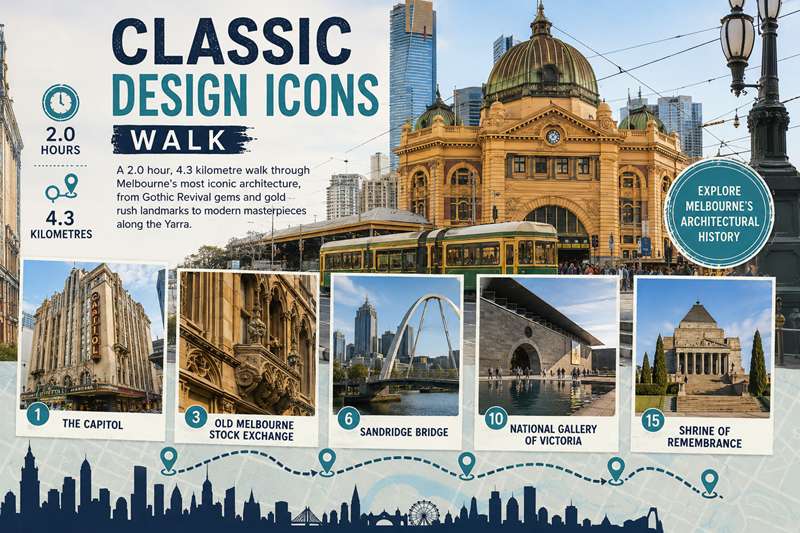
After the 1850s Victorian gold rush, Melbourne exploded with displays of new wealth. Tour dramatic Gothic Revival facades, Art Deco jewels and Neoclassical monoliths.
Explore these classic design icons on this 4.3km (2 hour) walk.
Classic Design Icons Walk Map
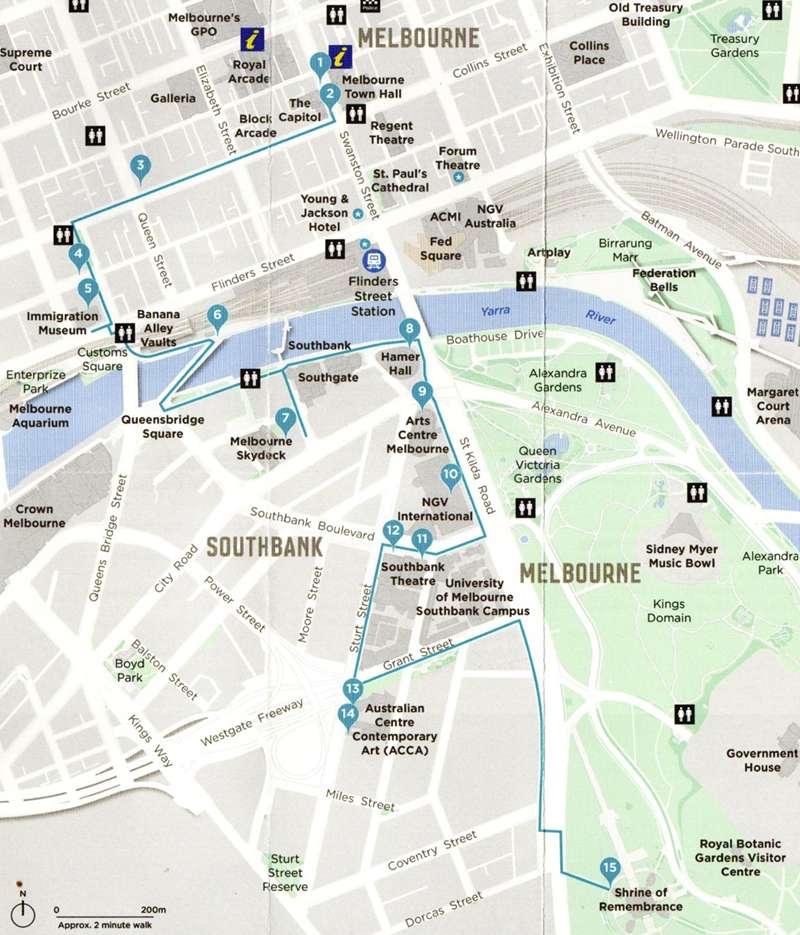
Start out at the 1924 Chicago Gothic cinema The Capitol (1) at 133 Swanston Street. It’s famous for its geometric, crystalline interior.
On the corner of Collins Street, enter the mosaic-tiled arcade of the 1932 Commercial Gothic Manchester Unity Building (2) by architect Marcus Barlow.
Continue down Collins Street for the stained glass and Gothic Revival gargoyles of the Old Melbourne Stock Exchange (3), 1889-91. On the corner the cathedral-esque sandstone ANZ Gothic Bank, 1883-87 boasts gilded ceilings.
A block south at 29-31 Market Street, is the Former Port of Melbourne Authority Building (4). This nine storey 1929 tower is a rare Beaux-Arts beauty in polished granite and marble.
Next door, the former Customs House, 1876, is now the Immigration Museum (5). You can explore Australia’s migration history inside.
Cross Flinders Street and veer left to Flinders Walk. Cross the Sandridge Bridge (6) and spot the Travellers sculptures for each migration era. On the other side find the figure of Gayip, a Woiwurrung word for the ceremonial meeting of different Aboriginal groups.
Take Southgate Avenue and turn right onto Riverside Quay. Take the lift to the top of the 300 metre tall Eureka Tower (7), named for the 1854 Eureka Stockade gold rush rebellion. Walk out onto the glass-floored Skydeck if you dare.
Stroll back along Southbank Promenade for riverfront dining and retail therapy in the Southgate Complex.
Head towards the St Kilda Road Arts Precinct (8), designed by modernist architect Sir Roy Grounds in 1960. A traditional gathering place for the Kulin Nations for thousands of years, from the late 1800s the site hosted ice rinks and circuses.
The Arts Centre Melbourne’s (9) subterranean theatres opened in 1984. The iconic webbed spire flares at the base to evoke a ballerina’s tutu.
Opened in 1968, the National Gallery of Victoria (10) began at the State Library Victoria in 1861. Touch the water wall at the entrance, see the world’s largest stained glass ceiling and wander the exhibitions all day.
Continue down Southbank Boulevard to Buxton Contemporary’s free gallery.
The matrix of glowing tubes and boxes is Southbank Theatre (11). Designed by ARM Architecture, it’s home to the Melbourne Theatre Company.
Refuel at Blondie before exploring The Melbourne Recital Centre (12). The acoustics are the star of this chamber music venue.
Turn left into Sturt Street for the rusted Australian Centre for Contemporary Art (ACCA) (13) to catch an installation. Snap a photo with Vault the giant yellow sculpture by Ron Robertson-Swann, 1980.
Next door, former 1892 brewery The Malthouse Theatre (14) is the place to catch contemporary performance.
Wander up Grant Street, turn right at St Kilda Road and cross to the 1934 Shrine of Remembrance (15) World War I memorial. The site is also an important acknowledgement of the sacrifice of Aboriginal people who served in a time when their civil rights were denied.
More Unmissable Architecture
Meet up like a Melburnian, ‘under the clocks’. Find fascinating gold rush era pubs and see The Forum theatre’s night sky ceiling glow blue.
Flinders Street Station
Flinders Street Station’s iconic yellow dome at the intersection of Swanston and Flinders streets is the gateway to the city. Since 1910, Melburnians have met ‘under the clocks’ at the main steps. Spot the angels in Mirka Mora’s 1986 mural, watching over the commuters.
Young & Jackson Hotel
On the corner of Flinders and Swanston Streets, the 1861 Young & Jackson predates the station opposite. Pop in for a pint and a pub meal and visit resident celebrity, Chloe, the legendary nude by Jules Lefebvre.
The Forum
Melbourne’s first cinema, the Forum Theatre, opened in 1929 on the corner of Flinders and Russell streets. Its famous twinkling night-sky ceiling, theatrical clock tower and ornate balconies are locally loved by concert and film goers.
BONUS Mac’s Hotel
Find Melbourne’s oldest surviving hotel at 34 Franklin Street. Serving since 1854, Mac’s Georgian bluestone was favoured by gold buyers and its stables could house 100 horses. Stay downstairs for relaxed pub fare at Captain Melville, or head upstairs for a drink at the Loch & Key cocktail bar and verandah.
Location
133 Swanston Street, Melbourne 3000 View Map


