Cape Bridgewater - Seal Colony Walk


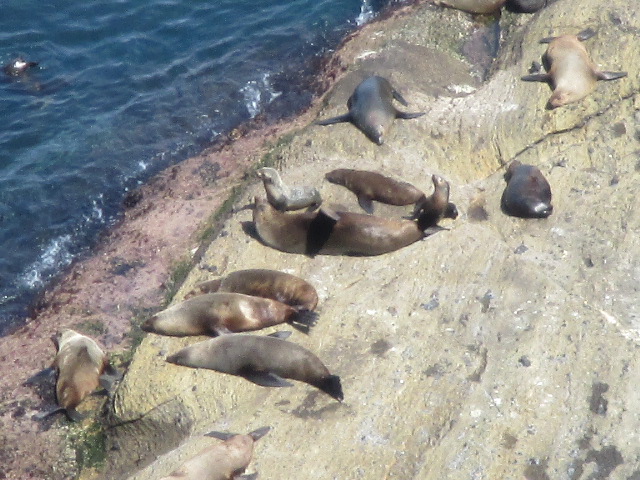
Cape Bridgewater Seal Walk trail south from the Bridgewater Bay Kiosk offers striking views across Cape Bridgewater, once a volcanic island that is now joined to the mainland by calcified sand dunes. The viewing platform at the end of the trail looks out over rock platforms and on to a colony of about 650 Australian and New Zealand fur seals. This is the only mainland breeding site for Australian and New Zealand fur seals.
Summary of Seal walk:
Length: 5 kilometres
Walk: 2 hours return
Track: Good
Grade: Quite steep on the outward part
Start: Bridgewater Bay Kiosk
Finish: Bridgewater Bay Kiosk
Nearby: Portland
Review:
A strong recommendation is to drop into the Bridgewater Bay Cafe for a meal and drink before heading off. They had huge, tasty burgers, great wraps and good coffee.
This is a lovely walk along the top of the cliffs but it can take more than two hours with kids. There are some spots early in the walk where you can access the beach and explore the rock pools. The walk is fairly steep going to the seals but is mainly downhill returning. At the highest point you are 135m above the ocean, which is the highest cliff in Victoria. There are some very steep, high cliffs beside the walking track and some care needs to be taken if you have children.
You can view the seals from a number of viewpoints at the top of the cliff and binoculars would be very handy to get a close-up view of the seals. Two fur seal colonies live on the rock faces at the waters edge and in the caves under the cliffs. The number of seals you can see will vary from hundreds in spring to a few. If there aren't many around, look carefully in the water. Some visitors have commented that they didn't see any seals. In any case, the walk and scenery are magnificent although seeing seals at the end of the walk is the cherry on the cake.
All the facilities have been provided by Great South West Walk volunteers who have done a great job constructing a lookout point to see the seals, maintaining the track and providing signage.
FUR SEAL COLONY INFORMATION
Statistics
Adult male Australian Fur Seals (Arctocephalus pusillus), measure 1.8-2.3m in length and weigh 200-360kg, while adult females measure 1.2-1.7m in length and weigh 35-110kg. Pups are born measuring 60-80cm in length and weighing 5-6kg, male pups slightly longer and heavier than female pups. Australian Fur Seals are known to dive to over 200m on occasion. Females and males become sexually mature as young as 2-3 years and the young males are usually driven away from any breeding age females by the dominant male and do not reach social maturity until they are 8-10 years of age. Australian Fur Seal males are known to live for about 19 years and females for 21 years.
Long Nosed Fur Seals (Arctocephalus forsteri), are smaller than their cousins, with females reaching around 1.5 metres in length and weigh 30 - 50 kg. As with most seal species the males are much larger, growing to 2 metres and 120-150 kg. Pups weigh 3-3.5 kg at birth. Females begin breeding at 4-6 years old, and the males at 8-10. Life expectancy in the wild is 14-17 years.
This species has a finer pointed muzzle and usually darker fur than the Australian Fur Seal.
Both Fur Seals’ diet consists of squid, (its favourite), octopus, crustaceans and small fish. It usually hunts schooling fish species such as Pilchards, Redbait or Mackerel.
Portland’s Seals
After many decades as a non-breeding colony, Cape Bridgewater has become the only mainland seal breeding colony in Australia, with pups usually born in December. Pups begin to swim at 6 weeks old but are not weaned until 3-6 months. Keep your eyes open for these cute pups as they play among the waves at the jetty (approx. 15mins into the kiosk end walk).
Lawrence Rocks is a non-breeding ‘haul out’ site, where juvenile and non-breeding adults can rest. The number of seals depends on the weather conditions and other factors such as feeding and breeding. The best times to visit the fur seals is between January and March when the weather is fine and calm, however seals can be seen all year round no matter what the weather conditions and at any time of the day.
Safety
Fur seals often visit Portland Harbour. It is very important that people do not feed these animals, as they can become dependent on handouts and may become aggressive if denied. This can be dangerous for children and adults and catastrophic for the seals.
In Victoria it is illegal to approach within 30 metres of a seal on land and 5 metres on a structure such as jetty or boat ramp.
Some More Facts
The Australian Fur Seal is the largest of all the fur seals, weighing around 200 - 300kg. It has a broad head, pointed snout and long backward sweeping facial vibrissae (whiskers). The body is robust and covered in thick brown layered hair except on the front and back flippers
The males are larger than the females and when mature carry a dark mane of coarse hair.
They have a set of carnivore-like teeth similar to those of a large dog or bear. Like all members of the Family Otariidae, Fur Seals and Sea Lions have external ears and can raise their body onto their front flippers to move around on land.
Recovery
Hunted to the brink of extinction in the 1800s due to the value placed on the waterproof leather made from the skins, all seals including fur seals are now wholly protected in Australia. The current Australian population is thought to be around 60,000 seals but may be as high as 80,000.
The Lady Julia Percy Island Colony in the east of Portland Bay and Seal Rocks at Philip Island are the largest breeding colonies in Australia.
Photos:
Location
Bridgewater Rd, Cape Bridgewater 3305 View Map
Web Links
→ Cape Bridgewater Geological Features (PDF)
→ Bridgewater Bay Cafe


