Camperdown - Wombeetch Puyuun Reconciliation Park


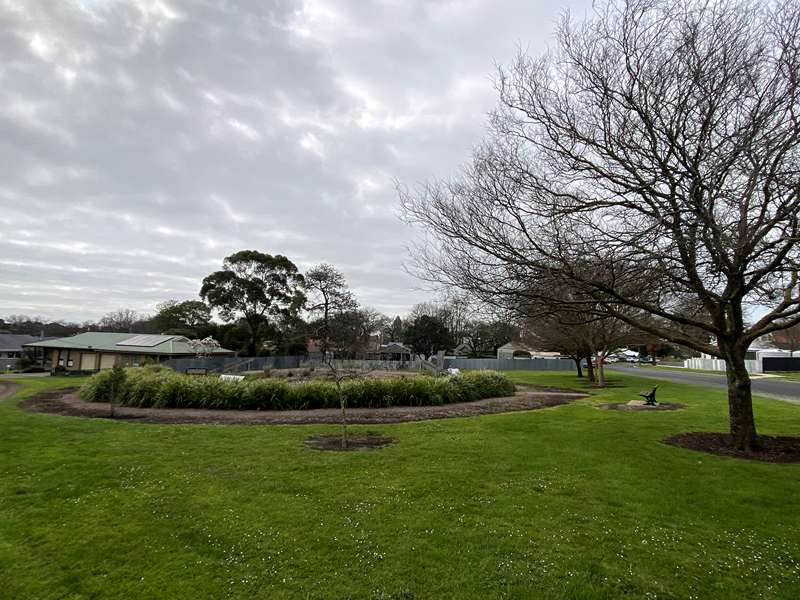
Wombeetch Puyuun Reconciliation Park is a small but culturally significant public park offering a place for reflection, learning and reconciliation. It commemorates the Traditional Owners of the Camperdown district and acknowledges the impact of European settlement on local Aboriginal communities.
For thousands of years, the Liwura Gundidj clan of the Djargurd Wurrung people were the Traditional Owners of the country around Camperdown.
In 1854, Bullenmere, also known as King Alick, petitioned the colonial administration to reserve part of the traditional hunting grounds around Mount Leura for his family. A 14.5-acre Aboriginal Reserve was subsequently proposed between Henderson Street and the Princes Highway.
Bullenmere died before the reserve was established. Despite representations on behalf of his son Prince Albert, the Victorian Government abandoned the proposal in 1860 and subdivided the land to accommodate the growing township.
The Reconciliation Park was established in Victoria Square in 2008 on land that had formed part of the proposed Aboriginal Reserve. It was named in honour of Wombeetch Puyuun, a respected Liwura Gundidj Elder who remained on his ancestral Country despite pressure to relocate to the Framlingham Aboriginal Mission.
Park features include:
- A native garden
- Aboriginal artwork
- Interpretive signs explaining the proposed Aboriginal Reserve
- Information about Wombeetch Puyuun and the Liwura Gundidj people
- An outdoor place for reflection, learning and community gatherings
Access for Dogs:
Keep dogs on a leash and away from garden beds and artworks. Owners must clean up after their dogs.
Opening Hours:
Open at all times.
Liwura Gundidj Story
The Traditional Owners of the Country around Camperdown are the Liwura Gundidj, part of the Eastern Maar Nation.
This park is the site of an Aboriginal Reserve. It is a site of reconciliation, and a place for learning and reflection about the Liwura Gundidj and the impact of European settlement upon their community. When Europeans arrived in 1838, the Liwura Gundidj showed great strength and courage to remain on their Country.
Bullenmere was a strong voice for the Liwura Gundidj. In 1854, he requested that some land at Mount Leura, which had been ‘held by native custom as their inheritance and hunting grounds’ be reserved for the use of his family.
Within three months a plan had been prepared. The Colonial Administration set aside an area of 14.5 acres between the school site in Hendersons Street and the Princes Highway, with 4.5 acres of this area being separately defined for the future use of Bullenmere’s young son, Prince Albert. It was planned to build a dwelling on the Reserve for Bullenmere and his family.
Sadly, Bullenmere and his family never got to use and enjoy the Reserve as Bullenmere entered the Dreamtime before the Reserve was approved. In October 1860, despite enormous representations by prominent citizens on behalf of Prince Albert, the Victorian Government abandoned all plans for the Reserve on the grounds that ‘the land was needed for the unexpected expansion of the township’.
Prince Albert died in 1863, aged 16, at the property ‘Meningoort’, where he was employed as a stockman.
This park is just a small area of what the Liwura Gundidj were promised.
Etching of early Camperdown with Djargurd Wurrung people in foreground, c1860 (John Crew, engraver)
Native Garden
Wombeetch Puyuun Park Garden
Eastern Maar have a long relationship with local plants. Some of these plants have been used in the circular garden and landscaping.
Caution: plants may be poisonous if not collected or prepared correctly.
Blackwood Acacia melanoxylon
Blackwood bark is a traditional treatment for rheumatism. The bark can be infused in hot water, then used to bath aching joints. The hard timber is important for making tools, implements and bowls.
Silver Banksia Banksia marginata
Silver Banksia trees grew in vast woodlands across the volcanic plains. Only a few old trees have survived, and their seeds are grown for restoration. The flowers give nectar which is traditionally used to sweeten drinking water. The seeds are eaten by Yellow-tailed Black-cockatoo.
Bidgee-widgee Acaena novae-zelandiae
Bidgee-widgee leaves are traditionally brewed into a medicinal tea. The prickly seed balls stick to fur or socks to spread the seed. Bidgee-widgee is in the same family as native raspberry, roses, and plums.
Common Billy-buttons Craspedia variabilis
Bright yellow Billy-button flowers have nectar for insects. Billy-buttons are in the daisy family. In hot conditions they will die back, then re-sprout the following spring.
Austral Stork’s-bill Pelargonium australe
Austral Stork’s-bill has a strong taproot that can be prepared as a food, or medicine for diarrhoea. It can live for decades with new stems growing from the big root.
Spiny-headed Mat-Rush Lomandra longifolia
The smooth, strap-shaped leaves are used for weaving. Women gather the leaves, split them, and tie them into bundles for soaking to make the leaves pliable. Beautifully woven baskets and eel traps can be made from this plant.
Kangaroo Grass Themeda triandra
Kangaroo Grass is traditionally gathered in wooden bowls. The seeds can be separated and grinding stones used to make flour. This can then be mixed with water to make a dough which is cooked into damper.
Lomandra small Brillen Lomandra filiformis
Wattle Mat-rush has several traditional uses. The pale bases of the leaves are edible, and the flowers are full of nectar. Butterflies are also attracted to the flowers.
Indigenous Artwork
Panel by Indigenous artist Fiona Clarke
The Boomerang symbolises how Aboriginal people always come back to their lands.
The Goanna symbolises the survival of Aboriginal people after colonisation.
The other sections of the design symbolise a variety of things such as, water holes, running water, fish and water life, hunting, tucker, men and women’s camps where men would discuss men’s business and women would discuss women’s business under the mink gills (stars) by a fire. There is also a section depicting an eel trap constructed in rivers to catch eels which were an important source of sustenance and important to survival and culture.
Wombeetch Puyuun
(Camperdown George) c.1818 - 1883
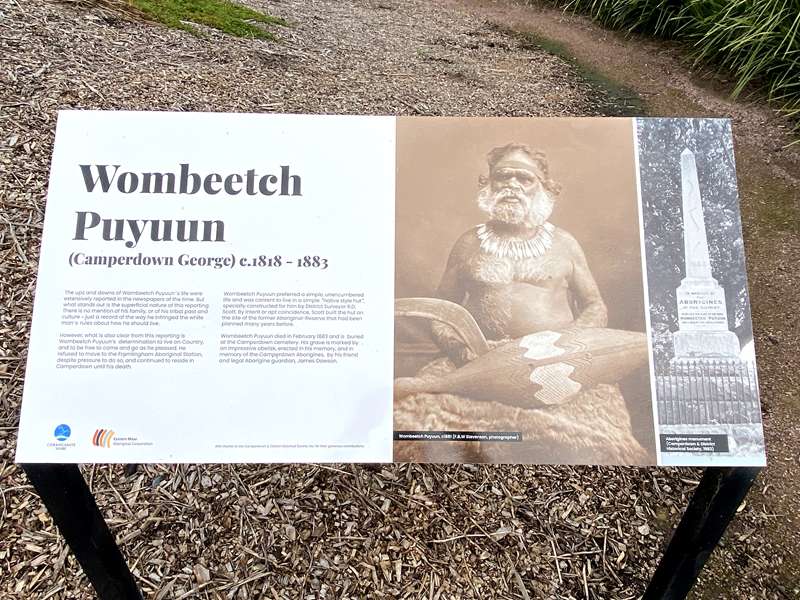
The ups and downs of Wombeetch Puyuun’s life were extensively reported in the newspapers of the time. But what stands out is the superficial nature of this reporting. There is no mention of his family, or of his tribal past and culture - just a record of the way he infringed the white man’s rules about how he should live.
However, what is also clear from this reporting is Wombeetch Puyuun’s determination to live on Country, and to be free to come and go as he pleased. He refused to move to the Framlingham Aboriginal Station, despite pressure to do so, and continued to reside in Camperdown until his death.
Wombeetch Puyuun preferred a simple, unencumbered life and was content to live in a simple “native style hut”, specially constructed for him by District Surveyor R.D. Scott. By intent or apt coincidence, Scott built the hut on the site of the former Aboriginal-Reserve that had been planned many years before.
Wombeetch Puyuun died in February 1883 and is buried at the Camperdown cemetery. His grave is marked by an impressive obelisk, erected in his memory, and in memory of the Camperdown Aborigines, by his friend and legal Aborigine guardian, James Dawson.
Wombeetch Puyuun, c1881 (F.W. Stevenson, photographer)
Photos:
Location
2B Walker Street, Camperdown 3260 View Map
Web Links
→ camperdownhistory.org.au/reconciliation-park-camperdown


