Camperdown Clock Tower


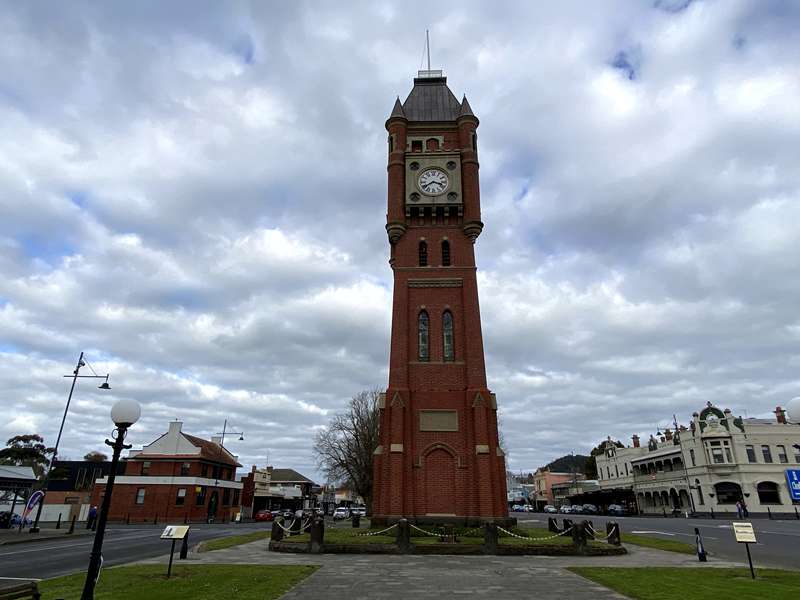
The Camperdown Clock Tower is one of Camperdown's most distinctive landmarks, standing in the centre of Manifold Street among the magnificent elm trees of Finlay Avenue.
The Gothic-style tower was built in 1896-97 as a memorial to Thomas Peter Manifold, son of pioneering settler John Manifold, who died in a hunting accident in 1895. A bequest of £1,000 was made for the construction of a clock tower in Camperdown.
Local architect Michael McCabe designed the tower and Peter Rodger of Williamstown was the builder. The tower stands on a bluestone base with a red-brick shaft and slate-roofed upper section.
The tower was formally handed over to Hampden Shire Council in July 1897.
The clock mechanism was supplied by T. Gaunt & Co of Melbourne and made by clockmaker Fritz Ziegler. It is a fine example of a flatbed turret clock and operates four clock faces.
Three bells were specially cast by Mears and Stainbank of London. The largest hour bell weighs approximately 410 kg. The clock originally chimed every quarter hour throughout the night, but after complaints from guests at the nearby Leura Hotel, an automatic device was installed in 1907 to silence the quarter-hour chimes between 11pm and 7am.
Visitors have the opportunity on selected days to climb inside the Clock Tower. The staircase passes the clock mechanism before continuing higher into the tower, with views across Camperdown and the surrounding volcanic plains from the upper levels.
Internal access involves numerous stairs and is not suitable for visitors unable to manage a steep stair climb.
Echoes of History:
The Camperdown Clock Tower is one of six sites included in the Echoes of History audio tour introduced in 2026.
Scan the QR code at the site to listen to the story of the Clock Tower. Other Echoes of History sites include the Theatre Royal, Finlay Avenue, Soldiers Memorial, Camperdown Courthouse and Camperdown Post and Telegraph Office.
Opening Hours:
The interior of the Clock Tower is generally opened to visitors on the first Sunday of each month by the Rotary Club of Camperdown. Opening arrangements can change, so check current visitor information before travelling specifically to climb the tower.
Cost:
Free to view from outside. Check current information for any charge or donation associated with internal access.
The following article appeared in the newspaper The Argus on Monday 22nd Mar 1897.
THE CAMPERDOWN CLOCK TOWER.
The clock tower erected with the proceeds of a bequest of 1000 pounds by the late Mr. T. P. Manifold has been completed and the clock placed in position. The tower, which is the only structure of the kind in Australia, occupies a commanding position at the intersection of Manifold and Pike streets. It is built of brick, on a massive Bluestone base, the roof being of slate, and the ornamentation of cement. It is 100ft. in height. The clock, which was constructed for the purpose by Messrs. T. Gaunt and Co. of Melbourne, has four dials, each 6ft. in diameter, the figures being 13in. in length. The three balls were cast specially for Messrs. Gaunt and Co. by Mears and Stainbank, of London, and weigh respectively 8cwt, 3.5cmt and 2cwt. They are of the best bell metal, with an admixture of silver, giving a richness to their tone not otherwise obtainable. The total cost of the tower was 950 pounds, and of the clock 450 pounds. This exceeded the amount of the bequest by some 400 pounds, which was generously given by the Messrs. Manifold. The ceremony of starting the clock was performed by Mrs. W. T. Manifold, in the presence of the members of the family and a few friends. The ribbon which secured the pendulum was severed by Mrs. Manifold with a pair of silver scissors presented to her by Messrs. T. Gaunt and Co. fur the occasion.
The Clock Tower History
IN DECEMBER 1838, JOHN, PETER AND THOMAS MANIFOLD TRAVELLED WEST FROM GEELONG AND DISCOVERED RICH GRAZING LAND AND A FRESH WATER LAKE - PURRUMBETE.
They settled beside the lake in January 1839. Other settlers soon followed and in 1852, the town of Camperdown was established a few kilometres west of Lake Purrumbete.
The unique Gothic style Clock Tower that stands in the centre of the town was built in memory of John Manifold’s third son, Thomas Peter Manifold, who was killed in a hunting accident in 1895.
On 8th January, 1896 a letter from the executors of Mr Manifold’s estate was received at a meeting of the Hampden Shire Council. The letter informed the Council that a sum of £1,000 had been bequeathed by Mr Manifold for the purpose of erecting a Clock Tower in Camperdown.
Local architect, Michael McCabe, was appointed to prepare the design which was approved by the Council and the Manifold executors late in 1896. The builder was Peter Rodger, Builder & Contractor of Williamstown, who completed the work in 1897.
The Clock Tower sits on a very solid rock barrier, then mounted on a bluestone base. During the construction, the bricks and mortar were raised to work levels through the use of a hod which was raised by a block and tackle using a pony as power. All day long the pony plodded up and down the avenue, covering short distances at first. When the tower was nearing completion, his journey took him to opposite the Mechanics Institute building near Bath Street. The bricks were laid at a rate of approximately (3 m.) per week with the bricks being brought from Melbourne by rail.
The 35.3m high tower was formally handed over to the Council on 7th July, 1897. The cost of building the tower was £983 with the mechanism a further £438 which the Manifolds, in their generosity, paid in full (a total of £1400).
During the first 10 years of its operation, the clock chimed ever quarter hour for 24 hours. However visitors who stayed at the nearby Leura Hotel complained of sleepless nights caused by the bells. An automatic device was installed in 1907 to silence the chimes between 11.00 pm and 7.00 am, but the striking of the bells on the hour still continues.
The clock mechanism is a fine example of a flatbed turret clock. It was made for T. Gaunt & Co of Melbourne by German born clockmaker Fritz Ziegler. It was the 39th of some 80 clocks built by Ziegler at his workshop at 148 Little Collins Street, Melbourne.
The three bells were cast especially for T. Gaunt & Co by Mears and Stainbank of London. Silver was added to the casting mixture, giving richness to the tone of the bells. The hour bell weighs 410 kg and the two chime bells weigh 155 kg and 105 kg.
There are three gear trains within the flat bed frame, each driven by separate weights: Quarter hour weights - 12 x 9kg (108 kg); Hour weights - 10 x 9kg (90kg) and Time weights - 9 x 9kg (81kg). The weights descend in a well beneath the bed to ground level, about 18 m below. Re-winding is by hand once a week and the clock will run for approximately 8 days when fully wound.
The two end gear trains operate the quarter chime and hour strike respectively. The quarter chimes are sounded on a two peal bell. They sound once at quarter past, twice at half past, three times at quarter to and four times on the hour. Each hour is counted out on the hour, following the quarter chimes, on a separate, larger hour bell.
The centre train is the going (time keeping) train. It is regulated by a 35 kg pendulum, through a double three-legged gravity escapement. This type of escapement was invented by Lord Grimthorpe and was developed in 1840 especially for the famous Westminster Clock (“Big Ben”) in London, which was the first clock to have such an escapement.
The drive from the train is taken vertically from the movement to a four-way crown wheel assembly located above the main mechanism. Four drive shafts each transmit movement to one of the dial movements, which consists of a 12:1 motion train transmitting motions through the dial to the hands.
The clock faces are 1.83 metres in diameter and the figures on the clock faces are 0.33 m in length. The hands are made of 3mm sheet copper with a copper tube full length, all soldered together on to a bronze centre. The hour hand is 63.5 cm and the minute hand is 93.98 cm. Each hand weighs 1.6 kg.
SOME FACTS & FIGURES
- The height to the top of the flagpole is 35.3 metres
- There are 95 steps within the Clock Tower
- The clock faces are 1.82 metres in diameter.
- The figures on the clock faces are 0.33 m in length.
- The total weight of the movement, weights and bells is over 2 tonnes.
The Clock is opened to the public, by the Rotary Club of Camperdown Inc., on the 1st Sunday of every month or by arrangement through the Court House Information Centre.
Location
180 Manifold Street, Camperdown 3260 View Map


