Camperdown Cemetery Self-Guided Tour


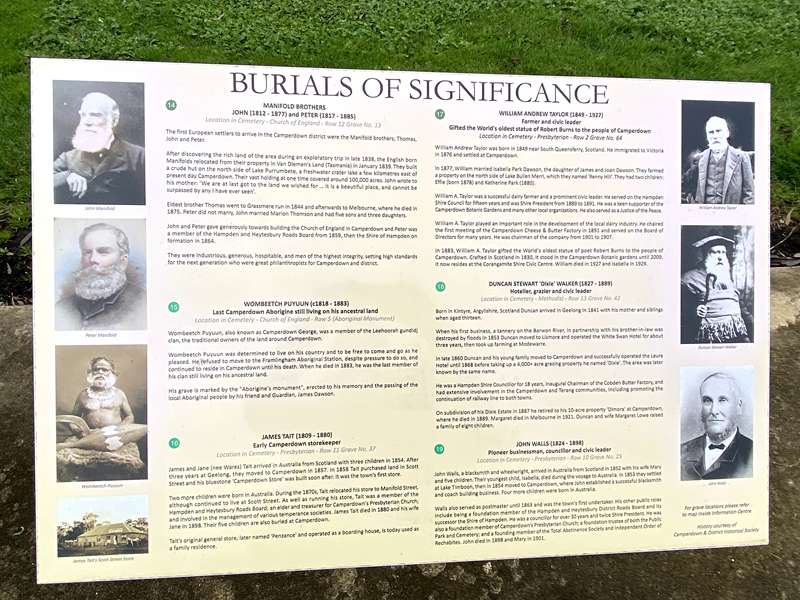
Explore the history of Camperdown and the surrounding district on a self-guided tour through the Camperdown Public Cemetery. A large cemetery map, numbered grave locations and three Burials of Significance panels introduce some of the Aboriginal people, early European settlers, pastoralists, business owners, craftspeople and civic leaders associated with the district.
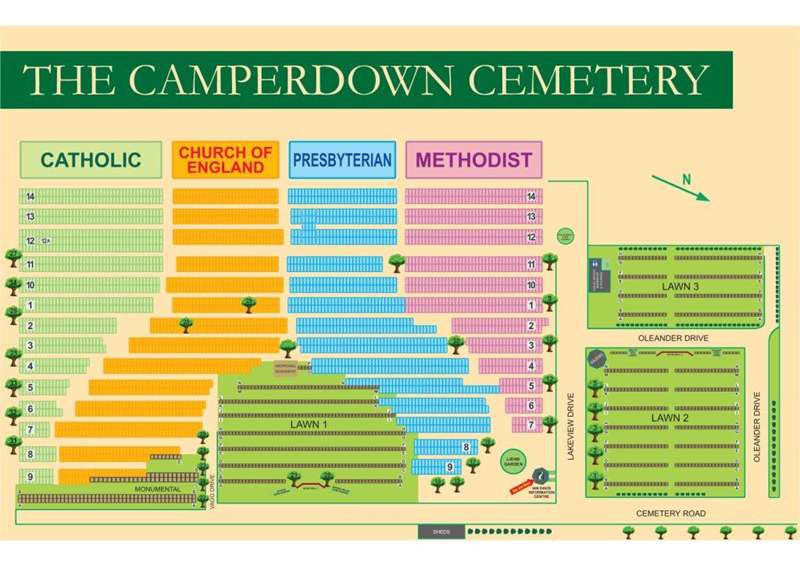
Begin at the Ian Davis Information Centre near the Cemetery Road entrance. The cemetery map identifies the Catholic, Church of England, Presbyterian, Methodist, monumental and lawn sections. Numbered symbols show the locations of significant graves and monuments.
History of Camperdown Public Cemetery:
Burials have taken place in the cemetery since 1854. The site was pegged out by District Surveyor Robert D. Scott in 1853 following instructions from the Surveyor General.
The first recorded interment was Edmund Baker, an Irish immigrant who died aged 44 following an accident at Koort Koort Nong. In 1857, James Bonwick noted that the cemetery reserve was being regularly used and contained 13 tombs.
Formal plans prepared by Robert Scott and his temporary assistant, Louis W. D’Elboux, were submitted in March 1858 and approved by the Governor in Council the following month. Prominent residents John Manifold, John Walls, Daniel Curdie, Adolphus Clark and T. W. Cooper were appointed as the cemetery’s first trustees.
Scott designed a formal radial layout of serpentine paths centred on a circular chapel reserve. Separate burial areas were provided for each denomination in the western half, with reserves in the eastern half and areas intended to be beautified with flowers and shrubs.
A wooden cottage was constructed for the sexton in 1874. This was followed in 1899 by a substantial timber residence for the permanent caretaker, designed by local architect Michael McCabe.
The cemetery reserve was resurveyed by James Short in 1894. This resulted in a slightly altered boundary and the removal of the eastern half of the original design and the proposed chapel reserve.
Later changes included using some paths for grave sites, converting reserves into lawn burial areas, purchasing additional land to the north and selling the caretaker’s cottage and surrounding land. The original trustees have since been replaced by the Camperdown Cemetery Trust.
Many fine monuments and tombstones can be found throughout the cemetery. Of particular historical importance is the grey granite obelisk erected by pioneer settler James Dawson in 1885 as a memorial to his Aboriginal friends, including Wombeetch Puyuun, who was also known as Camperdown George.
Camperdown Cemetery Map
Burials of Significance:
1. James Murdoch Arthur (1854-1924)
Location: Church of England section, Row 10, Grave 28
James Arthur was born at Port Fairy. He joined the Victoria Police Force in 1878 and was stationed in north-east Victoria, where he participated in the search for the Kelly Gang and the Glenrowan shootout that resulted in the capture of Ned Kelly in 1880.
Arthur served at Geelong from 1883. From 1886 he was the sole mounted police officer at Cobden, before receiving a promotion and returning to Geelong in 1897. In May 1902 he was posted to Camperdown as Senior Constable in Charge, remaining there until his retirement in 1924.
His duties included guarding cargo washed ashore from the Fiji and Newfield shipwrecks, locating and seizing illegal whisky stills in the Heytesbury district and maintaining the peace. He was remembered for his charitable and kind acts and for performing his duties with tact and fairness.
Arthur died in Melbourne and was buried beside his wife, who had died in 1912.
2. Edmund Baker (1816-1854)
Location: Catholic section, Row 2, Grave 35
Edmund Baker left Ireland late in 1851 with his wife and young family, hoping to establish a better life in Australia. They arrived at Geelong in April 1852.
Baker was employed at the docks by J. G. Ware of Koort Koort Nong Station. He was entrusted with a wagon and a team of six bullocks to carry supplies during the family’s journey to the property.
In October 1854, Baker was killed after falling from his rearing horse. He left his wife, Biddy, and their children Thomas, aged 16, John, aged 13, Nora, aged 10, and infant James.
He became the first person buried at Camperdown Cemetery when the site was marked only by pegs. His family selected a sheltered position down the slope.
Biddy and her children subsequently moved into Camperdown. Her sons worked as wool carriers and later became successful farmers with substantial landholdings. Many of Edmund Baker’s descendants remained in the Camperdown district.
3. Margaret Bamford, née Evans (1817-1857)
Location: Catholic section, Row 1, Grave 40
Margaret was the daughter of sailor Richard Evans. At the time of her marriage to farmer John Bamford on 28 May 1840, she was working as a spinner at Litton in Derbyshire, England.
Their first son, Samuel, was born soon afterwards and christened at Tideswell on 16 June 1840. By 1841, the family was living in the nearby village of Wardlow, where their second son, Jonathan, was born in December.
On 3 November 1843, Margaret, John and their two young sons joined approximately 340 emigrants travelling under the Bounty Scheme. They embarked from Liverpool aboard the Wallace on a 91-day voyage to Port Phillip. Eleven adults and 27 children died from typhus during the voyage.
The family arrived on 16 February 1844, travelled to Geelong in search of employment and later moved to the Camperdown district.
Margaret and John had another seven children: William, David, Ishmael, James, Ellen, John and Joseph. Margaret is believed to have died from complications following the birth of Joseph, who survived for eight months.
She is believed to have been the first woman buried at Camperdown Cemetery. Her descendants held three family reunions at Cobrico during the 1980s and placed a commemorative plaque on her previously unmarked grave.
4. Dr Daniel Curdie (1810-1884)
Location: Presbyterian section, Row 11, Grave 5
Daniel Curdie was born on the Isle of Arran in Scotland and arrived in Australia in 1839. He occupied land at Jancourt in 1840. When the pastoral run was divided between Curdie and his partners in 1843, he named his portion Tandarook.
Curdie returned to Scotland in 1851 and married Frances Purves in 1853 before returning to Australia. Daniel and Frances raised 10 children at Tandarook.
For more than 10 years, Curdie combined pastoral work with medical practice. Treating patients required him to make long journeys on horseback through the bush.
He was active in public affairs as an original member of the Hampden and Heytesbury District Roads Board, the first president of the Shire of Hampden, a founder of Camperdown Presbyterian Church and a Justice of the Peace.
Curdie was a friend and carer of local Aboriginal people. He was also an enthusiastic natural historian with extensive knowledge of geology and botany and collected specimens of plants, marine life and birds.
Dr Curdie died in 1884 and Frances died in 1899.
5. Isabella Park Taylor, née Dawson (1842-1929)
Location: Presbyterian section, Row 2, Grave 65
Isabella Park Dawson was born near present-day Warrandyte in 1842. She was the only child of James and Joan Dawson, who had emigrated from Scotland in 1840.
Between 1844 and 1866, the Dawson family operated Kangatong, a grazing property near Hawkesdale. Isabella grew up in the company of local Aboriginal people and became fluent in their languages.
The family moved to the Camperdown district in 1868 and lived at Wuurong on the southern side of Lake Bullen Merri.
Isabella and her father developed close and enduring relationships with Aboriginal people and carefully recorded their languages and culture. In 1881, James Dawson published Australian Aborigines: The Languages and Customs of Several Tribes of Aborigines in the Western District of Victoria, Australia with Isabella’s assistance. The book remains an important resource for reconstructing knowledge of Aboriginal languages, cultures and customs in western Victoria.
In 1877, Isabella married Scottish immigrant William Andrew Taylor. They lived at Renny Hill on the northern side of Lake Bullen Merri and had two daughters, Effie, born in 1878, and Katherine Park, born in 1880.
William died in 1927 and Isabella died in 1929.
6. James Dawson (1806-1900)
Location: Presbyterian section, Row 2, Grave 2
James Dawson was born at Bonnytoun in Scotland in 1806. He married Joan Anderson Park in 1837, and the couple sailed for the Port Phillip district late in 1839. They arrived at Williamstown in May 1840.
For the following four years, the Dawson family operated a dairy farm beside the Yarra River near present-day Warrandyte. Their only child, Isabella, was born there in 1842.
Between 1844 and 1866, the Dawsons operated Kangatong, a grazing property near Hawkesdale. They moved to Camperdown in 1868 and settled at Wuurong on the southern side of Lake Bullen Merri.
James and Isabella shared a deep interest in and respect for Aboriginal people. During their years at Kangatong and Camperdown, they studied the languages and cultures of the Indigenous peoples of the Western District.
James was appointed the local Guardian of Aborigines in 1876 and became a forceful advocate for Aboriginal interests.
In 1881, with Isabella’s assistance, he published the landmark book Australian Aborigines: The Languages and Customs of Several Tribes of Aborigines in the Western District of Victoria, Australia. It remains an important source of information about Aboriginal life at the time of European contact.
Joan Dawson died in 1879 and James died in 1900.
7. Harold Bertram “Joe” Lamb (1916-2004)
Location: Lawn 1, Row H, Grave 38
Harold Lamb’s interest in horses and buggies began on his family’s farm at Tesbury, where he learned wheelwright and blacksmithing skills from his father.
From 1960, Lamb assembled a large collection of horse-drawn vehicles. Many were in poor condition when acquired, but he restored them using traditional skills and other trades learned while working on the vehicles.
The collection became the basis of his private museum in Ower Street, where he held open days and demonstrations. His carriages appeared in street parades and were used to carry Santa through Camperdown at Christmas.
Lamb was involved in numerous community and sporting organisations, including cycling, trotting, junior football, basketball, swimming, youth organisations and tourism promotion. He received eight life memberships for his community service.
His contribution to sport was recognised with a British Empire Medal in 1972. His horse-drawn vehicle collection is now housed at Dairy Park in Cobden.
8. Peter McArthur (1819-1897)
Location: Presbyterian section, Row 12, Grave 26
Peter McArthur arrived in Australia from Scotland in 1839 and initially occupied land at Boorcan. In 1840, he and his business partner Nicholas Cole moved several miles north.
Their pastoral runs became known as Meningoort and West Cloven Hills. When the partnership was dissolved in 1843, Meningoort was allocated to McArthur and has remained in the family.
McArthur married Margaret McLean in 1856. They raised six sons and two daughters. After Margaret died in 1883, Peter married Eliza Hood in 1886.
A successful pastoralist, McArthur was active in community affairs. He was a foundation member of the Hampden and Heytesbury District Roads Board and its successor, the Shire of Hampden.
He served for many years as president of the Hampden and Heytesbury Pastoral and Agricultural Society and was also a Justice of the Peace.
Peter died in 1897 and Eliza died in 1926. The descendants of Peter and Margaret McArthur made significant contributions to public life, particularly in politics and law.
9. John McCabe (1834-1912)
Location: Catholic section, Row 14, Grave 1
John McCabe was born in Dublin and migrated in 1855, initially travelling to Tasmania. He was subsequently attracted to Victoria’s goldfields before settling in the developing town of Camperdown two years later.
While employed as a plasterer during construction of Samuel Cozen’s Timboon Inn, McCabe’s natural talent for stonework was recognised. He abandoned plastering and worked exclusively as a stonemason.
Over almost 30 years, he worked on numerous large residences and farm buildings throughout the district and became known for the quality and detail of his craftsmanship.
John married fellow Irish immigrant Ellen O’Connor. They had 10 children, six of whom died during infancy. He passed his stonemasonry skills to his son Michael McCabe.
John died in Camperdown after living in the town for 55 years. Ellen had died in 1903.
10. Michael O’Connor McCabe (1866-1944)
Location: Catholic section, Row 14, Grave 84
Michael McCabe was born in Camperdown to John McCabe and Ellen O’Connor. At the age of 15, he began working as an apprentice stonemason with his father.
After gaining five years of experience and following his father’s retirement, Michael worked as a mason on the new Princes Bridge in Melbourne. He then joined an architectural firm as an articled draughtsman and studied at night for three years.
McCabe returned to Camperdown and worked as a mason on the walls of Talindert before establishing an architectural practice in 1891. He designed or worked on numerous Manifold family properties, hotels, churches, public buildings and private homes throughout the district.
His most prominent and best-known design is Camperdown’s 1896 memorial clock tower.
Michael and his wife, Katherine Cahill, raised one son and six daughters at Keeyuga, an imposing three-storey Queen Anne-style house with a tower in Campbell Street.
From 1916, Michael temporarily replaced the Heytesbury Shire secretary, who was serving during the First World War. He gained his Municipal Clerks Certificate and from 1918 held town clerk positions in several Victorian towns, including a position at Armadale.
Michael died in 1944 while holidaying at Keeyuga. Katherine died in 1953.
11. Donald McNicol (1812-1903)
Location: Presbyterian section, Row 1, Grave 7
Donald McNicol arrived in Australia from Scotland in 1839 with his wife, Annie, and their three young daughters.
He had been recruited to work on a property that pastoralist Niel Black was yet to select. McNicol spent two months working with stock near Ballarat before serving for eight years at Black’s Glenormiston property, where he rose to the position of head stockman.
The McNicol family lived in a bark hut near the shores of Lake Terang, and two sons were born during this period.
Donald gradually acquired pastoral land, initially in partnership with his brother Duncan. Their first holding was the Dunoon run at the new settlement of Lake Timboon.
The brothers established the district’s first rudimentary store and post office on the western side of Mederanook Creek. The business operated from a bark hut with a canvas door nailed to a frame.
The family later acquired the 1,200-acre Pullenmere property, subsequently known as Basin Banks and now Wuurong, on the southern shore of Lake Bullen Merri. Donald successfully bred cattle and sheep and also held land at Marida Yallock and leased more than 2,000 acres at Elingamite.
During the early 1870s, Donald sold his properties and purchased 53 acres at Conical Hill on the eastern side of the Camperdown-Cobden Road. He built the house in which he lived until his death at the age of 91.
Annie died in 1892. Their home was later moved to make way for a reservoir, but the area remains locally known as Donald’s Hill.
12. Duncan McNicol (1807-1901)
Location: Presbyterian section, Row 12, Grave 47
Duncan McNicol and Jane, his wife of one month, arrived at Port Phillip from Scotland on 13 November 1839 following a seven-month voyage.
Several weeks later, Jane went into premature labour and gave birth to their daughter Christina in a Melbourne stable. After Jane recovered, the family moved to Glenormiston, where Duncan had been recruited by Niel Black as a shepherd and stockman.
During their five years at Glenormiston, Duncan and Jane lived at an outstation. Jane worked as a hutkeeper and night watchman, and another daughter and a son were born.
The family moved to the new settlement at Lake Timboon in 1845. Jane and the two youngest children died the following year and were buried in the nearby cemetery.
Duncan began acquiring land, initially in partnership with his brother Donald and John McKinnon. They leased the Dunoon run in 1847.
In 1848, the McNicol brothers opened the district’s first store and post office. It consisted of a bark hut with a canvas door attached to a wooden frame.
Duncan gradually purchased land around Lake Timboon and had the substantial bluestone residence Craigburn constructed during the early 1850s. He lived there until his death in 1901.
Craigburn remains standing in Depot Road, with the Old Timboon Cemetery in an adjoining paddock to the north. Jane and the two children were later reinterred in Camperdown Cemetery.
13. McDonald Family
Location: Presbyterian section, Row 12, Graves 35-37
The family headstone records Alexander McDonald, who lived from 1821 to 1874, his wife Elizabeth, née Sime, who lived from 1824 to 1885, and six of their children who died between the ages of 15 and 23.
Alexander and Elizabeth arrived from Scotland in 1848. Their first two children were sons who died before reaching two years of age, one at Geelong and the other at Hexham.
Alexander worked as a shoemaker at Hexham before purchasing land at Mount Shadwell, now Mortlake, in 1854 or 1855. He initially operated his shop from a slab hut. In 1859, the family built Mac’s Hotel on the same site.
Eight more children, including twins, were born between 1853 and 1865.
In 1868, the family moved from Mortlake after purchasing the Camperdown Hotel. Both parents and six of their children died while the family operated the hotel. The property was sold after Elizabeth’s death.
Two sons, John and Alexander, married before their deaths. John left a son named John Sime McDonald, while Alexander left a daughter named Ethel Maud.
William Henry, born in 1854, was the only surviving son. He lived until 1905 but did not marry, and his grave adjoins the family plot.
The youngest child, Isabella, was born in 1865. She married John Charles Haugh and had six sons and two daughters. Isabella lived until 1942 and is buried with John in Presbyterian Section 14.
14. Manifold Brothers - John (1812-1877) and Peter (1817-1885)
Location: Church of England section, Row 12, Grave 13
Thomas, John and Peter Manifold were the first European settlers to arrive in the Camperdown district.
After identifying the district’s rich land during an exploratory journey late in 1838, the English-born brothers relocated from Van Diemen’s Land, now Tasmania, in January 1839.
They built a basic hut on the northern side of Lake Purrumbete, a freshwater crater lake several kilometres east of present-day Camperdown. Their pastoral holding eventually covered approximately 100,000 acres.
John wrote to his mother that they had finally reached the land they wanted, describing it as beautiful and unsurpassed by anything he had seen.
Thomas moved to the Grassmere pastoral run in 1844 and later relocated to Melbourne, where he died in 1875. Peter never married. John married Marion Thomson and had five sons and three daughters.
John and Peter contributed generously towards the construction of Camperdown’s Church of England. Peter was a member of the Hampden and Heytesbury Roads Board from 1859 and later served on the Shire of Hampden following its formation in 1864.
The brothers were remembered as industrious, generous and hospitable men of high integrity. Later generations of the Manifold family became important philanthropists in Camperdown and the surrounding district.
15. Wombeetch Puyuun (c.1818-1883)
Location: Church of England section, Row 5, at the Aboriginal Monument
Wombeetch Puyuun, also known as Camperdown George, was a member of the Leehoorah Gundidj clan, the Traditional Owners of the land around Camperdown.
Wombeetch Puyuun was determined to continue living on his Country and to remain free to travel as he chose. He refused to relocate to the Framlingham Aboriginal Station despite pressure to do so and continued living around Camperdown until his death.
When he died in 1883, Wombeetch Puyuun was the last member of his clan still living on his ancestral Country.
He was initially buried in an unmarked grave in a wet and scrubby part of the cemetery. On returning from Scotland and learning of his friend’s death, James Dawson sought donations from European settlers for a suitable monument.
In 1885, largely at his own expense, Dawson erected a grey granite obelisk in memory of Wombeetch Puyuun and the passing of the district’s Aboriginal people. Wombeetch Puyuun’s remains were reinterred at the foot of the monument.
The obelisk is engraved with the year 1840, marking the beginning of the destruction of the local Aboriginal population, and 1883, the year Wombeetch Puyuun died. Carved symbols include a boomerang, club and message stick.
The monument and the graves of James and Isabella Dawson are included on the Victorian Heritage Register.
16. James Tait (1809-1880)
Location: Presbyterian section, Row 11, Grave 37
James Tait and his wife Jane, née Wares, arrived in Australia from Scotland with three children in 1854. After spending three years in Geelong, the family moved to Camperdown in 1857.
Tait purchased land in Scott Street in 1858. His bluestone Camperdown Store was constructed soon afterwards and became the town’s first store.
Two more children were born in Australia. During the 1870s, Tait moved his business to Manifold Street but continued living in Scott Street.
In addition to operating his store, Tait was a member of the Hampden and Heytesbury Roads Board, an elder and treasurer of Camperdown Presbyterian Church and a participant in the management of several temperance societies.
James died in 1880 and Jane died in 1898. Their five children are also buried at Camperdown.
Tait’s original general store was later named Penzance and operated as a boarding house. The building is now used as a private residence.
17. William Andrew Taylor (1849-1927)
Location: Presbyterian section, Row 2, Grave 64
William Andrew Taylor was born near South Queensferry in Scotland in 1849. He emigrated to Victoria in 1876 and settled at Camperdown.
In 1877, he married Isabella Park Dawson, the daughter of James and Joan Dawson. They farmed Renny Hill on the northern side of Lake Bullen Merri and had two daughters, Effie, born in 1878, and Katherine Park, born in 1880.
Taylor became a successful dairy farmer and prominent civic leader. He served on the Hampden Shire Council for 15 years and was Shire President from 1889 until 1891.
He supported the Camperdown Botanic Gardens and numerous other local organisations and served as a Justice of the Peace.
Taylor played an important role in developing the local dairy industry. He chaired the first meeting of the Camperdown Cheese and Butter Factory in 1891, served on its board for many years and was chairman of the company between 1901 and 1907.
In 1883, Taylor presented the people of Camperdown with what is believed to be the world’s oldest statue of Scottish poet Robert Burns. The statue was created in Scotland in 1830 and stood in the Camperdown Botanic Gardens until 2009. It is now located at the Corangamite Shire Civic Centre.
William died in 1927 and Isabella died in 1929.
18. Duncan Stewart “Dixie” Walker (1827-1889)
Location: Methodist section, Row 13, Grave 42
Duncan Stewart Walker was born in Kintyre, Argyllshire, Scotland. He arrived in Geelong in 1841 with his mother and siblings at the age of 13.
His first business was a tannery beside the Barwon River, operated in partnership with his brother-in-law. After floods destroyed the tannery in 1853, Walker moved to Lismore and ran the White Swan Hotel for approximately three years. He then took up farming at Modewarre.
Late in 1860, Walker and his young family moved to Camperdown, where he successfully operated the Leura Hotel until 1868.
He subsequently acquired a grazing property of more than 4,000 acres, which he named Dixie. The surrounding district later became known by the same name.
Walker served as a Hampden Shire councillor for 18 years and was the inaugural chairman of the Cobden Butter Factory. He was extensively involved in the Camperdown and Terang communities and promoted the continuation of the railway line to both towns.
Following the subdivision of the Dixie Estate in 1887, Walker retired to Dimora, his 10-acre Camperdown property. He died there in 1889.
Duncan and his wife, Margaret Lowe, raised eight children. Margaret died in Melbourne in 1921.
19. John Walls (1824-1898)
Location: Presbyterian section, Row 10, Grave 25
John Walls was a blacksmith and wheelwright who arrived in Australia from Scotland in 1852 with his wife, Mary, and five children. Their youngest child, Isabella, died during the voyage.
The family settled at Lake Timboon in 1853. In 1854, they moved to Camperdown, where Walls established a successful blacksmithing and coachbuilding business. Another four children were born in Australia.
Walls served as Camperdown’s postmaster until 1863 and was the town’s first undertaker.
His public positions included foundation membership of the Hampden and Heytesbury District Roads Board and its successor, the Shire of Hampden. He was a councillor for more than 30 years and served twice as Shire President.
Walls was a foundation member of Camperdown Presbyterian Church, a foundation trustee of Camperdown Public Park and Camperdown Cemetery and a founding member of the Total Abstinence Society and Independent Order of Rechabites.
John died in 1898 and Mary died in 1901.
Additional Graves Included in the Cemetery Brochure:
The graves-of-significance brochure available through the Camperdown Cemetery Trust also identifies the following people.
- Reverend John Barnet: The first resident Presbyterian minister in Camperdown. He drowned in a flooded creek on 24 November 1857 while travelling to conduct a service at Keayang Station near Terang.
- William Brown: A stonemason who helped construct Camperdown’s memorial clock tower.
The official website provides a cemetery map, an interactive grave search and downloadable cemetery history and graves-of-significance brochures.
Location
35 Cemetery Road, Camperdown 3260 View Map
✆ 0467 543 878
Email Enquiry
Web Links
→ camperdowncemetery.com.au


