Campaspe Shire Street and Public Art


Colbinabbin
Colbinabbin Art Silos by Tim Bowtell (2020)
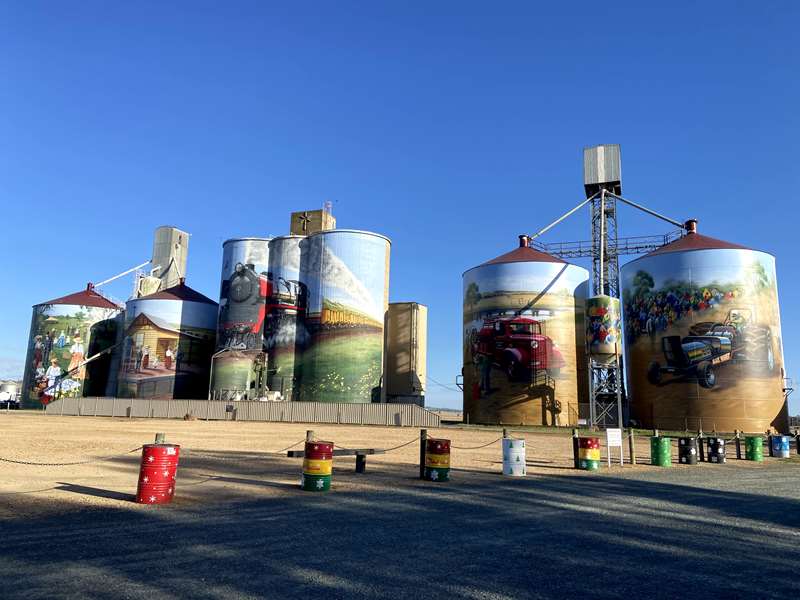
The silos represent the significance of the railway to the Colbinabbin district. In August 1881 a Colbinabbin Railway League consisting of farmers agitated for a railway line to enable the transportation of produce and livestock to Melbourne. Construction of the railway line was completed in 1913.
Location: Station Street, Colbinabbin
Country Hotel Mural by Tim Bowtell (2020, after Tom Roberts)
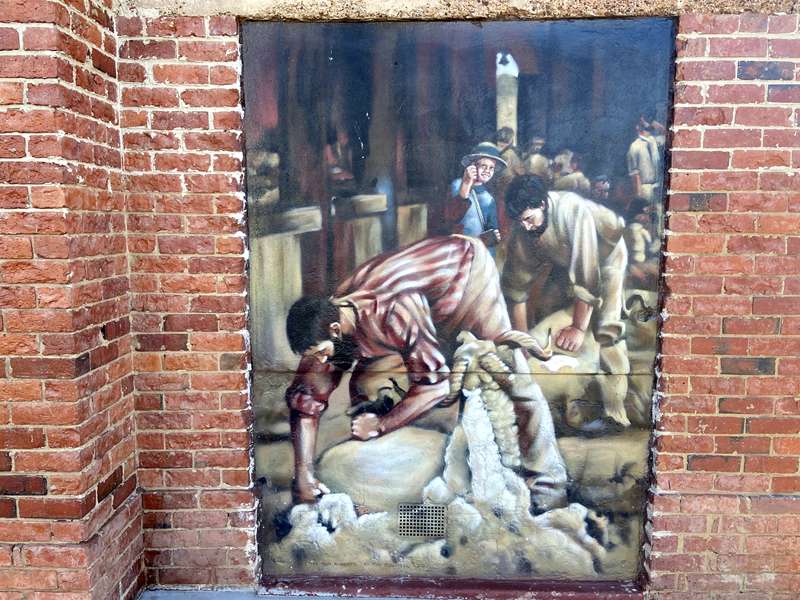
Location: Colbinabbin Country Hotel, 18 Mitchell Street, Colbinabbin
Echuca
A Requiem for the Murray River by Peter Toyne
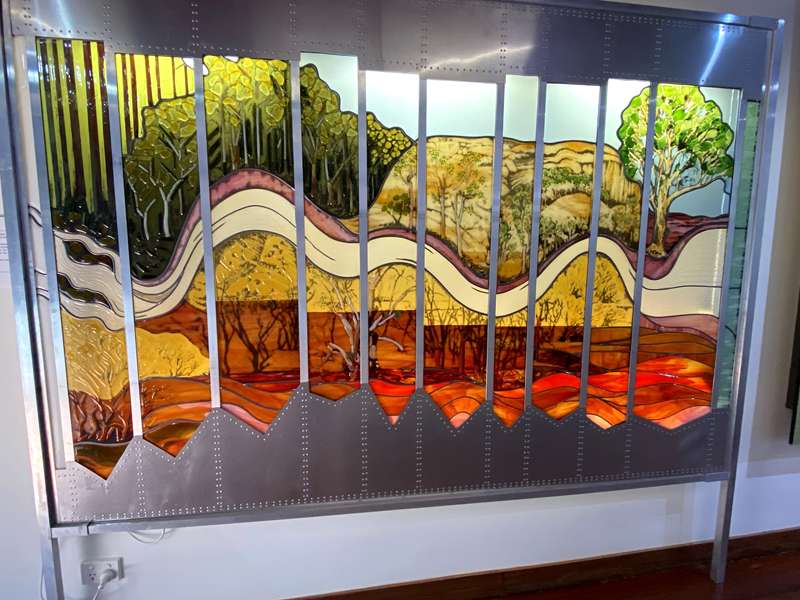
This artwork was produced following a photographic trip in 2008, which started at the source of the Murray River in the Victorian High Country and ended at the mouth of the river in South Australia. The work consists of printed and kiln-fired stained glass, set in a lead and aluminium frame. The top portion shows the river in its natural state while the bottom section records the effects of drought and the invasion by exotic plants on the ecology of the river. The work points to the public and private choices which must be made to ensure that the river can deal with challenges of the future. Peter Toyne is a descendent of John Henry Marsh and Caroline Edwards, who selected land in Thyra in 1876. By Peter Toyne
Location: Inside Port of Echuca Discovery Centre, 74 Murray Esplanade, Echuca
Echuca Library Bookcase Mural
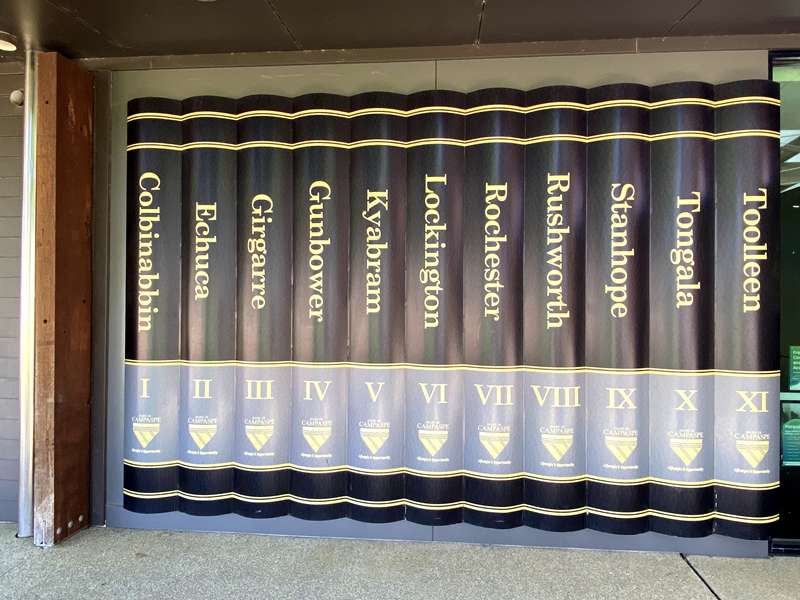
Location: Echuca Library, 310 Hare Street, Echuca
Girgarre
Girgarre Sound Walk
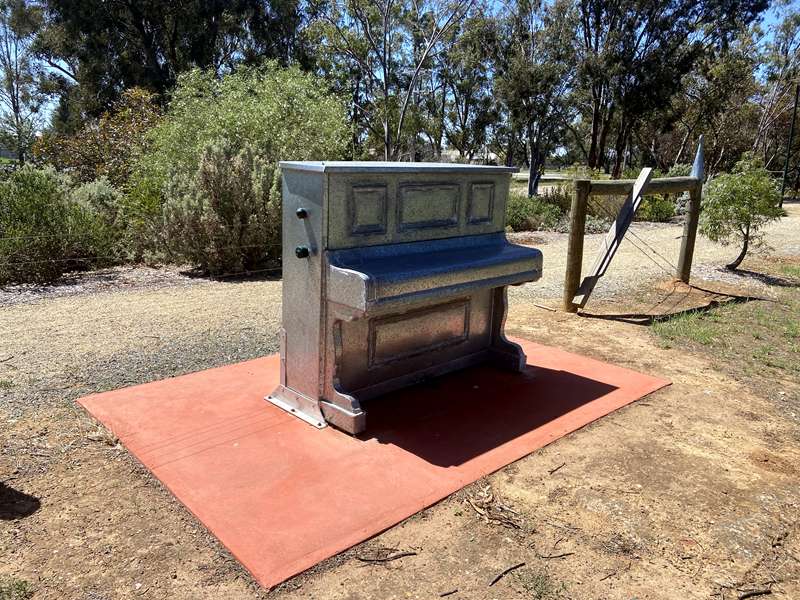
The Girgarre Sound Walk is a hands-on musical trail featuring interactive instruments made from recycled everyday materials. The shady walk passes through a treed area and lets visitors create their own sounds and tunes as they explore.
Location: Cnr Curr Road and Winter Road, Girgarre
Gunbower
Gunbower Hotel Mural by Jimmy D'Vate (2019)
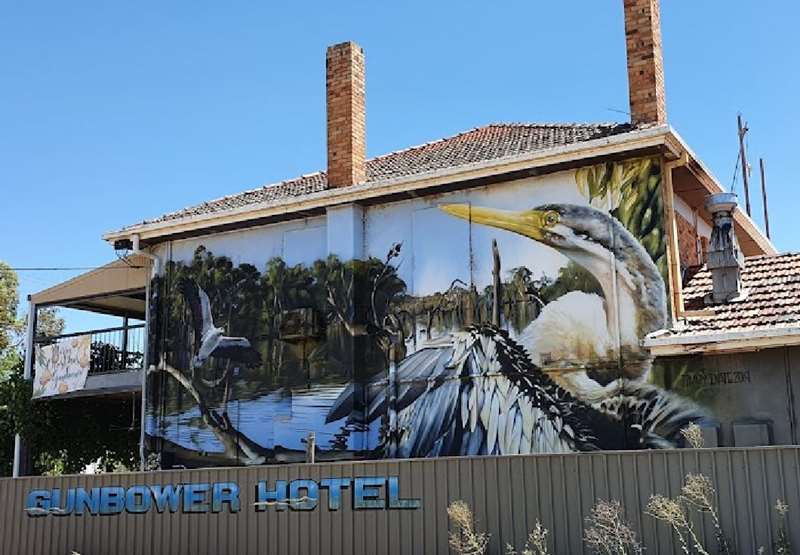
The mural on the side of the Gunbower Hotel depicts a snake-necked diver.
Location: Gunbower Hotel, 18-20 Murray Valley Highway, Gunbower
Kanyapella
Tongala Lions Dunny Downunder
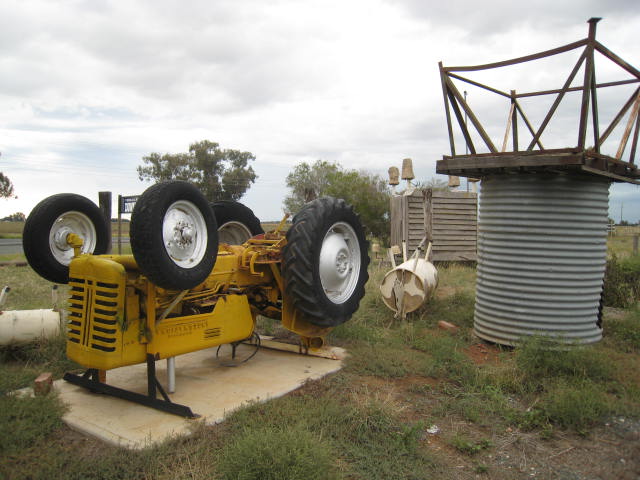
A quirky piece of Australiana featuring an upside-down dunny along with a tractor, seat, water tank, cows and sheep. The dunny was originally used as a wishing well.
Location: Murray Valley Highway, Kanyapella
Kyabram
Kyabram Water Tank Art by Jimmy DVate (2021)
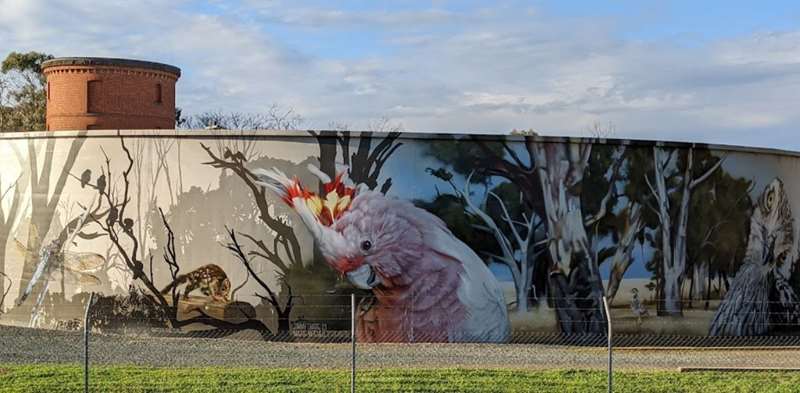
Painted in March 2021, the water tank mural highlights the wetlands at Kyabram Fauna Park and the wildlife found there. Three scenes depict fauna including a Major Mitchell's Cockatoo, Golden Whistler, Bush Stone-curlew, Spotted-tailed Quoll, Eastern Long-necked Turtle, Brolga, Crimson Rosella and Red-capped Robin.
Location: Cnr Union Street and Drum Street, Kyabram
Lockington
Kevin Sarre Shearing Sculpture by Ivo Tadic
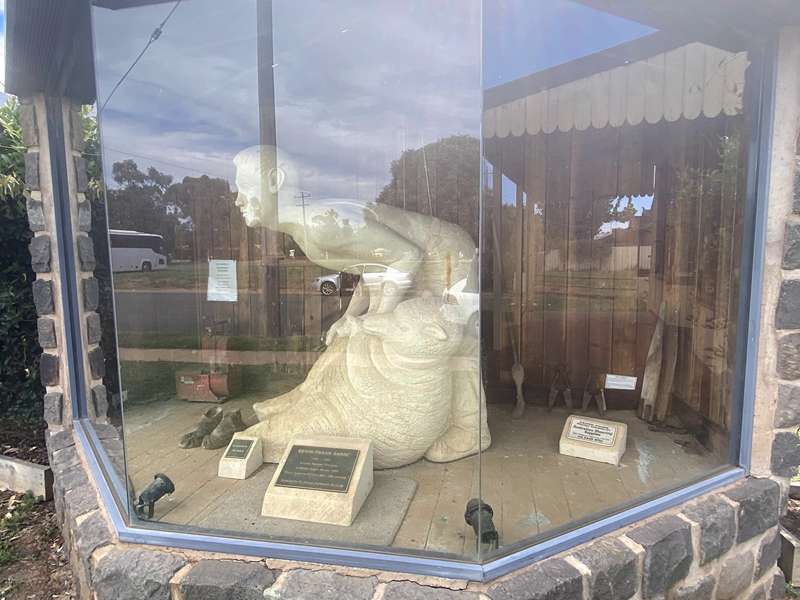
Kevin Frank Sarre (1933-1995), 5 times National Champion. A Golden Shears Winner 1965. World Shearing Record 1965 - 346 merinos. Unveiled by Cr. Murray McDonald 30-11-03
Location: Outside Lockington & District Living Heritage Complex, Lockington
Lions Apex Park Rotunda Mural
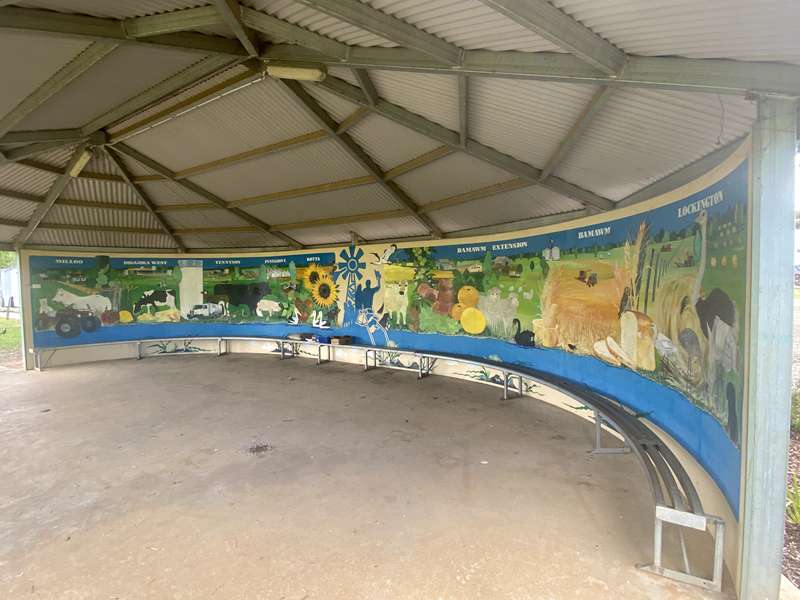
Location: Lions Apex Park, Pannoo Road and Lockington Road, Lockington
Lions Apex Park Tank Mural
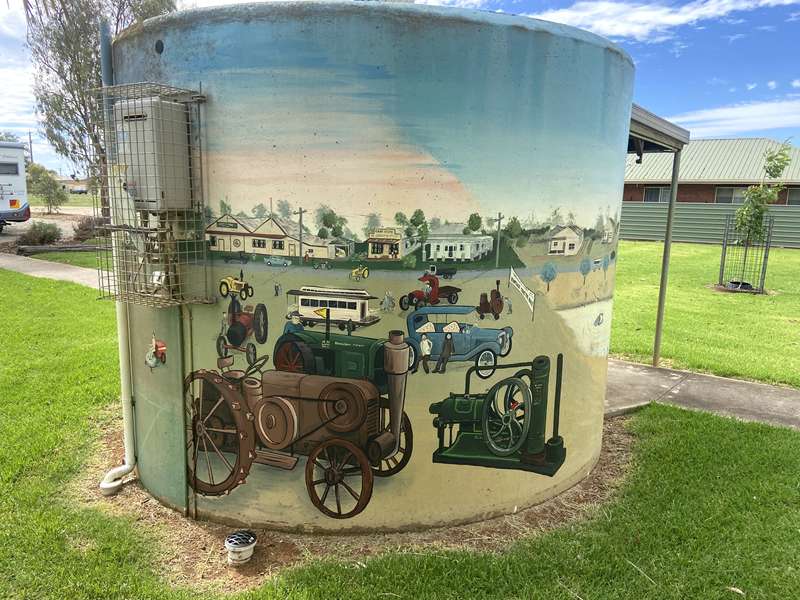
Location: Lions Apex Park, Pannoo Road and Lockington Road, Lockington
Lockington Pump Track Murals
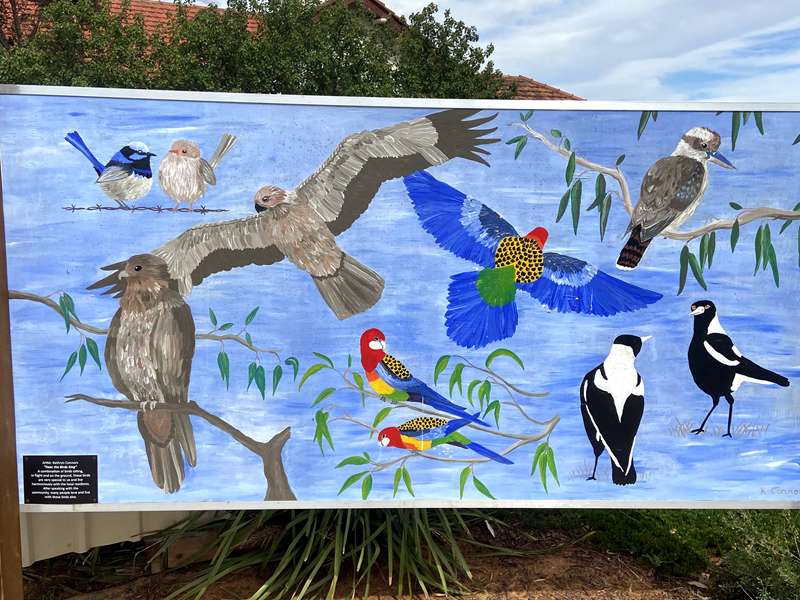
Artist: Kathryn Connors. “Hear the Birds Sing”. A combination of birds sitting, in flight and on the ground, these birds are very special to us and live harmoniously with the local residents. After speaking with the community, many people love and live with these birds also.
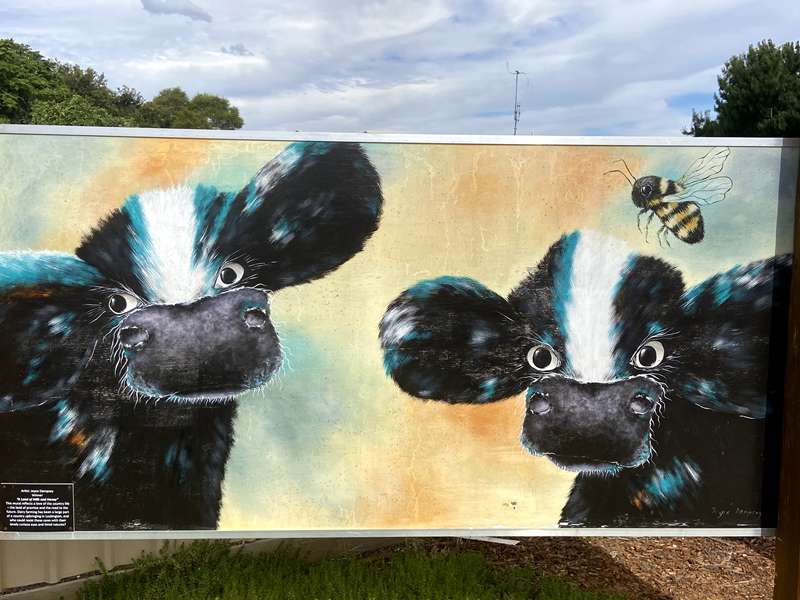
Artist: Joyce Dempsey. “A Land of Milk and Honey”. This mural reflects a love of the country life - the land of promise and the road to the future. Dairy farming has been a large part of a country upbringing in Lockington, and who could resist these cows with their lovely curious eyes and timid natures?
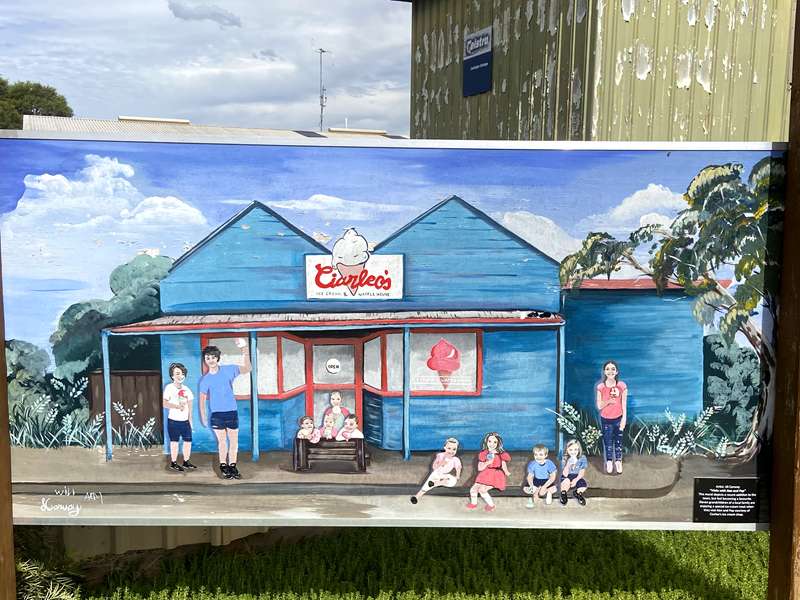
Artist: Jill Conway. “Visits with Nan and Pop”. This mural depicts a recent addition to the town, but fast becoming a favourite. Eleven grandchildren of a local family are enjoying a special ice-cream treat when they visit Nan and Pop courtesy of Ciurleo’s Ice cream shop.
Location: Lockington Pump Track, Pannoo Road and Lockington Road, Lockington
Rochester
Ron Iddles Mural by Tim Bowtell
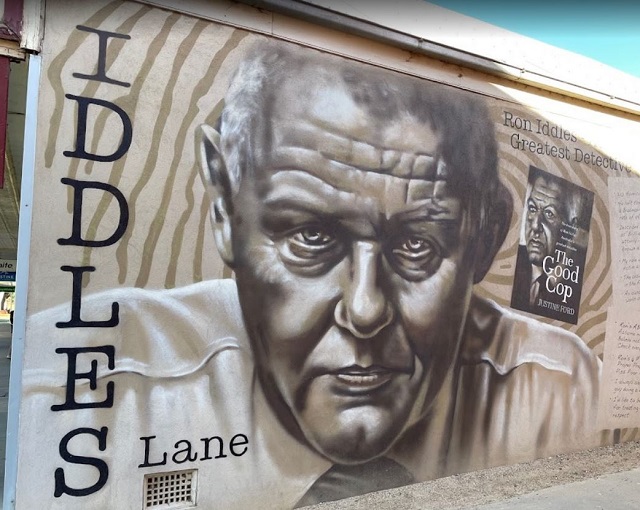
The sepia-toned mural honours the achievements of Barry Iddles and his family, including his twin brother, former Victorian homicide detective Ron Iddles, and sister Nancye. It depicts the family's beginnings with Iddles Brothers Shoe Shop in the 1950s and Ron's life story, with family photographs, quotes and a family tree.
Location: Iddles Lane, Rochester
Rochester Silo Art by Jimmy D'Vate
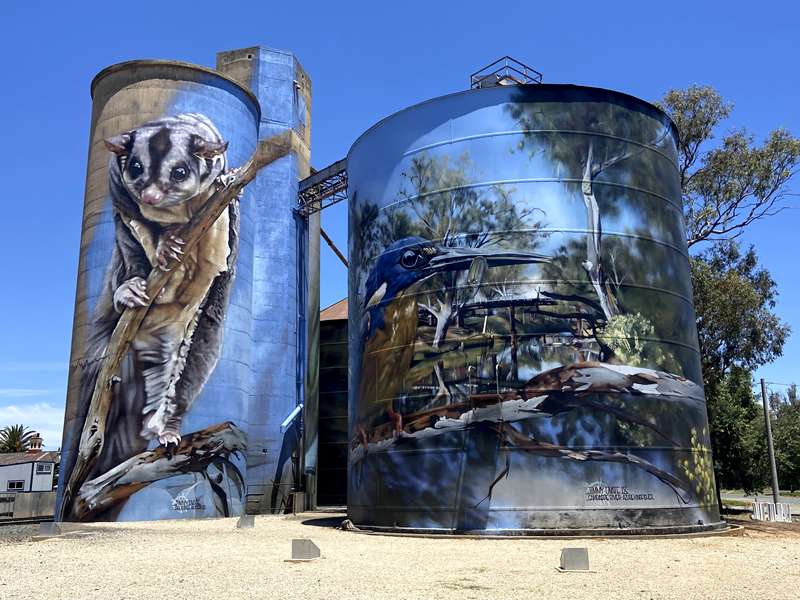
The silos feature native wildlife associated with the Rochester area. The original two silos, completed in July 2018, depict an Azure Kingfisher beside the Campaspe River and a Squirrel Glider clinging to a River Red Gum branch. A Duck-Billed Platypus was added in December 2021 and a New Holland Honeyeater perched on a Grevillea was added in 2024.
Location: 18 Ramsay Street, Rochester
Rochester Mural Park
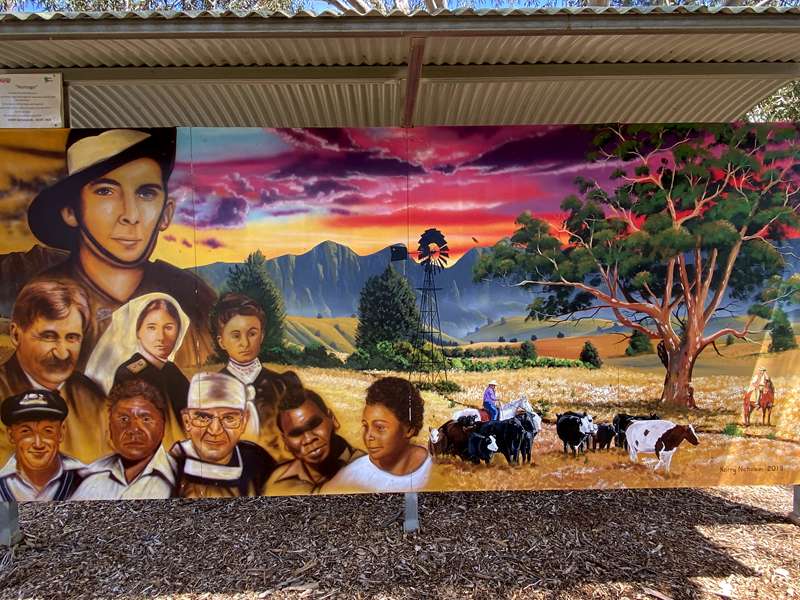
Rochester Mural Park features a changing selection of large murals created for the annual Rochester Mural Festival. The display includes winning works from previous festivals as well as other murals by artists from Rochester, Victoria and interstate.
Location: Moore Street, Rochester
Rochester Town Murals
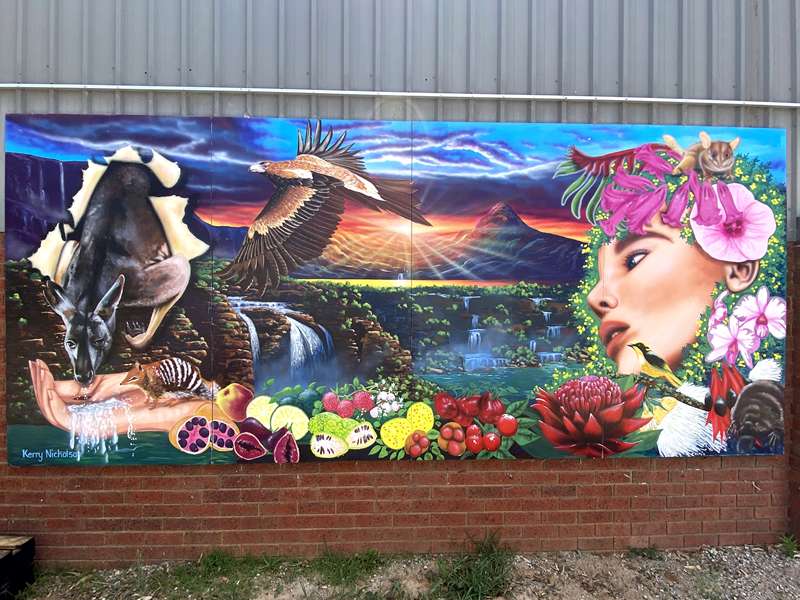
Rochester has many murals scattered throughout the town, including works created for the annual Rochester Mural Festival. Murals can be found on buildings, schools, businesses, laneways and other public spaces, with works by artists including Tim Bowtell, John Stevens, Kerry Nicholson, Jon Lam, Jimmy D'Vate and many others.
Location: Various locations around Rochester
Bluey Oldest Dog in the World Mural by John Stevens
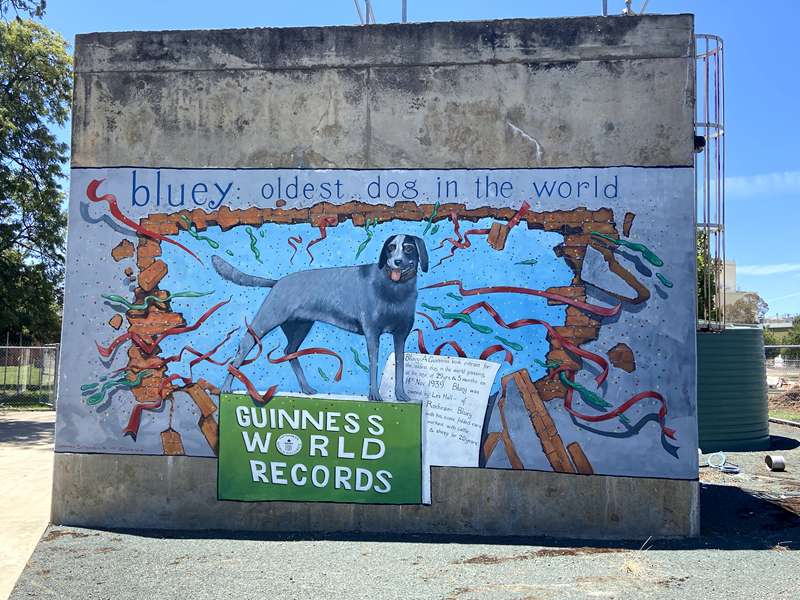
Bluey: oldest dog in the world. Bluey: A Guinness book entrant for the oldest dog in the world passing at the age of 29 yrs & 5 months on 14th Nov. 1939. Blues was owned by Les Hall of Rochester. Bluey with his iconic folded ears worked with cattle & sheep for 20 years.
Location: Near old Swimming Pool, 26 Ramsay Street, Rochester
Hubert Opperman Memorial
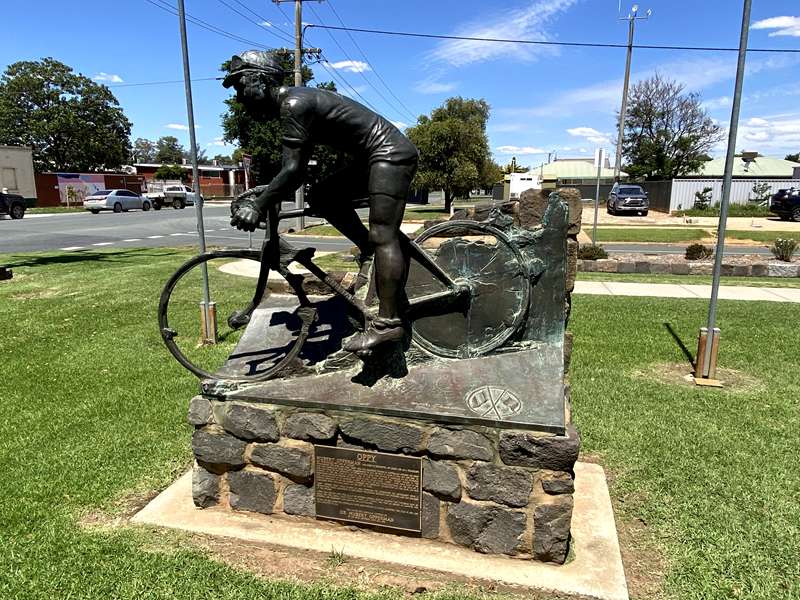
Hubert Opperman was born in Rochester. His early job as a telegraph boy encouraged his love of cycling.
Throughout the 1920s and 1930s "Oppy" was the dominant figure in Australian cycling. He first won the Australian Road Cycling Championship in 1924. He won it again in 1926, 1927 and 1929. At the same time he was becoming an international star. This statue is modelled on his stunning victory at the Bol D'Or in Paris in 1928. In the same year he was highly placed in the prestigious Tours de France. His first place in the 1265 km Paris - Brest - Paris road race of 1931 was the highlight of his sporting career. That year he was voted Sportsman of the Year by a French newspaper. In 1991 Sir Hubert attended the centenary celebrations of the race and was honoured with the Gold Medal of the City of Paris.
"Oppy" retired from cycle racing in 1940. Typically he celebrated his retirement with a twenty-four hour marathon at the Sydney Velodrome, breaking one hundred and one records in the process.
After war service with the R.A.A.F. he entered federal politics holding the Victorian seat of Corio for the Liberal Party from 1949 until 1967. During this time he served as Minister for Shipping and Transport and Minister for Immigration.
In 1967 he was appointed Australian High Commissioner to Malta, receiving the O.B.E. in 1953 and was knighted in 1968.
This statue was officially unveiled by Sir Hubert Opperman on his 90th birthday. 29th May 1994.
Location: Opperman Gardens, Cnr Northern Highway and Fraser Street, Rochester
Moore Street Park Stump Sculptures
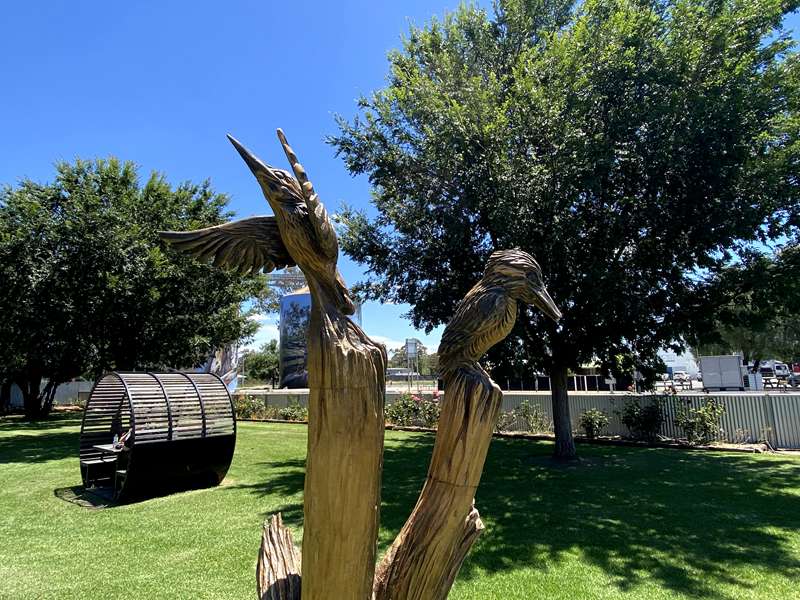
Location: Moore Street Park, Cnr Moore Street and Gillies Street, Rochester
Rochester Shire Hall Stump Sculptures
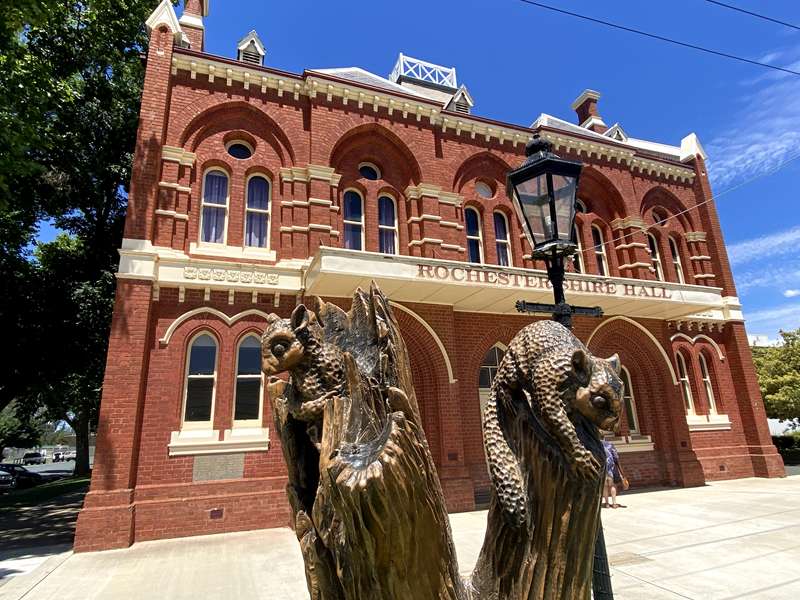
Location: Rochester Shire Hall, 45 MacKay Street, Rochester
Rotary Park Playground Hamster Wheel by DVATE
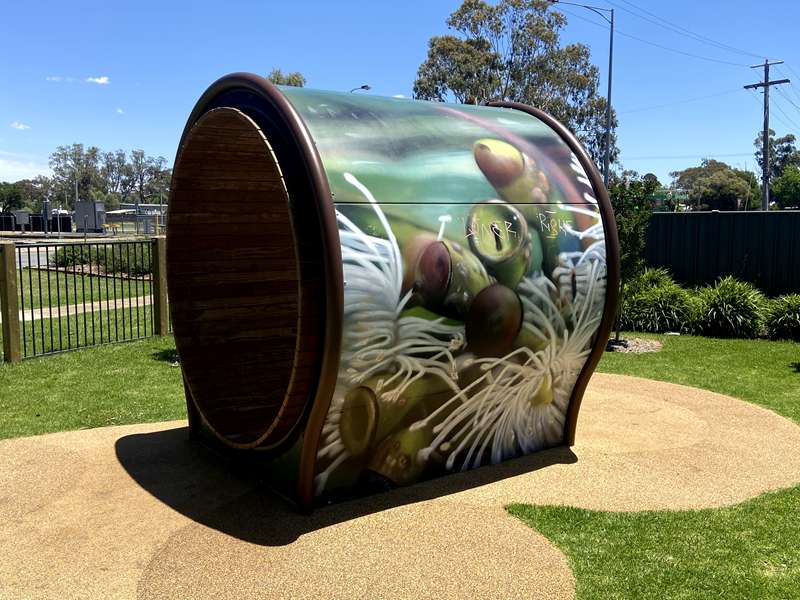
Location: Rotary Park Playground, 78 Moore Street, Rochester
Stanhope
Montevideo Maru Mural by Tim Bowtell
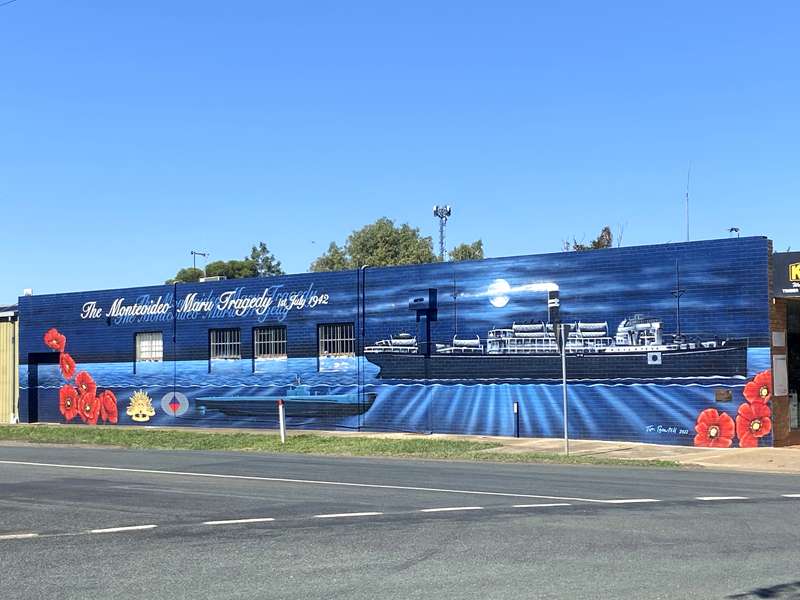
The large mural pays tribute to those who died in the sinking of the Montevideo Maru in 1942, including three servicemen who enlisted from Stanhope. The Japanese prisoner-of-war ship was torpedoed by the USS Sturgeon, which was unaware that Allied prisoners were aboard.
Location: Monash Street, Stanhope
Legendairy Stanhope Mural
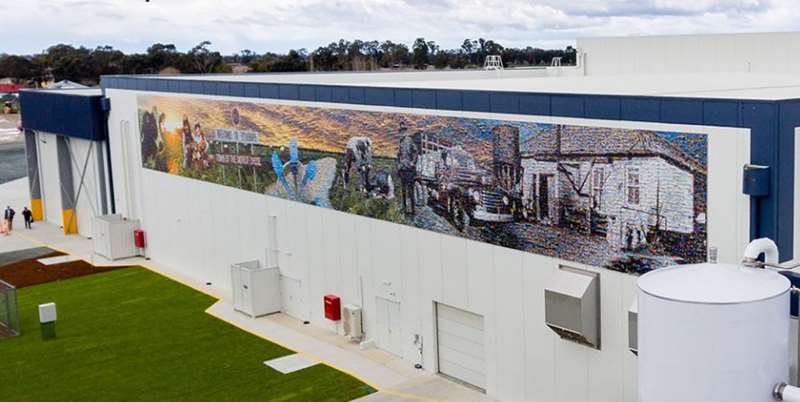
This enormous photo mural on the northern wall of Fonterra's cheese plant was created from more than 11,000 photographs submitted by Stanhope and District residents, Fonterra employees and members of the broader dairy community. Each photograph forms a tiny mosaic tile in the 48 metre by 5 metre mural, themed "Legendairy Stanhope - Proud People, Proud Community". The artwork celebrates Stanhope's cheese-making history and its strong connection with dairy farming and agriculture.
Location: 21 Midland Highway, Stanhope
Shop Window Murals
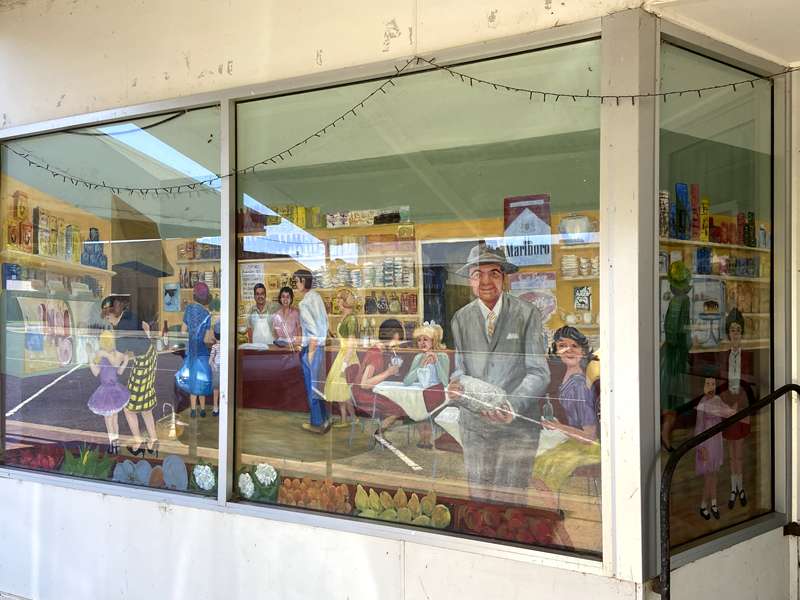
Location: Around 12 Birdwood Ave, Stanhope
Sir John McEwen Statue
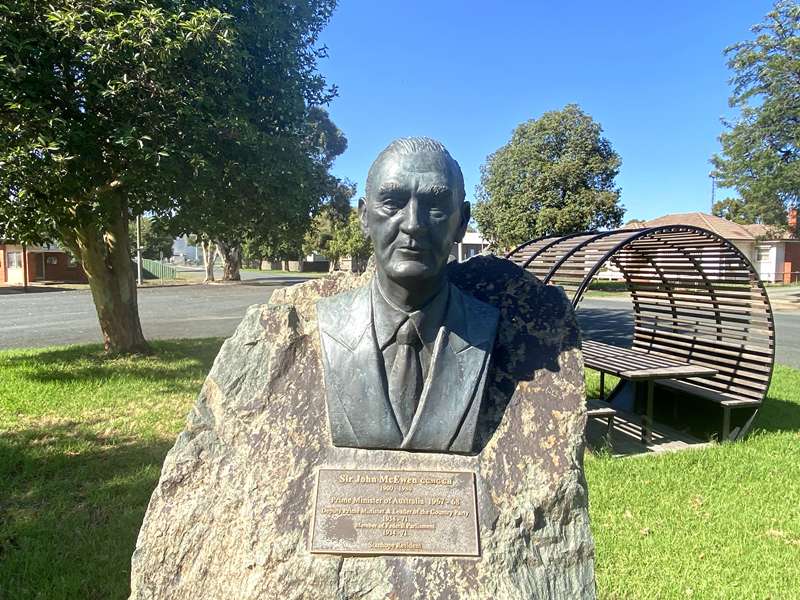
Rt. Hon. Sir John McEwen GCMG CH 1900 - 1980
Prime Minister of Australia 1967-68
John McEwen was born on 29 March 1900 at Chiltern in Victoria, to pharmacist David McEwen and Amy (Porter) McEwen. His mother died after the birth of their second child in 1901, and his father died in 1907. McEwen and his younger sister were raised by their grandmother, Ellen Porter, who ran a boarding house. They lived first at Wangaratta and then moved to Dandenong in 1912.
At the age of 13 McEwen left school and helped support the family, working at a local wholesale pharmaceutical supplier. In 1914, the family moved to Ballarat, where McEwen studied at night school. After two years of classes he qualified for entry to the Commonwealth Public Service. At the age of 16 he started work at the Crown Solicitor's Office in Melbourne.
McEwen had hoped to enrol at the Royal Military College at Duntroon, but instead applied for enlistment in the 1st Australian Imperial Force when he turned 18. He was called up on 9 August 1918 and was in camp awaiting embarkation for France when the armistice was declared.
Working as a farmhand, McEwen picked up sufficient experience to obtain a qualifying certificate and apply for land. He astutely chose a larger block (86 acres, 35 ha) at Tongala, rather than one of the smaller holdings which beggared many of his colleagues. To obtain some capital he worked as a wharf labourer in Melbourne. He survived drought and a rabbit plague in 1919, improved his property by tenacity and unremitting hard work and led what he recalled as a 'rough and ready' life, living in a humpy and spending solitary nights reading by the light of a kerosene lamp.
In 1919 McEwen joined the Victorian Farmers Union, one of the most influential of the primary producers groups that founded the Country Party the following year. At Ballanoca, Tongala, on 21 September 1921 he married Annie Mills McLeod; they were to remain childless. She worked with him to develop the farm.
With hard work and frugal living they added to their original farm holding. In 1924 the couple sold their dairy farm for £1000 to buy a larger property at Stanhope they named 'Chilgala' where they lived for more than fifty years. They developed it first as a sheep property and later changed to beef cattle. The McEwens were both active in the local community and in the broader issues of rural politics. In 1923-24 McEwen was the first chairman of the local Stanhope Dairy Co-operative, the forerunner of today's Fonterra factory in Stanhope.
A former clerk in the Crown Solicitor’s Office, Melbourne, John McEwen enlisted in the First AIF in the last year of World War I (1918). He later became active in the Victorian Farmers’ Union and the Victorian Country Party (National Party) McEwen was elected to the House of Representatives in 1934 as a Victorian Country Party representative, but he soon shifted his allegiance to the federal Country Party, which was the junior partner in the coalition government led by Joseph Lyons.
McEwen was promoted to the ministry in 1937 as Minister for the Interior. He ceased to be a minister when the Country Party dropped out of the governing coalition when Robert Menzies first became leader of the United Australia Party. But he became Minister for External Affairs and, later, Minister for Air and Minister for Civil Aviation when the Country Party, by then led by Arthur Fadden, re-joined the government.
In Opposition for most of the 1940s, McEwen again became a minister in the Menzies government, which was formed in December 1949. He was Minister for Commerce and Agriculture (1949-56), Minister for Trade (1956-63) and Minister for Trade and Industry (1963-71). He remained in the ministry of the Liberal/Country party coalition until his retirement from politics in 1971.
McEwen was narrowly beaten for the Country Party leadership in 1939, losing to Arthur Fadden. But he was successful in 1958 when he succeeded Fadden as both Party leader and Deputy Prime Minister. McEwen became Prime Minister on 19 December 1967 replacing Harold Holt, who had disappeared while swimming off the Victorian coast. His period in office was short - ending on 10 January 1968 when the Liberal Party chose John Gorton to be its leader.
Sir John McEwen, often referred to as “Black Jack” died at Toorak in 1980.
Location: Stanhope Memorial Park, Godley Place, Stanhope
Cafe Mural
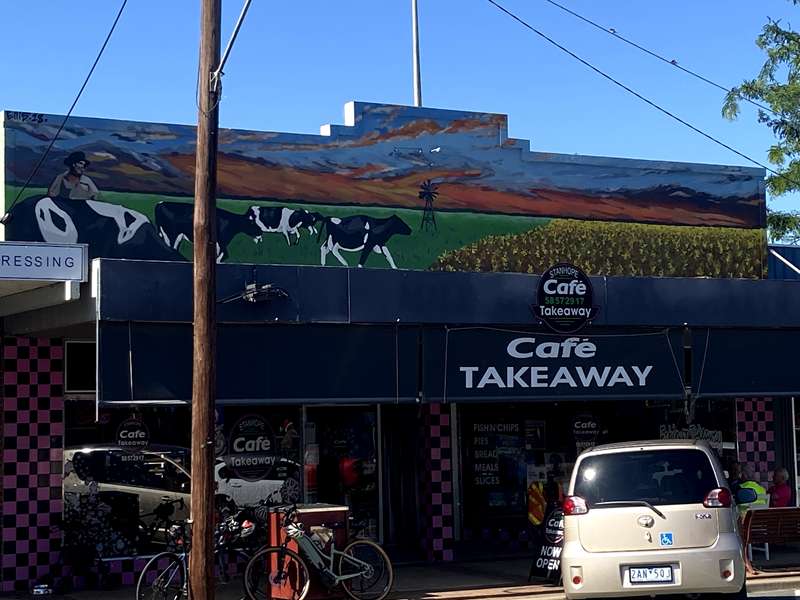
Location: Stanhope Cafe, 6 Birdwood Avenue, Stanhope
Legendairy Capital Cow
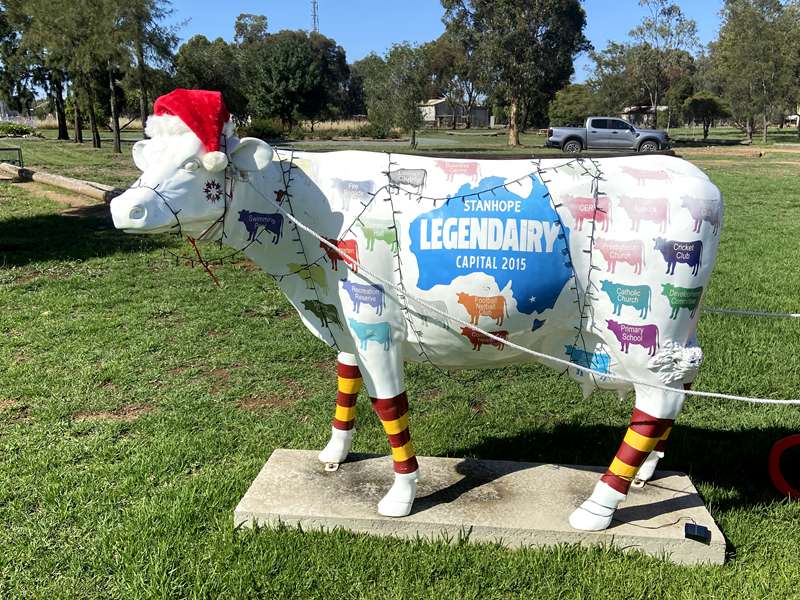
Location: Station Park, Brudenell Street, Stanhope
Tongala
Tongala Town Murals
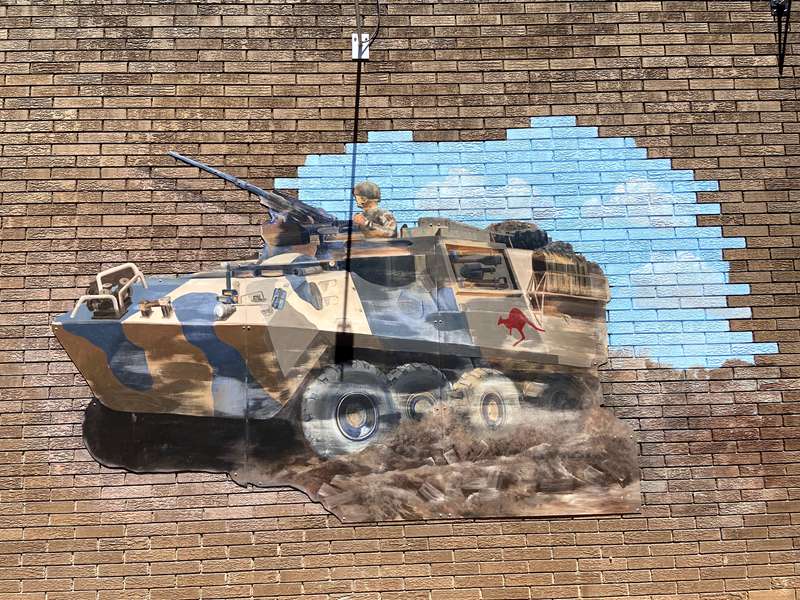
Tongala has more than 50 street murals painted on buildings and fences around the town centre. The artworks celebrate the town's history, people, industries and community.
Location: Various locations around Tongala, including Mangan Street
Railway History Monument
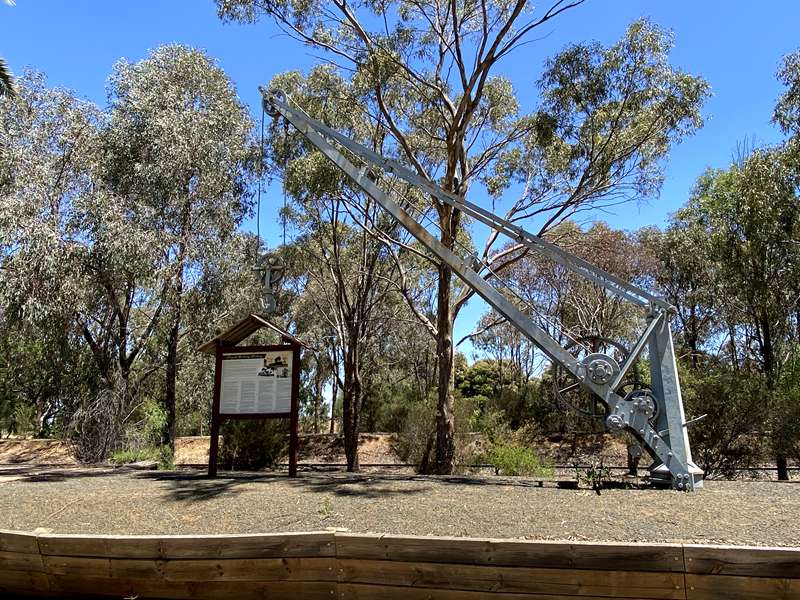
In 1841, young Edward Micklethwaite Curr, aged twenty, rode his horse from Port Phillip to the ‘Wyuna Run’, named by Mr. Mitchell Forbes Scobie, who had taken a lease on approximately 102,000 acres of land. Scobie told Curr that there was good land to the west of the ‘Wyuna Run’.
Edward Curr looked over the area and suggested to his father Edward Curr Senior, that he should take up a lease on the land. He took a lease from the government on 26,000 acres and named it the ‘Tongala Run’. Curr built and lived in bark huts and constructed a Shearing Shed, and later a Sheep Dip, near the Goulburn River.
Mr. Edward Curr Senior had turned his attention toward the Separation from New South Wales of the new State of Victoria; he died in 1851, the day the Separation was announced.
The “Tongala Run” was later sold. A plaque marks the site, just a short distance west of the northern end of Curr Road. The Government, after having large areas surveyed, Opened up the Land for Selection from the late 1860’s.
Squatters started to take up land, soon Schools were required; one opened in 1876 at the corner of Finlay and Curr Road and took the name Tongala, after the original ‘Run.’
A contract was signed on 11 June 1886, with a tender of 106,806 pounds, for the Extension of the Railway Line from Toolamba to Echuca, to be constructed by Nichol, Gray and Tamlyn.
With a Railway Station at Kyabram, the next station planned was for the corner of Curr and Mathieson Road, which would be a mile south of the then Tongala School, which was also used as the Post Office. Following many heated meetings and discussions with the surveyor and Government, it was eventually agreed that the railway station would be on the south-east section of Mr. Simon Mangan’s property and would be named Tongala Railway Station. The Railway Department agreed to the meeting’s final suggestion.
The railway land acquired, was on the south end of Mangan Street to Henderson Road and Finlay Road, as we know it today. Mr. Simon Mangan quickly planned streets and building blocks adjoining the proposed railway line; he also built the Railway Hotel, which he named Mangan’s Victoria Hotel and later built a Store, opposite and so, the beginnings of Tongala Town were formed.
The Railway line was built from both Kyabram and Echuca directions, toward each other, with the last section joining together, east of the Kyvalley Railway Crossing, on 28 March 1887. Cattle grids were put in at all railway crossings. The line was inspected on 29 July by officials of the Victorian Railways and Officially Opened on 18 August 1887.
A contract was signed on 29 April 1887, for the construction of 24 portable offices (i.e. railway stations) to be built by Mr. P.G. Grunt, of which one office was for Tongala. A Goods Shed was also built and later Trucking Yards.
The Crane on site, was a six-ton derrick crane, manufactured by W. Howard and Co, by a contract let on 16 March 1888. The Opening of the Railway Line was a great help to consolidate the local Settlement.
Location: End of the Avenue of Honour, Tongala


