Boyd Walking Tour (Murrumbeena)


The Boyd family have had a huge influence on Australia's art and cultural heritage, and a lasting connection with the Murrumbeena community. Our Boyd walking tour explores key Boyd family historical sites, while giving you insights into their stories and legacy.
The 1.9km long digital tour offers instant access to commentary, historic images and an interactive map with GPS tracking. The commentary covers all eight sites on the walk and is available as audio and text.
The tour starts outside the newsagency at 456 Neerim Road, Murrumbeena. It's right near Murrumbeena train station, which is on the Cranbourne and Pakenham Lines. You can also get to the starting point by using bus routes 822 and 624.
The Digital Walking Tour is available on the Glen Eira Walking Tours App. You can download the app from the App Store or get it on Google Play by searching 'Glen Eira Walking Tours.' You don't need wi-fi to download the app, but you should check your phone's mobile data allowance before you download it.
Before you start - About the Boyds
The Boyd family members have contributed enormously to the richness and diversity of Australia's artistic and cultural heritage. Through their creative endeavours including in painting, sculpture, pottery, literature, architecture and music, they have helped define the Australian identity. Their art, whilst sometimes unflattering to aspects of our history and culture, has assisted us in understanding ourselves better, as individuals and as a nation. Their influence on the Australian arts is powerful, unique and ongoing.
The first generation of this remarkable family was formed in the union of Arthur Merric Boyd and Emma Minnie Boyd (nee A’Beckett). They married in 1886, and lived and painted in Victoria and Tasmania, and across Europe. Their children formed the next generation of creative Boyds. Their first born child, Gilbert (1886) died in childhood. Of their four remaining children, Merric (1888) became a potter and visual artist, Penleigh (1890) a landscape and seascape painter, Martin (1893) a writer, and Helen (1903) a painter. The Walking Tour you are about to undertake is about the most creative of these four children, Merric Boyd.
Merric Boyd was born in his paternal grandparents’ house Glenfern in St. Kilda. Growing up in bayside Melbourne, between completing his secondary education and coming to Murrumbeena at the age of 25, Merric experienced a wide range of vocations including jackaroo, salesman and farmer. He also studied to be a church minister. It was whilst living at Yarra Glen that he became interested in sculpture and soon after in wheel-thrown pottery, and made the life decision to be an artist.
In 1913, Merric’s parents bought him a block of land in Murrumbeena and built a studio residence on it for him to live and work. Merric called it Open Country. Itwas purchased from a newly subdivided farming property at what is now 8 Wahroongaa Crescent, Murrumbeena. Merric’s parents chose Murrumbeena because Dr John Springthorpe lived in nearby Omama Road on his estate, Joyous Gard. He was an expert on neurological conditions including epilepsy, a condition which Merric lived with. John Springthorpe, and later his son Guy, became Merric’s physicians.
In 1913, Murrumbeena was a village in the country. Built around its railway station, it was a place ideally suited to Merric. It had enough shops to provide for his basic needs, deposits of clay from which to sculpt and throw pots, was distant enough from Melbourne for him to build and operate his pottery workshop and kiln, and had a station to provide access to Melbourne shops to sell his wares. It also had some significant natural and man-made features that provided Merric with places to create and to be inspired by, including nearby Murrumbeena Creek and the old Outer Circle Railway, where he was to spend a great deal of time.
Between his arrival in Murrumbeena and death at Open Country in 1959, Merric built a pottery and kiln, married artist and poet Doris Gough with whom he had five creative and artistic children — Lucy, Arthur, Guy, David and Mary — and produced some of the finest hand-made pottery made in this country or any other. He survived service in World War 1 and a fire in 1926 that destroyed his pottery, supported his family through the Great Depression and despite the affliction of epilepsy, continued to be highly creative until the end of his life.
Merric Boyd and his family’s time in Murrumbeena is an essential part of Glen Eira’s rich history and culture, and we are fortunate to have their story as part of ours. It is one to enjoy and to share. We invite you to do so.
Site 1 - Murrumbeena Village
456 Neerim Road, Murrumbeena (current site of newsagency)
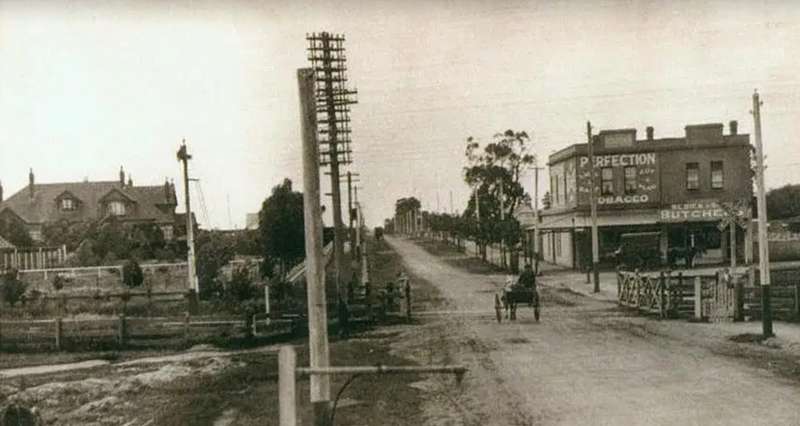
Murrumbeena is where Merric Boyd came to live in 1913. Back then, Murrumbeena was just a village. The Gippsland Railway was built in 1879 and crossed both Mirambeena and Neerim Roads. Murrumbeena Station was built the same year, leading to the renaming of Mirambeena Road and the rise of the Murrumbeena village. By the time Merric Boyd arrived in the area, this village boasted two estate agents, a laundry, a fruit shop, bookmaker and newsagent. To its south, lay the market gardens of East Bentleigh, and to the north, open paddocks and scrub. The east was open country, and beyond it, the township of Oakleigh. To the west was Carnegie, which was developing rapidly. By 1913, Carnegie's development was fast approaching Murrumbeena.
Merric was 25 years of age when he came to Murrumbeena. Born in 1888 in his grandparents’ house, Glenfern, in St Kilda, Merric was the second of the five children of Arthur Merric and Emma Minnie Boyd. They were both artists and could afford to travel the world and paint. Their first child Gilbert was killed in a horse riding accident in 1896, leaving Merric, Penleigh (born in 1890) and Martin (born in 1893). Their final child, Helen was born in 1903.
Merric's journey to Murrumbeena to live a life as a creative artist was not a simple one. He spent much of his youth living in Sandringham and Brighton, and attended Haileybury College. But whilst coming from a well-off background, Merric was restless and quite unsure of what to do in life. By the time he arrived in Murrumbeena, he had already worked as a jackeroo in the Riverina; studied at Dookie Agricultural College near Benalla; trialled the life of a farmer in Yarra Glen; tried to become a Minister in the Church of England at St. Johns Theological College; and studied for one term at the National Gallery Art School. None of these seemed to suit him, although he did discover an interest in clay and sculpture through a family friendship with the renowned Australian sculptor, Web Gilbert. It was this discovery which became the basis for Merric's lifelong interest in pottery.
Merric’s first experience with a potter’s wheel came while visiting a Burnley Pottery to buy clay. He loved the experience and was taught some basic skills on the wheel by their staff and gained access to a kiln. His first public exhibition was in 1911 at the Victorian Artists’ Society annual exhibition. He exhibited two sculptures, including a modelled head of Doris Gough, the woman he would marry four years later. Between 1912 and 1914 he worked at the Australian Porcelain Insulator Works in Yarraville.
Murrumbeena provided Merric with the resources he required to make pottery, including space to construct a studio and kiln, and good clay deposits. It also had a hansom cab service operated by Mr Grey from the front of Murrumbeena Station in Neerim Road. His horse was watered from a trough in front of Billy T Motors on the southern side of Neerim Road. During the 1920s and 30s, Merric and his wife Doris would be picked up from their Wahroongaa Crescent home by Mr Grey and dropped off at the station to catch a city train. Carrying cases packed with Merric’s valuable pottery, they would walk the city to stores like Georges, and Mair and Lyon, who sold his pottery to collectors, many of them wealthy, who appreciated the quality and originality of Merric's work.
While Merric is most recognised for his pottery, he also drew throughout his life especially in his middle and later years. He often drew landscapes, trees, farms and farm animals. These recalled his early years in the country, including his time as a jackaroo. He drew beach scenes of Port Phillip Bay and of areas such as Rosebud and Balnarring, where he and his family sometimes went on day trips and extended holidays. Merric often drew the houses, shops, trees, animals, fences and people of Murrumbeena. He drew the palm tree on the north eastern corner of Murrumbeena Road and Neerim Road, and the bread shop in Murrumbeena Road, which at the time was Murrumbeena’s post office. The Spirax sketch pads Merric drew on, almost exclusively were purchased from the Murrumbeena Newsagency and can still be bought from the same Neerim Road location today.
How to get to Site 2: Head in an easterly direction down Neerim Road until you reach 502 Neerim Road
Site 2 - The Arthur Merric Boyd Pottery
502 Neerim Road, Murrumbeena
In the 1940s Merric’s son — Arthur Boyd — in partnership with John Perceval and Peter Herbst, established the Arthur Merric Boyd (AMB) Pottery at 500 Neerim Road (now 502 Neerim Road). The pottery was named after Arthur’s grandfather. Arthur was very close to his grandfather and as a teenager, lived with him in Rosebud. It was at Rosebud and across the Mornington Peninsula, where Arthur painted coastal scenes and landscapes, such as his wonderful images of Arthurs Seat, and developed his skills as a painter under his grandfather’s watchful and artistic eye.
A pottery existed at 500 Neerim Road before the AMB Pottery. The Altamira Pottery was established in the late 1930s by Hatton Beck who was an Oakleigh potter. He had helped Merric fire his pots after Merric's pottery burnt down in 1926, and became a close family friend, marrying Lucy Boyd in 1939. He sold his pottery to Arthur and his partners in 1944 for 200 pounds and the AMB was founded.
The AMB Pottery occupied two shops, between the laneway and Heads Garage, a well-known local business and now an engineering works. Initially the AMB made functional items required by the government after the War, such as salt shakers, ramekins, dishes, cups, bowls and mugs. By the late 1940s, its potters began producing more creative works including pots, platters, vases and jugs. They often struggled to find outlets to sell their pottery, but eventually did so through shops such as the Primrose Pottery shop and Georges in the city. They also sold from their Neerim Road pottery. Major ceramic works produced at the AMB include Arthur Boyd’s Mother and Child, The Bride, Judas kissing Christ and David and Saul, John Perceval’s Delinquent Angels and Neil Douglas’s highly decorated bowls and platters with images of Australian flora and fauna.
Many artists and potters worked at the AMB, including Neil Douglas, who became a partner in 1950 after Peter Herbst left the business, David and Hermia Boyd, Charles Blackman, Albert Tucker, Tim and Betty Burstall, Jean Langley, John Howley and Tom Saunders. Carl Cooper was a neighbour of the Boyds and a frequent visitor at the AMB. Confined to a wheelchair through polio, Carl created hand-painted dishes and bowls inspired by Aboriginal art. The potters at the AMB fired Carl's pottery and returned it to him until he established a studio at his Omama Road home.
The AMB Pottery was a real curiosity for local residents. The potters looked so different to the men of the time, with their longer hair, clay covered clothes and unusual occupation. Some locals thought the potters were sick because the clay dust made them look pale. Others didn’t think the AMB was a shop at all because it looked so uncommercial.
While Arthur left the AMB Pottery after he and his wife Yvonne purchased their home at Beaumaris in 1955, Neil Douglas and John Perceval continued to operate the business. Pottery created under the name of the AMB continued to be made until 1962.
How to get to Site 3: Continue along Neerim Road for approximately 100 metres. Turn left at Hobart Road. Travel north along Hobart Road until you reach the tip of Wahroongaa Road. Turn right and travel until you reach the intersection with Weeoona Road.
Site 3 - Wahroongaa Estate
Corner of Wahroongaa Road and Weeroona Road, Murrumbeena
In 1913, Wahroongaa Road terminated at Weeroona Road. The remainder of Wahroongaa Road from this corner to Boyd Park, did not exist but instead, formed a boundary between two of the larger rural holdings in the northern area of Murrumbeena — the recently subdivided Wahroongaa Estate and the Springthorpe Estate. An unsold section of the Wahroongaa Estate lay to the north of that boundary and the Springthorpe Estate to the south.
The Springthorpe Estate was owned by Dr John Springthorpe, who acquired his property in 1909. The Wahroongaa Estate was owned by Mary Wilson. Wilson Street, which runs along the eastern side of Boyd Park, is named after her. Her property was almost four hectares and included much of the land between this corner and Dandenong Road and Boyd Park. Her property boundary crossed Boyd Park — the route of the old Outer Circle Railway and Murrumbeena Creek, and extended almost to Poath Road. In 1913, Mary subdivided her estate. To carry this out, two new streets were constructed off Weeroona Road that extended to Boyd Park. Merric Boyd’s property was purchased off the Wahroongaa Estate subdivision in one of these new streets — Wahroongaa Crescent.
Murrumbeena State School lies between Wahroongaa Road and Weeroona Road and opened in 1917. Up until then, local children were schooled from an annexe of Rosstown State School, later Carnegie State School, at the local Presbyterian church hall. The school was significantly enlarged in 1926 and adjoining properties purchased to cater for the school's growing enrolments. Merric and Doris Boyd’s children — Lucy, Arthur, Guy, David and Mary — all attended Murrumbeena State School, walking the short distance between their Wahroongaa Crescent home and the school, and entering via its back gate in Weeroona Road. Arthur’s talents were on display from a very early age at the school. He won its First Award for Art in every year between 1931 and 1934.
How to get to Site 4: Head north for approximately 80 metres until you reach the tip of Wahroongaa Crescent.
Site 4 - Wahroongaa Crescent
Corner of Wahroongaa Crescent and Weeroona Road, Murrumbeena.
Wahroongaa Crescent is the place where Merric Boyd spent almost all of his adult life. In 1913 the land on the southern or right hand side of the Crescent was yet to be sold off Mary Wilson’s Wahroongaa Estate subdivision. Occupying it and bounded by the Crescent, the railway line, Weeroona Road and what became Wahroongaa Road, was the Kershaw family, who lived in a large house near the top of the Crescent. The Kershaws were Merric Boyd’s first neighbours in Murrumbeena.
On 16 of August 1913, Merric’s parents purchased for him 8 Wahroongaa Crescent. Number 8 was one of eight lots along the northern side of the newly created crescent. Merric’s block had a depth of 63 metres. At the rear, it was 15 metres wide and at the Crescent, 19 metres wide. He called his home Open Country.
In October 1915, Merric married artist and poet Doris Gough. Born in 1889, Doris was the youngest of the six children. Her father was Thomas Gough, a naval officer who captained the ship the Cerberus, now the breakwater at Half Moon Bay. Her mother Evelyn Gough, was a political activist and journalist. In the year following their marriage, Doris’ mother, by then widowed, purchased numbers 12 and 14 in Wahroongaa Crescent and built her home which she called Green Pastures. Later that year, Merric’s parents Arthur Merric and Emma Minnie Boyd bought numbers 2, 4 and 6 in the Crescent and moved from Brighton to the new home, called Tralee, built on number 4 (the only Boyd house in Murrumbeena still standing). Finally in early 1918, Merric’s parents bought Number 10, the last unsold block of land on the northern side of Wahroongaa Crescent. Their purchase meant that for six years, from 1916 until 1922, the extended Boyd family occupied the entire northern flank of Wahroonga Crescent, from Weeroona Road to the old Outer Circle Railway line.
Merric’s parents and his mother-in-law came to Wahroongaa to support Doris and their first born grandchild — Lucy — born in 1916. Merric had enlisted in the armed forces to participate in the First World War. He trained as a mechanic in the Australian Flying Corps and in late 1917 Merric sailed to England. During his two years away and as a way of maintaining an income, Doris and baby Lucy lived with Evelyn Gough in Green Pastures while Open Country was rented to Victor and Dorothy Rathausky, the Rathausky's becoming lifelong friends of the Boyds. After the war, Merric remained in England and studied pottery. In 1919 he returned to Australia on the troop transport ship Euripides. On board, he gave pottery lessons to returning servicemen.
How to get to Site 5: Head down Wahroongaa Crescent for approximately 80 metres until you reach No. 8.
Site 5 - Merric Boyd's Open Country
8 Wahroongaa Crescent, Murrumbeena
The little cottage, Open Country, stood at 8 Wahroongaa Crescent as Merric Boyd’s home for over 50 years, from 1913 until 1964. Open Country was a simple weatherboard home which included two small bedrooms, a kitchen, pantry, bathroom and laundry. It also had a large central room, later known as the brown room. The brown room was used by Merric as a studio before becoming a family room. The floor plan of Open Country was square. The house stood in the middle of the block, just behind the front of the flats that are there today. It had a double-door way at the front with windows on either side. The ridge of the roof ran parallel with the Crescent with a gable at each end. Over time, the house was built on to. An annexe was added in the 1920s to accommodate Granny Gough in her later years and Arthur built on a little sleep-out at the rear of the house in the 1930s.
The garden ran wild. The grass was never cut. Mulberry trees grew in the front yard and were used by the Boyds and local children for their leaves to feed pet silkworms. Also in the front yard were wattles, a pine tree, a peppercorn tree, a large pear tree and a flowering gum, all behind an old wire fence. At the rear of the property were the ruins of Merric’s old pottery, which had burnt to the ground in 1926 when his gas kiln exploded. This event had a major impact on the Boyd’s finances and on Merric’s health. Before the fire, he had experienced much success with his pottery. He frequently appeared in newspapers, with articles promoting his pottery demonstrations at Open Country and in Melbourne, and describing him in one as being ‘the king of the Melbourne potters’. The fire, along with the oncoming Depression, caused the Boyd family a good deal of financial hardship in the late 1920s and beyond. Merric’s new pottery built in 1927 by local builders the Gilberts and smaller than the one he lost, stood between the rear of the house and the back fence, and allowed him to once again create pottery and generate an income.
Throughout the 1930s Merric continued to make and sell pottery. Through economic necessity, both he and Doris briefly worked at a porcelain factory in Yarraville. It was here that Merric produced what became known as cruffelware pottery — pottery made from porcelain — which gave it a smoother and more refined appearance. As the Boyd children got older, they all found work to generate an income for the family. Lucy worked as a nanny at Seymour for two years, while the boys were all employed by the Gilberts. Arthur also worked at a paint factory, Guy at a jewellers, and David at a nut and bolt factory. David held other jobs, including with a florist, a solicitor, a piano repairer and a photographer. During this time, they were experimenting with art and developing their skills. Their parents had always encouraged them to be creative. As children they played with clay, drew on the walls and even carved a dragon into the plaster of a bedroom, something that their parents approved of and encouraged them to do.
When the Second World War came, all three boys entered the Australian armed forces, while Lucy and Mary remained at Open Country. Lucy married potter Hatton Beck in 1939 and lived at Open Country, and in 1944 Mary married John Perceval. In the years that followed, almost to the end of Merric’s life, all of the Boyd children and their families lived at different times at Open Country, either in the old house or in other buildings constructed in their large back garden. Open Country was their family home and a place where they could settle, and which they could use as a platform to move forward in life whilst still supporting their parents.
Throughout the 1940s and 50s Merric’s health slowly declined and he pottered less while drawing more. He walked the streets of Murrumbeena and beyond to draw. Merric made thousands and thousands of drawings in his Spirax sketchbooks. He drew houses, people, shops, gum trees — anything that caught his eye — as well as memories from his early years.
By the end of the 1950s, Open Country was a run-down cottage with an overgrown garden, surrounded by the neat and proper houses of suburban Murrumbeena. A house in the country no longer, it was a remnant of a previous time. Its vigorous life had gone, replaced by stillness and quietness. Merric died there on 9 September 1959. Doris remained at Open Country and died there on 13 June 1960. Lucy and Hatton, who had been living in Brisbane since 1947, returned to Open Country. They established a pottery school and successfully taught there and held exhibitions. In 1963, they left Open Country, and in early 1964, the house was sold to a development company. The house was then demolished and 16 units were built.
This is what remains today at 8 Wahroongaa Crescent, Murrumbeena.
How to get to Site 6: Continue heading down Wahroongaa Crescent towards Boyd Park. Enter Boyd Park.
Site 6 - Boyd Park and the Outer Circle Railway
Boyd Park
Boyd Park is part of the original route of the Outer Circle Railway line. Despite it being long closed, the remnants of the railway line, including its tracks and a bridge, were present when Merric Boyd came to Murrumbeena. The line opened in 1890 and operated for just five years in Murrumbeena. It had originally run for 12 kilometres, from Fairfield to Oakleigh, and its construction overseen by the young, and later highly distinguished, Sir John Monash. It was first proposed in the early 1870s in a period of Victorian railway expansion to bring rail traffic from Gippsland into Melbourne through its northern suburbs. Its construction was seen as being an advantage to the government of the day in restricting the growth of privately owned rail companies, and was supported by Melbourne’s outer eastern districts which saw the line as a way of encouraging development.
The railway was a commercial failure. A major problem was that it never ran as one continuous line, which made it necessary for passengers to change trains between sections. The land boom that was expected to take place along its course did not eventuate, and goods and passenger traffic from Gippsland never used the line into Melbourne. By the time it was in operation, the government had bought the private railway which operated from South Yarra to Flinders Street, and a line connected Oakleigh to Melbourne. The Outer Circle was shut down in sections, beginning in 1893. The Oakleigh to Ashburton section, which included Murrumbeena, closed in 1885 and would never open again.
In Murrumbeena, the Outer Circle came off the Dandenong line near present day Hughesdale and ran the short distance to Neerim Road, continuing on a gentle downhill slope into a minor valley formed by Murrumbeena Creek in present day Boyd Park. The creek, now barrelled and running entirely underground, ran through what is now Springthorpe Gardens in Neerim Road and into Boyd Park. It and the Outer Circle Railway intersected at the bottom of Wahroongaa Crescent, a bridge and embankments carrying the line over the creek. Although the creek ran barely a trickle in summer, it could become a torrent after heavy rain. Local children, including the Boyd children often played in the creek after a downpour. A number of them, including David and Mary Boyd, and Lucy’s son Robert, almost lost their lives in a flooded Murrumbeena Creek.
After the Outer Circle’s closure and as Murrumbeena developed, it became a space for local residents to use. Sections were fenced and leased for horse agistment and for a period, a riding school operated from there. Children used the reserve — and especially the railway bridge and its embankments — as an adventure playground. They, including David Boyd, built a bike track on the large section of open space on the slope between Wahroongaa Crescent and Wahroongaa Road. Locals constructed communal bonfires for events such as Guy Falke’s Night. An especially large one was built to celebrate the end of the Second World War.
Around 1930, the railway bridge was demolished. The line remained until wartime when the rails were pulled up for scrap. Later, when the creek was barrelled, the two small footbridges that had crossed it at Wahroongaa Crescent and Wahroongaa Road were demolished. Merric often sketched from the Wahroongaa Crescent bridge. It was also frequently used by the Boyd family and countless others to buy their milk from the well-known Cove’s Dairy in Wilson Street.
In 1955 the Outer Circle Railway in Murrumbeena was rezoned from Railway Easement to Future Main Road Reservation, in order for a new road to be built. This was abandoned in December 1983. It was then proposed to zone the railway land Residential C, enabling sections of it to be sold and subdivided. A community association, the Murrumbeena Outer Circle Parkland Retention Group, formed to fight the proposal. Their lobbying, which included significant media events and the involvement of Guy Boyd through the The Age newspaper, was supported by Caulfield Council. It led to the formation of a study group to investigate creating one long linear park that incorporated all of the remaining Outer Circle land. In late 1986 the study group recommended that the Outer Circle Railway land be transferred to Crown ownership and that an Outer Circle Railway Linear Park be established, and in February 1988, this took place. In 1989 and 1990 significant community tree planting began in the reserve, organised by the Caulfield Environment Group with the assistance and support of Caulfield Council. It was officially named Boyd Park in 1992.
How to get to Site 7: Now you are in Boyd Park, follow the path in a southerly direction heading back towards Neerim Road. Once you leave the park turn right into Omama Road. Head in a westerly direction until you reach the corner of Joyous Gard Court and Omama Road, Murrumbeena.
Site 7 - Dr John Springthorpe and Joyous Gard
Corner of Joyous Gard Court and Omama Road, Murrumbeena
This corner was the entrance to the home of Dr John Springthorpe, which he named Joyous Gard. A long driveway led from this point to his home, located at the end of Joyous Gard Court. His property was accessed through the enormous gates that are now located at the entrance to Springthorpe Gardens in Neerim Road. Two years after his death in 1933, Dr Springthorpe’s house was demolished and his land subdivided around the newly constructed Joyous Gard Court. The gates were donated to Caulfield Council and erected in Springthorpe Gardens.
Dr Springthorpe’s property was one of a number to be created from the 1909 subdivision of the Omama Estate, which was owned by Margaret and Arthur Tuckett. Their property included most of the land between Hobart Road and Boyd Park, and between Neerim Road and the Wahroongaa Estate, and they established a beautiful garden there. Their home was accessed via a long driveway that wound in from Neerim Road along what is now Tuckett Street and Joyous Gard Court. The subdivision of their land, which included the construction of Omama Road, saw their house being sold to Dr Springthorpe.
The selection of Murrumbeena as a place for the young Merric Boyd to live was based on Dr Springthorpe’s residence in the area. Merric and Dr Springthorpe were related — the doctor was a cousin of his mother, Emma Minnie. Dr Springthorpe was a doctor of medicine, and became Merric’s physician. In the middle and later years of his life, Merric suffered from epilepsy, the impact of which became more pronounced as he aged. Merric’s parents may or may not have been aware that he had this condition before he came to Murrumbeena, but there is little doubt that they had some concerns about his health and believed he may require special care from a trusted doctor. They would have known that through Dr Springthorpe, Merric would receive such care, and have it close at hand. This was indeed the case; Open Country and Joyous Gard were barely 100 metres apart.
Merric and Doris Boyd and their family occasionally dined with the Springthorpes at their Joyous Gard home. The Boyd children sometimes visited the Springthorpes offering to sell them what David Boyd called ‘bits and pieces’ of pottery.
How to get to Site 8: Head in a southerly direction down Tuckett Road until you reach the intersection with Neerim Road. Stop at the entrance gates to Springthorpe Gardens.
Site 8 - Springthorpe Gardens
Corner Tuckett Street and Neerim Road, Murrumbeena.
These bluestone gates stood at the entrance of Dr John Springthorpe’s Joyous Gard Estate. They were from the Melbourne Hospital, Melbourne’s first public hospital, on the corner of Lonsdale and Swanston Streets. Dr Springthorpe was presented with these gates in 1910 in appreciation for his services when the hospital site was redeveloped. Tuckett Street was once a part of the original driveway of the Tuckett's Omama home. Apart from the Springthorpe Estate, the subdivision of Omama led to the creation of the Corinan Estate, which extended from Tuckett Street almost to Hobart Road. This estate included a grand house which faced Neerim Road near Tuckett Street. It included ponds, aviaries and free running deer.
The Springthorpe Estate, along with Corinan and remnants of the Wahroongaa Estate, were last of the significant properties to be subdivided in the northern section of Murrumbeena between Neerim Road and Dandenong Road. They had been present when Merric Boyd arrived and remained intact until their development in the 1930s. It was then that the rural nature of northern Murrumbeena was changed forever. The only home that remains from the subdivision of Omama is Yaralla, on the corner of Omama Road and Tuckett Street.
While many Murrumbeena residents lamented the loss of Murrumbeena’s estates and rural character, Merric Boyd does not appear to be one of them. He seems to have adapted readily to the changes that occurred around him. He was genuinely interested in all things in his environment, natural and man-made, and created images of both.
The Boyd heritage is one of the very special features of Murrumbeena. As a creative family whose interests touched virtually every area of the arts, the Boyds stand alone, and while their physical presence has gone, their memory in Murrumbeena lives on. It survives in the physical presence of Tralee, the original home of Arthur Merric and Emma Minnie Boyd at 4 Wahroongaa Crescent. It endures in the thousands of drawings that Merric created of the area, and in the minds of those who knew the Boyds and pass on their memories to others. It continues with those who appreciate and value the things the Boyds valued — like creativity, self-expression and family life. And it lives on in those who take the time to travel the streets of Murrumbeena and learn about this creative Australian family.
How to get back to the starting point: Head back up Neerim Road towards the train station.
Location
456 Neerim Road, Murrumbeena 3163 View Map
Web Links
→ Glen Eira Self-guided Walking Tours
→ Download the Glen Eira Walking Tours app (the App Store)
→ Download the Glen Eira Walking Tours app (Google Play)


